4338.208 · July 27, 2018 AD
The Takedown
A routine walk down Argent Street turns into Felicity's first real test in Broken Hill. When a Friday afternoon disruption spirals beyond anyone's control, her training kicks in before her brain does — and the crowd loves it. But the cheering fades fast when she realises that doing the right thing by the book and doing the right thing by this city might not be the same thing at all.
"They train you to react. They don't train you for the silence afterwards, when everyone's watching and you're not sure if you just proved yourself or proved their point."
We were outside the chemist, Mitchell pointing out which side streets connected back to the residential blocks, when I noticed the noise.
Not one sound — a shift. The Friday hum of Argent Street had been steady for the past twenty minutes: car engines, voices, the clatter of shopping, a radio playing somewhere. But something had changed in the texture of it. Ahead of us, towards the eastern end of the street where the shops thinned out and the scrub started pressing closer, voices were rising. Not screaming — not panic — but the unmistakable pitch of people whose afternoon had just been interrupted by something they hadn't planned for.
Mitchell heard it before I understood it. He stopped mid-sentence, his head turning east, and for a few seconds he just listened — the way I'd seen him do everything, with that focused, unhurried attention that filtered noise into information.
"Right," he said, and pulled his radio from his belt.
It crackled before he could key it. A voice I didn't recognise — clipped, slightly out of breath: "All units, we've got a roo on Argent, heading west from the Sulphide Street end. Wildlife are on scene but it's not cooperating. It's a big male. Heading into the shops stretch."
Mitchell keyed the radio. "Mitchell. I'm on Argent near the chemist with Constable Massey. We'll hold here."
I looked east. Three blocks ahead, the traffic had stopped — not slowed, stopped. Utes and sedans sat at odd angles, some with their doors open, hazard lights ticking. People were spilling off the footpath into the road to get a better look, and other people were pulling them back. A council ranger's truck, white with the orange stripe, was parked diagonally across the intersection, and I could see two figures in high-vis moving in the road with their arms outstretched, though at this distance it looked like mime — frantic, exaggerated gestures directed at something I couldn't yet see.
Then the crowd shifted, and I saw it.
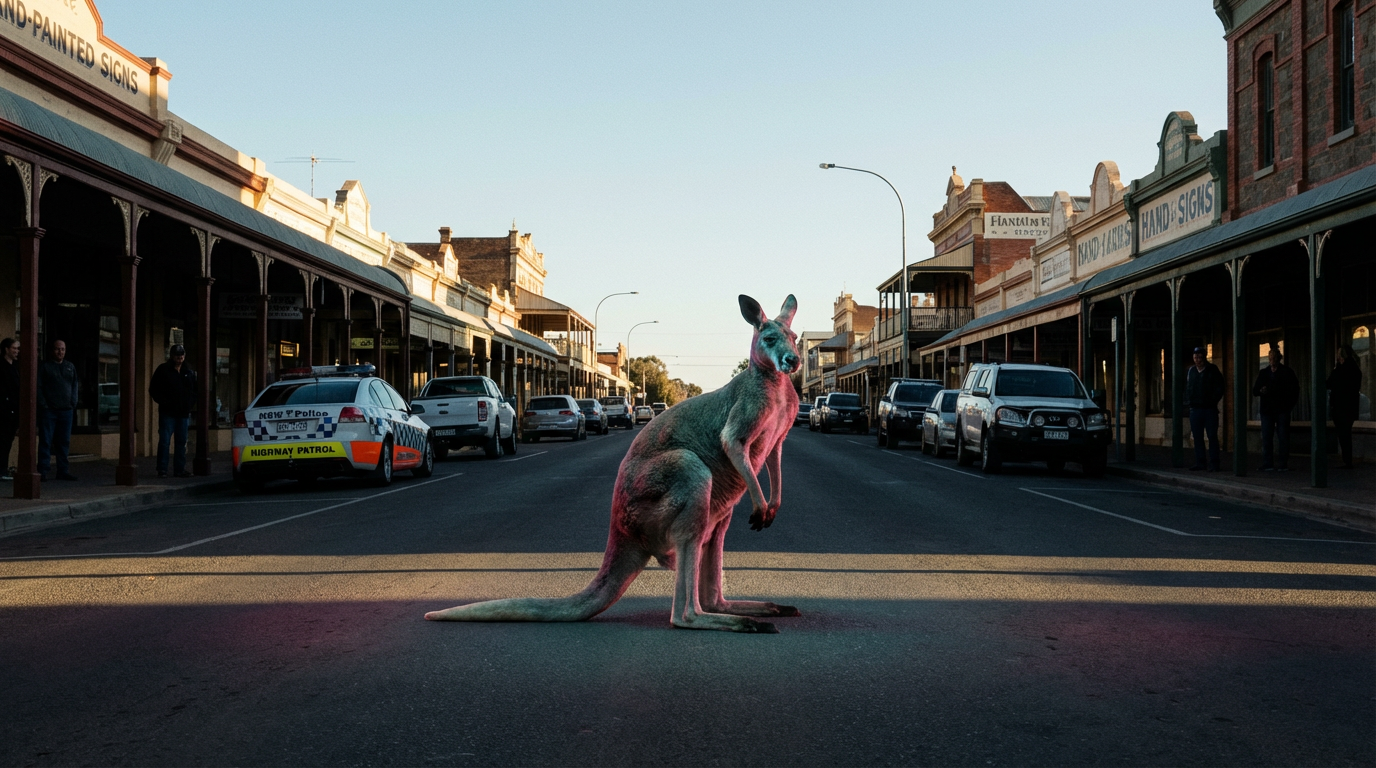
A red kangaroo. A big one — fully grown male, easily six feet if it straightened up, moving west along Argent Street at a loping canter that covered ground with deceptive speed. Its tail dragged behind it like a counterweight, thick as a man's thigh, and its head swivelled constantly — left, right, left — with the jittery, hyper-alert focus of a wild animal surrounded by things it didn't understand and couldn't escape. It wasn't panicking. That was almost worse. It was assessing, and every assessment was sending it further into the heart of town.
"Oh, you're kidding me," I said.
"Just stand back," Mitchell said. Not sharp, but firm. The kind of voice that didn't leave room for discussion. "Stay on the footpath, keep behind me, and don't approach it. Watch."
Behind the kangaroo, the operation that had clearly been going on for some time was becoming visible. Two officers — I could make them out now, one in full uniform, one in shirtsleeves — were working the eastern end, trying to funnel foot traffic off the road and redirect cars down side streets. They'd been at this for a while; the sweat patches and the body language said so. The ranger and his offsider — a younger bloke in a wide-brimmed hat — were jogging to keep pace, trying to shepherd the animal towards Crystal Street, where it could cut south and find its way back to the scrub. The plan was obvious. The kangaroo's opinion of the plan was equally obvious.
It kept coming west. Towards us. Towards the busiest stretch of Argent Street on the busiest afternoon of the work-week.
The news rippled ahead of the animal faster than the animal itself. A woman outside the bakery grabbed her daughter's hand and pulled her inside. The bloke at the newsagent stepped out with his sandwich board, realised what was happening, and stepped back in with the sandwich board, pulling the door shut behind him. Further along, a shop owner — heavyset, apron still on — emerged onto the footpath and stood in his doorway with his arms folded, apparently having decided that his threshold was where the roo's welcome ended and daring it to disagree.
Car horns started. One first — a long, stupid blare from somewhere back in the traffic jam — and then two more, as though honking at a kangaroo were a strategy anyone had ever tried successfully. The roo's ears flattened. Its pace changed — faster now, bouncier, agitated. The horns were making it worse.
"Fucking idiots," Mitchell said, under his breath. It was the first time I'd heard him swear. He keyed his radio again. "Mitchell. Can we get someone to shut those horns up? They're pushing it forward."
The school kids found it first. A group of boys — thirteen, maybe fourteen, still in uniform, bags hanging off one shoulder — came pelting around the corner from Chloride Street at full tilt, phones already out, faces alight with the particular electricity of adolescents who have just learned that something incredible is happening and they are not yet there to witness it. One of them was shouting — "It's fucken massive!" — and the others were laughing, jostling, nearly tripping over each other in the rush to get closer.
Mitchell stepped into their path. Not aggressively — he simply appeared, solid and immovable, in the gap between a parked ute and the kerb.
"Boys. Back on the footpath. Right now."
They pulled up. The ringleader — freckled, sunburned, already taller than half his mates — opened his mouth to argue.
"Now," Mitchell said. The word was quiet and carried the weight of a man these boys had known their entire lives, whose authority didn't come from the uniform but from the fact that he'd coached their football, knew their parents, and would absolutely ring their mothers if they gave him a reason. They retreated to the footpath, phones still raised, still filming, but at a distance.
More kids were arriving. Word had spread the way word spreads in a town where everyone's phone is already in their hand — fast, excited, uncontrollable. Girls in school uniforms clustering in pairs, pointing, squealing. A group of older teenagers on the opposite footpath, too cool to run but craning their necks. Little kids being physically restrained by parents who'd appeared from nowhere, one hand on a collar, the other shielding their eyes from the sun as they tried to track the animal.
The kangaroo was fifty metresaway now. I could see it properly — the sheer size of the thing, the reddish-grey fur, the muscle packed across the chest and forearms. This was not a postcard. This was not a tourism ad. This was a wild animal built to fight, to kick, to disembowel a dog with its hind claws, and it was loping down the main street of a town full of people who were mostly treating it as entertainment.
Mitchell moved. Not towards the roo — towards the footpath, methodical, urgent in a way that didn't look urgent. He steered a woman with a pram back against the shopfront. He gestured two old blokes away from the kerb. He caught the eye of the shop owner in the doorway and shook his head — go inside — and the man, to his credit, went, pulling the door behind him. Each adjustment was small, precise, targeted. No shouting, no drama. He was closing gaps, reducing exposure, the way you'd clear a room before something unpredictable entered it.
"Massey, keep that lot back." He pointed at a cluster of school kids who'd gathered near the TAB, at least ten of them now, pressing forward like spectators at a parade. I moved towards them — grateful for something to do, every academy instinct finally given permission to fire — and spread my arms.
"Back up, please. Behind the awning. Come on."
A girl of about eight looked up at me with enormous eyes. "Is it going to come this way?"
"Probably, love. That's why we need you back here."
"Cool," she said, and retreated approximately one metre.
The ranger — Dennis, I heard Mitchell call him — had caught up. He was stocky, fifties, sunglasses shoved up on his forehead, breathing hard. His offsider was circling wide on the opposite side of the road, trying to get ahead of the animal. Between them and the two officers further back, they'd been trying to create a corridor towards Crystal Street, but the roo had ignored every exit they'd offered. It was locked onto Argent Street now, the wide open road apparently making more sense to its animal brain than the narrow side streets, and every attempt to redirect it had only pushed it forward.
The kangaroo stopped.
Right there, in the middle of the road, maybe thirty metres from where I was standing. It sat back on its haunches and went still. Its head turned slowly — left, right — with the unnerving calm of something that had decided it wasn't going anywhere and was waiting for the rest of the world to adjust its plans accordingly. The street, which had been a rolling chaos of shouts and car horns and running feet, went oddly quiet. Even the school kids stopped talking. There was something in the animal's stillness that demanded it — a presence, a solidity, as though the kangaroo had temporarily claimed ownership of the road and everyone within fifty metres had instinctively recognised the transfer of authority.
A car horn blared from the backed-up traffic. The roo's ears flattened against its skull.
"For fuck's sake," Dennis said, loud enough for the whole block to hear. "Someone shut that bloody horn up or I'll shove it so far up his exhaust pipe he'll be honking out his sunroof."
A ripple of laughter along the footpath. The horn stopped.
Dennis moved slowly — very slowly — into the road, arms wide, talking in a low, steady voice that didn't carry its words but carried its tone: calm, firm, unhurried. His offsider mirrored him from the other side. Mitchell had positioned himself on the footpath to their left, blocking the gap between two parked cars — not confronting the animal, just closing an option, reducing its choices to the one they wanted it to make.
The kangaroo watched them. Its nostrils flared. One massive foreleg shifted, claws scraping the bitumen with a sound that carried further than it should have.
Then it moved. Not towards Crystal Street — of course not — but west again, two enormous bounding hops that closed five to ten metres in a heartbeat. A woman screamed. Someone dropped something glass. The school kids surged backwards in a wave, the eight-year-old grabbing my sleeve with a grip that could have bent steel.
"It's alright," I said, and gently detached her fingers. "It's alright. It's just moving."
Dennis swore again — fluently, comprehensively, with the creative anatomical specificity of a man who had been doing this job for decades and whose patience had been surgically removed sometime around 2004. His offsider broke into a jog, circling wide, trying to get ahead of the animal before it reached the next intersection.
Mitchell was already there. He'd anticipated the move — read the animal's body language, or read the street, or simply done this enough times to know which way a panicked roo would break — and was standing at the gap between the butcher and the real estate office, arms wide, blocking the footpath. Not heroically. Not dramatically. Just there, in the right place, at the right time, because he'd thought three steps ahead while everyone else was still reacting to the step in front of them.
The kangaroo slowed. Dennis closed from behind, his offsider from the right. Mitchell held the left. The animal's head swivelled — searching, calculating — and for a long, taut moment it could have gone anywhere. Into the butcher's. Into the road. Straight at Mitchell.
Then the crack.
Not a crack — a snap, electric and flat, nothing like a gunshot, nothing like anything I'd heard on a street before. The kangaroo's body seized. Every muscle locked at once, the massive frame going rigid mid-step, and then it dropped — not gracefully, not like an animal lying down, but like something whose strings had been cut. It hit the bitumen on its side with a sound like a sack of wet cement, the impact hard enough to bounce its skull off the road. Its legs kicked once, twice — spastic, involuntary, wrong — and then it was still, except for the shallow, rapid flutter of its ribs.
I didn't understand what had happened. Not immediately. The crowd didn't either — the noise cut out like someone had pulled a plug, replaced by a stunned, ringing silence that lasted maybe two seconds before it broke apart into shouting.
The young bloke was already stepping back. Mid-twenties, stocky, the kind of build you get from loading trucks, not from a gym. Stubbies, work boots, a faded singlet with a rip at the collar. He was holding the taser loosely at his side, the wires still trailing from it to the probes buried in the kangaroo's flank, and his expression was utterly calm — the face of someone who'd done a job and was waiting for the next part to happen.
"Jesus Christ," someone said behind me. A woman's voice, high and thin.
"About bloody time," said someone else.
The next part happened fast.
An older man emerged from the crowd on the opposite footpath — late fifties, same build as the young bloke but thicker, heavier, the family resemblance obvious even at a distance. He walked with the unhurried gait of a man who owned property and considered this his business. He was carrying a rifle. A bolt-action .22, held at his side in one hand, barrel pointed at the ground, as casually as you'd carry a cricket bat. He didn't look at the crowd. He didn't look at the officers. He walked straight to the kangaroo, which was still twitching on the bitumen, its eyes rolling, a thin line of saliva stretching from its mouth to the road, and he stood over it.
He racked the bolt. The sound was very clear.
"No — " Dennis started, already moving, one hand raised.
The man put the muzzle against the kangaroo's temple and fired.
The sound was enormous. Not the flat snap of the taser but a real detonation, the kind that punches through your chest and leaves your ears ringing. The kangaroo's head jerked sideways. A spray of blood and something thicker — grey, pinkish, I didn't want to catalogue it — fanned across the bitumen in an arc that reached the front wheel of a parked Commodore. The body convulsed once, violently, the massive tail slamming the road hard enough to crack the sound through the street like a second shot, and then it was still. Completely still. The blood was already pooling, dark and quick, spreading in a shape that had no pattern, finding the camber of the road and tracking towards the gutter.
The street erupted.
Not in one direction — in all of them at once. A woman screamed. Someone was clapping — actually clapping, a slow, deliberate applause from somewhere near the bakery. A man in a hi-vis vest shouted "You fucking beauty!" and punched the air. A mother clamped her hands over her daughter's eyes and turned away. The school kids were frozen, phones still raised, capturing something they hadn't expected and couldn't process — half of them grinning, half of them white-faced. The eight-year-old at my elbow had gone completely silent, her hand on my sleeve again, gripping hard.
"Shit," Mitchell said. Quiet, to himself. Not shock — assessment.
The older man lowered the rifle. He cracked the bolt, ejected the spent cartridge — it pinged off the road and rolled, a small brass cylinder catching the afternoon light — and tucked the rifle under his arm. He said something to his son, too low to hear, and the son nodded and began reeling in the taser wires.
I was already moving.
There was no thought, no decision tree, no risk assessment. There was a man standing in a crowded street holding a firearm that he'd just discharged next to a dead animal and fifty civilians and a dozen children with their phones out, and my body did what two years of academy training and six months of operational service had wired it to do. I crossed the distance in four strides — maybe five, I don't remember — and hit the rifle from below with the heel of my palm, knocking it upward and out of his grip. It clattered to the road. The man's head snapped towards me, his mouth opening — surprise, outrage, something — but I was already behind him, my hand on his wrist, twisting his arm up between his shoulder blades, my other hand on the back of his neck, driving him forward and down.
He hit the bitumen hard. Knees first, then chest, then his cheek against the road, and I felt the impact travel through his body into my hands. He was heavy — solid, weathered muscle under sun-damaged skin — and he grunted on contact, a sound more of indignation than pain. I had his arm locked behind his back before he could decide whether to resist, my knee in the small of his back, my cuffs already off my belt and onto his wrist with a speed that surprised even me.
"Hands behind your back. Now."
"What the fuck — "
"Other hand. Behind your back."
The second cuff clicked. I held him there, face down on the hot bitumen, the blood from the kangaroo maybe three metres away, spreading slowly towards us, and I could feel my heart — rapid, hard, slamming against my ribs like it was trying to get out.
The crowd went absolutely berserk.
A roar — not a scream, not a gasp, a full-throated roar — erupted from both footpaths. Cheering. Whooping. Someone was wolf-whistling. The school kids were losing their minds, phones pivoting from the dead kangaroo to the woman in uniform pinning a man twice her size to the road, and I could hear the words already forming — "Did you see that?" — "She just fucken decked him!" — "Get it on video!" The bloke in the hi-vis who'd been clapping before was now laughing so hard he'd bent double, one hand on his knee. Two women near the chemist were applauding. The eight-year-old, still frozen where I'd left her, had her mouth open in a perfect circle.
The son dropped the taser.
"Oi! Get off him! That's my fuckin' dad!"
He took one step forward. I looked up at him from the ground, one hand still on his father's back, and whatever was in my face stopped him. He stopped. His fists were clenched, his jaw was working, and I could see the calculation happening — the animal part of his brain that wanted to charge forward running headlong into the part that could see the uniform, the cuffs, the absolute certainty with which I was holding his father to the road.
"Step. Back." My voice didn't sound like mine. Harder, flatter, stripped of everything except the instruction.
He stepped back.
Mitchell arrived. Not running — Mitchell didn't run — but covering ground fast, his face unreadable, his eyes taking in the scene with the systematic efficiency I'd watched him apply to everything all afternoon. The cuffed man on the road. The son, trembling with fury, fists still clenched. The rifle on the bitumen. The dead kangaroo. The crowd. Me.
He crouched beside me. Close enough that only I could hear him.
"You alright?"
"Yeah."
A pause. One second, maybe two. His eyes on the cuffs, on the man's position, on my hands.
"Alright." He straightened up.
He turned to the father first. Looked down at him with an expression that wasn't anger, wasn't sympathy, but something in between — the look of a man who understood exactly what had just happened and was already sorting through the pieces.
"Keith."
"Jim." The man's voice was muffled against the bitumen, thick with rage. "Tell this bloody woman to get off me. I was doing everyone a goddamn favour."
"I know, mate." Mitchell's voice was steady. Infuriatingly calm. "But you just discharged a firearm on Argent Street on a Friday afternoon in front of thirty school kids. You know I can't leave that where it is."
"It was a bloody roo, Jim! Not a person!"
"I know what it was." Mitchell crouched again. "Keith. Look at me."
The man twisted his neck. His cheek was scraped from the bitumen — a raw, red graze from his ear to the corner of his mouth, grit embedded in the skin. His eyes were furious, but beneath the fury I saw something else. The slow, sickening recognition of a man who was beginning to understand that the thing he'd done — the practical, obvious, common-sense thing — had just become something entirely different.
"You need to come to the station," Mitchell said. "Both of you."
"Bullshit."
"Keith."
"I'm not going to the bloody station for putting down a roo that your lot couldn't handle. Dennis had his thumb up his arse for twenty minutes — "
"Hey, fuck you, Keith!" Dennis called from somewhere behind us.
"You need to come to the station," Mitchell said again, same tone, same volume, as though the objection hadn't happened. "We'll sort it out there. But you can't stay here, and I can't let you walk home with that" — he nodded at the rifle — "while half the town's got their phones out."
The son was pacing. Short, tight lines, four steps and turn, four steps and turn, the way a caged animal moves. He was muttering — I caught bullshit and unbelievable and something about city cops that I chose not to hear.
"Ryan," Mitchell said, and the pacing stopped. "You too, mate. Station. We'll get this squared away."
"He didn't do anything wrong."
"I hear you. Station."
Ryan looked at his father, face down on the road, a woman half his weight kneeling on his back. He looked at Mitchell. He looked at the crowd, who were watching with the rapt attention of people who had not expected this much entertainment from a Friday afternoon and were determined to get every last second of it.
"Fine," he said. The word came out like he was spitting a stone. "Fuckin' fine."
Mitchell nodded at me. "Massey. Let him up."
I eased my knee off Keith's back and helped him to his knees, then to his feet. He was unsteady — the adrenaline crash hitting, or the humiliation, or both. His face was a mess — the graze weeping, grit and dust in his eyebrows, his bottom lip bleeding where he'd bitten it on impact. He looked at me for the first time. Really looked, the way you look at someone who has just done something to you that you will not forget.
"You're new," he said.
It wasn't a question.
Mitchell picked up the rifle. He cleared the chamber — checked the breach, engaged the safety, held it by the stock. Dennis's offsider was already radioing for support to manage the crowd and deal with the carcass. Dennis himself was standing over the dead kangaroo with his hands on his hips, shaking his head slowly, his expression suggesting that Keith's assessment of his thumb's recent location was not entirely without foundation.
"Massey," Mitchell said. "Walk with Keith. I'll bring Ryan."
Keith held his cuffed wrists out behind him and looked at me. "Can you at least take these off? I'm not going to run. Whole bloody town just watched you flatten me — where am I going to go?"
I looked at Mitchell. His face gave me nothing.
"They stay on until we're at the station," I said.
Keith's jaw tightened. He turned and started walking.







