4128.59 · February 28, 1808 AD
The Resolution Delivers Her Cargo
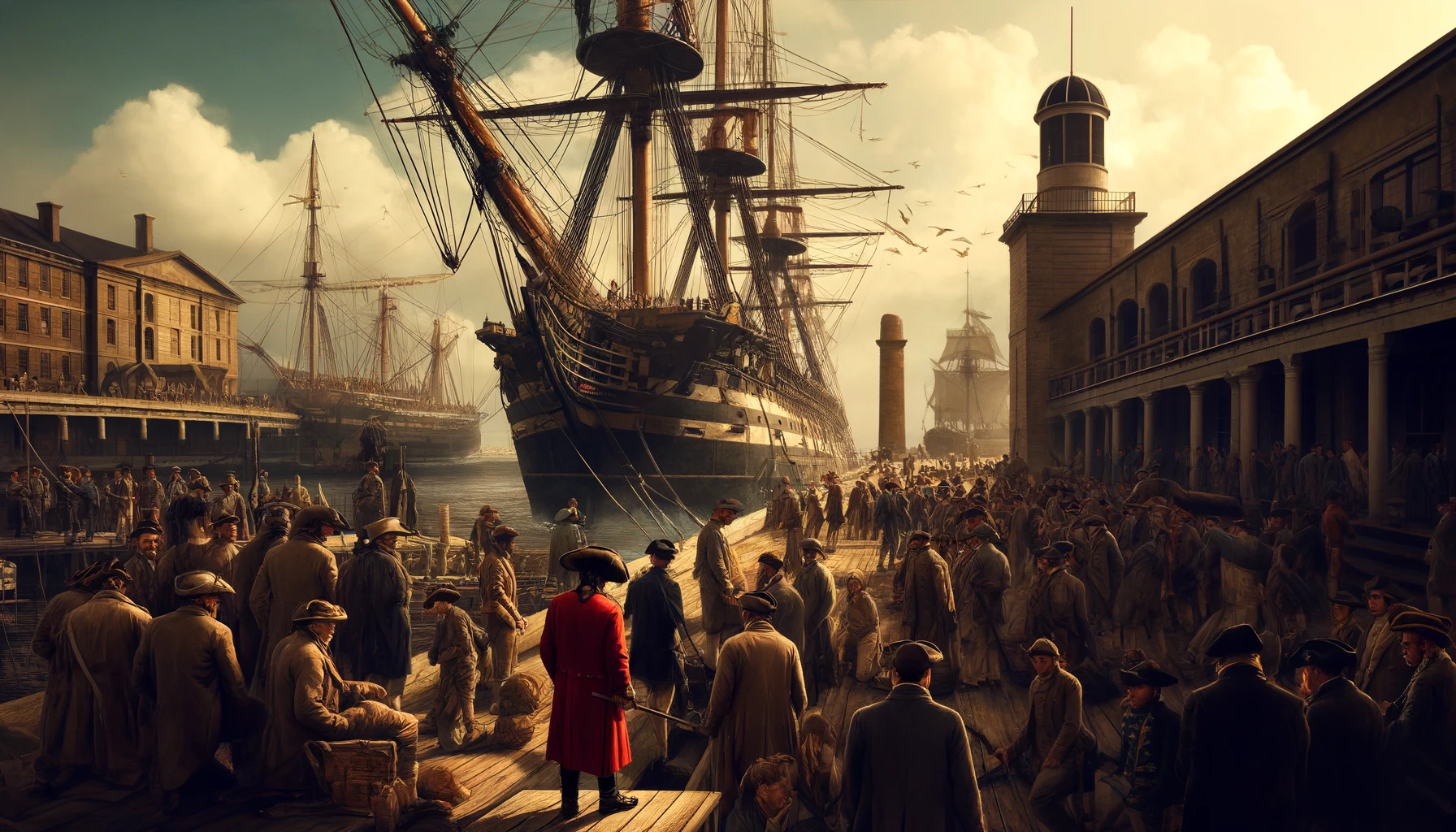
The convict transport HMS Resolution arrived at Sydney Cove after a ten-month voyage from Portsmouth, carrying one hundred and fifty prisoners to the colony of New South Wales. Captain Josiah Haverford oversaw the disembarkation and processing of the convicts, who were assigned to stations throughout the colony including the government farm at Parramatta and the quarries at Castle Hill.
The cry of land came down from the masthead shortly after dawn, when the eastern sky had barely begun to shed its burden of stars. The HMS Resolution, her weathered hull and salt-crusted rigging bearing witness to ten months upon the ocean, had completed the fifteen-thousand-mile journey from Portsmouth to the far side of the world.
The vessel navigated the treacherous entrance to Sydney Harbour with the steady hand of Captain Josiah Haverford at her helm. The sandstone headlands rose on either side, their faces glowing amber and ochre in the strengthening light, whilst sulphur-crested cockatoos wheeled overhead in shrieking multitudes. For the one hundred and fifty convicts crowded at the starboard rail, many seeing land for the first time since England's coastline had faded into grey memory, the sight provoked reactions ranging from desperate hope to undisguised terror.
Sydney Cove revealed itself as the Resolution rounded the final headland—a settlement that had transformed remarkably in the twenty years since the First Fleet's arrival. Brick and stone buildings lined the waterfront. A church spire rose above the rooftops. Streets climbed the gentle rise in something approaching order, and vessels of every description lay at anchor throughout the harbour, their masts creating a forest of timber against the pale sky. The Union colours snapped from a pole atop the highest point of land, proclaiming British dominion over this distant corner of the earth.
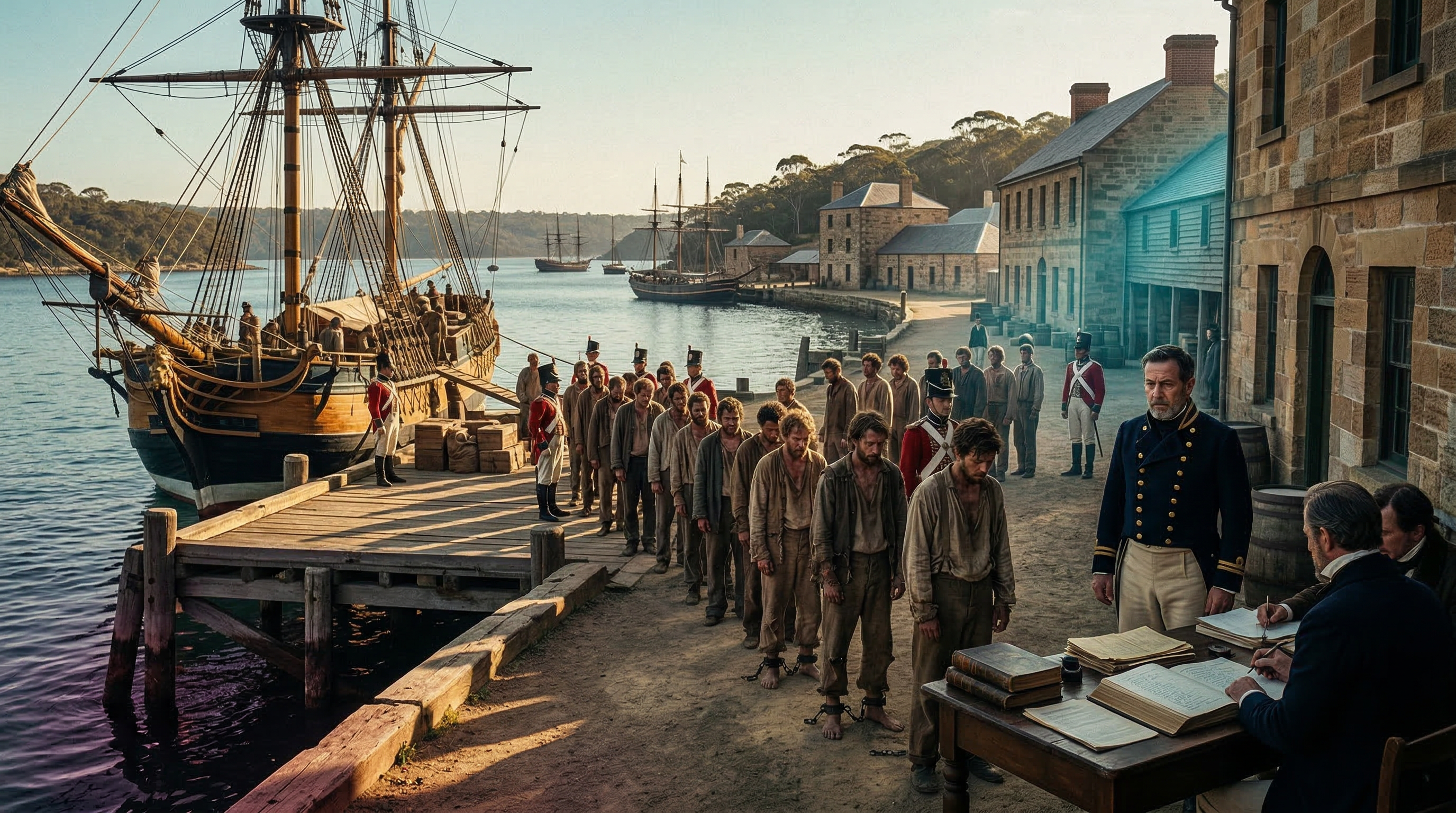
The anchor plunged into the harbour shortly before midday, and for the first time in three hundred days the endless motion of the sea gave way to the gentle sway of sheltered waters. Soldiers of the New South Wales Corps formed ranks along the dock, their red coats vivid against the weathered timber, whilst colonial officials, merchants, and curious onlookers gathered to witness the arrival of the newest additions to the convict population.
Captain Haverford established himself at a makeshift desk near the head of the dock, ledgers and documents spread before him, a clerk at his elbow with quill poised. The processing commenced with the grinding efficiency that characterised such occasions—each convict brought forward in turn, their particulars recorded, their fates determined by the stroke of a pen. Name. Crime. Sentence. Skills, if any. The questions came in clipped tones, the answers scratched into the colonial record.
The assignments distributed the human cargo according to the colony's needs. Those deemed fit for the harshest labour found themselves directed toward the transport bound for Castle Hill, where the government quarries consumed men with an appetite that showed no sign of satisfaction. Others received assignment to road gangs, their bodies to be spent carving passages through the bush that pressed close against the settlement's boundaries. A fortunate minority, possessed of skills that rendered them useful to free settlers, were allocated to private households where regular meals and shelter might at least be expected.
The government farm at Parramatta claimed its share of the new arrivals—men whose crimes had been judged insufficiently severe for the quarries, whose constitutions appeared capable of agricultural labour, whose futures remained uncertain but not entirely without hope. Among them stood William Jeffries, a twenty-two-year-old dockworker from Portsmouth convicted of stealing a pocket watch, his seven-year sentence stretching before him like a road disappearing into fog.
The heat built as the afternoon advanced, pressing down upon the dock with an intensity that left English-born skin prickling with the promise of burns to come. The tar between the planks grew soft underfoot. Sweat soaked through the convicts' tattered clothing, and more than one man stumbled as legs weakened by months of confinement struggled to find their balance upon ground that refused to pitch and roll.
By late afternoon the processing had concluded and the various transports had departed for their destinations. The quarry-bound prisoners disappeared toward the west, their chains rattling accompaniment to a journey from which many would not return. Those assigned to Parramatta gathered near the harbour's edge, awaiting the march that would carry them to their new lives on the morrow. The remainder—a collection of men bound for road gangs and private service—dispersed under guard to their respective holding points throughout the settlement.
The Resolution sat lighter in the water now, her cargo delivered, her purpose fulfilled. She would take on provisions and minor repairs before beginning the long voyage back to England, where another complement of the condemned awaited transport to these distant shores. The cycle would continue as it had for two decades, the empire's unwanted transformed by the alchemy of distance into the colony's essential labour force.
As the sun descended toward the western ranges and the harbour waters shifted from blue to gold to deepening purple, the newest convicts confronted the reality of their situation. Whatever lives they had known in England—whatever families, trades, hopes, and grievances had shaped their former existences—belonged now to memory alone. The land that stretched beyond Sydney's modest boundaries offered no promises save the certainty of toil and the possibility, however remote, of eventual redemption.
The twenty-eighth of February drew toward its close. Somewhere in the settlement, a dog barked. The cockatoos settled into their roosts with diminishing clamour. And one hundred and fifty men who had been Englishmen that morning faced their first night as prisoners of New South Wales.







