4308.263 · September 19, 1988 AD
The Quiet Before Shadows
In Broken Hill, Violet Dallow begins her day surrounded by the familiar rhythms of family life and the wild promise of the Outback. Between shared breakfasts, quiet dreams, and fleeting laughter, the morning unfolds with a deceptive calm that lingers over the Dallow household.
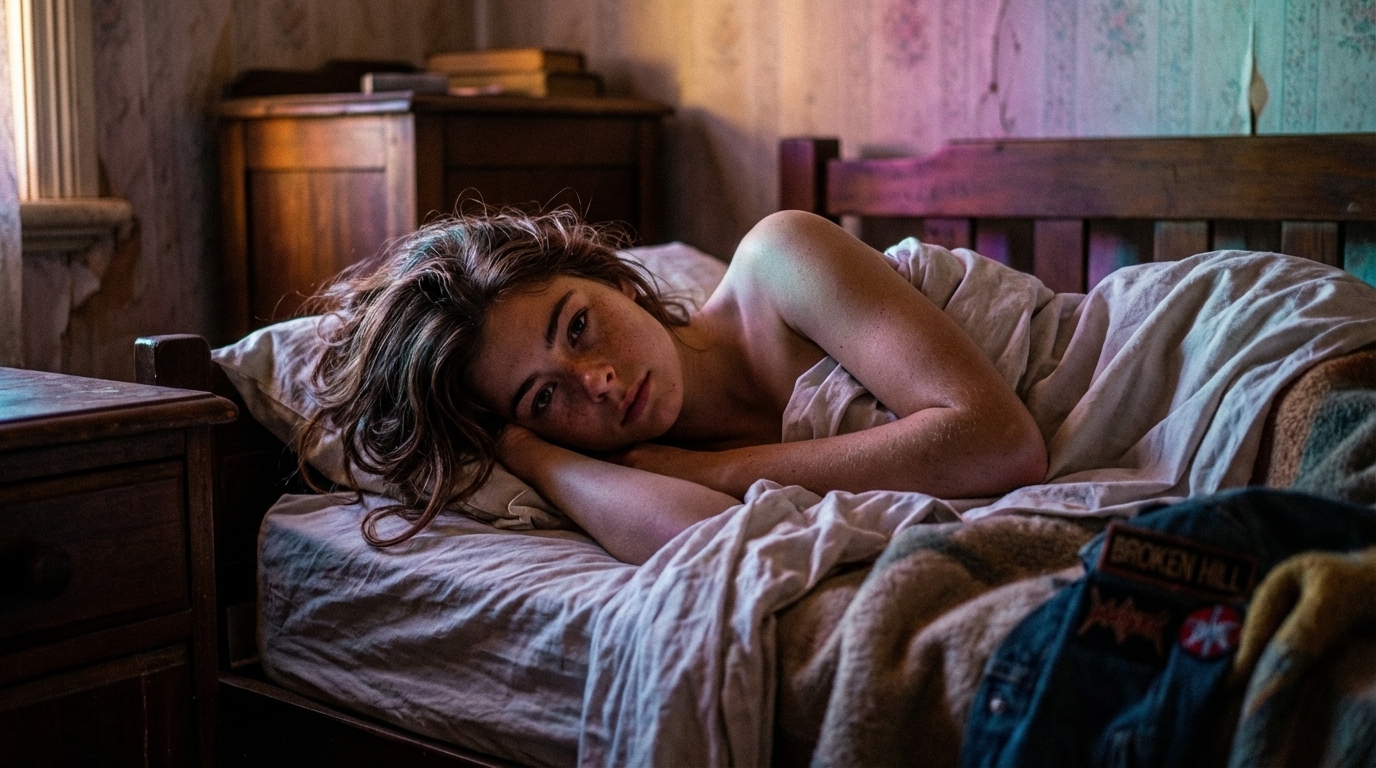
"Dreams are only safe until the world decides to wake you." — Evelyn Dallow
In the mining town of Broken Hill, dawn crept in with a quiet insistence, brushing its pale gold fingers across the corrugated rooftops and cracked verandahs of weather-beaten homes. The land beyond—the brittle expanse of the Outback—seemed to exhale as the first light slanted over its ochre skin, stirring dust motes and shadows in equal measure. A mob of galahs screeched somewhere in the distance, their riotous cries breaking the hush, while the scent of eucalyptus—sharp, clean, almost medicinal—rose from the dew-damp trees that framed the edge of town. That scent clung to everything: the wooden fenceposts, the rusted tin sheds, even the fabric of dreams.
Inside the Dallow home, tucked away on the quieter side of Chloride Street, sixteen-year-old Violet lay half-wrapped in a tangle of sheets, one arm thrown above her head in unconscious defiance. Her bed creaked faintly as she stirred, the mattress thin but familiar beneath her. A wisp of morning air slipped in through the slightly ajar window, lifting the faded lace curtain in a slow, ghostlike sway. The movement cast flickering patterns across the bedroom walls—shadows of leaves and light, like the pages of a half-remembered story still waiting to be told.
Violet’s eyes cracked open, reluctant but alert, pupils adjusting to the glow seeping in from the east. There was a moment’s pause before awareness returned, like the aftertaste of a strange dream that stubbornly refused to fade. Her chestnut curls—untameable at the best of times—splayed across the pillow in soft rebellion, catching the golden threads of sunlight that had begun to slip between the curtain folds. Her face, not yet touched by the self-consciousness that adulthood would bring, was a mix of sleep-heavy softness and something fiercer beneath—restlessness, or perhaps hunger.
The room was humble but lived-in. A hand-sewn quilt draped over the foot of the bed, stitched together from fabric scraps Evelyn had hoarded over the years—florals, stripes, old school uniforms. A small wooden desk sat in the corner, littered with pages torn from exercise books and battered library novels with cracked spines. A dried wattle branch hung above the mirror, brittle and forgotten, but not yet discarded. On the wall, thumbtacked at odd angles, were yellowing news clippings—one about a prospector who’d vanished near Silverton in 1921, another detailing the recent council vote on heritage preservation. Violet’s little museum of the unexplained.
She let out a soft sigh, not quite a groan, and rolled onto her side, pulling the sheet up over her shoulder. Her eyes lingered on the curtain’s gentle flutter. There was something about mornings like this—when the air was still cool, the light not yet harsh—that made everything seem both possible and unbearably far away. Another day in Broken Hill. Another crack in the surface of things, waiting to be pried open.
As consciousness slowly settled into her limbs, Violet lay still beneath the covers, letting her thoughts drift and unfurl like smoke across the wide-open country of her mind. They wandered, unhurried, into the memory of the wilderness just beyond Broken Hill’s edge—a terrain she knew not just with her feet but with something deeper, almost ancestral. The Outback was more than backdrop; it was participant, confessor, conspirator. Its breath stirred the branches of the towering eucalyptus trees, whispering in rustling tongues about things long buried beneath the dust. Gnarled gullies, dried riverbeds, and skeletal fences haunted the margins of her dreams, speaking in a language older than English and older than fear.
That rugged, red land had always felt like hers. Not in ownership—she knew better than to pretend mastery over it—but in kinship. She could remember, even as a little girl, the sensation of pressing her palms to the hot, cracked soil, marvelling at the way it stained her skin a ruddy orange. Others spoke of the Outback with caution or outright disdain. Violet thought of it with reverence, like one might think of a god—capricious, dangerous, and unknowably beautiful.
Her room echoed that bond. It was a shrine to movement, to questions without answers, to everything that existed beyond Broken Hill’s stifling borders. Faded posters—Uluru at sunset, the snow-capped peaks of the Andes, a grainy image of Shackleton’s ship frozen in ice—covered the cracks in the plaster. Trinkets lined the narrow shelves: a rusted key she’d found near an abandoned rail siding, a snake vertebrae coiled in a glass jar, an opal no larger than a thumbnail, pinkish and imperfect. Her map of Australia, thumbtacked to the western wall, was riddled with coloured pins—blue for places she’d been, red for places she longed to reach. The edges were curled and faded from sun, the surface soft from the oils of her fingers.
Beside the bed, a leaning stack of books threatened collapse. The top one, a dog-eared copy of Tracks by Robyn Davidson, still held a gumleaf as a makeshift bookmark. Beneath it, volumes on geology, bush survival, and out-of-print adventure novels jostled for space. Some had her notes scribbled in the margins: questions, theories, sketches of unknown footprints. Her curiosity was not the idle sort—it came with teeth.
From outside the half-closed bedroom door came the muted thrum of domestic life beginning. The tick of the old wall clock in the hallway. The soft groan of plumbing pipes under the floorboards. And then—distinct and immediate—the aroma of coffee, dark and rich, curling through the air like an offering. Violet’s stomach stirred. The smell had a gravity to it, one that pulled her back toward the present.
In the kitchen, she knew, Jasmine would already be deep into her routine. At thirteen, Jasmine had developed the kind of precision that made Violet both amused and vaguely uncomfortable. There was something almost odd about the way she moved—methodical, elegant, as though she’d rehearsed every motion. Her hair, always brushed into submission and tied into a perfect low ponytail, rarely had a strand out of place. Violet could picture her now: standing on tiptoe to reach the top cupboard, setting two mugs down side by side, her brow furrowed in quiet determination.
It wasn’t that Jasmine lacked warmth—far from it. But where Violet burned like a wildfire, Jasmine moved like a river cutting stone. Deliberate. Enduring. They were different currents of the same water.
Violet stretched languidly beneath the sheet, her limbs unfolding like a cat’s, toes brushing the cold iron curve of the bedframe. The sensation made her shiver pleasantly, anchoring her back to the real—wood, metal, linen, breath. Above her, the ceiling bore the faint stains of past winters and hairline cracks that spidered outward like tributaries on a faded map. She stared at them, tracing imagined routes, still half-lost in the dusty hinterlands of her dreams.
The morning was unfolding with that peculiar hush unique to early spring—the kind that felt both expectant and heavy with secrets. The sort of silence that didn’t last long in Broken Hill, where cicadas would soon start their raspy chorus and the sun would bleach every colour into submission. But for now, she lingered, suspended between sleep and waking, the wilderness in her head refusing to fully loosen its grip. Not yet.
With a sudden, decisive movement, Violet threw back the sheet. It fell in a crumpled heap at the foot of the bed. Her legs swung over the edge, feet meeting the floorboards with a soft thud. The timber was cool against her soles, smooth in some places, splintered in others—a familiar discomfort she didn’t mind. She relished contrasts: the bite of morning air against skin still warm from sleep, the thin chill of the floor after the cocoon of her quilt. It made everything feel real.
She leaned across to the small wooden table beside her bed and squinted at the squat, ticking clock. Its yellowed face and worn hands were a relic from her father’s youth, but it still kept good time. Just past six. A smile ghosted across her lips—early enough to feel ahead of the day, but not so early as to arouse suspicion. She was free, for a little while at least, to make the morning her own.
Dressing took moments, slipping into a pair of faded jeans that bore the scuffs and stains of too many climbs and crawls to count. The denim hugged her knees, frayed at the seams, stiff in places where mud had long since dried into memory. She pulled on a loose-fitting shirt, pale blue, once her father’s—now softened by time and stolen permanently to her side of the laundry. It smelled faintly of dust and sunlight.
Sitting on the edge of the bed, she tugged on her boots—thick-soled, laced to the ankle, their leather softened to the shape of her feet. As she tightened the laces with quick, sure fingers, she glanced at the mirror propped haphazardly atop her chest of drawers. The glass was slightly warped, the frame chipped, but the reflection was unmistakable: a girl not quite grown, wild-eyed and sure-footed, looking back with something like defiance.
Her hair, as ever, was a tangle of chestnut coils. She ran a brush through it half-heartedly, wincing at a particularly stubborn knot before giving up altogether. There were better things to do than wage war on her hair. She tucked a few stray strands behind her ears and stood, already thinking ahead—of the sun on red rock, of the places no one else bothered to look. Of what the day might reveal, if she moved quickly and paid attention.
She was, in that moment, not merely awake—but alive.
The modest kitchen of the Dallow home stirred with the low, comforting hum of early morning life. The air was heavy with the scent of sizzling butter and sweet batter, mingling effortlessly with the crisp, mineral tang of the Outback breeze drifting in through the open louvre window. Dust swirled faintly in shafts of golden light, catching on the edges of enamel mugs and the chipped Formica table, casting long, lazy shadows across the linoleum floor.
Violet padded in with quiet confidence, her boots scuffing softly against the floorboards. The kitchen was small but well-used, its surfaces crowded with the familiar clutter of lived-in love: a bowl of overripe mandarins, a tin of mismatched cutlery, a cracked clock ticking just a fraction too slow. Everything had a place, not by order but by memory.
Jasmine stood at the stove, framed by morning light, her slight figure radiating the purposeful calm of someone already three steps into the day. A thin smear of flour graced her cheek like a badge of honour. The skillet hissed gently beneath her hand as she flipped another pancake with a casual flick of the wrist.
The sisters exchanged a glance—brief but loaded with shared language. There was no need for words; their bond was a thread that ran deep, forged in late-night whispers, stolen bicycles, and the countless invisible moments that wove childhood into sisterhood.
“Morning, Jazzy,” Violet greeted, her voice rough with sleep but rich with warmth. She leaned against the doorframe, arms folded, eyes bright. “What’s on the menu today, then?”
Jasmine turned with a mock flourish, spatula raised like a conductor’s baton. “Pancakes, as usual,” she said, grinning. “Didn’t fancy experimenting. Besides, Mum’s already elbow-deep in fabric, so it’s just us for brekkie.”
Violet followed her sister’s gaze to the adjoining room, where Evelyn sat hunched over her sewing table, a pair of gold-rimmed spectacles perched precariously on her nose. The steady rhythm of the sewing machine pulsed like a heartbeat through the house—soft, repetitive, soothing. Scraps of fabric lay like fallen petals around her feet, and her hands moved with quiet meaning, feeding cloth through the machine with the same care she’d used to mend scraped knees and school dresses.
This morning, she was stitching something new—sky blue cotton, with white piping and a delicate row of brass buttons. A neat pile of half-finished garments lay to one side, each piece imbued with her quiet strength, her love stitched into every seam.
Violet stepped closer, her voice gentling. “Mum, those look amazing.” Her eyes scanned the neat folds, the tiny, even stitches. “Is that for the Silverton trip?”
Evelyn paused and looked up, brushing a strand of greying auburn hair from her face with the back of her hand. Her eyes—soft, brown, tired but kind—met Violet’s with a smile that deepened the fine lines around her eyes, each one a testament to years of holding everything together.
“Yes, it is,” she replied, her voice calm and low, with that faint lilt that always reminded Violet of lullabies hummed in darkened rooms. “I want you to have something special to wear—something of mine, really. Are you excited?”
Violet hesitated for only a heartbeat, her gaze flicking to the pancakes Jasmine was now stacking onto a plate like golden bricks. She smiled, wide and true.
“Of course,” she said, turning to sit. “It’s going to be an adventure.”
As Violet and Jasmine tucked into their breakfast, the comforting weight of golden pancakes settled warmly in their stomachs. The sweetness of syrup, pooled and glistening in the plate’s shallow curve, clung to their forks and fingers like honey from a beehive. Outside, the pale light of morning deepened, drawing sharper shadows across the kitchen walls and picking out the worn grain of the table where generations of meals had come and gone. The tang of eucalyptus still clung faintly in the air, mingling with the comforting scent of warm batter and the citrus zing of freshly squeezed juice.
Each bite was a small indulgence—an act of rebellion against the often sparse rhythm of outback living. These breakfasts, simple and unhurried, were rare things, tucked between their mother’s long work hours and the encroaching demands of school, chores, and the steady tug of time.
As she chewed, Violet’s gaze drifted beyond the scuffed window frame, beyond the scraggly hills that bordered town, and far beyond that—to places only she could see. In her mind’s eye, the Outback gave way to the steel and sandstone spires of some grand university cloister, perhaps in Sydney or Melbourne—places with names like Monash, Macquarie, or the sandstone sanctuaries of the University of Sydney. She imagined herself beneath ivy-covered archways, hunched over notebooks filled with ideas that sparked like flint, her voice rising confidently in lecture halls that echoed with the pulse of possibility.
But then the city gave way to another dream: amber plains stretching out beneath a foreign sun, her hand shielding her brow as she scanned the horizon for giraffes moving like ghosts through the heat-haze. An African safari—untamed, immense, intoxicating. The word safari alone gave her a thrill, like it might come true just by speaking it aloud.
And yet, the dream that lingered longest—the one rooted not in fantasy but necessity—was her vision for water. Not just saving it, but understanding it. Harnessing it. She imagined herself among scientists and engineers, studying aquifers, building systems, designing futures. Out here, water was more precious than gold, and the land whispered warnings to anyone who would listen. Violet was listening.
Her fork drifted aimlessly through a puddle of syrup as her thoughts coalesced. Then, as if stirred by some internal breeze, she spoke.
“Jazzy,” Violet said, softly, watching the light catch in the amber swirl of syrup, “have you ever thought about what you want to do when you grow up?”
Jasmine looked up mid-bite, lips pressed together in quiet thought. She reached for her glass of orange juice—slightly warm now—and took a slow sip, her eyes narrowing as she weighed the question like a stone in her palm.
“I’m not sure yet,” she said finally, setting the glass down with care. Her voice was thoughtful, uncertain but unafraid. “Maybe something with animals. Or nature. I like being outside… same as you, really. But I think I’ve got time to figure it out.”
“You’ve got plenty of time,” Violet said with a quiet smile, reaching across the worn table to give Jasmine’s hand a squeeze. Her fingers were small but strong, the skin marked faintly by sunlight and youth. “Just make sure to dream big, alright?”
Jasmine grinned, dimples appearing, a flash of mischief brightening her face.
“Like you and your grand adventures?”
“Exactly,” Violet laughed, the sound soft and rich in the morning stillness. She leaned back slightly, soaking in the warmth of the moment, the fullness of the air. “Dreams are what keep us going. Without them, we’d be as dry as the Outback in a drought.”
Jasmine giggled at that, and for a brief moment, the world outside the kitchen walls—the sunbaked roads, the whispered rumours, the ghosts of the past—seemed a little further away.
Their mother, seated at her worktable just beyond the kitchen threshold, paused mid-stitch, the fine thread taut between her fingers. She listened quietly, the murmured dreams of her daughters weaving themselves into the gentle rhythm of morning. A smile crept to her lips—soft, knowing, touched with something unspoken.
“You girls have always been dreamers,” Evelyn said, her voice carrying the delicate blend of affection and gravity that only mothers seemed to master. Her eyes remained on the fabric in her lap, but her words reached them clearly. “Just remember, it’s the hard work that makes those dreams come true. Your father and I didn’t get where we are by wishful thinking alone.”
The sewing machine clicked back to life, its motor low and steady like a purring cat. The scent of starch and cotton mixed subtly with the remnants of syrup and scorched butter, grounding the moment in the sensory textures of home.
Violet looked over at her mother, a flicker of something moving behind her eyes—gratitude, maybe, or something more complicated. She admired Evelyn’s strength, even envied it on occasion. But part of her also resisted it. Her mother’s kind of grit was rooted in routine, repetition, sacrifice. Violet’s own craving leaned toward motion, rupture, and risk. It wasn’t that she disbelieved in hard work; she just wanted her sweat to fall on uncharted ground.
And so, each day she stole a little bit of wilderness for herself. After school, before dinner, sometimes even at dawn—Violet would scale the sun-scorched escarpments beyond the western edge of town, their iron-rich faces sharp and unforgiving. She climbed eucalyptus trees like a possum, her fingers finding knotted handholds in the peeling bark, her boots scraping against brittle limbs. The trees whispered to her as she climbed, their tall silver arms swaying and creaking like old men keeping ancient secrets. Up there, above the scrub and the sprawl, Broken Hill shrank into insignificance. The mines, the rusting fences, the hollow clatter of daily life—it all melted into the red earth, and she could pretend, for just a few moments, that she was somewhere else entirely.
Her hands bore the callouses of those small rebellions. Her knees often bore the bruises. But she wore both like medals.
“Violet, can you pass me the syrup?” Jasmine’s voice cut gently through her reverie.
“Sure thing,” Violet murmured, reaching across the table. The bottle was sticky to the touch, its label faded from sunlight and spills. As she handed it over, her gaze lingered on the thick amber liquid within, catching the light like a trapped sunbeam. She smiled faintly.
“Remember when we used to pretend this was a magic potion?” she said. “We’d take one drop and suddenly be able to fly or speak to animals or turn invisible.”
Jasmine chuckled, a quiet sound, as she drizzled the syrup in slow spirals over her remaining pancakes. “You always made up the best stories. I think you truly believed it worked.”
“Maybe I still do,” Violet replied with a grin, leaning back slightly. “Any plans for after school today?”
Jasmine paused to chew, then dabbed at her mouth with a napkin. “Not really,” she said thoughtfully. “I thought I might go for a walk later. Maybe to the park. The jacarandas should be in bloom now.”
Violet’s face brightened. There was something about that image—purple blossoms against a pale sky—that stirred her.
“That sounds perfect,” she said, already imagining the scent of crushed petals and warm grass. “Mind if I join you? I need to stretch my legs after being cooped up in classrooms all day.”
“Of course not,” Jasmine said, her smile small but sincere. “It’ll be nice to have some company.”
For a moment, neither of them spoke. The silence between them was comfortable, filled with history and hope. Outside, the wind shifted, and somewhere in the distance, a dog barked. The jacarandas were blooming, and the world—just for now—felt wide and full of promise.







