4308.279 · October 5, 1988 AD
The Name in the Static
At dawn on the fifth of October, Constable Harris walks his morning rounds through Silverton and finds what the Strangler left for the town to see. A girl's body propped against the stone wall of the gaol, candles guttered in the dust around her, her face turned toward the empty street as though daring anyone to look away. When Harris radios Broken Hill, Barry Glasson tells him to keep it quiet. Harris says the name anyway.
Dawn came to Silverton the way it always did — quietly, without ceremony, the light spreading across the desert and finding nothing to celebrate. The township lay scattered along its single road, stone cottages and corrugated sheds crouching low against the earth as though bracing for another day of heat and wind and the particular silence that places carried when most of the people who had once lived in them were gone. The pub. The hotel. The gaol. The windmill turning slowly in a breeze that carried nothing but dust.
Constable Harris walked his rounds at first light because that was when he walked them, a habit maintained less from duty than from the comfort of routine in a posting that offered little else. Silverton did not require much policing. Its permanent population could be counted on two hands, its troubles confined to the occasional drunk or trespasser, its dramas the small kind that small places produced. Harris had been stationed here long enough to know every building by its silhouette and every sound by its source, and the mornings had settled into a rhythm so predictable that his body conducted the rounds while his mind occupied itself elsewhere.
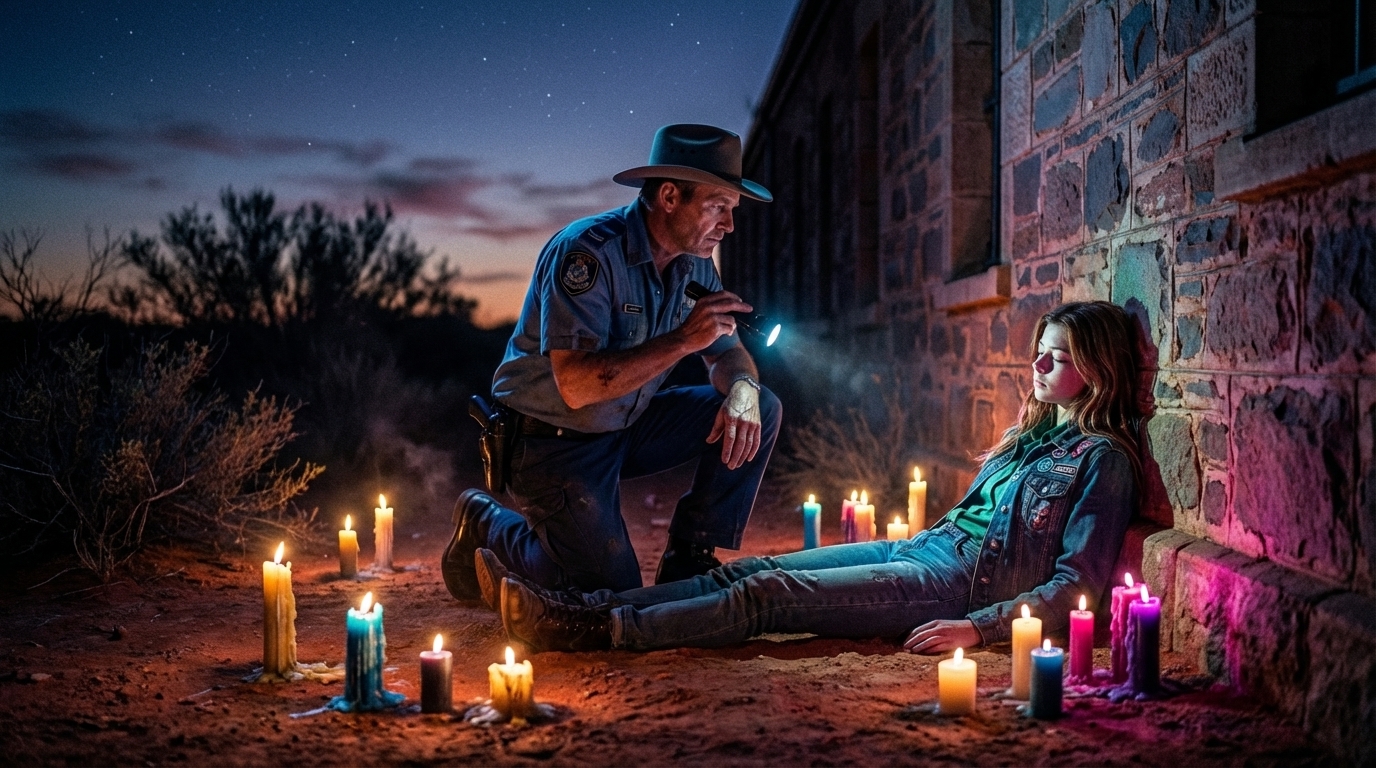
His torchlight caught it at the base of the gaol's stone wall.
At first his mind offered the kind explanation — discarded clothing, a swag left by someone sleeping rough, the debris that accumulated against walls where the wind deposited whatever it carried. The beam moved across the shape and his feet continued for two more steps before the information his eyes had gathered reached the part of his brain that processed it, and then his feet stopped and his stomach dropped and the morning changed permanently.
She had been arranged. That was the word that would stay with Harris longer than any other — not left, not dumped, not abandoned, but arranged. Her small frame was propped against the gaol wall in a sitting position, her back to the stone, her face turned toward the empty street. Her wrists were bruised dark above hands that lay open in her lap. Around her, stubby candles had been placed in the dust, their wax dribbled into pale pools, their wicks blackened and spent. They had burned for hours before the night extinguished them. The staging was deliberate, theatrical, the work of someone who regarded the presentation of a body as an act requiring the same attention as its creation.
The gaol wall rose behind her, pale stone and barred windows, a building that had once caged criminals and that now served as the backdrop for something worse than any crime it had originally been built to contain. The barred windows stared outward with blind indifference, the same indifference the building had maintained through every decade of its existence, the same indifference it would maintain for every decade to come.
Harris staggered back. The bile reached his throat before the conscious thought reached his mind, and for a moment he stood bent at the waist, one hand on his knee, his torch beam swinging wild across the ground, breathing through his mouth the way his training had taught him to breathe at scenes where the air itself felt contaminated by what it surrounded.
He had seen death before. Not often — this was Silverton, not Sydney — but enough to know what a body looked like when it was simply dead and what a body looked like when someone had made it into something else. This was the second kind. The candles, the positioning, the face arranged toward the street — these were not the actions of someone disposing of evidence. These were the actions of someone leaving a message.
His radio was in his hand before he had decided to use it. The crackle of static, the dispatcher's voice, and then the connection routing through to Broken Hill and the voice he had been directed to contact in circumstances matching this description.
Barry Glasson's voice came through flat and controlled, carrying the particular tone of a man whose response to crisis had been rehearsed until the rehearsal was indistinguishable from instinct. The instruction was immediate: keep it quiet. The report would read accidental exposure. Another runaway. The words arrived with the administrative efficiency of a protocol being executed rather than a decision being made, and Harris received them with the growing certainty that the man on the other end of the radio had been expecting this call — perhaps not this morning, perhaps not this specific body, but this category of event, this type of discovery, this need for containment.
Harris looked at the girl against the wall. The candles. The bruises. The face that stared down the empty street with the fixed gaze of someone who could no longer close her eyes. She was young. She was someone's daughter. She had a name, and the name was one that Harris recognised because Broken Hill was small enough that its children were known by more than their parents, and this girl had been reported missing from a Girl Guides camp five days ago, and the search for her had consumed every resource the region possessed.
He keyed the radio. His voice, when it came, carried something that Glasson's did not — the rough edge of a man whose compliance had reached its limit and whose conscience had overridden the protocol his superior was attempting to enforce. He told Glasson that containing this one would not be possible. He said the name.
Violet Dallow.
The name travelled the radio frequency from Silverton to Broken Hill and entered the static that connected the two places, and the static held it the way the gaol wall held the girl — without judgment, without mercy, without any mechanism for giving back what it had received.
The morning light strengthened across Silverton. The shadows shortened. The windmill continued its slow turning. The stone cottages and corrugated sheds maintained their low postures against the earth. The gaol held its wall and the girl against it and the candles in the dust around her, and the day that had begun as every other day in Silverton had begun proceeded into a future that would be different from every day that had preceded it.
Harris stood on the road with the radio in his hand and the morning sun on his face and the knowledge that whatever happened next — the investigators, the press, the questions that the name Violet Dallow would generate across the region and beyond — had already begun, and could not be called back.







