4338.10 · January 10, 2018 AD
The Lie That Landed
A government office on the fourth floor of a Hobart CBD building becomes a theatre of failed performance as the morning crawls toward noon. Nathan Cowdrey's attempt to maintain professional composure fools almost everyone — but Verity Sloane is not almost everyone, and the excuse he offers her as he flees toward his midday appointment marks the first fracture in a friendship built on the assumption that they never lied to each other.
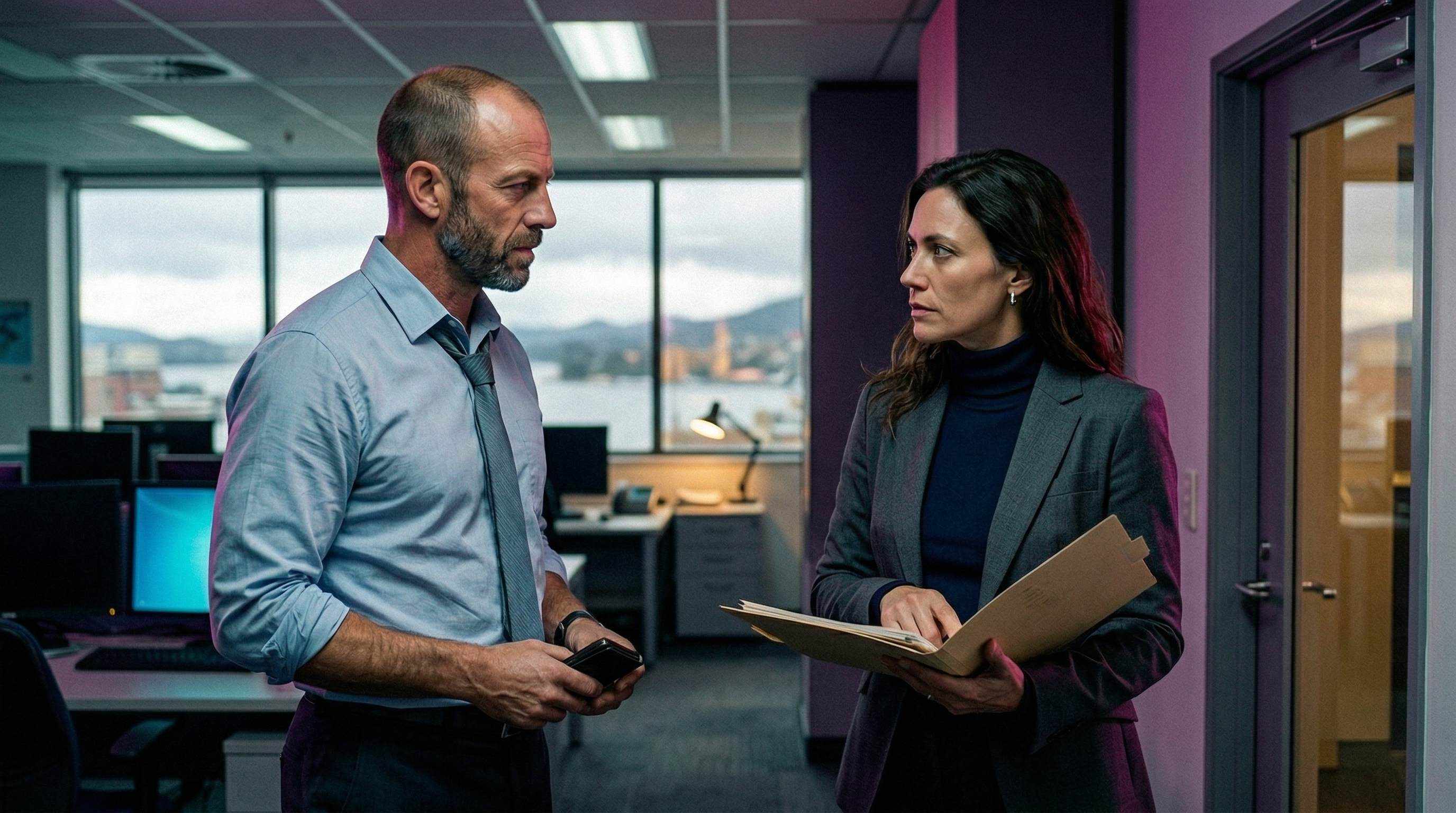
The fourth floor of the Hobart CBD government building operated on a particular frequency that morning — the muted hum of a skeleton crew going through motions that barely mattered. The post-holiday lull had hollowed the open-plan office to a third of its usual population, leaving stretches of empty desk and dormant monitor between the few analysts who had returned early enough for the first full week of the year. The air conditioning whispered through vents angled at nothing. Motivational posters addressed vacant chairs. The Inteq OneGov upgrade — that sprawling, multi-departmental IT consolidation that consumed most of the floor's working hours — sat in its digital folders with the patience of something that knew it would still be there whenever anyone summoned the will to attend to it.
Nathan Cowdrey could not summon the will. The requirements document had been open on his screen for the better part of two hours, its hundred-plus pages of technical specification scrolling past his eyes without depositing a single useful thought. Authentication protocols. Data migration frameworks. User acceptance criteria. The terminology registered as sound rather than meaning, each phrase dissolving on contact like sugar dropped into water too hot to hold its shape. His cursor blinked at the same position it had occupied since eight-fifteen, a small mechanical pulse measuring out time that refused to pass at any speed resembling mercy.
The phone on his desk contributed its own silence. A text message to Seth — dispatched shortly after the Post-it note's discovery — remained suspended in the grey purgatory between sent and delivered, its single tick unchanged across fifteen, then twenty, then thirty compulsive checks. The device sat dark and still, offering nothing, confirming nothing, its blankness acquiring the quality of a statement rather than an absence. Whatever had prompted Seth to leave a handwritten summons on a desk in a building he had no professional reason to enter, he had subsequently made himself unreachable by every conventional means.
The office moved around its distracted occupant with indifferent routine. Colleagues arrived in ones and twos, dropping bags and exchanging the low-stakes pleasantries of people returning from holiday — a cricket match dissected, a restaurant in North Hobart recommended, the weather remarked upon with the resigned familiarity of Hobartians who had learned that their summers could not be trusted. A phone rang across the floor and Nathan flinched, his shoulders jerking upward in a spasm that drew a glance from the woman at the diagonal desk. He arranged his face into something approximating professional absorption. She returned to her work. The performance held, barely, sustained by the simple mathematics of a near-empty office where no one was paying close enough attention to notice that one of their number had ceased to function.
Time behaved strangely. It had flowed so easily through the early morning — the café, the waterfront, the golden walk through Salamanca Place — each moment dissolving into the next with the frictionless grace of a day that had not yet found a reason to resist. Since the note, something had changed in its viscosity. Minutes thickened. The clock on the screen advanced in increments that seemed to require physical effort, each digit turning over with the reluctance of machinery operating against its own design. Nine-seventeen became nine-thirty-two became ten-fifteen, and each transition felt like pushing through something dense and resistant, a medium that had congealed around the simple act of waiting.
The view through the floor-to-ceiling windows offered no assistance. The Derwent still sparkled, the sailing boats still moved, but the scene had acquired the quality of a painting — beautiful, static, belonging to a morning that no longer included Nathan in its ease. Cloud was thickening over kunanyi, the mountain's summit disappearing behind a grey density that often preceded the summer storms Tasmania delivered without warning. The atmospheric pressure seemed to drop in sympathy with something less meteorological, the air acquiring a heaviness that pressed against the windows and settled into the space between desks.
At eleven-thirty, the decision to leave arrived with the finality of something that had been inevitable since eight o'clock. The walk to Cornerstone Café required ten minutes at most. Nathan had thirty to spare. But the office had become intolerable — its recycled air, its blinking cursor, its cheerful posters exhorting excellence and collaboration at a volume that now felt obscene. He gathered his wallet and phone with movements calibrated to project a casualness he did not possess, the phone's blank notification bar reflecting his own tight expression back at him in miniature.
He almost made it to the door.
Verity Sloane occupied a particular position in the office's social architecture — not management, not administration, but something more lateral and considerably more perceptive. Her background in forensic accounting had furnished her with a set of observational habits that never entirely switched off, a capacity for detecting inconsistency that she applied to human behaviour with the same rigour she had once brought to suspect ledgers. She and Nathan had built a friendship across years of shared lunches and dissected office politics, the kind of working relationship that accrues trust through repetition until it becomes load-bearing. She knew his patterns. She knew when those patterns deviated. And she was standing between him and the exit with a manila folder under one arm and her head tilted at the angle that meant something had caught her attention.
The offer of company was casual in delivery and surgical in intent. Verity's eyes moved across Nathan's face with the methodical attention of someone cataloguing evidence — the tension in his jaw, the width of his eyes, the particular quality of haste in his movements that distinguished leaving-for-lunch from fleeing. Her expression maintained a studied neutrality, but behind it the machinery was working, cross-referencing his current behaviour against the baseline she had accumulated across years of observation.
Nathan declined. The excuse he offered — personal time, delivered in a voice that wavered at precisely the wrong moment — contradicted everything Verity knew about the way he processed difficulty. He was a man who talked through problems, who converted anxiety into language, who had used her as a sounding board for everything from project frustrations to romantic disappointments. Requesting solitude was not merely unusual; it was structurally inconsistent with the person she had spent years learning to read.
The lie landed between them with an almost audible weight. Verity registered it — the flicker in her eyes confirmed as much, a fractional narrowing that represented the forensic mind noting a discrepancy and filing it for later retrieval. She did not pursue it. Not yet. The single word of her acceptance carried the particular neutrality of someone choosing patience over confrontation, allowing the falsehood to stand while reserving the right to dismantle it at a time of her choosing.
Nathan passed through the door and into the corridor beyond, his footsteps echoing against polished flooring with a rhythm that sounded too fast, too urgent, broadcasting departure rather than describing it. The lift arrived with its customary chime, its mirrored walls multiplying his reflection into an infinite regression of diminishing figures — each one slightly more distorted, slightly further from the original, disappearing into a vanishing point that felt, in this particular moment, uncomfortably apt.







