4344.15 · January 15, 2024 AD
The Kisura Contract
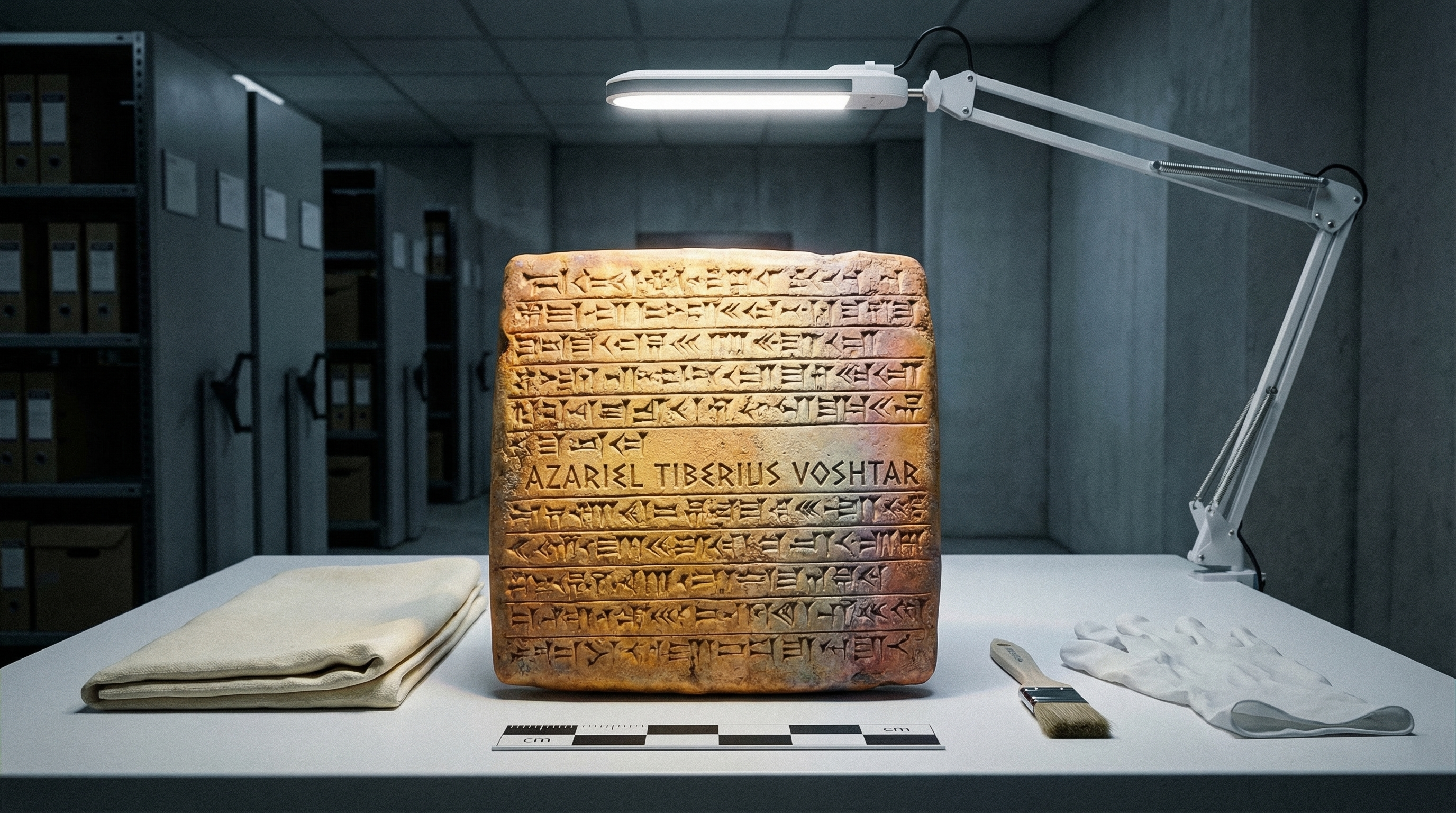
A routine cataloguing session in the lowest vault of The Preservation's Karaköy archive yields a discovery that four thousand years of searching had failed to produce. Beneath mislabelled Roman parchments in Box 247, wrapped in linen that has outlasted the empire whose archivists sealed it, a ten-centimetre clay tablet bears the name Azariel Tiberius Voshtar — the first physical evidence of the man himself, rather than the bloodline he left behind. The fragment has waited two centuries in a box that Ottoman cataloguers dismissed as commercially mundane. It will not wait any longer.
The Karaköy facility's Sub-Level Three had not been opened in eleven days. The shopkeeper above had continued selling Ottoman sea charts to tourists throughout the mourning period, unaware that the woman whose death had closed the sub-levels for the longest unbroken stretch in their two-century history had spent thirty years descending the concealed staircase behind his shelving unit. Ayşe Osman's absence was absolute now — not the temporary quiet of a holiday or a research trip to another facility, but the permanent silence of a workspace whose most experienced occupant would never return to it. The climate-control system had maintained its seventeen degrees and forty-five per cent humidity regardless, preserving documents with the mechanical indifference of technology that did not mourn.
Dr Mira Osman descended the staircase that morning carrying the weight of inheritance in ways both figurative and procedural. The digital preservation project required verification of every Ottoman-era catalogue entry — a task her grandmother had begun decades earlier and which now fell to a twenty-seven-year-old whose SOAS doctorate and seven years of junior Archive Keeper service represented a fraction of the institutional knowledge that had died in a hospital bed in Ankara. The work was methodical by design: photograph each document, cross-reference against the handwritten Ottoman indices, create digital records that would survive even if the physical archive suffered the fate that every Preservation facility eventually suffered. Not if. When. The operational assumption that had governed Archive Keeper practice since Uruk first burned.
Box 247 occupied a shelf in the northeastern corner of Sub-Level Three, catalogued in Ottoman Turkish script that dated its classification to the 1820s. The entry was terse and dismissive: commercial documents, Roman period, primarily Greek with some Latin, no particular historical significance. Two centuries of Archive Keepers had accepted this assessment. The box had sat undisturbed through the collapse of the Ottoman Empire, through two world wars, through the transformation of Istanbul from imperial capital to modern metropolis, through the quiet decades when Ayşe Osman had worked these same shelves without ever lifting this particular lid. The cataloguer's judgement — mundane, insignificant — had functioned as a seal more effective than any lock.
The lid released a breath of air that had been trapped since the reign of Mahmud II. Dust rose with the reluctance of particles that had settled into permanence, disturbed now by hands wearing conservation gloves whose nitrile grip felt clinical against the wooden edges of a box that predated the invention of the material by a century and a half. Seventeen documents lay within. Most were parchment in various stages of degradation — the Roman commercial records the Ottoman cataloguer had described, contracts and correspondence whose Greek and Latin scripts were visible even through the foxing and brittleness that two millennia of imperfect storage had produced. A few papyrus fragments had deteriorated beyond any possibility of unfolding. The collection was, precisely as advertised, mundane.
Except for what lay beneath it.
At the bottom of the box, wrapped in linen whose preservation spoke of deliberate conservation rather than accidental survival, sat a clay tablet. Ten centimetres square. Early Bronze Age manufacture, unmistakable in its dimensions and the texture of its fired surface. The Ottoman cataloguer had either failed to notice it entirely — possible, if the Roman documents above had been examined without fully emptying the box — or had noted its presence and dismissed it as unreadable, the script being neither Greek nor Latin nor Ottoman Turkish but something far older and, to an archivist of the 1820s, far less interesting.
The script was Sumerian. Cuneiform wedges pressed into clay by a reed stylus in the hands of someone trained in the scribal arts of the third millennium BCE. The symbols were clear despite their age — clay did not degrade the way organic materials degraded, did not fade or fox or crumble. Fire, which destroyed parchment and papyrus, merely hardened clay. Baked it permanent. Whatever conflagration had claimed the archive where this tablet originally resided had not destroyed the document but preserved it, transforming a temporary administrative record into something approaching eternity.
The Preservation had understood this principle since its earliest operations. When Archive Keepers in antiquity needed to ensure a document's survival across catastrophes, across the collapse of empires, across millennia of entropy and violence and the simple neglect that consumed most human records, they copied to clay. The tablet in Box 247 bore the hallmarks of exactly such deliberate preservation — the script too precise for a routine commercial record, the clay too carefully prepared, the linen wrapping too intentional. Someone, at some point in the long chain of transmission that connected the Bronze Age to a basement in twenty-first-century Istanbul, had recognised this tablet as worth protecting and had taken measures to ensure it survived.
The first line of the inscription identified the document as a contract executed in the town of Kisura during the sixth year of the reign of Šulgi. The merchant party was named as Ea-nasir. The terms concerned grain storage and distribution — standard commercial arrangements of the period, the bureaucratic infrastructure that sustained Mesopotamian urban life. Nothing in these opening lines distinguished the tablet from thousands of similar documents scattered across museum collections and university archives worldwide.
The second named party changed everything.
Azariel Tiberius Voshtar. The name was inscribed in the clear, practised cuneiform of a scribe recording a legal agreement — a name entered as a matter of administrative routine by someone who could not have known that four and a half millennia later, an organisation spanning seventeen major archive facilities across six continents would have spent its entire existence searching for exactly this evidence. The Preservation had tracked his bloodline through Charlemagne and Genghis Khan, through Egyptian pharaohs and unnamed Mesopotamian farmers, through the genealogical proliferation that mathematics called the Charlemagne Effect and that The Preservation called the mission. They had known Azariel existed. They had protected his descendants through every catastrophe history had produced. They had never possessed a single document from his own hand, his own lifetime, his own story.
The gap had persisted for four thousand years. The twenty-one years between Azariel's departure from the village of Amar-Sin and his appearance in Ur — where he delivered a speech that convinced nearly a hundred people to follow him into the wilderness to found a city called Fordingrad — had remained entirely blank. No archive in The Preservation's global network had yielded a fragment. No cataloguing effort across centuries of systematic searching had surfaced a reference. The wandering years, as the organisation's internal records designated them, existed as an absence so complete that some within The Preservation had questioned whether documentary evidence had ever existed to be found.
Box 247 answered that question.
The tablet sat on the examination table under archival-grade LED lighting that had replaced oil lamps, then gas, then early electric fixtures across the facility's two-century history. The cuneiform caught the light at angles that gave the impressed wedges a three-dimensional quality, shadows pooling in the channels cut by a stylus held in hands that had last moved forty-five centuries ago. The Sumerian text continued beyond the opening lines — terms of employment, compensation, obligations, the contractual framework that Bronze Age commerce required — and every additional line confirmed what the first reading had suggested. This was not a fragment whose attribution might be disputed, not a damaged inscription whose name might be reconstructed in multiple ways. The identification was unambiguous. The provenance, whilst complex — a chain of custody stretching from Kisura through unknown intermediate archives to Ottoman-era Istanbul — was consistent with the transmission patterns The Preservation had documented for other materials of comparable age.
The facility's protocols for discoveries of this magnitude were explicit. Documentation first: photograph every surface from every angle, in every light condition. Transcription second: render the cuneiform into transliteration, then translation, recording variant readings and uncertainties. Metadata entry third: digital archive system, full cataloguing, cross-references to related materials. Report fourth: regional supervisor notification, preliminary assessment, request for instructions regarding further investigation or archival disposition.
The protocols existed because The Preservation had learned, across four millennia of operation, that the excitement of discovery was the enemy of rigorous preservation. Documents had been damaged by handlers too eager to read them. Contexts had been lost by Archive Keepers too focused on content to record the physical circumstances of recovery. The protocols imposed discipline on the human tendency to prioritise revelation over method, ensuring that even the most significant find was processed with the same systematic care applied to a routine census fragment.
The protocols were followed. Every photograph was taken. Every line was transcribed. Every metadata field was completed. The digital record was created with the thoroughness that seven years of training and three decades of inherited institutional expectation demanded.
But the report was not filed. Not immediately. Not that day.
The decision to withhold — or rather, to delay — represented something more complex than simple insubordination. The Preservation's leadership had spent three years issuing communications of escalating urgency regarding the bloodline collapse. The global vaccination programme had been compromised by actors who understood the genetic markers that made Azariel's descendants viable and had engineered modifications to damage those markers at population scale. The percentage of carriers had fallen from roughly sixty to eighty per cent of the global population to perhaps fifteen. The organisation's four-thousand-year mission — the strategic marriages, the encouraged proliferation, the protection of carriers through wars and plagues and civilisational collapses — had been devastated in eighteen months.
Into this crisis, a clay tablet had surfaced bearing the name of the man whose bloodline the entire enterprise existed to protect. Not his descendants' names. Not the genealogical records that Archive Keepers had catalogued for centuries. His name. His employment. His presence in a town called Kisura that no historical record had previously documented. Proof that the wandering years had left traces. Proof that other fragments might exist, scattered through the same archival chains of transmission that had carried this one from the Bronze Age to a shelf in a basement beneath a map shop in Karaköy.
The implications radiated outward from the examination table like cracks spreading through glass. If one document had survived, the chain of copying and redistribution that Archive Keepers had maintained across millennia might have preserved others. If Azariel had worked in Kisura, the merchant Ea-nasir might appear in additional records — contracts, correspondence, the administrative detritus that Mesopotamian commerce generated in quantities that occasionally survived their civilisation. If the wandering years had left documentary traces in one town, they might have left traces in others, and those traces might be sitting in boxes that Ottoman or Byzantine or Roman cataloguers had classified as mundane and left undisturbed for centuries.
The archive was silent. Sub-Level Three held its particular stillness — the atmosphere of a chamber opened infrequently, disturbed rarely, its contents measured in millennia rather than years. The climate-control system hummed at a pitch below conscious attention. Above, through nine metres of stone and earth and the concealed staircase and the shelving unit and the cramped shop floor, Karaköy continued its ancient business of selling and buying, the waterfront district's commerce flowing as it had flowed since Genoese traders first established their colony on the Golden Horn's southern shore.
The tablet sat under the examination light. Forty-five centuries of silence, broken by a morning's routine cataloguing in a facility whose existence most of Istanbul did not suspect. The fragment was small enough to hold in one hand. The name inscribed upon it connected to a genealogical network that encompassed billions of living people, to a dimensional realm called Clivilius whose existence most of humanity had never imagined, to a technology called CLIVE whose nature The Preservation's own junior operatives did not fully comprehend, to a crisis unfolding in the present that threatened to sever connections the organisation had maintained since before the Library of Alexandria burned.
A single employment contract from a forgotten Mesopotamian town. Three moons of grain accounting for a merchant whose name might or might not appear in any other surviving record. The most significant archival discovery in The Preservation's four-thousand-year operational history, catalogued and photographed and transcribed with the methodical precision of an Archive Keeper whose hands had stopped shaking and whose mind had not stopped racing.
The dust had settled. The fragment had been found. And the question it posed — whether the rest of Azariel's wandering years might yet be recoverable from the scattered remnants of archives that had burned and been rebuilt and burned again across the long centuries of human record-keeping — hung in the climate-controlled air of Sub-Level Three like a challenge issued across millennia to anyone with the training to read it and the determination to answer.







