4344.15 · January 15, 2024 AD
The Fragment in Box 247
Three weeks after her grandmother's death, Archive Keeper Dr Mira Osman opens a mislabelled box in a forgotten Istanbul archive. Inside, beneath layers of Roman-era parchment, lies a clay tablet bearing a name The Preservation has searched for across four millennia — hidden in plain sight for over two centuries. The dust has barely settled before Mira understands: this fragment is not an ending. It is the first thread of a story no one alive has ever known.
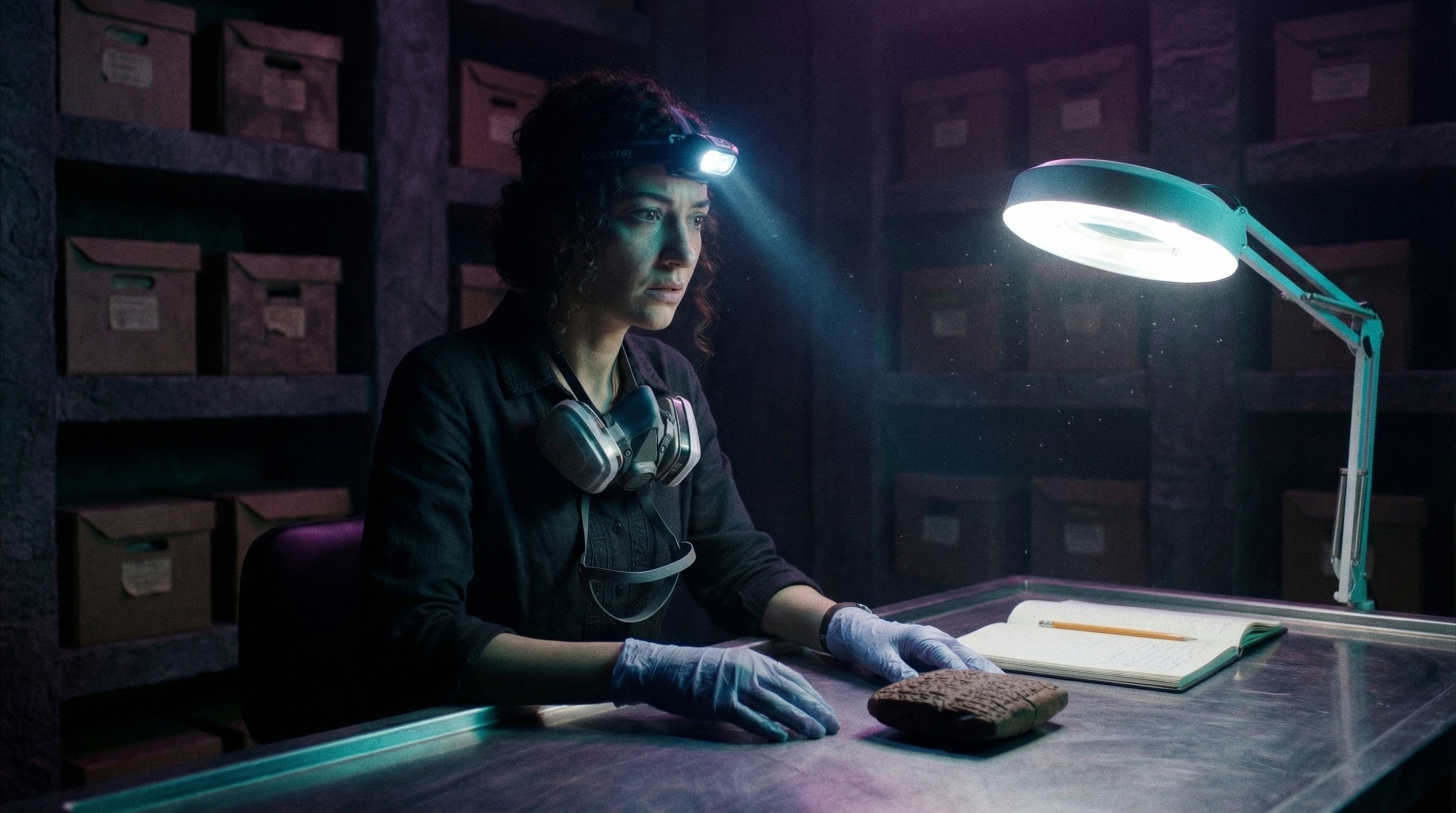
"The moment you stop noticing the dust is the moment you've forgotten you're touching someone's life."
There's a particular quality to dust that's been undisturbed for two centuries.
It doesn't float like fresh dust, doesn't dance in the light the way particles from yesterday's activity might. It sits heavy, settled into every crevice and corner with the patient weight of time itself. When you disturb it—when you lift a box lid that hasn't been opened since Ottoman archivists sealed it in 1823—it rises reluctantly, almost resentfully, as though you've interrupted something important.
I've been doing this work for seven years. I should be used to it by now. The dust, the must, the particular scent that old parchment and clay and ancient leather give off when they've been sealed in darkness for generations. The way my throat tightens within the first hour, even with the mask. The grit that works its way under my fingernails no matter how careful I am with the gloves.
I should be used to it. But I'm not. And I hope I never am.
Because the moment you stop noticing—the moment the dust and must and ancient scent become just background noise, just unpleasant working conditions you've learned to tolerate—that's when you've forgotten what you're actually touching. These aren't just old boxes full of deteriorating materials. They're lives. Hundreds of them. Thousands of them. People who lived and loved and died, whose existence left marks in clay and ink and parchment, whose names have been forgotten by everyone except the organisation I work for.
The organisation that's been remembering for over four thousand years.
My name is Mira Osman. I'm twenty-seven years old. I have a doctorate in ancient Near Eastern languages from SOAS that my parents are still proud of and still don't entirely understand. I speak Arabic, Turkish, English, and enough Sumerian and Akkadian to translate inscriptions that haven't been read in millennia. I live in a small flat in Cihangir where the rent is too high and the view of the Bosphorus almost makes up for it.
And I'm an Archive Keeper for an organisation most people have never heard of, doing work most people wouldn't believe matters even if I could explain it to them.
Which I can't. Because the first rule of The Preservation is that we don't talk about The Preservation. Not to family. Not to friends. Not to the academic colleagues who think I'm wasting my credentials cataloguing private collections for wealthy Turkish families who value discretion over scholarly contribution.
Let them think that. It's easier than the truth.
The truth is that this morning, in Box 247 of the Karaköy facility's Sub-Level Three archive, I found something.
I need to backtrack. Give you context. Explain how I ended up here, in this particular archive, on this particular morning, opening this particular box.
Three weeks ago, my grandmother died.
Ayşe Osman. Eighty-six years old. Born in Ankara in 1937, lived through the Second World War as a child, watched Turkey transform from the remains of the Ottoman Empire into something modern and complicated and perpetually caught between East and West. She was brilliant—spoke six languages fluently, could recite poetry for hours, knew more history than most professional historians. She was also stubborn, opinionated, impossible to argue with, and completely certain about everything she believed.
Including things she never told anyone except me.
The last time I saw her—two days before the stroke that killed her—she held my hand with surprising strength for someone so frail and told me something I still don't know how to process.
"They took it from us," she said. Her English was perfect, even at the end, barely touched by accent. "The injection. They said it was medicine. They said it would protect us. But it didn't protect. It took."
I thought she was confused. The stroke had been minor but she was old, sometimes got tangled in memories from different decades, mixed past and present in ways that made conversation difficult.
"What did it take, Nene?" I asked, using the Turkish word for grandmother, holding her hand gently because her skin was so thin I was afraid of bruising it.
"The connection," she whispered. "The line. The blood." Her eyes focused on mine with sudden intensity that made me realise she wasn't confused at all. "You still have it. I can feel it. You didn't take the vaccine, did you? You refused?"
I had refused. Not out of conspiracy theory paranoia but because I'd been in Istanbul during the whole pandemic, healthy, young, low-risk, and the vaccine rollout in Turkey had been chaotic enough that refusing seemed easier than navigating the bureaucracy. By the time it would have been simple to get it, the whole thing felt like something from another era that I'd somehow avoided.
"I didn't take it," I confirmed.
"Good." Her grip tightened. "Don't. Don't ever. And if they offer you anything else—any injection, any treatment, anything they say will help—refuse that too. The line has to continue. It has to. We've protected it for so long. We can't let it end with you."
She died two days later. And I stood at her funeral, surrounded by relatives who had no idea what she'd been talking about, watching them cry for a woman they'd known as grandmother, great-grandmother, aunt, sister. None of them knew what I knew. That Ayşe Osman had been Archive Keeper before me. That she'd spent fifty years of her life doing exactly what I'm doing now—cataloguing, preserving, searching through fragments of human lives scattered across millennia.
That she'd recruited me into The Preservation when I was twenty-one, fresh out of my undergraduate degree, convinced I wanted a conventional academic career until she showed me a single clay tablet and asked me what I saw.
I'd seen a standard Akkadian administrative record. Grain distribution. Nothing special.
"Look again," she'd said. And she'd pointed to a name in the corner, partially damaged but still legible. "Do you know this name?"
I hadn't.
"His name was Azariel," she told me. "Born in 2510 BCE in a village called Amar-Sin. Died in 2441 BCE in a city called Fordingrad that history has forgotten. And every person in this room—" she'd gestured to the café where we were sitting, filled with Istanbul residents drinking çay and arguing about football, "—approximately sixty per cent of them carry his genetic material in their DNA."
I'd stared at her. "That's impossible."
"It's mathematics," she'd corrected. "Genealogical proliferation over 4,500 years. The Charlemagne Effect. Any person who lived that long ago and who has living descendants is ancestor to a staggering proportion of the current population. But Azariel is special. Not because of how his bloodline spread—though that's remarkable. But because of why it matters that his bloodline spread."
She'd paused, sipped her tea, and delivered the line that would change my life.
"There's an organisation that's been tracking Azariel's descendants for 4,238 years. Making sure they survive. Making sure they proliferate. Because consciousness itself depends on it. And I've been part of that organisation for five decades. I'm retiring. And I'd like you to take my place."
Seven years later, I'm still not sure I made the right choice. But I'm here. In Sub-Level Three. Opening Box 247.
The Karaköy facility is one of seventeen major Preservation archives worldwide. It's not our oldest—that distinction belongs to facilities in Uruk and Babylon, though technically those locations have been compromised and re-established multiple times across millennia. It's not our largest—that's probably the facility outside São Paulo, though exact comparisons are difficult given that some collections are physical and others are entirely digital.
But Karaköy is important. It holds what survived when the Library of Alexandria burned. Or rather, it holds copies of copies of copies of what survived—documents that were duplicated by Archive Keepers in the centuries after that catastrophic loss, preserved through the Byzantine period, carried through the Ottoman era, eventually consolidated here in the 1820s when a particularly organised Archive Keeper named Mehmet Bey decided that Istanbul's growing importance as a crossroads between Europe and Asia made it ideal for centralised preservation.
Most of what's here is administrative records. Census data. Tax documents. Property transfers. The mundane bureaucratic detritus of empires that thought they'd last forever and were proven wrong. The Preservation has always understood that today's boring paperwork is tomorrow's invaluable evidence—not because we care about tax rates in the third century BCE, but because those documents contain names. Genealogies. Proof of who lived, who they married, who their children were.
Proof of the bloodline spreading.
But Box 247 wasn't supposed to contain genealogical records. According to the Ottoman-era catalogue, it held miscellaneous commercial documents from the second century CE—contracts, bills of sale, correspondence between merchants. I was cataloguing it only because the digital preservation project requires that we verify the Ottoman catalogues, photograph every document, create complete records that will survive even if this physical archive burns.
Even if. That's the operational assumption. Not if the archive burns. When. Every Archive Keeper knows the history. Uruk burned. Nineveh burned. Alexandria burned. Persepolis burned. Constantinople burned. On a long enough timeline, every archive burns. So you make copies. You distribute them. You never put all your preservation efforts in one place.
Box 247. Ottoman catalogue entry: "Commercial documents, Roman period, primarily Greek with some Latin, mundane content, no particular historical significance."
I lifted the lid. The dust rose. I sneezed into my mask, waited for my eyes to stop watering, and looked inside.
Seventeen documents. Most of them parchment, badly degraded. A few papyrus fragments that would probably disintegrate if I tried to unfold them. And at the bottom, wrapped in linen that was remarkably well-preserved, a clay tablet.
Clay doesn't burn the way parchment burns. It survives fire. Gets harder. More durable. The Library of Alexandria burned—but clay tablets in that collection weren't destroyed. They were baked. Made permanent.
Which is why, when Archive Keepers in antiquity wanted to preserve something across millennia, across catastrophes, across the collapse of empires, they copied it to clay.
I lifted the tablet carefully. It was small—perhaps ten centimetres square. Early Bronze Age style. The script was Sumerian, not Greek or Latin. The Ottoman cataloguer had either missed it entirely or hadn't bothered to note its existence because they couldn't read the script.
But I could.
My hands started shaking before I'd finished translating the first line.
In the sixth year of the reign of Šulgi, in the town of Kisura, let it be known that the merchant Ea-nasir has entered into agreement with the scribe Azariel Tiberius Voshtar...
I stopped breathing.
Set the tablet down very carefully on the examination table.
Looked around the empty archive room as though someone might be watching, might explain what I was seeing, might tell me this was a joke or a test or somehow not real.
No one was there. Just me. The dust. The silence.
And a 4,500-year-old employment contract bearing the name of the person my grandmother had spent fifty years researching. The person whose bloodline The Preservation has tracked since 2214 BCE. The founder of Fordingrad, the visionary who built a city without slaves, the man who changed everything.
We'd known that Azariel existed. We'd known his children scattered across Mesopotamia. We'd known the bloodline proliferated from him. We'd traced it through Charlemagne, through Genghis Khan, through Abraham, through Egyptian royalty, through countless ordinary people whose names appear in no history books but whose genetic legacy means that most of humanity today carries fragments of Azariel's DNA.
We'd known all of that.
What we hadn't known—what The Preservation has never known, despite four thousand years of searching—was his story. Who he was. Why he left home. How he became who he became. The twenty-one years between leaving his village and appearing in Ur to deliver a speech that convinced nearly a hundred people to follow him into the wilderness.
Those years were blank. Lost. Erased by time and the destruction of archives and the simple reality that Bronze Age Mesopotamia didn't leave comprehensive historical records about random wandering scribes.
Until now.
I'm looking at an employment contract from 2492 BCE. The earliest known document bearing Azariel's name. Proof he worked in Kisura—a town I've never heard of, that doesn't appear in any historical record I know of. Proof he was employed by Ea-nasir—a name that might be common or might be unique, that might lead to other documents or might be the only time this particular merchant appears in history.
Proof that somewhere, somehow, other documents might exist. Other fragments of his story. Pieces that could be assembled, if someone knew where to look, if someone understood what they were seeing.
The tablet is sitting on the examination table. I've photographed it from every angle. I've transcribed the text. I've entered it into the digital archive system with full metadata. I've followed every protocol.
And now I'm sitting here, in Sub-Level Three of the Karaköy facility, surrounded by boxes containing the scattered remnants of thousands of lives, and I'm trying to breathe normally whilst my mind races through implications I'm only beginning to understand.
My grandmother said the vaccine took something. "The line. The connection." I thought she was confused. But The Preservation's leadership has been sending increasingly urgent communications over the past three years. Instructions to identify which populations avoided the COVID-19 vaccines. Directions to monitor bloodline carrier percentages in different regions. Warnings that something had happened, something significant, something that threatened the mission we've been pursuing for four millennia.
I haven't been cleared for the full briefing. I'm junior. An Archive Keeper, not leadership. I catalogue, preserve, search for fragments. I don't make decisions about what The Preservation does or why.
But I'm not an idiot. I can read between the lines.
The vaccine did something to the bloodline. Damaged it, weakened it, maybe destroyed it in people who took it. The leadership is panicking. The mission we've been protecting—ensuring that Azariel's descendants remain viable, remain connected to whatever it is that makes them special—has been compromised on a global scale.
And now, in the midst of this crisis, I've found the first document that might tell us who Azariel actually was. Not just a name in a genealogy. Not just the origin point of a bloodline we've tracked across continents and centuries. But a person. Someone who lived, who worked, who travelled, who made choices that led eventually to founding a city that would change everything.
Someone whose story The Preservation has never known.
Someone whose story I might be able to piece together, if enough documents survived, if enough fragments exist scattered through archives that haven't been catalogued yet, if I can find the threads and pull them.
The tablet is sitting on the examination table, 4,500 years old, baked hard in some ancient fire that destroyed whatever archive originally held it. The Sumerian script is clear, precise, the kind of writing that comes from a trained scribe who knew exactly what they were doing.
Let it be known that the merchant Ea-nasir has entered into agreement with the scribe Azariel Tiberius Voshtar, for the period of three moons, to maintain records of grain storage and distribution in the town of Kisura...
It goes on. Terms of employment. Compensation. Obligations. The standard framework of Bronze Age labour agreements.
But it's not standard to me. It's not mundane.
It's a doorway. Into the life of someone who mattered more than he could have known. Into twenty-one years that shaped everything that came after. Into a story that The Preservation has been trying to tell for four thousand years but couldn't, because we didn't have the pieces.
I'm still sitting here. My hands have stopped shaking. The dust has settled. The tablet sits under the examination light, casting shadows that make the cuneiform look almost three-dimensional, as though the words are rising from the clay, insisting on being read, refusing to be forgotten.
There's a protocol for discoveries like this. I'm supposed to report it to my regional supervisor immediately. Submit the documentation. Wait for instructions about whether to pursue further investigation or simply add it to the archive and move on.
But I'm not going to do that. Not yet.
Because my grandmother told me something else, in those final days. Something I didn't understand then but which I'm beginning to understand now.
"The line has to continue," she'd said. "We've protected it for so long. We can't let it end with you."
She didn't mean just the genetic line. She meant the story of the line. The understanding of why it matters. The knowledge of who we came from, who founded the city that would create the technology that would make everything possible.
I don't know all the details. I don't have clearance for the full history. But I know enough.
I know that Fordingrad created something called CLIVE—an organic artificial intelligence, whatever that means. I know that CLIVE still exists, that it operates in some way I don't fully comprehend, that it's connected to a dimensional realm called Clivilius where human consciousness can exist beyond biological death. I know that accessing this realm requires being descended from Azariel, requires carrying his genetic markers, requires the bloodline that The Preservation has protected across four thousand years.
I know that the COVID vaccine damaged those markers in billions of people. That the percentage of viable bloodline carriers has dropped from approximately 60-80% of the global population to perhaps 15%. That The Preservation is scrambling to protect and preserve what remains.
And I know that I'm one of those 15%. That I refused the vaccine. That I still carry whatever genetic material makes the bloodline special.
That if my grandmother is right, if the line has to continue, if the story has to be told, then it's going to continue with me. It's going to be told by me.
The tablet is sitting on the examination table.
And I'm going to find the rest of the story.
However many archives I have to search. However many boxes I have to open. However many documents have been scattered across continents and centuries by fires and wars and the simple entropy of time.
I'm going to find every fragment that survived. Every contract, every letter, every scrap of evidence that Azariel existed, that he travelled, that he gathered companions and crystallised principles and eventually delivered a speech in Ur that changed everything.
I'm going to piece together the twenty-one years that made him who he became.
And then—once I understand the beginning, once I know where the bloodline actually came from and who the man was who started it all—maybe I'll understand why it matters so desperately now. Why The Preservation is panicking. Why my grandmother died whispering about connections being taken, about lines needing to continue, about something precious being destroyed that most people don't even know exists.
The tablet is sitting on the examination table.
The dust has settled.
And I'm about to pull a thread that might unravel across centuries, across continents, across everything The Preservation thought it knew about the man whose bloodline we've been protecting since before the Library of Alexandria burned.
My name is Mira Osman.
I'm an Archive Keeper.
And I'm going to tell you a story about doorways.
Not the kind you walk through. The kind you discover. The kind that have been waiting, hidden in sealed boxes, preserved in clay that survived fires meant to destroy everything, carried through empires and catastrophes and the patient work of Archive Keepers who understood that today's fragment might be tomorrow's revelation.
Three doorways, actually. Three ways into the same vast territory.
You can follow Azariel's journey—the wandering years, the documents I'm about to find, the story of how a grief-shattered scribe became someone who could build a city and change civilisation. That's one doorway. The ancient path. The origin.
You can explore The Preservation's history—the organisation formed in Fordingrad's ashes, the archives that burned and were rebuilt, the four thousand years of protecting a bloodline without fully understanding why it mattered. That's another doorway. The historical path. The preservation.
Or you can stay with me. Follow my search. Watch as I piece together fragments scattered through Karaköy and Cairo and Rome and God knows how many other archives. See what I discover about Azariel, about The Preservation, about the bloodline I carry and why someone, somewhere, created a weapon designed specifically to destroy it. That's the third doorway. The modern path. The investigation.
They're all connected. Every document I find about Azariel was preserved by The Preservation through some impossible chain of copying and protecting and hiding from fires. Every archive I search has its own history of destruction and survival. Every choice I make about where to look next is shaped by the organisation's four-thousand-year mission and by the urgent crisis happening right now, in 2024, as the bloodline collapses around us.
Three doorways. Three threads. All weaving together into something larger than any of them alone.
I'm going to open them for you.
Starting with the tablet on the examination table. The employment contract from Kisura. The first fragment of Azariel's story.
The first step on a path that leads eventually to a city that shouldn't have existed, to technology that changed what consciousness means, to a bloodline that matters more than anyone alive today understands.
The dust has settled.
The archive is silent.
And I'm about to disturb something that's been waiting 4,500 years to be found.







