4344.35 · February 4, 2024 AD
The Cost of Silence
A Sunday afternoon in a Beyoğlu café exposes the fracture that The Preservation's oldest operational principle — silence — carves through the lives of those who serve it. A decade-long friendship between two Boğaziçi graduates strains against the weight of things that cannot be spoken. One woman sees the exhaustion, the grief, the evasion. The other cannot explain any of it. The Preservation has operated in secrecy for four thousand years. The cost has always been borne by the people closest to its operatives — people who can see the shape of a secret without ever being permitted to know its name.
The Preservation's first operational principle predated its formal establishment by centuries. Silence — the absolute prohibition against disclosure to anyone outside the organisation's structure — had governed the conduct of those who tracked Azariel's bloodline since before the network had a name, before Archive Keepers existed as a designated role, before the seventeen facilities that now constituted the global infrastructure had been built beneath their various shopfronts and institutional facades. The principle was older than any of its current operatives. Older than most of its archives. It had survived the destruction of Uruk and the burning of Alexandria and the fall of Constantinople because the alternative — exposure — had been demonstrated, repeatedly across millennia, to produce consequences that made secrecy's costs seem bearable by comparison.
Those costs were borne not by the organisation but by its operatives. And not only by its operatives, but by the people who loved them.
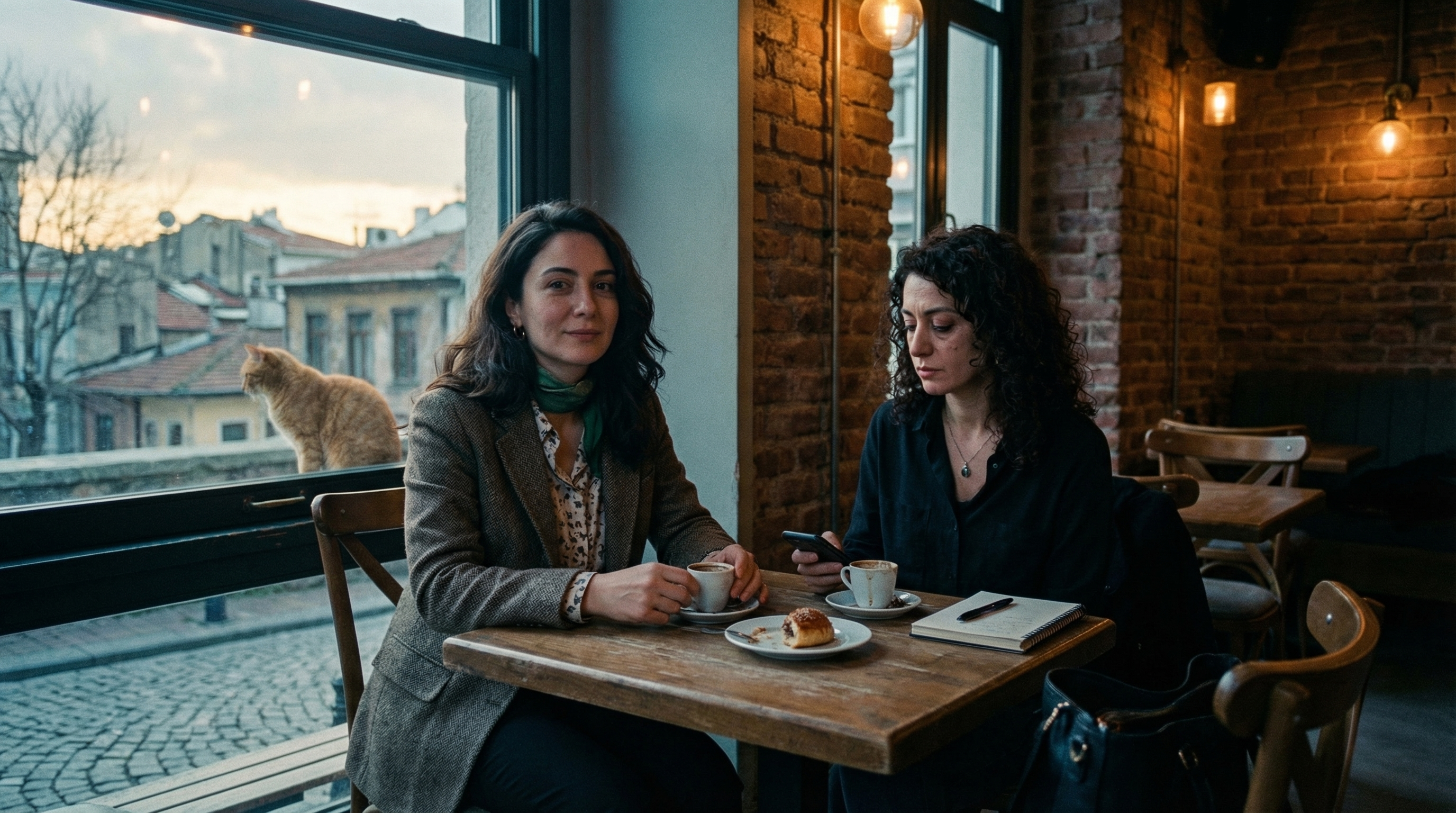
In a speciality coffee shop on Serdar-ı Ekrem Caddesi in Beyoğlu — the kind of bright, airy establishment where baristas could recite the altitude at which their beans had been cultivated — two women sat at a corner table by the window and navigated the particular difficulty of a friendship in which one party carried knowledge the other was forbidden to share. The winter light fell across the table between them with the indifferent clarity of a February afternoon in Istanbul, illuminating what anyone watching might have mistaken for an ordinary Sunday catch-up between old university friends. The espresso machine hissed. A cat — orange, territorial — sat on the window ledge outside, observing pigeons with predatory patience. The conversation moved between Turkish and English with the fluency of people who had been switching languages in each other's company for a decade.
Aylin Nur Demir had trained as an archaeologist at Boğaziçi before pivoting to cultural journalism — features for Cornucopia, the English-language quarterly, covering Ottoman architectural restoration and the tensions between heritage preservation and property development that defined contemporary Istanbul's relationship with its own past. She possessed the journalist's instinct for evasion: could identify the shape of what people were not saying as precisely as what they were. She had been calling for days. The calls had gone unanswered. The texts had accumulated without reply. The voicemail — containing, by her own assessment, her finest comedic material — had been heard but not acknowledged.
The meeting had been arranged through the particular persistence that a decade of friendship authorised. It was not a request. It was an intervention conducted in the language of coffee orders and affectionate accusation, and it confronted the Archive Keeper across the table with a question that four thousand years of operational protocol had no satisfactory answer for: are you all right?
The question was not new. Every Archive Keeper in The Preservation's history had faced some version of it — from spouses, from siblings, from the friends and colleagues and family members who existed outside the organisation's boundaries and who could observe the symptoms of covert work without ever being told its nature. The exhaustion. The unexplained absences. The evasion that calcified over years into a permanent deflection so practised it no longer felt like lying, even though it was. The Preservation's institutional records — those that touched on personnel matters rather than genealogical tracking — contained oblique references to operatives whose personal relationships had collapsed under the sustained pressure of mandated secrecy. Marriages ended. Friendships atrophied. The people closest to Archive Keepers learned, eventually, either to stop asking or to accept answers that both parties knew were insufficient.
Ayşe Osman had navigated this for fifty years. Her granddaughter, seven years into the work and six weeks past bereavement, was learning that the navigation did not become easier with practice. It became more fluent. The deflections grew smoother, the cover stories more naturalistic, the performance of ordinary life more convincing. But fluency was not the same as ease. The wall between what could be shared and what could not did not shrink with familiarity. It merely became better plastered.
The journalist across the table was not fooled. She could see the dark circles that weeks of disrupted sleep had carved beneath her friend's eyes. Could see the weight loss that came from substituting toast and cold tea for proper meals. Could see the particular quality of distraction that manifested as a hand reaching for a phone screen three times in the space of a single coffee, checking for a reply from Cairo that would not arrive on a Sunday. She identified what she was seeing with the directness that made her good at her work: it looked like someone carrying something heavy and pretending it weighed nothing.
The accuracy was precise enough to sting. The Preservation's silence rule existed to protect the organisation's security, to prevent exposure that might compromise four millennia of accumulated infrastructure. It did not exist to protect operatives from the erosion of their personal lives. That erosion was understood, within the organisation's culture, as an acceptable cost — regrettable but necessary, the price of participation in work whose significance justified the sacrifice. Whether the people who paid that price alongside the operatives — the friends who received half-truths, the parents who were told plausible fictions about private collection work, the partners who learned to stop asking why their loved ones disappeared into archives for weeks at a time — would have agreed with that assessment was a question The Preservation had never formally asked.
The conversation in the Beyoğlu café lasted roughly ninety minutes. It moved through the stages that such conversations always moved through when a perceptive outsider confronted an operative whose cover was thinning: initial deflection met by gentle insistence; partial truth offered as substitute for full disclosure; the momentary crack where genuine emotion surfaced before being smoothed over; the redirection toward safer topics that both parties accepted as a mercy rather than a resolution. The grandmother's death was acknowledged. The grief was admitted. The work was described in terms so vague — a document, potentially connected to other documents, probably nothing — that they communicated almost no information whilst technically being true.
The journalist accepted the boundaries because she had learned, across ten years, that pushing past them produced withdrawal rather than disclosure. The Archive Keeper accepted the boundaries because she had no choice. The Preservation's first rule was not a guideline. It was not a recommendation. It was the foundational operating principle of an organisation that had survived four thousand years of civilisational upheaval by ensuring that its existence remained invisible to everyone outside its structure. Archive Keepers who violated this principle endangered not only themselves but the entire network — the seventeen facilities, the centuries of accumulated documentation, the genealogical records that tracked Azariel's bloodline across continents and millennia.
The stakes made the silence understandable. They did not make it painless.
The café's Sunday crowd thinned as Istanbul shifted from the quiet of the weekend to the gathering momentum of the working week ahead. The conversation found its way, eventually, to the territory of ordinary friendship — a man being cautiously dated, a pigeon that had caused alarm in the Karaköy facility, a mother's persistent enquiries about grandchildren, a documentary about Göbekli Tepe. The journalist laughed with the particular warmth of someone who loved her friend despite the walls between them. The Archive Keeper laughed with the particular relief of someone who had survived another interrogation without fracturing.
They parted on the street outside as the light went grey-gold over Beyoğlu's rooftops. An emerald scarf disappeared around a corner toward Galata. The Archive Keeper walked the other direction, uphill through narrow streets toward the flat in Cihangir where notebooks and photographs and five abandoned glasses of tea marked the geography of an obsession that could not be explained to anyone who did not hold clearance that The Preservation granted to fewer than a hundred people worldwide.
The call to prayer began as the last light faded — rising from minarets across the city, voice layering upon voice until Istanbul itself seemed to vibrate with the sound. It was an ancient impulse given modern amplification: the human need to fill the sky with longing, to project into the gathering dark some assertion that meaning persisted beyond what could be seen or proven or shared with the people standing beside you.
The Preservation had been filling its own kind of silence for four thousand years. Its Archive Keepers had been carrying the weight of that silence for just as long — in Uruk and Babylon and Alexandria and Constantinople and Istanbul, in every city where the organisation had established operations and where operatives had maintained relationships with people who deserved honesty and received, instead, the careful architecture of plausible omission.
The cost was not measured in documents lost or facilities compromised. It was measured in phone calls not returned. In conversations conducted behind smiles that functioned as walls. In the particular loneliness of standing at a window watching cargo ships move through the Bosphorus at dusk, holding a phone that showed no new messages from Cairo, eating chestnuts purchased from a street vendor because a friend had said to eat something and chestnuts were technically something.
Small costs. Human costs. The kind that four thousand years of operational philosophy had deemed acceptable, and that the people who bore them had no authority to dispute.







