4338.208 · July 27, 2018 AD
The Chewbathian Coins
After the camp settles for the night, Chris reveals a handful of ancient coins he unearthed during the afternoon's digging. The markings read "Chewbathia" and bear denominations in a currency no one recognises. What begins as shared fascination fractures into the settlement's first serious conflict over information, secrecy, and who decides what the others are permitted to know.
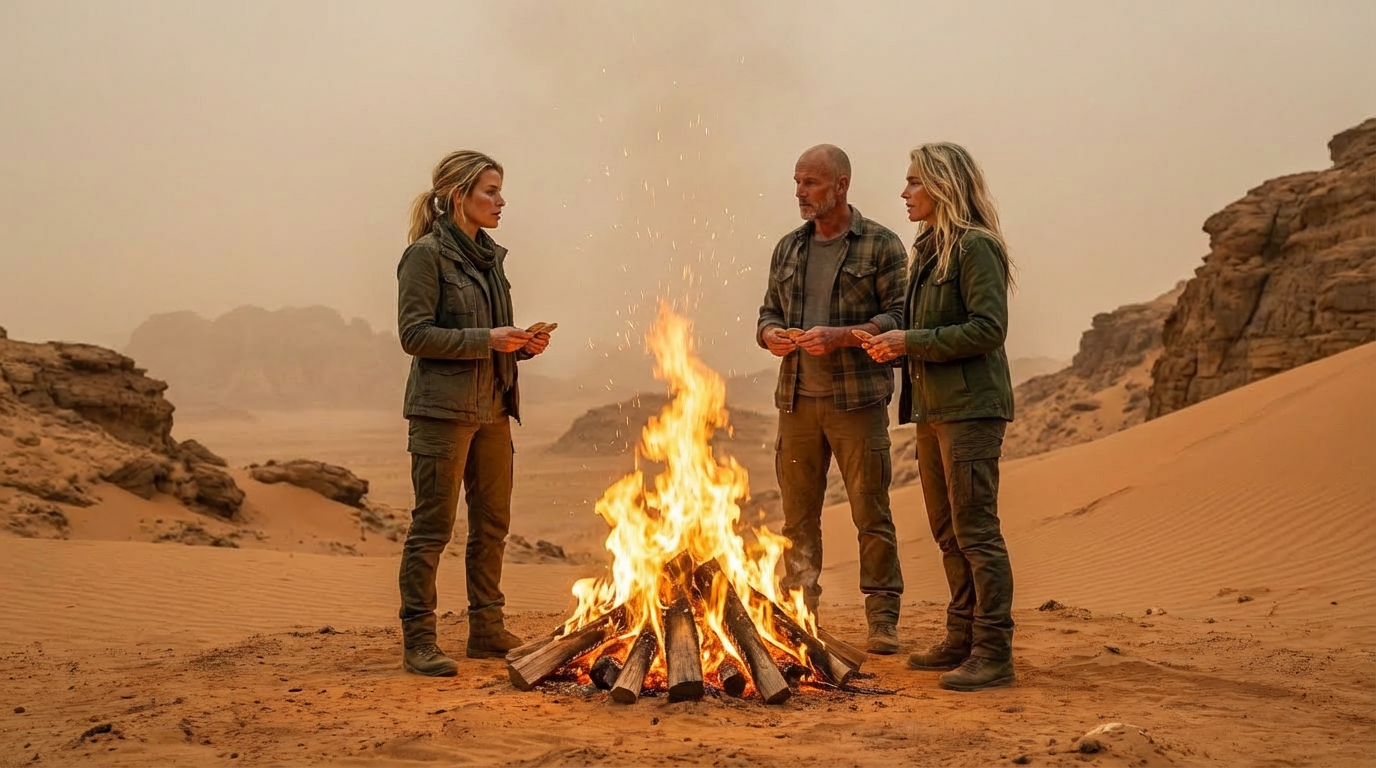
The camp had thinned to its late-night configuration, most of the settlers having retreated to their tents in the warm aftermath of the meal and the song. Karen and Glenda remained at the fire, their conversation winding through the subjects that the day's compressed timeline of arrivals and discoveries had not permitted them to address properly. Resilience. Adaptation. The particular loneliness of being displaced into a world that offered no familiar architecture for grief. The fire crackled between them with the comfortable irregularity of something that had been burning long enough to require no tending.
Chris had been hovering at the edge of the conversation for some time, close enough to be felt but not quite participating. His restlessness was uncharacteristic. The man who had spent the afternoon methodically surveying soil and driving tent pegs into alien earth with the steady patience of a lifelong land worker now shifted his weight from foot to foot, his hand moving repeatedly to his trouser pocket in a gesture that suggested he was carrying something he had not yet decided to reveal. Karen noticed. She had been watching him in her peripheral vision for long enough that concern had fermented into irritation.
When she challenged him directly, Chris produced what he had been concealing. Several small metallic objects, flat and round, their surfaces dulled by age but catching the firelight with brief flashes of worn silver. He had found them while digging that afternoon, buried in the soil along the riverbank beneath the hard crust. He believed they were coins.
Glenda's reaction was immediate and visceral. She gasped before she could contain it, reaching for one of the objects with the reverence of someone handling a specimen whose significance exceeded its physical dimensions. The coin was cold, its edges worn smooth by time or use, its surface etched with symbols and script that belonged to no language any of them recognised. She held it to the firelight, turning it slowly, reading the inscription aloud. Chewbathia. The word fell from her lips with a weight that seemed to surprise even her, stirring something at the base of her memory that she could not yet fully retrieve. Her father had told stories. Fragments, allusions, references to places and currencies that did not belong to Earth. She had filed them as the eccentricities of a brilliant mind grown strange in grief. Now, in the flickering light of a campfire in another dimension, those fragments rearranged themselves into something that felt less like fiction and more like testimony.
Chris identified the numerals engraved on the surface: twenty cliv. The denomination confirmed what the shape and weight of the objects already suggested. These were coins, minted in a currency that predated the settlement's arrival by an indeterminate span of time, bearing the name of a place or civilisation that none of them had encountered but which had clearly existed here before them.
The implications divided the three of them along lines that had not previously been visible. Karen's response was pragmatic: the coins represented evidence that Clivilius had been inhabited before their arrival, and such evidence should be shared with Paul, the settlement's de facto leader, so that the community could assess its significance collectively. Glenda's response was protective: the discovery was too raw, too laden with unknowns, to be introduced into a settlement already struggling with the basic mechanics of survival. Paul had enough to manage without the burden of a potentially paradigm-altering archaeological find. Chris, whose instinct in most disputes was to seek the path of least resistance, sided with Glenda. Until they understood more about what the coins meant, there was no practical benefit to alarming the wider group.
Karen did not accept this reasoning. She argued that withholding information from the settlement's leader was not caution but secrecy, and that secrecy in a community this small and this fragile was corrosive by nature. The position was consistent with everything she had demonstrated since her arrival: a belief in transparency, in collective decision-making, in the principle that shared knowledge distributed both the burden and the benefit of discovery. Glenda held the opposite ground with equal conviction. Her certainty carried an urgency that went beyond strategic disagreement. Something about the coins had activated a deeper instinct in her, a recognition she could not yet articulate but which told her that this knowledge, prematurely shared, could do more harm than good.
The confrontation escalated with a speed that neither woman would have predicted an hour earlier, when they had been sitting companionably by the same fire discussing the challenges of building a life in dust. Karen extended her hand for the second coin. Glenda refused to return it. The exchange sharpened. Karen insisted. Glenda snatched the remaining coin from Karen's grasp with a swiftness that startled all three of them, tucked both coins into the one place she knew Karen would not reach for them, and told her, in language that left no room for ambiguity, to back off.
The silence that followed was absolute. The fire crackled between two women who had, only hours earlier, pledged to paint a masterpiece together. Neither moved to reconcile. Neither apologised. They turned from each other and walked to their separate tents, the distance between them wider than the physical space suggested, the warmth of the evening's earlier unity extinguished as thoroughly as if it had never existed.
Chris, left standing at the fire with empty hands and the particular expression of a man who had not anticipated that pocket change could detonate a budding friendship, retreated to his tent without comment.
In the darkness of her canvas shelter, Glenda recovered the coins from where she had stowed them and pressed them against her chest. She had nearly lost them in a stumble at the tent entrance, the objects scattering across the floor in a moment of fumbling panic that undercut the dignity of her earlier stand. She found them both, held them close, and sat in the dark turning over the word Chewbathia like a stone in her mouth. Her father's stories circled at the edges of her memory, closer now than they had been in years, carrying implications she was not yet ready to face but could no longer dismiss.
In her own tent, Karen lay on her back and listened to the voice that sometimes spoke to her from the dimension itself. It was not a voice in the audible sense but a presence that threaded through her consciousness with observations she could not have generated on her own. The coins, it told her, were not relics but keys. Symbols of connection to histories and lives woven through the fabric of Clivilius long before the settlers of Bixbus had arrived. The message was not reassuring so much as orienting: a reminder that they stood on ground already walked by others, and that the questions the coins posed would not be answered by argument around a campfire but by the patient, difficult work of understanding a world that was older and more populated with meaning than any of them had yet grasped.
Sleep did not come easily to either woman. The coins, small enough to fit in a closed fist, had cracked open something between them that would take considerably longer to mend. The settlement's day had ended with a song. Its night ended with a rift.
