Sylvie Joan Sprake
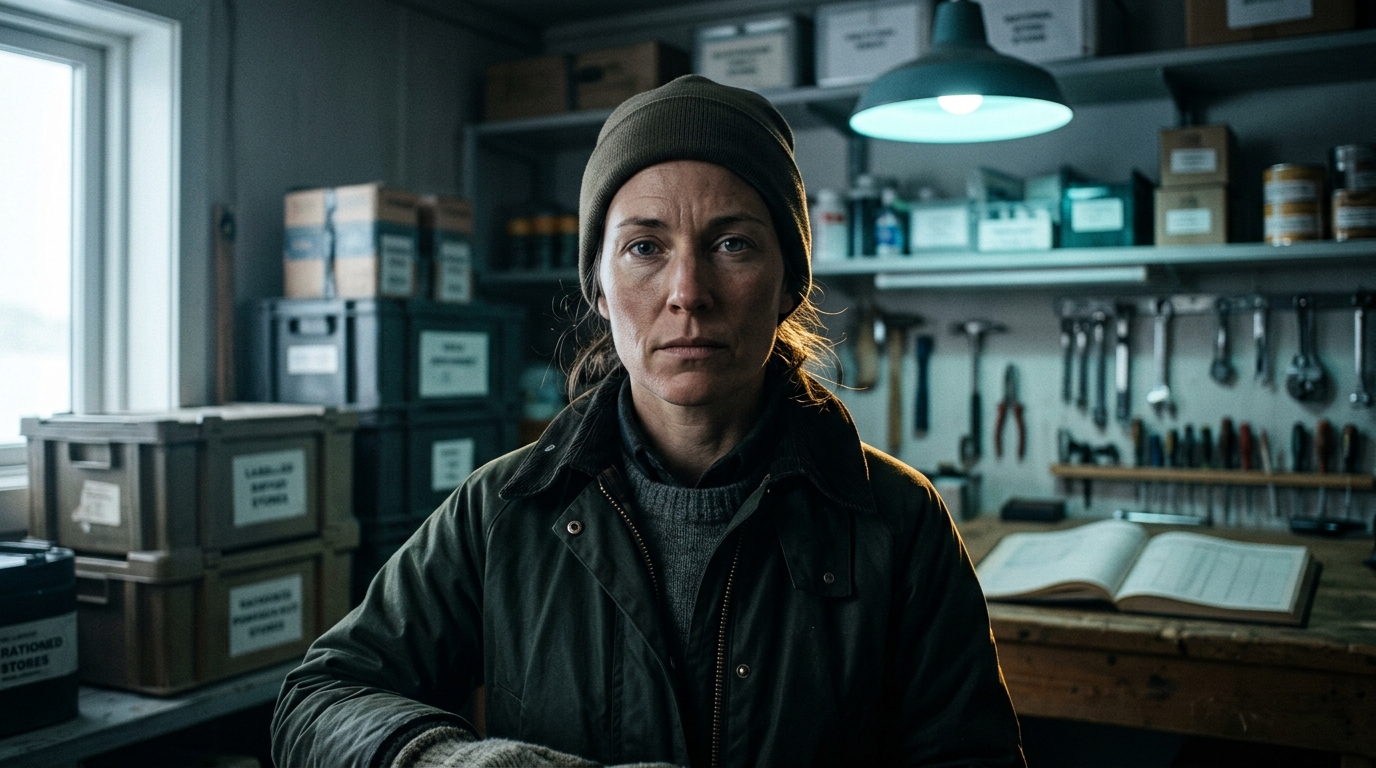
Sylvie Joan Sprake (1959–2007) was the third Guardian of Belkeep, a British environmental planner recruited by Jeremiah Atkins and given her Portal Key in December 1987. Austere, precise, and unsentimental, she built and ran the isolated settlement's supply lines and infrastructure for two decades, keeping it alive by function rather than by rule. She stayed rooted where other Guardians came and went, and her accidental death in 2007 removed the one constant Belkeep could least afford to lose.
The Signalman's Daughter
Sylvie Joan Sprake was born on 3 October 1959 in Saltburn-by-the-Sea, a wind-lashed coastal town on the edge of the North Yorkshire moors. She was the only child of Martin George Sprake (1926–1995), a former Royal Navy signalman turned railway signal operator, and Joan Margaret Sprake, née Rawdon (1932–1981), a librarian and amateur naturalist known locally for her meticulous herbarium work and her quiet defiance of parochial convention.
The Sprake household was structured, sparsely furnished, and ruled by an unspoken ethic of personal responsibility. Conversation was practical, warmth was implicit rather than stated, and the television stayed off for most of the week. Sylvie grew up steeped in that quietude; among her earliest memories were cataloguing pressed seaweed with her mother and walking the clifftops in silence with her father, who taught her Morse code before she turned nine.
At Huntcliff Secondary School she became known among her teachers for her squared-off handwriting—diligent, reserved, and alarmingly precise. She excelled at geography and mathematics but showed little interest in accolades or the ordinary business of student life. While other pupils filled their free periods with clubs and social events, Sylvie spent hers in the school archives, redrawing old settlement maps of the Cleveland coast.
In 1977 she took up a place at the University of Hull, in the Department of Environmental Geography, where she formed a quiet rapport with two lecturers: Harold Pentlow, who encouraged her fieldwork, and Nerys Bowles, a Welsh geomorphologist who introduced her to the idea of micro-resilience in human settlement patterns. Those ideas would prove central to everything she later did.
Her 1981 dissertation, on human settlement in marginal terrains, drew on case studies from Orkney, Snowdonia, and the Pennines to argue that decentralised infrastructure and modular provisioning were the only viable long-term model for isolated communities. She graduated with First Class Honours and no fanfare, and when she was urged toward postgraduate research she declined, remarking that it was too much writing about things no one built.
Marginal Terrains
She returned to North Yorkshire and went into applied environmental planning. Her first post was as a junior field officer with the North York Moors Uplands Commission, a small and underfunded body charged with monitoring the sustainability of remote hill communities. The work was logistical—compiling seasonal water-table data, supervising minor resettlement schemes, mapping erosion across disused bridleways—and she earned a quiet reputation for taking on the assignments others avoided: winter data audits in snowbound hamlets, waste-flow modelling for single-track villages, solo treks to measure frost stress on rural infrastructure. One supervisor found her reports unemotive but uncannily accurate.
Between 1983 and 1986 she worked on sub-regional planning projects across the Cleveland and Pennine fringe, often subcontracted by local authorities struggling with depopulation and land-use conflict. She collaborated with scattered grassroots sustainability networks without ever fully joining any of them, and when invited to sign manifestos or sit on advisory collectives she generally declined, noting privately that such efforts ran to too many vision boards and not enough toolkits.
She was reserved but not isolated. She kept a modest circle of professional acquaintances, and for a time she was engaged to Gareth Knowles, a water-systems consultant from Ripon whom she met on a pilot project in decentralised filtration. They became engaged in early 1985 and moved into a terrace cottage in Loftus, but the engagement was called off within the year, with no explanation offered. Gareth later said she had been unshakeably loyal to principles he had never known she held.
By the end of 1986 she was working as an independent consultant on short-term contracts, had stopped applying for permanent posts, and had begun to withdraw from most professional networks. Her movements grew more deliberate, her communications sparser. Unremarked by her colleagues, she had also begun quietly cataloguing secluded locations across northern England—rail sheds, abandoned pumping stations, forgotten forestry buildings—sites she judged logistically significant but underused. Years later it would become clear that many of them were the first Earth-based points to which she would anchor Portal access from Clivilius. At the time, no one asked why, and she offered no reason.
The Third Key
On 17 September 1987 she met Jeremiah Sebastian Atkins at a closed-door seminar in Newcastle-upon-Tyne, held under the title of post-state viability in isolated human settlements and drawing barely a dozen participants. She delivered a concise, incisive presentation on decentralised resource planning in hostile environments—without slides, reading from handwritten notes and hand-annotated maps. Jeremiah approached her afterward, and their first exchange was formal, even guarded.
Over the following three weeks they corresponded through encrypted courier drops in Kendal and Leeds, and Jeremiah gradually disclosed the existence of Clivilius: a hidden parallel geography reachable only through Portal Keys, each forming a fixed link between Earth and a point in that other world. Cody Jennings had activated the first such key earlier that year and established the remote outpost of Belkeep. Randal Klein, the second Guardian, had activated his on 13 December 1987, with Jeremiah present to oversee it.
Jeremiah was himself a Guardian, though he had never set foot in Belkeep; the settlement was sealed off behind mountains and unforgiving seas, and his part lay in careful selection rather than in crossing. From Cody's sparse communications it was plain that Belkeep sat in a perilous position—windswept, ringed by frozen cliffs and granite ridges, without native plant or animal life, wholly dependent on shipments from Earth for food, tools, clothing, and medicine. What the place needed was someone who could shoulder the logistics of survival without romanticising them, and Jeremiah judged that Sylvie held the exact combination of composure, pragmatism, and refusal to sentimentalise hardship the work demanded.
On 23 December 1987, in a decommissioned maintenance depot beneath York Central Station, she received her Portal Key—the third issued. The activation site was a bare concrete recess against the depot's north wall, a smooth iron surface painted matte grey. At eleven minutes past five that evening she pressed the key to it, and the wall opened into a swirling vertical mass of colliding colour; the air thickened, a low vibration ran through the stone, and without ceremony she stepped through.
She emerged inside the Belkeep Portal Cavern, a vast, silent chamber deep within glacial rock, dimly lit by phosphorescent veins in the stone. Cody, expecting that another Guardian might come, had left a set of carved instructions mounted near the Portal, directing whoever arrived to a shelter dug into a stone hollow on the north ridge, above the Gunlah run-off, and telling them to wait there for the sun, when he would come to find them. Sylvie read the words once, pocketed the note, and began walking.
Unlike ordinary settlers—who, on entering Clivilius, were bound to it permanently—Sylvie retained the power to move between the worlds. As a Guardian she became one of the lifelines on which the whole settlement depended, ferrying seeds, tools, medicine, metalwork, and ration staples from Earth. Within weeks of her arrival she had run three supply crossings, mapped a wide radius around the settlement, and set up a ledger system that would remain in use for nearly two decades. Her bond with Jeremiah was never affectionate; it was one of mutual recognition. She did the exact thing she had been chosen for, neither more nor less.
By Function, Not Force
She had arrived not into a settlement but into stark uncertainty. The cavern was the only shelter from the cold; outside lay unbroken mountain, ice, and lifeless ground, without a tree or an animal or a natural sound. Belkeep was barely an idea, anchored only by Cody and by Randal Klein, who had come through ten days earlier and was already worn thin by the work of carving order out of chaos. Sylvie took no time to acclimatise. From the moment she arrived she assumed responsibility for infrastructure and logistics, and set about the business of keeping people alive.
The Portal at Belkeep was anchored to its single point in Clivilius but could be opened to any location on Earth that a member of her Guardian group had previously activated, and it was this that made her a lifeline in the most literal sense. Drawing on the network of former colleagues, remote landowners, and off-grid contacts she had built over years of fieldwork, she arranged the quiet acquisition and transport of supplies—unused agricultural equipment out of Cumbria, surplus seed stock from a conservation trust near Hexham, cold-weather fabrics and salvageable tools through a shell cooperative in North Yorkshire—never fully disclosing where any of it was going.
Her movements on Earth were deliberate and unobtrusive: no names, no paper trail, coded exchanges and borrowed vehicles, a rotation of access points tied to sites she had activated—a disused railway tunnel outside York, a forestry shed near Edale, an abandoned maintenance station buried in the moorland by Kielder Water. To the few who noticed her comings and goings she gave the cover of remote relief work or private retreat; the truth, that she was provisioning a new world, stayed entirely her own.
Inside Belkeep she devised the settlement's first terrain grid, marking zones for storage, habitation, waste, and tool repair, and engineering the water lines from estimates of glacial run-off. She mapped the wind corridors, logged exposure risks, and imposed strict rotation on the use of heat sources to conserve fuel that had to be carried overland. Her administration was austere and unsentimental—she resisted ceremonial naming, discouraged decorative building, and forbade the use of timber for anything but fuel and critical shelter; everything, she insisted, had to have a function. Asked about her infrequent absences on Earth, she said only that a root system did not grow if it was continually pulled up.
The first full winter of Belkeep's founding was brutal. In March 1988 Randal Klein was killed in a blizzard on an attempted route survey beyond the ice shelf, a loss that shook a settlement of fewer than thirty souls. Sylvie did not let it become a collapse; she absorbed the planning duties he had left, redistributed the labour schedules, and pushed through three successive supply crossings to keep the place running. From that point, and for nearly the next two decades, Belkeep had only two living Guardians—Sylvie and Cody Jennings—and between them they held the settlement together.
Not everything she brought across was cargo. On rare, carefully judged occasions she brought people—displaced, unmissed, able to endure. The most consequential came on 14 February 1990, when she opened a Portal in a derelict barn in Powys and brought through four survivors of a farmhouse fire at Cwm Bryn Glas: Huw Parry, Mills Rowntree, Daniel Brohm, and a quiet Welsh care worker named Grace Levis. Grace would in time marry Cody Jennings and bear the twins who became central to Belkeep's later story. Sylvie, characteristically, made little of it; she had judged the four of them fit to survive, brought them across, and returned to her ledgers.
Her foresight was vindicated most sharply in the winter of 1992–93, remembered in Belkeep as the Winter of Severance—a prolonged atmospheric disruption that drove temperatures far past thirty below and stalled access to Earth for nearly nine days. The layered storage grids and decentralised fuel caches she had built into the settlement were the only reason Belkeep came through the coldest week in its recorded history without a death. She held no title and there were no ranks; but within Belkeep, everything ran through Sylvie—not by force, but by function.
The Constant
In the years that followed she remained one of the few fixed points in a settlement forever in flux. Where other Guardians cycled in and out of Earth and the population shifted with the hard demands of the place, Sylvie stayed rooted. Her crossings grew narrower and more surgical—brief excursions to restock a critical supply or recover a specific tool—and she stopped explaining her absences or announcing her returns. Her presence, like the frost, was simply assumed.
As new settlers arrived with their own philosophies and experiments in governance, she refused alignment with any of them. She abstained from council votes, resisted every ideological label, and turned down appointment to any formal body; she was not there to steer people, she told one young settler who asked why she took no public role, only to stop the wheels coming off. Her influence, for all that, was profound. She trained two full cohorts of supply runners in route secrecy and pack discipline, compiled and maintained a structural registry that catalogued every modification, repair, and collapse in the settlement's architecture since its founding, and served—almost always silently—as a point of moral reference through disputes and long stretches of strain.
Wren's Reach
On 14 February 2007, Sylvie left the main settlement on what the logbook recorded as a routine frost-boundary audit, a solitary inspection of weather-stress markers along the northern ice rim. When she had not returned by nightfall, few were alarmed; she had bivouacked overnight often enough when conditions made return unwise. When she was still absent on the second evening, a three-person search team went out after her.
Her body was found at first light on 16 February, near the narrow inlet known as Wren's Reach—a treacherous, ice-covered ledge notorious for unstable footing and deceptive depth. She had fallen close to eight metres and suffered severe head injuries. Her field pack was intact and her ledger dry, wrapped in waxed linen; its last entry noted only that the twelfth north marker was splitting, and that sound carried strangely there that day.
There was no final letter and no message to Earth. Her affairs there had been quietly wound down over the preceding five years, her cottage in Saltburn long since sold, and no living family remained. Per her own written instructions no formal rites were held. She was buried in a shallow ridge just beyond the northern supply vault, beneath a single slab of dark slate cut from the quarry face behind the Portal Cavern, inscribed with her name, her dates, and three words the settlement had settled on without dissent: that she had stayed when others left.
The Winter She Left Behind
What her death took from Belkeep was more than her systems, and the settlement felt it at once. For twenty years she had been the one constant the place could not do without, and her loss—sudden, accidental, and absolute—was the one it could least afford. Something went out of Belkeep when she died that it never recovered, and the grief did not stay grief for long.
In the seasons after, the settlement sank into what its people came to call the Belkeep Winter—not the weather but the affliction that came with it, the long dark getting down into a person and slowing them, hollowing them out, sitting them in front of a wall for hours at a stretch. Some of those it took worst walked out to the cliffs one grey morning and did not come back. The Guardians stopped bringing new souls through the Portal, there being no sense hauling people into a place that could no longer swear to keep them alive, and the slow decline set in that would define the settlement's final decades and, in time, orphan children not yet born.
Her name was rarely spoken in the Belkeep that followed—not from neglect but from a kind of respectful difficulty, her memory bound up with the beginning of the settlement's long unravelling. She had built the systems that held the place together in life, and in death she became the line its history divided on: the years while Sylvie Sprake kept the wheels from coming off, and the years after, when they did.







