4308.263 · September 19, 1988 AD
Splinters of Morning
Before school, Violet lingers on the family’s weathered porch, caught between the stillness of the Outback and the pull of distant dreams. Joined by Jasmine, she steps from reflection into routine, the morning air heavy with both belonging and quiet longing.
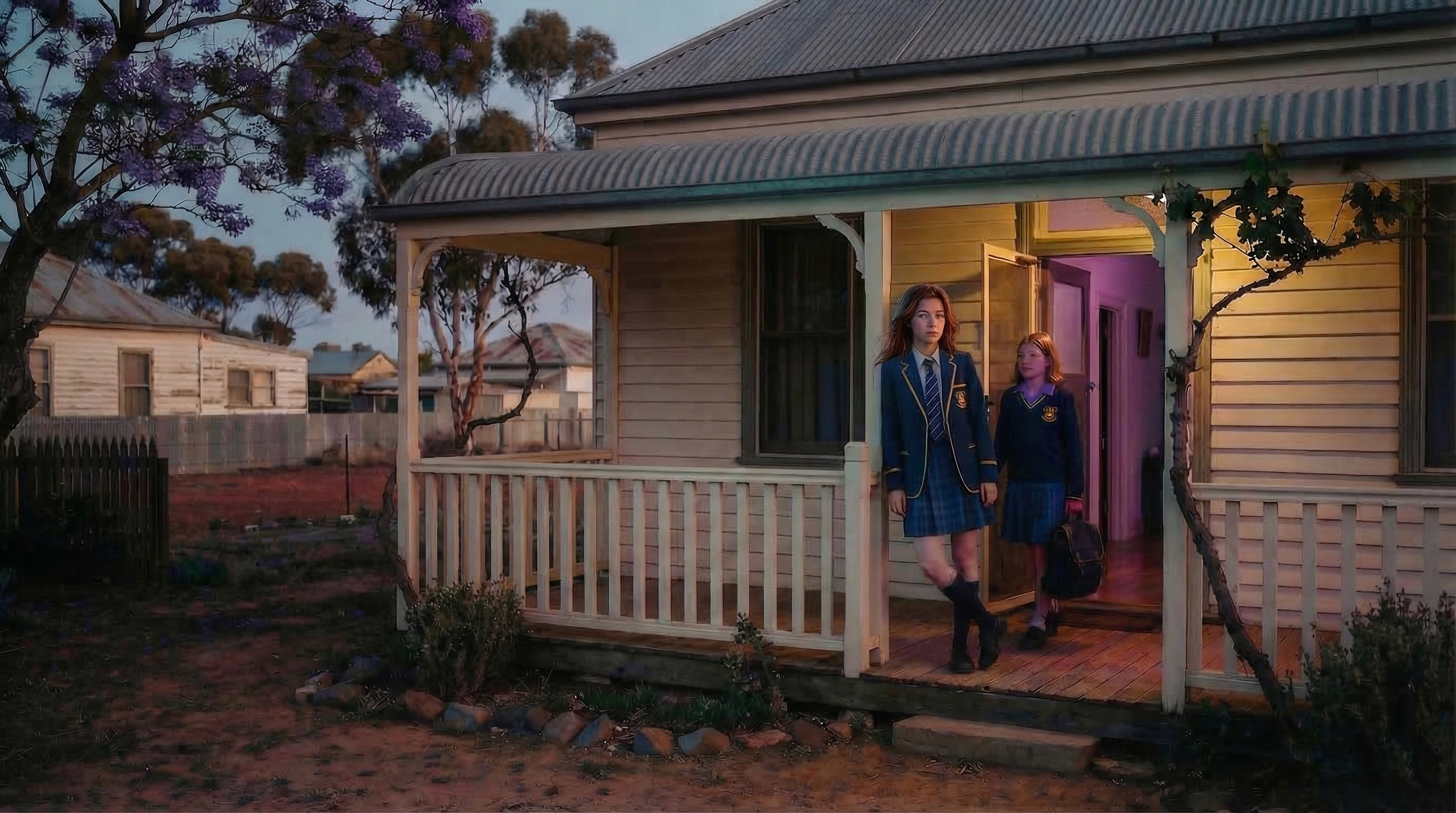
“Some places don’t just surround you—they get under your skin and refuse to let go.” — Violet Dallow
Violet stood alone on the weathered timber porch, its boards sun-bleached and creaking softly beneath her boots. The early morning air clung to her skin with a gentle chill, the kind that only lingered for a short while before the unforgiving heat of the day took hold. Her arms folded loosely across her chest, hands tucked under her elbows for warmth, she watched her breath briefly cloud in the air, disappearing just as quickly as it came.
Behind her, the screen door clattered once, then again, as Jasmine’s hurried footsteps receded back inside. Forgot her textbook, no doubt—the same one she misplaced at least twice a week. Violet didn’t move. She was used to the pauses in their mornings, these small detours that gave her stolen moments alone. Moments like this one.
She closed her eyes and inhaled slowly, the air sharp and clean in her lungs. There was a clarity to mornings like this—when the town was still, the light was soft, and the world hadn’t yet begun to make its demands. The scent of eucalyptus drifted lazily on the breeze, mingling with the dry tang of red dust and the faint mineral sharpness of stone warmed by sun and time. It was a smell she knew better than her own perfume. A smell that clung to clothes, hair, memory.
When she opened her eyes again, her gaze was pulled, as it always was, to the horizon—the vast, open expanse that rolled out endlessly before her. The scrubland, painted in rust and umber, shimmered faintly beneath the early sun. Tufts of spinifex swayed gently in the breeze, defiant in their tenacity. The land wasn’t empty, not really. It was alive in ways most people never bothered to see.
To Violet, it was never just landscape. It was language.
The ancient gum trees rose like monuments, their bark peeling in curls, their limbs twisted into gnarled silhouettes against the brightening sky. They stood as watchmen, quiet and enduring, their roots sunk deep into history. The shadows they cast were long and shifting, and she fancied that if you stared long enough, they might begin to move of their own accord.
Somewhere in the near distance, a kookaburra let out its cackling song—loud, wild, impossible to ignore. The sound sliced through the stillness like a blade, familiar and strange all at once. Violet’s lips curled into the faintest smile. That call—it was part of her. Embedded in her bones, as much a part of Broken Hill as the mines and the rusted tin roofs.
And yet, even as she drank in the beauty, there was always that tug—that quiet ache behind her ribs. The yearning for something more, something beyond. The Outback whispered its secrets to her, yes, but it also held her in place. Its beauty could be a cage, too—sunlit and sacred, but confining nonetheless.
She stepped forward, the porch step groaning softly beneath her worn boots, and let her fingertips brush the splintered edge of the railing. It was warm already, the wood having held on to the chill of night but now beginning to drink in the sun. The rising light played across her features, catching in the fine hairs on her cheek, glinting in her eyes, gilding the soft curve of her jaw. For a moment, with her eyes closed and her chest rising slowly, Violet felt herself suspended between two worlds—here, and not here. Present, and already half gone.
She inhaled deeply, the morning air sharp with eucalyptus and dust, and let it fill her lungs like a benediction. The scent was dry and clean and ancient, the kind that told you exactly where you stood in the world—and just how far you were from anything else.
Yet, rather than feeling hemmed in by the endless emptiness of the landscape, Violet felt a strange swell of belonging. Not comfort, exactly—it was too raw for that—but something elemental. Her veins pulsed in time with the Outback. It was in her blood, this place: its silence, its heat, its stubborn resilience. It shaped her bones, coloured her thoughts. And though she often dreamed of foreign cities and crowded trains, of languages she didn’t speak and roads slick with rain, Broken Hill was her beginning. It would always be her origin story.
The porch beneath her feet bore the weight of decades—worn timber boards softened by years of barefoot summers, spattered with old nail heads and faint rings from forgotten mugs of coffee. Violet ran her hand along the railing, fingertips catching on splinters and the warped ridges where the varnish had long since peeled away. It was rough, imperfect, like so much of their life—but it had held. It had endured. Like they all had.
How many times had she stood here, she wondered, watching the horizon glow with the slow rise of another day, pretending the road at the end of their drive led to somewhere grand—somewhere other? Dozens. Hundreds. Too many to count. She had traced that same red line in her imagination over and over, chasing it all the way to the sea or the city or some place where her name might mean something more than just another surname scribbled on a school roll.
Her thoughts turned, as they often did, to her parents. Robert, her father, already deep underground by now, lost in the clatter and dust of the mine shafts—those same mines that had given Broken Hill its backbone and its bruises. And Evelyn, likely pulling on her cardigan at that very moment, preparing for her shift at the hospital. She moved through other people’s pain every day, quietly mending and tending, her own sorrows folded neatly beneath the starch of her uniform.
Their absence, though expected, left a familiar hollowness. Not a gaping wound—more like a small, worn space inside her, smoothed over by time. Violet understood, even if she resented it some mornings. This was what life looked like here: people working themselves thin to make ends meet, to keep houses upright and meals on the table, to keep dreams from drying up like the salt pans outside town.
And still, the yearning pulled at her—insistent, impossible to ignore. A hunger for elsewhere. For elsewhere’s noise, and strangeness, and anonymity. For places where people hadn’t already made up their minds about who she was and who she’d be.
But no matter how vividly she imagined distant lands—velvet nights in Cairo, the wet shine of London streets, a dirt road somewhere in Namibia—there was always this place. This land that refused to let go of her, no matter how far her mind travelled. It was the tension that shaped her days: to leave, or to belong. To run, or to root.
The screen door creaked again, a thin, reedy sound that cut through the stillness like a twig snapping underfoot. Jasmine had returned, and with her came the quiet inevitability of the day pressing in—school, obligation, the dull rhythm of structure reasserting itself.
Reluctantly, Violet peeled herself away from her thoughts, as though dragging her mind out of soft earth. The warmth of her reverie, so rich just moments before, slipped from her like morning mist. She sighed, slow and weighted, her shoulders dipping slightly under the invisible yoke of routine.
Jasmine was already beside her. There was something almost ethereal about her presence—light brown hair tied back in a neat plait, the end brushing gently against her collar. Her skin still held the last traces of childhood softness, but her expression carried a clarity that belied her years. There was a brightness in her eyes that had not yet been dimmed by the slow erosion of hope that adulthood brought. She looked up at Violet with a gentle sort of readiness, her face expectant, full of quiet, youthful resolve.
She didn’t need to ask where Violet’s mind had wandered. She never did. Jasmine had always been good at reading between the silences.
“Ready, Vi?” she asked, her voice soft, almost tentative. The eagerness was genuine, but beneath it, Violet detected a thread of concern—something quiet and small, like the echo of a worry not yet voiced aloud.
Violet glanced at her, the corners of her mouth tugging into a smile that fought to appear effortless. It didn’t quite succeed, but it was enough. Jasmine didn’t press. She never did.
Despite her young age, Jasmine had a quiet steadiness that felt far older. She wasn’t precocious—not in the showy way some children were—but rather observant, patient, composed. She seemed to know when to speak and when to simply be, a quality Violet often envied in her. Jasmine didn’t yearn to escape like Violet did, but she understood the ache, even if she couldn’t name it.
“Yeah,” Violet said at last, her voice hushed but sure. She adjusted the strap of her backpack, the canvas soft from use, and hoisted it over her shoulder. The weight settled across her back, a familiar burden, worn and real.
“Let’s get going.”
With that, they stepped off the porch together, the wooden boards creaking a final goodbye beneath their feet as they descended into the waiting day.







