Sophia Rose Brown
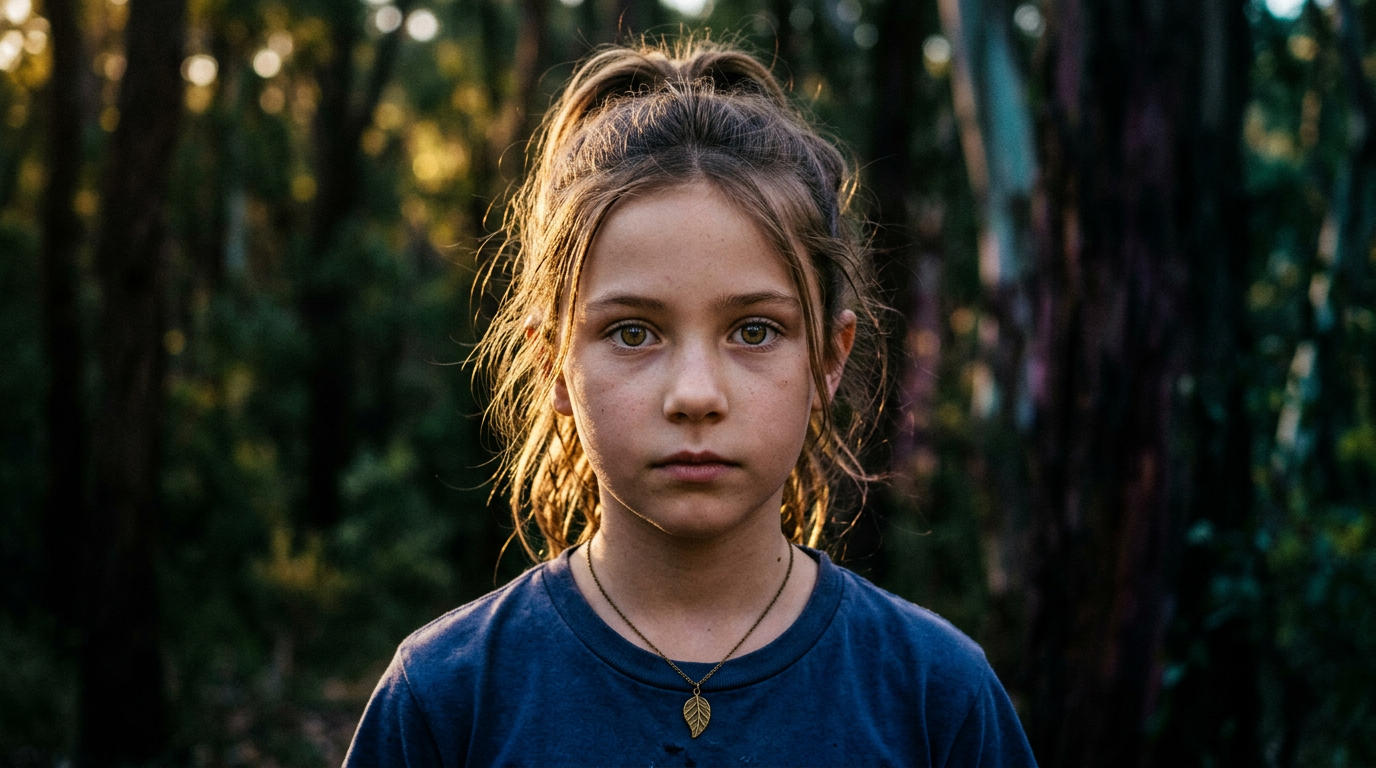
Sophia Rose Brown, born 15 December 2006 in Brisbane, was the youngest child of Jonathan David Brown, a landscape architect, and Rebecca Louise Brown, an environmental journalist. A morally earnest and emotionally intense girl with a deep concern for the natural world, she attended Brisbane Grammar School and dreamed of becoming an environmental scientist. She died on 5 August 2018, aged eleven, from chest injuries sustained in the school bus collision in Clivilius.
The Treasure Chest
Sophia Rose Brown was born on 15 December 2006 at the Mater Mothers' Hospital in South Brisbane, the third child and second daughter of Jonathan David Brown, a landscape architect, and Rebecca Louise Brown (née Kearney), an environmental journalist. She arrived four years after her brother, Matthew James Brown, born on 22 June 2002, and two years after her sister, Alice Catherine Brown, born on 11 August 2004. The family lived in a timber Queenslander in Paddington, on a steep street that caught the afternoon breeze off the river and where Rebecca had planted the front garden with native grasses and grevilleas that she described, to anyone who would listen, as a small act of resistance against the suburb's creeping gentrification.
Jonathan worked for a mid-sized landscape architecture firm in Fortitude Valley, designing public parks, riverfront promenades, and the kinds of urban green spaces that local councils commissioned and then quietly reduced in scope when budgets tightened. He was a mild, careful man who approached his work with a craftsman's patience and his family with a gentleness that his children sometimes mistook for passivity.
Rebecca was the opposite — sharp, vocal, opinionated, and possessed of a conviction about environmental matters that she brought to everything from her journalism to her grocery shopping. She wrote for a Brisbane-based environmental magazine and freelanced for the national press, covering stories on reef bleaching, deforestation, land clearing, and water management with a rigour that earned her professional respect and a domestic life in which the recycling was sorted into five categories and the children knew the word "ecosystem" before they knew the word "algebra."
Matthew was the easy child — athletic, sociable, untroubled by the kinds of questions that kept his mother working late and his youngest sister lying awake. He played rugby union at school, had a wide circle of friends, and treated the household's environmental intensity with the affable tolerance of a teenager who had grown up inside it and considered it normal without feeling compelled to join the cause. Alice was sharper, more like Rebecca in temperament, and at twelve had already developed the capacity to argue a point with a fluency that impressed her mother and infuriated her father. She was interested in theatre, in clothes, in the social mechanics of Year 7, and in Sophia primarily as a source of mild exasperation.
Sophia was the youngest, and she was the one who took it all to heart. Where Matthew shrugged and Alice debated, Sophia absorbed — the conversations at dinner about reef mortality, the documentaries Rebecca watched on the couch on Sunday evenings, the quiet fury in her mother's voice when another land-clearing approval came through. She was not a precocious child in the conventional sense. Her reading was average. Her mathematics was below average in a way that caused Rebecca more concern than Sophia's teachers thought warranted. But she had a moral seriousness that was startling in a child her age, a conviction that the world was being damaged and that the damage mattered, and that conviction shaped everything from her friendships to her lunchbox.
She kept a wooden box under her bed that she called her treasure chest. It contained labelled specimens collected from family walks and school excursions — smooth river stones, seed pods, pressed leaves, the occasional feather identified with a handwritten tag in her careful, rounded script. The box was a habit she had started at six, when Jonathan had taken her to the Mount Coot-tha Botanic Gardens and she had filled her pockets with so many fallen leaves that Rebecca had to empty them before the washing. Jonathan built the box for her that weekend from offcuts of Tasmanian oak left over from a project, and Sophia treated it with a reverence that was out of proportion to its contents and entirely in proportion to its significance. It was her archive. It was proof that the world contained things worth keeping.
The Petition
Sophia attended Brisbane Grammar School from Year 5, entering in 2017 alongside a cohort that included several of the students who would later board the bus to D'Aguilar. She was not a natural student in the academic sense — she struggled with mathematics, found grammar exercises tedious, and had a tendency to drift during lessons that did not engage her moral imagination. Her science marks were strong, particularly in topics related to ecology and environmental systems, and her geography teacher noted that Sophia approached the subject with an earnestness that went well beyond what the curriculum demanded.
She was, by the accounts of her teachers and classmates, an intense child. This was meant kindly by some and less kindly by others. Sophia cared about things visibly, vocally, and without the social awareness that might have taught her to modulate the caring for her audience. She launched a petition in Year 5 to ban single-use plastic from the school canteen, collecting thirty-two signatures and presenting it to the deputy principal with the gravity of someone delivering evidence to a parliamentary inquiry. The deputy principal thanked her and explained that the matter was under review, which it was not. Sophia checked back every fortnight for the rest of the term.
She went through a phase at ten of refusing to eat meat, a decision that lasted five months and produced a household negotiation of considerable complexity. Rebecca, who was sympathetic to the principle but concerned about nutrition, agreed to cook vegetarian meals three nights a week. Jonathan, who had grown up on a cattle property near Dalby and considered a meal without meat fundamentally incomplete, adapted with the quiet resignation of a man who had learned to choose his battles. Matthew ate whatever was put in front of him. Alice declared the entire exercise performative, a word she had recently learned and was deploying with enthusiasm, and the resulting argument between the two sisters required Rebecca to intervene with a firmness that left both girls crying and Jonathan standing in the kitchen holding a spatula and wondering how dinner had become a philosophical crisis.
The vegetarianism lapsed when Sophia attended a friend's birthday party and ate three sausage rolls without thinking, then spent the evening in a state of remorse so acute that Rebecca had to sit with her on the bathroom floor for an hour explaining that making a mistake did not undo a principle. It was a formative exchange. Sophia was the kind of child who held herself to standards she could not always meet, and the gap between her convictions and her capacity to live by them was a source of private anguish that she lacked the vocabulary to articulate and that adults, when they noticed it at all, tended to dismiss as childhood dramatics.
Her friendships were earnest and sometimes fragile. She was close to Charlotte Davis, who shared her love of nature if not her political intensity, and to Mia Anderson, whose gentleness provided a counterweight to Sophia's fervour. She found Ava Johnson's artistic detachment baffling — how could someone care so much about colour and so little about what was happening to the reef? — and said so, producing a falling-out in Year 6 that lasted two weeks and ended with an apology that Sophia delivered with the solemnity of a peace treaty. She was not unkind. She was simply incapable of understanding how anyone could know what she knew and not feel what she felt, and this incomprehension made her, at times, a difficult friend.
She cried easily. This embarrassed her and she could not stop it — tears came when she watched footage of bleached coral, when she read about species extinction in the magazines Rebecca left on the coffee table, when Alice told her she was being annoying, when a classmate threw a recyclable bottle in the general waste bin. The crying was not theatrical. It was involuntary, the overflow of an emotional system that processed the world's damage as personal grief, and it was the quality that made adults want to protect her and other children want to avoid her. She was aware of both responses and powerless to alter either.
Rebecca watched her youngest daughter with a mixture of recognition and concern. She saw herself in Sophia — the same moral intensity, the same inability to let things go — and she understood, in a way that Jonathan did not, that the quality which made Sophia exhausting to live with was also the quality which would, given time and structure, make her formidable. Rebecca told Jonathan once, after a particularly difficult evening in which Sophia had refused to go to bed until she had finished writing a letter to the local council about a tree-clearing project on their street, that their daughter was going to be either an activist or a nervous wreck, and that the difference would depend entirely on whether someone taught her how to carry the weight without being crushed by it.
The Pressed Leaf
The overnight field trip to D'Aguilar National Park was, for Sophia, the highlight of the school year. She had prepared for it with the thoroughness of a researcher equipping an expedition — her backpack contained a sketchbook, coloured pencils, a small notebook she used to document plant species, a field guide to south-east Queensland flora that Rebecca had bought her for her eleventh birthday, and three ziplock bags for collecting specimens. She wore her hair in a ponytail secured with a band made from recycled fabric, and the leaf-shaped pendant necklace that Alice had given her for Christmas hung at her collarbone.
The bus departed Brisbane Grammar School on the morning of Saturday, 4 August 2018, carrying fifteen students and five adults. Sophia sat near the front with Charlotte Davis, the two of them sharing a packet of dried mango and discussing what they hoped to find in the park. Sophia wanted to see a brush turkey nest — she had read about the males' mound-building behaviour and was fascinated by the engineering of it. Charlotte wanted to find a creek. The trip was a weekend science and nature study excursion, with a guided walk on the first day, campfire activities in the evening, and the return to Brisbane on Sunday morning.
At D'Aguilar, Sophia was the student who asked more questions of Susan Clarke during the guided walk than any other child on the trip. She wanted to know why the canopy was denser on the southern slope, whether the creek they crossed was part of the Brisbane River catchment, what the fungal growth on the fallen log meant for the decomposition cycle of the forest floor. Clarke, who was accustomed to children's attention spans shortening after the first hour, found Sophia's sustained engagement remarkable and slightly tiring. Sophia filled four pages of her notebook and pressed a fern frond between the pages of her sketchbook, wrapping it in a tissue to preserve the shape.
She did not find the brush turkey nest. She was disappointed in the specific, disproportionate way of a child who had invested a plan with more emotional weight than it could bear, and Charlotte sat with her at the campfire that evening and told her they could look again in the morning. Sophia rallied. By the time the group was singing around the fire — badly, with Raj Patel providing an enthusiastic if tuneless lead — she was sketching the silhouette of the tree line against the last light, her pencil moving quickly across the page in strokes that were more impressionistic than precise.
She was not a meticulous illustrator like Ethan Williams, who sat on the other side of the fire with his head bent over a drawing of something she could not see. She drew feeling, not structure — the shape of a place, the mood of a moment, the sense of being somewhere that mattered.
The bus departed D'Aguilar on the morning of 5 August for the return to Brisbane. Sophia sat with Charlotte near the middle of the bus, her backpack on the floor between her feet, the pressed fern frond safely inside her sketchbook. She was talking about what she would write in her nature journal when she got home — a practice Rebecca had encouraged since Sophia was eight, and which had produced a shelf of notebooks in her bedroom that documented every bushwalk, every park visit, every significant tree in the Paddington neighbourhood.
The bus passed through a Portal opened across a road in the Brisbane suburbs and collided with a motorhome and a station wagon on the far side, in the landscape of Clivilius. The impact threw passengers forward and sideways through the bus. Sophia, seated in the middle section, sustained blunt force trauma to her chest. The injuries were catastrophic — a pneumothorax collapsed her left lung, and internal bleeding from the impact accelerated beyond what the body of an eleven-year-old could compensate for. Raj Patel reached her within minutes, and his medical training allowed him to identify the nature of the injuries immediately. Without surgical intervention she would not survive. There was no surgical intervention available. There was nothing except a man kneeling beside a child on unfamiliar ground, telling her that she was not alone.
Sophia Rose Brown died on 5 August 2018. She was eleven years old. Charlotte Davis was beside her. The pressed fern frond from D'Aguilar was still inside the sketchbook in her backpack, flattened and intact, a specimen from a forest that now existed on the other side of something none of them understood.
The surviving students and adults who built the settlement of Bixbus in the months that followed named the Sophia Brown Environmental Research Centre in her memory — a facility dedicated to understanding the ecology of Clivilius, the world they could not leave. It was the kind of honour Sophia would have been embarrassed by and secretly, fiercely proud of, and it carried forward a principle she had held since she was old enough to hold anything: that the world you lived in deserved your attention, your care, and your refusal to look away.
In Brisbane, the Brown family learned that a school bus carrying their youngest daughter had failed to return from D'Aguilar National Park. Jonathan rang the school, then the police, then Rebecca, who was at a conference in Sydney and caught the first flight home. The search found nothing. The bus, the children, the adults — all of them had vanished from a suburban road with no wreckage, no skid marks, no trace. The investigation continued for months. It produced no answers. The file was never closed and never resolved, and the Browns were left in the particular limbo of families who cannot grieve because they have not been given permission to believe the worst.
Rebecca stopped freelancing. She could not write about environmental damage with the same conviction when the world had taken her daughter and offered no explanation. Jonathan continued to work, because the gardens he designed still needed designing and because stillness, for a man who had always been quiet, became unbearable when the house contained one fewer voice. Matthew, who was sixteen, absorbed the loss in the way of a teenage boy who did not have the tools to process it and would not acquire them for years. Alice, who was fourteen and who had spent the last year telling Sophia she was annoying, carried the weight of that final assessment with a guilt she did not speak about and which settled into her like sediment, reshaping the contours of the person she was becoming.
The treasure chest stayed under the bed. The nature journals stayed on the shelf. The leaf-shaped necklace was not among the belongings returned from the school, because there were no belongings returned from the school, because there was nothing to return. Rebecca opened the treasure chest once, six months after the disappearance, and found inside it the careful labels in Sophia's rounded handwriting — river stone, Enoggera Creek, 14 March 2018; seed pod, Bunya Mountains, October 2017; feather, unknown species, backyard, June 2018 — and closed it again, and did not open it after that.







