4338.208 · July 27, 2018 AD
Sinking Feeling
Another vehicle arrives in Clivilius only to immediately surrender to the dust, and Jamie finds himself digging uselessly at a wheel that won't be freed. But the afternoon's real challenge comes when Joel appears over the rise, croaking a single word that Jamie initially mistakes for a plea—until he realises his son isn't asking for help, he's offering it.
"There's a particular kind of exhaustion that comes from trying to build something while the ground itself refuses to cooperate—and I'm not entirely sure I'm still talking about the car."
The trowel scraped across wet concrete with a sound that had become the soundtrack of my afternoon—a flat, grating rasp that should have been satisfying in its productivity but instead felt like fingernails dragging across the inside of my skull. Back and forth, smoothing the grey slurry into something that might, if we were lucky, eventually resemble a foundation for one of the sheds.
My knees ached from kneeling on the hard-packed ground. My lower back had begun that familiar throbbing protest that came from hours of hunched labour. Sweat had traced dirty lines down my temples despite the moderate Clivilius temperature, mixing with the fine red dust that coated everything here until I probably looked like some kind of terracotta sculpture slowly coming to life.
This is what my nursing degree prepared me for. Trowelling cement in another dimension.
The irony wasn't lost on me. A career of caring for the elderly, of gentle touches and patient listening, of managing medications and easing fears—and here I was, covered in grit and concrete residue, building structures I had no real expertise in creating. But that was Clivilius, wasn't it? Everyone became whatever the moment required, whether they were qualified or not.
The sharp bark snapped my concentration.
My head snapped up before I'd consciously registered the sound, some primal part of my brain already cataloguing: dog, unfamiliar, approaching. The grey expanse of wet concrete beneath my hands suddenly seemed irrelevant as my attention swivelled towards the crest of the nearest hill.
"Lois!"
Glenda's voice rang out with an excitement that seemed wildly disproportionate to the circumstances, and I watched her jog towards a golden retriever that had appeared over the rise like a canine sunrise—all bounding enthusiasm and gleaming fur and tail-wagging energy that seemed to mock the grim determination with which we'd all been approaching our survival tasks.
The dog bounded into camp with the kind of wholehearted joy that only animals and the deeply deluded seemed capable of maintaining. Its gleaming coat looked almost luminous against the dull ochre backdrop of our settlement.
"Not another fucking dog." The words emerged as barely more than a mutter, escaping my lips with all the enthusiasm of air leaking from a punctured tyre. My grip tightened on the trowel until my knuckles ached.
Henri and Duke were already more than enough canine responsibility. Feeding them, managing them, keeping track of their various needs whilst simultaneously trying to survive in a dimension that shouldn't exist—adding another mouth to our already precarious equation felt like the universe's idea of a cruel joke.
What's next? A cat? A horse? A whole bloody menagerie appearing over that hill?
I forced my attention back to the concrete, trying to lose myself in the repetitive motion of smoothing, in the physical sensation of the trowel's handle against my palm, in anything that might distract me from the simmering frustration that seemed to have taken up permanent residence in me since arriving in this place.
"Lois, down!"
Glenda's command snapped through the air with an authority that made my head lift again despite my best intentions to remain uninvolved. My body was already in motion before my mind fully caught up—rising from my crouch, trowel still clutched in one hand, legs carrying me towards the tent where Joel had emerged.
My son stood in the tent's entrance, watching the approaching chaos with an expression I couldn't quite read. His posture still carried that careful quality of someone managing pain, of someone whose body had been through an ordeal it hadn't yet fully recovered from. But there was something else there too—a flicker of interest, maybe. A brief lifting of the exhaustion that had draped over him since his impossible return from death.
I halted mid-stride as the scene before me shifted into something unexpected.
Joel crouched down, moving with a cautiousness that spoke of his injuries but also of his inherent gentleness—that quality I was only beginning to recognise in him, this son I'd barely known existed until his throat was slit and his blood soaked into Berriedale concrete. His arms wrapped around the golden fur, fingers stroking with a tenderness that seemed completely at odds with the harshness of our circumstances.
When did I last see anyone touch anything here with genuine softness?
The question surfaced unbidden, carrying with it an ache I wasn't prepared to examine.
"Seems she likes you."
Glenda's observation carried warmth that momentarily pierced the armour of my frustration. Her smile was broad and genuine, the kind of expression that suggested she saw something hopeful in this small interaction—something I wanted to dismiss as naïve but couldn't quite manage to.
Duke approached the pair with the wariness of a diplomat entering contested territory. He circled, nose working overtime, gathering intelligence about this golden intruder who had appeared without warning in his established domain. Lois, startled by his forensic sniffing, leapt backwards with a little yelp, her tail blurring into motion so fast it seemed to create its own small windstorm.
The two dogs began a cautious dance—that peculiar canine ritual of assessment and negotiation, of establishing hierarchy through a language of posture and scent that humans could observe but never fully translate.
Henri, true to form, made a brief appearance at the tent flap before apparently deciding that social obligations were beneath him. He surveyed the scene with an expression of profound disdain—or what passed for disdain on his pushed-in face—then retreated back inside to resume whatever sulking he'd been engaged in. The brief flash of his brown and white fur disappeared into the tent's shadows like a ghost withdrawing from mortal concerns.
Typical. Can't be bothered with anything that doesn't involve food theft or dramatic displays of wounded dignity.
I found myself caught up in watching Joel and Lois, in the simple pleasure my son seemed to derive from running his fingers through the dog's fur. The frustration that had been building all day began to ease slightly, like a fist slowly unclenching.
"We need a road."
Paul's voice boomed across the settlement, shattering the fragile moment of peace like a brick through a greenhouse window. He trudged down the final slope towards camp, his shoes leaving deep impressions in the soft earth, dust billowing around his calves with each heavy footfall.
The fatigue in his steps was obvious—that particular kind of bone-deep weariness that came from physical exertion in unfamiliar terrain. But beneath the exhaustion, determination radiated from him like heat from a furnace.
Lois abandoned Joel with the fickle enthusiasm dogs reserved for new arrivals, dashing towards Paul with a zeal that made her previous bounding entrance seem restrained by comparison. Her paws kicked up tiny dust storms as she closed the distance, her whole body vibrating with the kind of uncontained joy that made me vaguely envious.
When did I last feel anything with that intensity? Happiness so fierce it couldn't be contained?
Paul crouched to meet her, indulging the greeting with an affection that softened the rugged lines of his face. Keys arced through the air towards Glenda, who caught them with a grace that suggested reflexes honed by decades of juggling competing demands.
"Ooh, you're a beautiful girl."
Paul's murmur was affectionate, gentle in a way that reminded me how complicated people could be—how someone could be infuriating one moment and unexpectedly tender the next. His fingers worked behind Lois's ears with the skilled attention of someone who understood dogs, who knew exactly where the good scratching spots were.
"My car's here?"
Glenda's voice carried a mix of surprise and something that might have been hope—the peculiar hope of someone unexpectedly reunited with a piece of their former life. She held up the keys, turning them over in her hands as though examining artefacts from a previous existence.
"Yeah." Paul's attention remained partially fixed on Lois, who seemed determined to monopolise every scrap of affection he was willing to offer. "It's got bogged just over the hill."
The words landed with the dull thud of inevitability. Of course it had. Nothing in Clivilius could be simple. Nothing could arrive without complications, without problems to solve, without additional demands on energy we didn't have to spare.
Kain's laughter bubbled up from somewhere behind Paul, a sound that felt almost foreign in its lightness.
"We definitely need a road."
The humour in his voice sparked an answering flicker somewhere in me—not quite amusement, but something adjacent to it. The absurdity of our situation, the cosmic joke of trying to build civilisation from scratch in a dimension that seemed designed to thwart every effort, demanded either laughter or tears. Today, apparently, we were choosing laughter.
But Paul's expression darkened, his eyes meeting Kain's with a warning edge that suggested the time for levity had passed.
"I wouldn't be laughing if I were you. You wanna be the one to collect the stuff in it or dig it out of the dust?"
Glenda huffed, her frustration carrying notes of fond exasperation that spoke of long experience managing difficult personalities.
"Honestly. This camp is like living with a bunch of children sometimes."
She began walking in the direction Paul had indicated, Lois and Duke falling into step behind her like a mismatched honour guard. Her shoulders were set with determination, her stride purposeful—she was going to deal with this bogged car whether the rest of us helped or not.
Paul and Kain exchanged glances heavy with shared guilt and amusement, their expressions so reminiscent of schoolboys caught mid-mischief that something loosened in my chest.
"I don't think she's got any children."
The joke escaped me before I'd consciously decided to make it, some reflexive attempt to lighten a mood that threatened to tip towards genuine conflict.
"I heard that!"
Glenda's voice echoed back to us, stern but threaded with unspoken laughter. She didn't turn around, didn't break stride, but I could picture the wry smile that probably tugged at her lips.
"Come on." Kain's nod towards Glenda's retreating figure was an invitation and an instruction. His movement carried the easy confidence of youth, that particular quality of someone who hadn't yet accumulated enough disappointments to question whether effort led to results. "Let's get this car."
I drew in a deep breath—the air here always tasted strange, neither quite clean nor polluted but somewhere between, carrying hints of dust and distant water and something else I couldn't identify—and fell into step with Paul and Kain as they followed Glenda's trail.
"Hey, where are the new people?"
Paul's question broke our walking rhythm, his gaze scanning the settlement as though Karen and Chris might materialise from behind a tent if he looked hard enough.
"Karen and Chris?"
Kain's clarification was probably unnecessary, but it served to confirm that we were all thinking about the same conspicuous absence.
"Yeah."
My shoulders lifted in a shrug that communicated more than I intended—indifference layered over frustration, resentment dressed up as casual dismissal. The struggle with the tent earlier, the hours of cement work, the general chaos of keeping this fragile settlement functioning—none of it had involved Karen or Chris's participation. Their absence from labour had been noted, catalogued, filed away in the growing mental ledger of grievances I was maintaining.
"They've gone for a walk." Kain filled the silence my shrug had created, his tone neutral in a way that suggested he too had noticed but was choosing not to dwell on it.
Gone for a walk. How lovely for them. The rest of us are working ourselves raw and they're taking a fucking stroll.
"Oh, to the lagoon?"
Paul's question carried a smile in its undertones, an attempt at lightness that only underscored the divisions forming within our group. Some people worked. Some people wandered. And the gap between those two approaches was widening daily.
"Pretty sure…" Kain's voice trailed away as we crested the small rise and the bogged vehicle came into view.
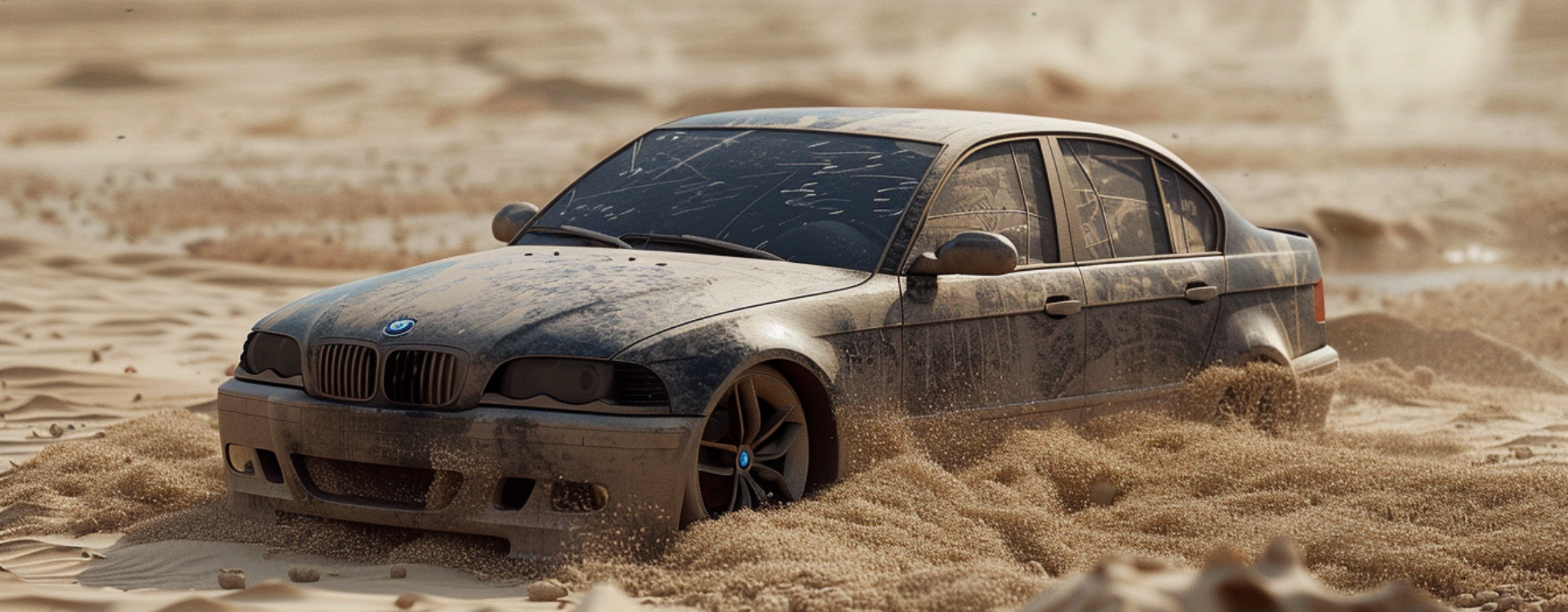
The charcoal BMW sat listing in the dust like a beached whale, its rear wheel buried to the axle in the soft substrate that passed for ground here. Dust coated every surface, transforming what was probably an expensive car into something that looked like it had been dragged through a sandstorm and left for dead.
Bet it's a nice car underneath all that shit.
The thought was irrelevant, disconnected from our immediate circumstances, but my brain offered it anyway—some remnant of the normal world where people cared about such things, where the make and model of your vehicle meant something beyond its capacity to transport supplies.
I circled the car, assessing the damage with the clinical eye of someone who'd grown used to evaluating problems. The wheel wasn't just stuck; it had sunk deep, the dust and sand swallowing it like quicksand claiming an unwary traveller.
"Fuck! You've done a good job, Paul."
The words emerged carrying all my accumulated irritation, though a thread of dark amusement wove through them. There was something almost impressive about how thoroughly the wheel had been buried.
"It all happened so quickly."
Paul's defence came swift and automatic, embarrassment battling with justification in his tone. He gestured towards the wheel as though its current state explained itself, as though anyone else would have fared the same way.
"I bet it did."
My scepticism was unconcealed, though whether I was really doubting Paul's abilities or simply channelling frustration at the universe in general, I couldn't have said. Everything here felt like swimming against a current that never stopped pushing back—every step forward met with two steps of unexpected resistance.
Kain's soft chuckle cut through the tension, a diplomatic intervention disguised as amusement.
Glenda had already opened the passenger door and was rummaging through the contents with the focused determination of an archaeologist excavating a promising site. Whatever she was searching for, she attacked the task with the kind of energy that made me feel exhausted just watching.
I crouched beside the buried wheel and began attempting to clear the dust away, my hands working at the loosely packed substrate in what I already knew was a futile exercise. The fine particles shifted beneath my fingers like dry water, immediately flowing back to fill any space I managed to create. It was like trying to dig a hole in the ocean.
Shit.
The word escaped as a frustrated exhale, mingling with the dust I'd inadvertently stirred into my own face. Every swipe of my hand accomplished nothing permanent—the wheel remained just as buried, the dust just as determined to maintain its grip.
"Think we can dig it out?"
Kain's question carried hopeful undertones as he crouched beside me, adding his hands to the useless effort. His presence felt like solidarity, even if his contribution was equally ineffective.
"Not with our hands."
I cast a sidelong glance at him, demonstrating the futility by letting a handful of dust slip through my fingers. It cascaded back to the ground and immediately began creeping towards the wheel again, as though magnetised.
"Shovels then?"
The suggestion was a pivot towards practicality, towards actually solving the problem rather than just complaining about it. I appreciated that quality in Kain—his instinct to look for solutions when others, myself included, were still cataloguing complaints.
I inhaled deeply, weighing our limited options against the scope of the task. The dust swirled around us, stirred by our movements, creating a localised haze that made the air taste gritty and unpleasant.
"Shovel might work. Probably the best we can do."
Concession and resignation wrapped together in the admission. We weren't going to magic this wheel free. We were going to have to dig it out the old-fashioned way, with tools and labour and probably a healthy serving of additional frustration.
"I'll go grab them."
"Hang on."
My hand shot out to grasp Kain's arm, halting his departure before he could act on the impulse.
"Go check the Drop Zone first. The shovels we've been using are all covered in cement. Might make it a little more challenging for us."
The admission felt like an indictment of our general state of disarray. We couldn't even keep our tools clean and organised, couldn't maintain the basic infrastructure of work. Everything was improvised, compromised, barely functional.
"Sure."
Kain's nod was quick, decisive. He rose with the fluid energy of someone whose joints hadn't yet learned to protest, and I watched him navigate the small rise that separated us from the Drop Zone—that mysterious location where Luke deposited supplies from Earth, the umbilical cord that kept us tethered to a world we might never see again.
His figure was silhouetted briefly against the sky before disappearing over the crest.
I hauled myself upright, my knees singing their familiar complaint at the change in position. Dusting off my hands was an exercise in futility—the fine grit clung to everything, embedded in the creases of my palms, wedged beneath fingernails, coating skin like a second layer I couldn't shed.
There was no point in continuing to paw at the buried wheel until we had proper tools. The dust would win every time.
"Do you want to carry anything back now? Or wait to see if we can dig this car out?"
The question was practical, an attempt to make use of the waiting time. Glenda's head was halfway through the passenger door, her body angled in a way that suggested she was conducting a thorough inventory of the car's contents.
"Hmm."
Her voice emerged muffled, thoughtful, barely more than a vibration against the car's interior.
"I'll take this one for now…"
Her words trailed off into ambiguity, leaving the decision hanging in the air like dust motes suspended in light.
"Joel?"
My attention snapped away from Glenda with the suddenness of a rubber band released from tension. The figure approaching from camp moved with uncertain steps, each footfall carrying the careful quality of someone testing their own limitations.
My voice emerged barely louder than a whisper, disbelief and concern tangling together.
What the hell is he doing out here? He should be resting. He should be in the tent, recovering, not walking across open ground towards a bogged car.
"I'll check on him when I get back to camp."
Glenda's response seemed to miss the urgency entirely, her attention still partially captured by whatever she'd found in the car's interior.
I was already moving, ignoring her comment as my legs carried me towards Joel with a haste born of parental concern I hadn't known I was capable of feeling until this impossible son appeared in my life.
"Joel! What the hell are you doing here?"
The words carried worry and frustration in equal measure, my voice rising despite my best efforts to keep it controlled. Seeing him this far from the safety of camp, from the tent where he should have been healing, set every protective instinct I possessed into overdrive.
"Help."
Joel's voice emerged as a croak, his damaged throat still recovering from its impossible healing. The single word landed like a punch to my gut.
Shit!
Panic spiked through my system, my pulse accelerating with the sudden conviction that something had gone wrong, that Joel needed assistance, that the fragile recovery we'd been nursing had somehow collapsed.
"You need help?"
My pitch rose as I gestured frantically for Glenda to abandon whatever she was doing and come over. My hands wanted to reach for Joel, to support him, to somehow physically confirm that he was alright.
But Joel shook his head quickly, his expression shifting into something I couldn't immediately interpret. He raised his hand, pointing towards the bogged car behind us.
"Help."
The word came softer this time, its meaning transformed by context and gesture. Not a plea for assistance but an offer of it.
The realisation washed over me like cool water after fever. He wasn't asking for help. He was offering to help. Wanting to contribute, to participate, to be something other than a patient requiring constant supervision.
"I don't think that's a good idea. You should be resting."
The objection rose automatically, my hands moving to his shoulders in an attempt to guide him back towards camp. Every instinct I possessed screamed that he needed to conserve his strength, that pushing himself could undo whatever healing had occurred, that keeping him safe was more important than accepting his contribution.
"Here, take this."
Glenda's voice cut through my internal debate. She brushed past me, dismissing my concerns with a gesture that suggested she'd evaluated the situation and reached a different conclusion.
She handed Joel a pillow—something she'd retrieved from the car, apparently—her expression suggesting she knew exactly what she was doing.
"As long as you are careful, I think some movement will be beneficial."
The words were confident, reassuring in a way that made me want to argue even as they undermined my objections. She was the doctor here. She understood bodies and healing in ways I'd never properly learned despite my nursing background.
I felt my face arrange itself into a pout—an expression that felt ridiculous on a man my age but accurately reflected the conflict churning inside me.
"Are you sure you can manage?"
The question was directed at Joel, doubt heavy in every syllable. Part of me wanted to wrap him in cotton wool, to create an impenetrable barrier between him and anything that might cause further harm. He'd died once already. The thought of anything threatening his fragile recovery made my chest tight with fear I couldn't fully articulate.
But Joel's silent nod carried certainty that transcended his damaged voice.
I watched him, this son I barely knew, asserting his own agency in a situation where I wanted nothing more than to protect him. The internal war continued—protectiveness versus respect, fear versus trust.
But if he feels like he is ready to move, why should I be the one to stop him?
The question had no easy answer. We were all navigating unprecedented territory here, all trying to balance survival against sanity, safety against the need to feel useful.
When I noticed the violin case resting on the car's bonnet, it took a moment for the significance to register.
"This must mean that Luke has spoken with Pierre!"
Glenda's exclamation carried hope and longing in equal measure. Her hands hovered over the case with something like reverence, as though touching it too quickly might shatter the reality of its presence.
"Your husband?"
The question was intuitive, though I was still piecing together the connections.
"Yes."
Confirmation and sorrow wrapped together in the single word. Her voice carried the particular ache of enforced separation, of loving someone across a barrier that couldn't be crossed.
"I miss him terribly already."
The admission struck deeper than I expected. In the chaos of survival, in the constant demands of building and planning and managing interpersonal conflicts, it was easy to forget that everyone here had left someone behind. Everyone carried their own private grief alongside the shared challenge of existing in this impossible place.
"How does your violin imply that?"
The connection between instrument and husband remained unclear to me, the logical leap just beyond my grasp.
"I highly doubt that Luke would have known to bring me my violin."
"You'd be surprised."
The words emerged with half-joking cynicism, though beneath them lurked genuine uncertainty about Luke's capabilities and knowledge.
Nothing Luke brings us would surprise me at this point.
The thought remained unspoken, private. Luke had demonstrated too many impossible things for me to be confident about the limits of what he might know or accomplish.
Glenda secured the violin with care that bordered on ceremonial, her movements carrying the particular attention we reserve for things that matter beyond their practical value.
"Where is Kain?"
The question pivoted us back to immediate concerns, to the bogged wheel and the task still waiting.
"He went to the Drop Zone to see if there are any more shovels so we can dig this fucking wheel out."
My frustration surfaced in the profanity, though it was aimed more at circumstances than any individual.
Glenda's practical mind was already working, already searching for alternatives.
"Aren't there shovels near the shed site?"
I grimaced. "They're covered in cement."
The admission felt like confessing to a failure of organisation, of foresight, of basic competence. We should have cleaned the tools. We should have maintained them properly. But we'd been too busy, too tired, too overwhelmed by the constant demands of survival to manage even basic maintenance.
"How the hell did they get… never mind."
Glenda's frustration mirrored my own, rising briefly before she consciously released it. Her head shook in resignation as she slung the violin case strap over her shoulder, accepting yet another complication in what had become an endless parade of complications.
Joel's voice cut through the moment, weak but determined.
"Help."
He waved the pillow to catch my attention, his intention clear despite his limited ability to articulate it. He wanted to contribute. He wanted to carry something, do something, be part of the solution rather than just a problem requiring management.
"Right. Of course."
My resistance crumbled in the face of his persistence. I reached into the back seat, pulling out a large suitcase that had been wedged behind the driver's seat.
A small smile crept across my face as I looked up at Joel, who waited patiently on the slight rise.
Kate's raised a great lad.
The thought arrived with unexpected warmth, an acknowledgement of the woman who'd shaped my son during the nineteen years I'd been completely absent from his life. Whatever qualities Joel possessed, whatever strength and gentleness and determination he'd developed—those came from Kate. From her sacrifice and devotion and the choices she'd made when I was too young, too clueless, too distant to be any kind of father at all.
As I lifted the suitcase and began walking towards Joel, my mind wandered through territories I usually avoided.
I wonder if she ever found someone else.
The question surfaced from depths I preferred to keep undisturbed. Kate had been—what? Twenty-three when I'd known her? Barely more than a girl herself, really, taking care of a teenager who had no business being involved with anyone, let alone becoming a father.
Does Joel have someone else he calls Dad?
The thought carried a strange mixture of emotions. Jealousy seemed inappropriate—I'd forfeited any claim to the title through decades of oblivion. But there was something else there too, something that ached in a way I couldn't quite name. The awareness of all the moments I'd missed, all the firsts I'd never witnessed, all the ordinary days of raising a child that had happened completely without my knowledge or participation.
Joel stood above me on the rise, pillow clutched against his chest like a shield or a treasure. For a moment I could see echoes of Kate in the shape of his jaw, the set of his eyes.
She did good. Whatever else happened, she raised him right.
The suitcase was heavy in my hands as I climbed towards my son, but the weight felt different somehow. Less like a burden and more like a beginning.
