Sarah Louise Pafistis
Sarah Louise Pafistis, born 14 September 2002 in Hobart, Tasmania, is a talented yet deeply complex artist whose journey reflects the struggles of loss, adaptation, and self-discovery. Growing up in the Pafistis family's Battery Point mansion, Sarah developed exceptional artistic abilities before her father Adrian's mysterious disappearance in July 2018 shattered her world. Reunited with her family in Clivilius in August 2018, Sarah faces the emotional challenges of life in Bixbus whilst wrestling with feelings of inadequacy, resentment, and longing for the life she left behind.
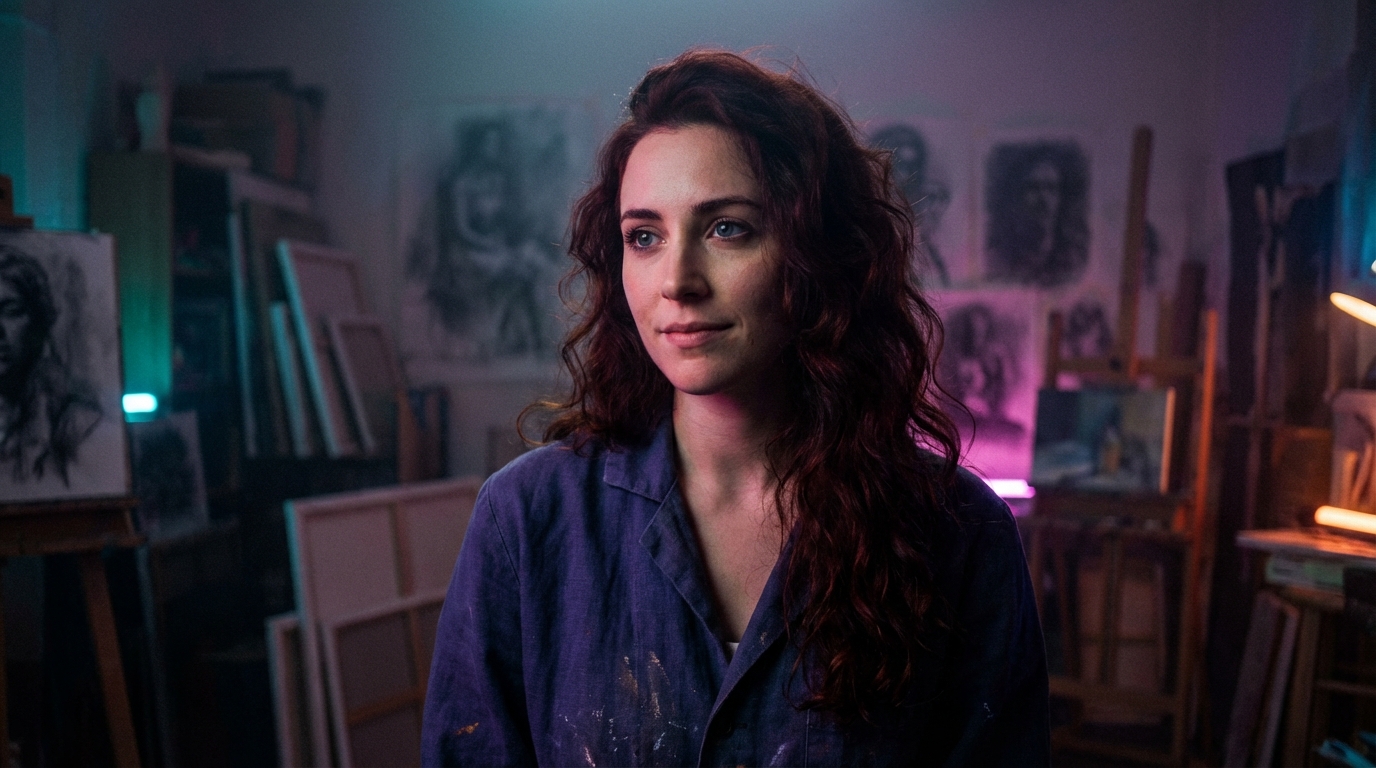
Born into Beauty and Craftsmanship
Sarah Louise Pafistis entered the world on 14 September 2002 at Royal Hobart Hospital, the first child of Adrian Louis Pafistis and Sharon Louise Pafistis (née Reynolds). Her birth represented hope and promise for a young couple who had already bridged continents to build their life together—Adrian, the Australian-born builder with Greek heritage, and Sharon, the Cornish hairdresser who had made Tasmania her home. Sarah's middle name honoured her mother's own middle name, a quiet gesture of continuity and connection that would prove prophetic as the two women navigated parallel journeys of creative expression and resilient adaptation.
The Battery Point mansion where Sarah spent her childhood was itself a work of art—a custom-designed home that her father had both designed and built, representing the pinnacle of his architectural vision. The modern mansion blended contemporary design with classic European elegance, featuring a grand entrance with Renaissance-inspired columns, a spacious foyer, and an expansive living area with soaring ceilings and floor-to-ceiling windows providing breathtaking views across Hobart's harbour. For Sarah, this was not merely a house but the physical manifestation of her parents' combined creative vision—her father's structural precision meeting her mother's aesthetic sensibility.
The property included a luxurious heated pool where Sarah learned to swim, a built-in barbecue area where family gatherings unfolded, and meticulously landscaped gardens where her mother tended vegetables with the same careful attention she brought to styling hair. Sarah's earliest memories were filled with light—the distinctive Tasmanian quality of illumination pouring through those floor-to-ceiling windows, catching dust motes in the afternoon sun, creating ever-shifting patterns that perhaps first sparked her interest in visual composition.
Her family environment was deeply bicultural. From her father, Sarah inherited Greek-Australian heritage—stories of her grandfather Kostas's poker tournaments in Melbourne, traditions of filoxenia (sacred hospitality), the rhythms of Greek Orthodox celebrations. From her mother came Cornish heritage—tales of fishing villages and cliff-side cottages, of her grandmother Iris's seamstress precision, of The Rose Harbour Tearooms where beauty was created from simple ingredients. This complex ancestry gave Sarah a sense of belonging to multiple traditions whilst being fully rooted in none—a pattern that would repeat when circumstances later forced her between worlds entirely.
When Sarah was four years old, her sister Brooke Isabella Pafistis arrived on 9 November 2006, transforming Sarah from only child to eldest daughter. The shift brought new responsibilities and new identity. Sarah became protector, role model, quasi-parental figure even at her young age—patterns that would intensify as family circumstances grew more complicated. Yet she also gained a companion, someone with whom to share the peculiar experience of growing up Pafistis, of navigating between their parents' combined heritages, of understanding that their family was somehow different from others around them.
The Pafistis household was characterised by creative expression and intellectual curiosity. Adrian taught both daughters to observe buildings with critical eye, to understand how structures revealed their makers' values and priorities. Sharon encouraged aesthetic experimentation, transforming their home into a space where artistic pursuits were not merely tolerated but celebrated. Weekends were filled with family outings—hikes on Mount Wellington where Adrian pointed out geological formations and discussed sustainable architecture, visits to Salamanca Market where Sharon examined textiles and colour combinations, beach trips where both girls were encouraged to collect materials for creative projects.
The family also included Zephyr, a mischievous ferret whose playful antics and endless curiosity provided comic relief and unconditional affection. For Sarah, Zephyr became an unlikely anchor during difficult times—a creature whose stolen trinkets and impromptu treasure hunts reminded her that joy could exist even amidst loss, that not everything had to carry weight and meaning.
The Emergence of Artistic Voice
Sarah's creative talents manifested early and unmistakably. By age five, she was drawing with unusual focus and precision, creating compositions that suggested intuitive understanding of balance and form. Her parents recognised this gift and nurtured it carefully—providing quality art supplies, enrolling her in community art classes, taking her to exhibitions at the Tasmanian Museum and Art Gallery where she could observe works by both established and emerging artists.
Unlike many children whose artistic interests prove transitory, Sarah's commitment deepened as she matured. Drawing and painting became her primary language, the means through which she processed experiences and emotions that words couldn't adequately capture. Her work during primary school years was characteristically bright and imaginative—landscapes filled with impossible colours, portraits that captured emotional essence rather than photographic accuracy, abstract compositions that suggested she was already developing personal artistic vocabulary.
At St Michael's Collegiate School, where Sarah began her secondary education, her talent found institutional recognition and support. The school's strong arts programme provided structured instruction in various mediums—oils, acrylics, watercolours, charcoal, pastels—allowing Sarah to develop technical proficiency whilst maintaining expressive freedom. Her teachers noted both her natural ability and her unusual emotional depth, the way her canvases seemed to contain layers of meaning that belied her age.
By her early teenage years, Sarah was beginning to gain recognition within Hobart's local art community. Her work appeared in student exhibitions that attracted attention from local galleries and collectors. She developed a distinctive style characterised by vivid imagination and emotional complexity—pieces that were technically accomplished yet retained rawness and vulnerability that made them compelling. Adult viewers sometimes found themselves unsettled by Sarah's work, sensing that the young artist was accessing and expressing something beyond typical adolescent experience.
Yet beneath this emerging artistic success lay quieter struggles. Sarah had always been introspective, prone to self-doubt and anxious rumination. She questioned whether her talent was genuine or merely fortunate accident, whether she could sustain artistic development, whether she would ever truly succeed as an artist. These were not unusual concerns for a creative adolescent, but Sarah experienced them with particular intensity, perhaps sensing even then that her path would not be straightforward.
She was also a natural caretaker, frequently stepping into quasi-parental roles for her younger sister Brooke when their parents' demanding careers consumed their attention. Adrian's construction company required long hours and constant availability; Sharon's salon business meant early mornings and late evenings. Sarah became the one who helped Brooke with homework, who listened to her practice piano, who mediated minor conflicts and provided emotional support. This responsibility deepened their bond but also left Sarah feeling pressured to suppress her own anxieties and doubts to maintain stability for her sister.
The Fracture: Adrian's Disappearance
On 30 July 2018, when Sarah was fifteen years old, her father Adrian left their Battery Point home for what should have been a routine work consultation. He never returned. The immediate aftermath was characterised by confusion and disbelief—surely there was simple explanation, surely he would contact them soon, surely this was temporary disruption rather than fundamental rupture.
But as hours became days and days became weeks, the reality settled with crushing weight. Adrian was gone. Police investigations revealed unsettling patterns—connections to other disappearances, mysterious client names, circumstances that seemed to defy rational explanation. Sarah watched her mother Sharon navigate this impossible situation with determined composure, maintaining routines, cooperating with detectives, protecting her daughters from the full horror of not knowing.
For Sarah, Adrian's disappearance shattered the carefully constructed sense of normality she had relied upon. The Battery Point mansion—previously a sanctuary of creative expression and family warmth—became a mausoleum of memories, each room echoing with absent presence. The architectural details her father had so carefully designed now seemed to mock his absence, the empty spaces where he should have been growing more pronounced with each passing day.
Sarah's art during this period underwent dramatic transformation. The bright, imaginative canvases of her earlier work gave way to darker, more abstract pieces filled with jagged edges and discordant colour palettes. Her paintings became expressions of a world that no longer made sense, attempts to process grief and confusion that had no adequate outlet through conventional means. Teachers and fellow students noticed the change, some disturbed by the rawness of Sarah's new work, others recognising it as authentic artistic response to genuine trauma.
She struggled to balance her own emotional devastation with the need to support Brooke, who at eleven years old required explanations Sarah couldn't provide and reassurance Sarah didn't feel. She watched Sharon throw herself into the investigation, connecting with other families who had experienced similar mysterious disappearances, pursuing leads that official channels had dismissed. Sarah found herself simultaneously admiring her mother's determination and resenting the way it left Sarah responsible for maintaining household stability.
The weeks following Adrian's disappearance marked Sarah's transition from adolescence to something else—a premature adulthood forced by circumstances, a loss of innocence that couldn't be recovered. Her artistic work became her refuge, the one space where she could express the full complexity of her feelings without needing to protect others or maintain appearances. Yet even this refuge felt hollow, as she questioned whether creating beauty had any meaning when the person who had most encouraged her talent was gone.
Portal Crossing and Impossible Reunion
On 17 August 2018, weeks after Adrian's disappearance, Sarah's world shifted again in ways that defied comprehension. The specifics of how Sharon, Sarah, and Brooke came to cross through a Portal into another dimension remain somewhat unclear—whether Sharon had discovered the Portal's existence through her investigation, whether they were given genuine choice about crossing, whether they were manipulated or coerced. What is certain is that on that day, the three Pafistis women left Earth behind and entered Clivilius, the alien world where Adrian had been forcibly taken.
The reunion with Adrian was complex and emotionally fraught. Sarah felt simultaneous relief, confusion, and anger—relief that he was alive, confusion about the impossible circumstances, anger at the months of separation and unanswered questions. Why hadn't he found a way to contact them? Why hadn't he fought harder to return? Why had he allowed them to suffer through weeks of not knowing whether he was dead or alive?
These questions, largely unspoken but deeply felt, created an emotional chasm between father and daughter that reunion alone couldn't immediately bridge. The years of close relationship—the weekend hikes, the discussions of architecture, the quiet father-daughter moments that had characterised Sarah's childhood—felt simultaneously recent and impossibly distant. They were together again, but they were not the same people who had separated, and the intervening trauma had changed them both in ways that made reconnection difficult.
Adaptation and Alienation in Bixbus
The settlement of Bixbus, where the Pafistis family found themselves, was harsh and unforgiving—a stark contrast to the comfortable Battery Point mansion Sarah had known. The arid landscape, the makeshift infrastructure, the constant dust, the lack of privacy in a small community where everyone knew everyone's business—all of it pressed on Sarah with oppressive weight.
She found the transition profoundly difficult. Where Sharon approached their new reality with determined pragmatism, channelling her entrepreneurial skills and community-building experience into making Bixbus liveable, Sarah experienced primarily loss. She had left behind not just physical comforts but her entire artistic support network—the teachers who had nurtured her talent, the galleries that had begun to show interest in her work, the peers who understood her creative process. In Bixbus, she was merely another displaced refugee, her artistic identity suddenly irrelevant in a context dominated by survival concerns.
Yet Sarah's artistic skills found new application in Bixbus, though not always in ways she welcomed. She used her talents to help beautify the settlement, painting murals on communal buildings, designing visual elements for public spaces, contributing to the aesthetic transformation of the colony from mere survival camp to something approaching liveable community. This work became a symbol of hope and defiance for other settlers—proof that beauty could persist even in harsh circumstances, that human need for aesthetic expression transcended practical necessity.
Privately, however, Sarah often struggled with a sense of futility. Did her murals truly matter? Did beautifying buildings change the fundamental reality of their displacement? Was she creating art or merely decorating a prison? The barren landscape left her feeling stifled, the lack of solitude and privacy that had been essential to her creative process making genuine artistic work difficult. She longed for the freedom she had taken for granted in Hobart—the ability to retreat to her private space, to work without constant awareness of others' needs and expectations, to create without feeling that every piece had to serve some communal purpose.
Her relationship with Sharon became more complicated in Bixbus. Where they had once shared aesthetic sensibility and creative understanding, they now found themselves at odds about fundamental approaches to their situation. Sharon's unyielding determination to adapt, to make the best of impossible circumstances, to build community and maintain dignity—all admirable qualities—sometimes clashed with Sarah's lingering scepticism and grief for the life they had lost. Sarah often felt caught between wanting to support her mother and yearning to carve out a life of her own, free from the expectations placed upon her as eldest daughter and as talented artist whose work was now community resource rather than personal expression.
Her bond with Brooke remained strong but was also tested by their circumstances. Sarah continued to serve as protector and confidante, helping her younger sister navigate the challenges of adolescence in an alien world, supporting Brooke's musical aspirations even when proper instruments were scarce. Yet the protective role also wore on Sarah, creating resentment she couldn't fully acknowledge—resentment not at Brooke herself but at the circumstances that required Sarah to be caretaker rather than simply sister, that demanded her strength when she felt most vulnerable.
Creative Defiance and Private Struggle
Despite these challenges, Sarah displayed remarkable resilience, though of a different character than her mother's practical determination. Her artwork in Bixbus became acts of creative defiance—assertions that beauty mattered, that aesthetic expression was not luxury but necessity, that human beings required more than mere survival. The murals she painted across Bixbus's buildings became landmarks, gathering places, touchstones for a community learning to build identity in displacement.
Yet the public nature of this work also created pressure. Sarah's art was no longer purely personal expression but community service, her talent now conscripted into collective project of making Bixbus liveable. She found herself creating to meet others' needs rather than her own inner compulsions, producing work that inspired hope in others whilst privately questioning whether hope was justified.
Her private artwork—the pieces she created for herself rather than for communal spaces—grew increasingly dark and abstract. These works, which few others saw, explored themes of imprisonment, loss, alienation, the gap between performance and authentic feeling. They were technically accomplished but emotionally raw, suggesting that Sarah was processing trauma through her art even as she questioned art's capacity to truly address or heal such profound disruption.
She struggled with questions of artistic authenticity and purpose. Was she still an artist if her work served primarily practical community-building functions? Could beauty truly matter in context of forced displacement and ongoing uncertainty about future? What did it mean to create in circumstances she hadn't chosen and from which she couldn't escape? These were not merely abstract philosophical questions but lived dilemmas that affected her daily experience and sense of self.







