4338.10 · January 10, 2018 AD
Salt and Ceremony
The streets of Hobart shimmer with the promise of another unseasonable scorcher as Nathan Cowdrey performs the most carefully guarded observance in his daily architecture — the walk from his bus stop to a waterfront café on Salamanca Place, where a barista whose name he has spent six months deliberately not learning prepares his latte with a rosetta that never varies. The ritual is small, wordless, and disproportionately precious.
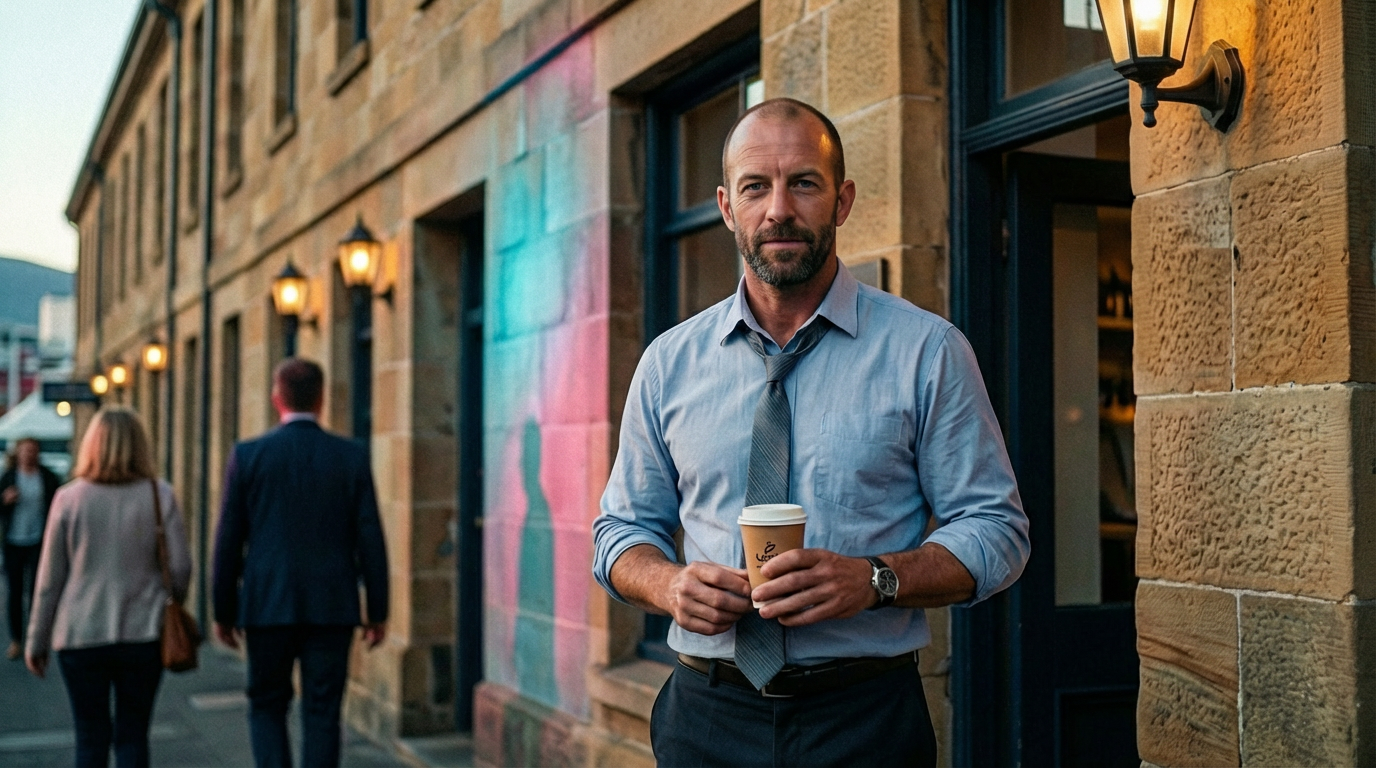
Nathan Cowdrey's feet met the pavement with a lightness that had no business belonging to a man in leather shoes on a Wednesday morning. He noticed it as he stepped from the bus — that peculiar buoyancy in his stride, as though the warm Hobart air had conspired with his mood to subtract a few kilograms from his frame and redistribute them elsewhere. It was the kind of step that belonged to someone younger, someone less encumbered by the accumulated weight of routine and responsibility, and he was aware that it made him look faintly ridiculous — a grown man bouncing along the footpath like a child who had been told the day held something worth hurrying toward.
The bus groaned away behind him in a cloud of diesel and compressed air, and Hobart's CBD opened before him in the slanting gold of early morning. January had brought a run of days that pushed the city toward temperatures it was neither built for nor temperamentally suited to endure. Already the sandstone façades along the waterfront were drinking the sun, their colonial surfaces warming from the cool ash-grey of dawn to the honeyed amber that Nathan had come to associate with Hobart at its most beautiful — that narrow window between the city's waking and the moment the heat became punitive. By midday, the pavement beneath his leather soles would radiate enough warmth to cook an egg. At seven-thirty, it merely tingled.
He could taste salt. The Derwent was close enough to season the air, that faint mineral signature threading through the diesel fumes and the eucalyptus drifting down from the slopes of kunanyi — the mountain he was still training himself to call by its proper name after a decade of habit that clung like burrs. The peak dominated the western skyline as it always did, its dolerite columns catching the dawn light at angles that made the summit appear to breathe, and Nathan felt the familiar tug of reassurance that its permanence provided. Mountains did not change. Mountains did not leave.
He was aware that his attachment to routine had intensified over the preceding year in ways a therapist might find productive to explore. The bus at the same time each morning. The same route through the same streets. The same destination, approached with the same anticipation, yielding the same small reward. He had become an architect of predictability, constructing his days from reliable materials — sandstone and timetables and the knowledge that certain things would be exactly where he had left them — and if the structure he had built was perhaps more fortress than home, he preferred not to examine the distinction too carefully.
Salamanca Place received him in its customary weekday quiet. The Saturday market crowds existed only as a future possibility, and in their absence the cobblestones carried his footsteps with an intimacy that the weekend bustle would have swallowed. The old warehouses — repurposed now into the galleries and boutiques and artisanal establishments that constituted Hobart's particular brand of curated charm — stood with their doors closed or just opening, their sandstone flanks warm to the touch where the sun had already reached them. A gull tracked his progress from a bollard with the unsettling attentiveness of a creature that had evolved to judge.
The café occupied a corner position that maximised its exposure to the morning light, broad windows throwing golden rectangles across the pavement outside. Nathan could smell it from twenty paces — that rich, faintly narcotic promise of freshly ground beans and butter-laminated pastry, the olfactory signature of a place that took its coffee with a seriousness bordering on devotion. He had been coming here for six months, five mornings a week, thirty weeks of near-identical visits that had calcified from habit into something more deliberate, more necessary, more fragile than he cared to admit.
It was not, he would insist to anyone who asked, about the coffee. The coffee was exceptional — single-origin beans roasted in small batches by a solemn craftsman in New Town who approached the process with monastic intensity — but exceptional coffee could be sourced elsewhere. Nor was it the aesthetic, though the exposed sandstone and native pepper on the menu and the carefully casual industrial fittings achieved precisely the effect they were designed to achieve. What drew Nathan back, morning after morning, what had transformed a café visit from convenience into ceremony, stood behind the counter with honey-brown stubble and a smile that made the whole performance worthwhile.
Nathan did not know his name. This was not an oversight but a policy — six months of deliberate, disciplined ignorance maintained against every social instinct that urged him to simply ask. He had catalogued the young man with the thoroughness of a naturalist documenting a rare species: the way the stubble grew darker along the jaw and lighter near the ears, the copper undertones that summer coaxed from it, the dimple that appeared in the left cheek when the smile reached its full wattage. He knew the precise angle at which the barista tilted the milk pitcher to achieve the micro-foam that distinguished competence from artistry. He knew the rhythm of the tamping, the positioning of the cup, the controlled arc of the pour.
What he did not know — the name, the surname, the life that existed beyond the counter — he preserved as a conscious absence, a mystery whose power resided in its unsolved state. To learn the barista's name would be to collapse the wavefunction of possibility into a single, fixed reality. There might be a partner waiting at home. There might be indifference. There might be something worse than indifference — politeness, the careful kindness of a young man letting down a regular customer gently. The unnamed version of this person existed in a space where none of those outcomes had yet been determined, and Nathan was not prepared to sacrifice that quantum comfort on the altar of actually knowing.
The door opened to the familiar envelope of sound and warmth. Steam hissing. Conversation murmuring. A beat pulsing through the speakers at the calibrated volume that energised without demanding attention — something contemporary that Nathan's younger colleagues would have identified instantly and that he could only file under the broad heading of music made by people whose names he would never retain. The queue was short. The barista turned.
The smile arrived like sunrise over the Derwent — unhurried, warm, carrying no obligation. Not the mechanical courtesy of customer service but something that appeared, however briefly, to acknowledge Nathan as a specific person rather than the next transaction in a sequence. The dimple materialised. Nathan's ribs performed that small interior lurch they had been performing for six months, that flutter he had long since stopped attempting to rationalise.
The question was asked and answered in a nod. Nathan's voice, he suspected, would have emerged at an unreliable pitch had he attempted to deploy it. Thirty-four years old and rendered functionally mute by grooming and a well-timed smile — a condition for which no medical literature existed and no remedy suggested itself beyond the obvious one he lacked the nerve to pursue.
He watched the preparation unfold with the attention he might once have given to a concert or a sunset. The precise tamping of the grounds. The mechanical whir of the machine. The milk transforming under the steam wand from ordinary liquid into something glossy and paint-thick, that alchemical transition that separated technicians from artists. The pour came in a controlled white stream, cutting through crema, and the rosetta bloomed on the latte's surface with its customary mathematical symmetry — each leaf identical to every leaf that had preceded it across six months of mornings. A signature. A covenant.
Their fingers did not touch during the handover. They never did. The space between his hand and the barista's existed as a charged absence — a centimetre of air dense with everything Nathan would never say and the barista would never be given the opportunity to answer. The cup was warm against his palms, the heat seeping through ceramic into skin, and the aroma rose in a fragrant cloud — dark chocolate, stone fruit, something almost floral beneath — filling the small space between Nathan's face and the drink with a richness that was, for one suspended moment, indistinguishable from happiness.
The parting pleasantries exchanged themselves with the reliable precision of liturgy, and Nathan stepped away from the counter. He navigated the thickening queue, pushed back through the door, and the waterfront morning received him in a blaze of harbour light. Constitution Dock shimmered. Fishing boats rocked at their moorings, their hulls fragmenting into bright shards on the water's surface. The heat was building, the city shedding its dawn gentleness in favour of something more insistent, and Nathan walked through it with the barista's borrowed energy pulsing in his step and the latte warming his palms while the memory of the smile warmed something less easily located.
Nathan walked with the barista's borrowed energy pulsing through him, his step carrying that inexplicable bounce, the latte warming his palms while the memory of the smile warmed something less easily located. He passed the sandstone façades that whispered of convict labour and colonial ambition, past the tourists consulting their phones with the bewildered enthusiasm common to visitors who had expected a quaint backwater and discovered instead a city with opinions about coffee. The morning stretched ahead, golden and uncomplicated, and for these last few minutes before the office building's glass façade imposed its demand for professional composure, Nathan allowed himself to inhabit the version of himself he preferred — the one who existed in café light and unnamed possibility, unanchored from the obligations that would shortly reclaim him.







