Richard Franklin Mitchell
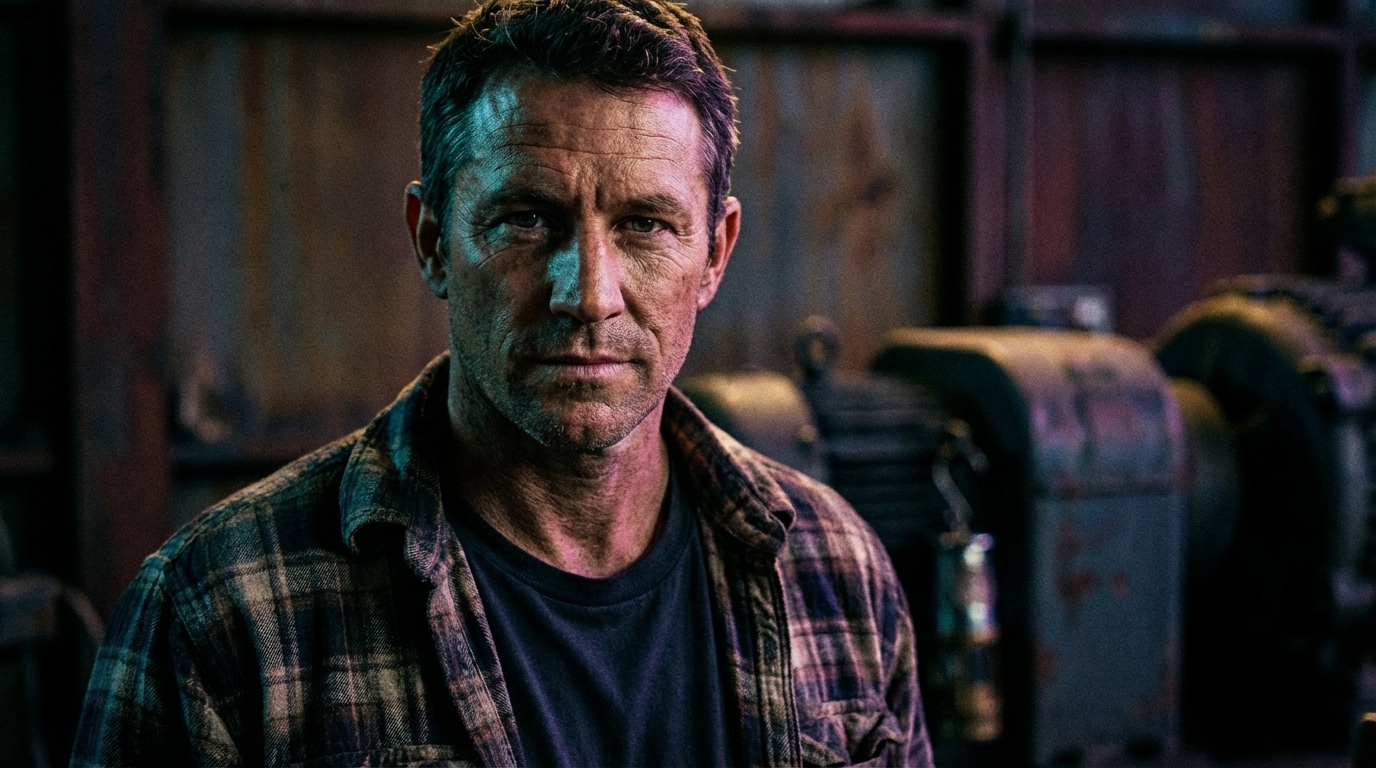
Richard Mitchell (1935–2002) embodied the stoic resilience of Broken Hill's mining community—a man whose identity was forged in darkness underground and tempered by decades of dust, danger, and discipline. Rising from labourer to foreman, he commanded respect through uncompromising standards and quiet competence, his advocacy for safety measures born from the tragedy of losing his youngest brother Peter in a 1972 mine collapse. He married schoolteacher Margaret Lawson in 1958 and raised three children, though his relationship with youngest son Ethan—the "ghost whisperer" whose supernatural sensitivities defied everything Richard understood—remained an unbridgeable gulf of loving incomprehension until his death from mining-related lung disease.
Early Life and Family Background
Richard Franklin Mitchell was born on 22 June 1935 at Broken Hill District Hospital in New South Wales, the first child of John "Jack" Mitchell and Edith Mitchell, née Clarke. His arrival came during the depths of the Great Depression, when the mining town's fortunes had contracted along with the global economy, and families like the Mitchells counted every shilling with careful desperation. The weatherboard cottage on Oxide Street where Richard spent his earliest years was modest even by Broken Hill standards—three rooms for a family that would eventually number six, with an outhouse in the yard and water carried from the communal tap at the corner.
Jack Mitchell had followed his own father into the mines at fifteen, inheriting both the trade and the taciturn disposition that seemed to pass through generations of Mitchell men like an heirloom. He worked the underground shifts at the Broken Hill Proprietary Company, disappearing before dawn and returning after dark, his skin permanently grey with the fine dust that no amount of scrubbing could entirely remove. Jack was not unkind, but neither was he demonstrative; he showed his love through provision rather than affection, through presence rather than words.
Edith Mitchell, née Clarke, had grown up on a struggling pastoral station near Menindee before moving to Broken Hill in search of work during her late teens. She possessed the practical resilience of women raised in the harsh interior—capable with needle and thread, resourceful in stretching meals across lean weeks, and possessed of a quiet strength that held the household together through countless small crises. She supplemented the family income by taking in laundry from miners' families, her hands perpetually reddened and rough from lye soap and scrubbing boards.
The Mitchell household expanded steadily through the late 1930s and 1940s. Thomas "Tom" arrived in 1938, Nancy in 1941, and finally Peter in 1946—four children spaced across eleven years, their births marking the rhythms of a family rooted deeply in Broken Hill's red earth. Richard, as the eldest, assumed responsibilities early: minding younger siblings, helping with household chores, learning to read the moods of overworked parents and adjust his behaviour accordingly.
Jack's older sister Alice also featured in Richard's childhood, though their relationship was complicated by Alice's reputation in the community. Born in 1905, Alice Mitchell had never married, instead establishing herself as the town's unofficial healer and keeper of esoteric traditions. She lived alone in a small cottage on Crystal Street, where neighbours came seeking folk remedies for ailments that resisted conventional treatment and explanations for occurrences that defied rational understanding. Jack tolerated his sister's eccentricities but made clear his disapproval of her "superstitious nonsense," a dismissal young Richard absorbed and would later echo with even greater conviction.
Childhood and Education
Richard's childhood unfolded against the backdrop of recovery and war. The late 1930s brought gradual improvement to Broken Hill's fortunes as global demand for metals increased, though the onset of World War II in 1939 transformed the town into a strategic asset requiring protection. Richard was four years old when the conflict began and would carry fragmented memories of blackout curtains, ration books, and the January 1942 news that Japanese submarines had attacked Sydney Harbour—suddenly making the war feel terrifyingly close to the isolated mining town.
He attended Broken Hill Public School from 1940, walking the dusty streets each morning with his younger brother Tom trailing behind. Richard proved an adequate student—bright enough to satisfy his teachers, practical enough to see little point in education beyond its immediate utility. He excelled in mathematics and mechanical drawing, subjects that rewarded logical thinking and concrete application, while showing less enthusiasm for literature or history, which seemed to him exercises in imagination rather than substance.
The household atmosphere valued hard work over academic achievement. Jack Mitchell had left school at fourteen; his sons would be expected to do the same, trading desks for mine shafts as generations of Mitchell men had done before them. Richard accepted this trajectory without resentment. The mines represented stability, community, belonging—a continuation of family tradition that required no justification beyond its own existence.
His aunt Alice occasionally attempted to interest young Richard in her world of herbs and folklore, but he resisted with the stubborn scepticism his father had modelled. When Alice spoke of spirits lingering in certain places or patterns repeating across generations, Richard would shift uncomfortably and find reasons to be elsewhere. The supernatural held no appeal for a boy whose universe was built on tangible realities: ore to be extracted, machinery to be maintained, wages to be earned. Whatever Alice saw in the shadows, Richard refused to look.
Entering the Mines
Richard left school in December 1950, two weeks after his fifteenth birthday, and presented himself at the Broken Hill Proprietary Company hiring office the following Monday. The foreman who interviewed him noted the Mitchell surname with recognition—Jack was a reliable worker, and sons of reliable workers were generally reliable themselves. Richard was assigned to the surface crews initially, hauling materials and learning the rhythms of industrial operation before being permitted underground.
His first descent into the earth came in March 1951. The cage dropped through darkness while Richard gripped the safety rail, his stomach lurching as the daylight above shrank to a distant square and then disappeared entirely. The tunnel at the bottom was low, hot, and filled with sounds that would become the soundtrack of his working life: the clang of metal on rock, the rumble of ore carts on rails, the shouts of men coordinating in the gloom. The air tasted of dust and sweat and something older—the minerals themselves, perhaps, releasing their ancient presence into the atmosphere.
Richard took to mining with the natural aptitude of someone born to the trade. He learned to read the rock face for signs of instability, to operate the pneumatic drills that made his arms ache for hours after each shift, to move through tunnels with an economy of motion that conserved energy for the long hours underground. His supervisors noted his reliability and his willingness to take on difficult assignments without complaint. Within two years, he had been promoted to a drilling crew; within five, he was leading shifts of his own.
The work was dangerous, and Richard witnessed injuries and deaths that would stay with him throughout his life. A cave-in during his third year killed two men Richard had shared lunch with that same morning. A faulty explosive detonation in 1956 left another colleague permanently deaf. These tragedies were absorbed into the fabric of mining life—acknowledged, mourned briefly, and then set aside so that work could continue. To dwell too long on death was to invite paralysis, and paralysis was a luxury no miner could afford.
Marriage and Family
Richard met Margaret Lawson at a community dance in August 1956, the same month his father Jack died of a heart attack while working the night shift underground. The juxtaposition of grief and attraction created a strange emotional landscape that Richard navigated with characteristic stoicism—attending his father's funeral on a Thursday, returning to the dance hall the following Saturday because life, he had learned, continued regardless of loss.
Margaret was twenty-two, a schoolteacher at Broken Hill Primary with a degree from Sydney Teachers' College that made her something of an anomaly in a town where most women married young and worked only until children arrived. She was pretty in an unconventional way—dark hair, bright eyes, a quick smile that transformed her otherwise serious expression—and possessed of an imagination that Richard found simultaneously attractive and slightly unsettling. Where he saw the world in concrete terms, Margaret perceived layers of story and meaning that escaped his notice entirely.
Their courtship was brief by the standards of the era. Richard proposed in February 1958, and they married at St Peter's Anglican Church on 12 April of that year—a modest ceremony attended by family and colleagues, followed by a reception at the Miners' Memorial Hall. They moved into a rented cottage on Garnet Street, the first home Richard had occupied that didn't belong to his parents, and began the process of building a life together.
Margaret brought warmth to Richard's existence that he hadn't known he was missing. Her presence softened the edges of his stoicism, drew laughter from him that surprised both of them, and created a domestic space that felt genuinely like home rather than merely shelter. She understood that his reserve was not coldness but simply the way Mitchell men were built—products of an environment that rewarded endurance over expression—and she loved him without requiring him to be someone he wasn't.
Their first child, William, arrived on 3 March 1960. Richard held his newborn son in arms still aching from the day's shift and felt something shift in his chest—a fierce protectiveness, an overwhelming sense of responsibility, and beneath it all a terror of inadequacy that he would never quite shake. He had become a father, and fatherhood demanded things he wasn't certain he possessed: patience, tenderness, the ability to guide a life toward destinations he could barely imagine.
Sarah followed in 1963, and finally Ethan in 1968—three children born across eight years, each receiving the love Richard was capable of expressing even when the words themselves remained trapped somewhere between his heart and his throat. He worked longer hours to provide for his growing family, taking extra shifts when they were offered, building a modest savings account that would protect against the uncertainties mining families knew too well.
The Death of Peter Mitchell
On 14 September 1972, Richard's youngest brother Peter was killed in a mine collapse at Level 12 of the South Mine. He was twenty-six years old, married with two young children, and had been working the same underground shifts that had claimed their father sixteen years earlier. The collapse occurred without warning—a section of roof giving way under pressure that geological surveys had failed to identify, burying Peter and one other miner beneath tons of rock before anyone could react.
Richard was on the surface when the emergency sirens began their wailing. He joined the rescue crews that worked through the night and into the following day, digging with hands that bled through his gloves, refusing rest until his body simply refused to continue. They recovered Peter's body eighteen hours after the collapse, crushed but recognisable, his face frozen in an expression that Richard would see in nightmares for years afterward.
The loss transformed Richard in ways both visible and hidden. His advocacy for safety measures, already present, became almost obsessive. He challenged supervisors who cut corners, documented violations that others preferred to ignore, and pushed for improvements in ventilation, shoring, and emergency procedures that eventually became standard practice throughout the Broken Hill operations. Some colleagues appreciated his dedication; others resented his interference. Richard cared little either way. Peter's death had revealed the cost of complacency, and he would not permit that lesson to be forgotten.
His relationship with his surviving siblings became strained in the aftermath. Tom, who had also witnessed the rescue effort, retreated into alcohol and eventually developed the lung disease that would kill him in 1999. Nancy had long since departed for Sydney and seemed relieved to maintain distance from the tragedy. Only Alice, their elderly aunt, attempted to offer comfort—speaking of souls at rest, of patterns completing themselves, of meanings that transcended the merely physical. Richard listened politely and understood nothing. His brother was dead. No amount of mystical interpretation could change that fact.
The Foreman Years
Richard's promotion to foreman came in 1978, recognition of nearly three decades of service and a reputation for competence that even his critics couldn't dispute. The role brought new responsibilities: managing crews of twenty to thirty men, coordinating operations across multiple levels, ensuring that production targets were met without sacrificing the safety standards he had fought so hard to establish. It also brought distance from the physical labour he had performed since adolescence—more paperwork, more meetings, more time spent on the surface rather than underground.
He adapted to the administrative demands with the same methodical approach he brought to everything. His office in the mine's surface complex was spartan—a desk, two chairs, a filing cabinet containing meticulously organised records of shifts worked, incidents reported, and grievances addressed. He spoke to his workers with gruff directness, expecting the same honest effort he demanded of himself and tolerating no excuses for substandard performance. The men under his supervision either respected him or resented him; few felt indifferent.
The 1980s brought changes to the mining industry that Richard observed with wary acceptance. Mechanisation reduced the number of workers needed; corporate restructuring created new hierarchies of management; economic pressures demanded increased productivity from decreased workforces. He navigated these shifts as best he could, advocating for his men when their jobs were threatened, accepting the inevitable when advocacy failed, and maintaining the professional standards that had defined his career regardless of what the accountants in distant offices might decree.
Throughout these years, Margaret remained his anchor. She had retired from teaching after Ethan's birth, devoting herself to raising their children and maintaining the household that had become Richard's refuge from the demands of work. Their marriage was not without tension—his emotional reserve frustrated her sometimes, her imaginative flights baffled him often—but the fundamental bond between them remained strong. They had built something together, and that something endured.
The Distance from Ethan
Of Richard's three children, Ethan presented the greatest challenge to his understanding. Bill had followed the expected path—mining engineering degree, position with the company, a career trajectory that Richard could comprehend and support. Sarah had chosen nursing, a practical profession that aligned with her nurturing temperament. But Ethan seemed to exist in a different world entirely, one populated by whispers and shadows and meanings invisible to ordinary perception.
The transformation had begun after Alice's death in October 1981. Ethan was thirteen, and something in him seemed to shift with the old woman's passing. He began speaking of voices, of presences, of knowledge that arrived through channels Richard couldn't identify and didn't wish to examine. Margaret, with her appreciation for folklore and mystery, listened to their son with concern but also fascination. Richard listened with growing alarm.
"The boy needs help," he told Margaret one evening, after Ethan had described hearing Alice's voice rising through the floorboards. "Medical help. There's something wrong with him."
Margaret had disagreed, gently but firmly. She saw in Ethan something that reminded her of the stories Alice had shared over the years—a sensitivity to unseen dimensions of reality that might be gift as much as affliction. Richard saw only symptoms that required treatment, a son drifting away from the solid world he understood into territories that frightened him precisely because they defied his comprehension.
The distance between father and son widened through Ethan's teenage years. They occupied the same house but increasingly different universes. Richard's attempts at connection—offers to explain mining operations, invitations to watch football matches, suggestions of practical career paths—were met with polite but obvious disinterest. Ethan's world revolved around cemeteries and ghost stories, around his aunt Alice's old books and the reputation he was acquiring as Broken Hill's "ghost whisperer." To Richard, it seemed like wilful eccentricity at best, emerging mental illness at worst.
He loved his son. This was never in question, never something Richard doubted even in his most frustrated moments. But love and understanding were different things, and he possessed only the former. The gulf between them became something both acknowledged and neither could bridge—a permanent feature of their relationship rather than a problem to be solved.
The Murder of Violet Dallow
In September 1988, Ethan's secret relationship with sixteen-year-old Violet Dallow ended in tragedy when she was murdered by the Silverton Strangler following her disappearance from a Girl Guides camp. Richard learned of his son's involvement only afterward, when police questioned Ethan as part of their investigation. The revelation that his twenty-year-old son had been conducting a clandestine romance with a teenage girl—meeting in cemeteries at night, sharing obsessions with the supernatural and unexplained—confirmed Richard's worst fears about the path Ethan had chosen.
He attended Violet's funeral at Margaret's insistence, standing in the crowded pews of St Matthew's Church while a community mourned a young woman he had never met. Ethan was there too, his face a mask of grief that Richard couldn't read. Whatever his son had felt for Violet Dallow—love, infatuation, something darker—it was beyond Richard's capacity to evaluate. He knew only that Ethan had been drawn into tragedy through the same fascination with death and mystery that had always troubled him, and he couldn't help wondering whether different choices might have led to different outcomes.
The investigation cleared Ethan of any involvement in Violet's murder, but suspicion lingered in some quarters of Broken Hill. Richard found himself defending his son to colleagues who expressed doubts—not because he understood Ethan, but because blood demanded loyalty regardless of understanding. The experience drew them no closer together; if anything, the shared trauma deepened the silence between them, creating new regions of pain that neither could articulate.
Declining Years
Richard retired from active mining in 1995, his body finally demanding acknowledgment of the decades of strain it had endured. His lungs had deteriorated from years of dust exposure—the chronic cough that had been a minor annoyance in his fifties becoming a constant companion in his sixties, stealing breath that had once seemed inexhaustible. His back ached with the accumulated damage of countless heavy lifts; his hands, once steady enough to operate the most delicate equipment, now trembled when he raised his morning tea.
He accepted these diminishments with the same stoicism that had characterised his entire life. Complaint served no purpose; the body aged and eventually failed, and no amount of protest would alter that trajectory. He continued visiting the mine sites when his health permitted, watching operations with the critical eye of someone who had spent forty-five years understanding every aspect of the work. Younger foremen tolerated his presence with varying degrees of patience, some grateful for his accumulated wisdom, others eager for him to relinquish his grip on an industry that had moved beyond him.
Margaret remained his constant companion through these years, her own health relatively robust, her patience with his stubbornness apparently inexhaustible. They fell into the rhythms of retired life: quiet mornings, shared meals, evening television programs that Richard watched with half-attention while his thoughts drifted to memories of the underground. The cottage on Garnet Street, where they had raised three children and weathered countless storms, became their entire world.
His relationship with Ethan remained distant but not severed. They saw each other at family gatherings—Christmas dinners, birthday celebrations, the occasional Sunday lunch that Margaret orchestrated with diminishing hope of reconciliation. The conversations were polite and superficial, carefully avoiding the territories of belief and meaning that separated them. Richard had made his peace with the fact that he would never understand his youngest son, and Ethan had apparently made the same accommodation in reverse.
Final Days and Death
Richard's health declined sharply in early 2001. The lung disease that had been slowly stealing his breath accelerated its progress, leaving him unable to walk more than a few steps without gasping. Doctors confirmed what he had long suspected: decades of inhaling mine dust had damaged his lungs beyond recovery. Treatment could ease symptoms but not halt the underlying deterioration. He received this news with characteristic calm, asking only how long he might expect and what arrangements should be made.
The final eighteen months of Richard's life unfolded in the narrowing territory between his bedroom and the sitting room, with occasional excursions to the verandah when weather and energy permitted. Margaret nursed him with devoted attention, refusing offers of professional care, determined that her husband would spend his remaining time in the home they had built together. Sarah visited frequently, her nursing skills proving valuable in managing his increasing frailty. Bill came when work allowed, their conversations focused on practical matters—the house, the finances, the arrangements that would need to be made.
Ethan visited too, though less frequently and with visible discomfort. The sight of his father diminished—this man who had seemed so solid, so immovable, now reduced to bones and laboured breathing—appeared to affect him deeply. They spoke little during these visits, but Richard occasionally caught Ethan watching him with an expression he couldn't interpret. Perhaps his son was listening for something, attending to dimensions of his father's dying that Richard himself couldn't perceive.
On 9 October 2002, Richard was admitted to Broken Hill Base Hospital following a severe respiratory crisis. The doctors stabilised him but were clear about the prognosis: his lungs were failing, and no intervention could reverse the process. He spent his final weeks in a private room overlooking the town he had never left, receiving visitors who came to pay respects and share memories of the man he had been.
Richard Mitchell died on the morning of 27 October 2002, with Margaret and Sarah at his bedside. His final words, spoken to Sarah as she adjusted his pillow, were entirely characteristic: "Don't let them make a fuss."
Funeral and Legacy
The funeral service was held on 31 October 2002 at St Peter's Anglican Church—the same sanctuary where Richard had been baptised as an infant and married as a young man. In accordance with his wishes, the ceremony was simple and traditional, devoid of elaborate eulogies or excessive sentiment. Bill delivered a brief tribute highlighting his father's work ethic, dedication to safety, and devotion to family—words that captured the surface of Richard's life without attempting to plumb its depths.
The church was filled with mourners: mining colleagues spanning four decades, neighbours from Garnet Street, members of the community who had known Richard as a fixture of Broken Hill's industrial landscape. At the back of the church, separate from the family pews, stood Ethan—silent, watchful, his presence an acknowledgment of the complicated bond that death could not entirely dissolve.
Richard was buried at Broken Hill Cemetery, his grave marked by a headstone reflecting the unadorned practicality that had defined his character:
Richard Mitchell1935–2002Husband. Father. Miner.A life built on hard work.
The inscription captured something essential about the man, though it necessarily omitted the complexities—the love he struggled to express, the grief he carried privately, the son he could never understand, the world he helped build one shift at a time. Those who had known him would remember the fuller picture; those who came after would see only the words carved in stone.
His legacy lived on in the safety protocols he had championed, the miners he had trained, and the family he had sustained through decades of steady provision. Bill inherited the family home and maintained it as Richard would have wished—practically, without sentiment, with attention to the structural integrity that kept a house standing through the years. Margaret survived him by thirteen years, joining him in the cemetery in 2015 after a quiet death that mirrored his own.
And Ethan continued his solitary communion with the dead, visiting his father's grave on occasion, perhaps listening for a voice that had never learned to speak the language his son could hear. Whether Richard's spirit lingered—whether any part of him remained in the earth that had claimed his body—was a question the living son could not definitively answer.
Some silences, even death cannot break.







