Rebecca Anne Monk
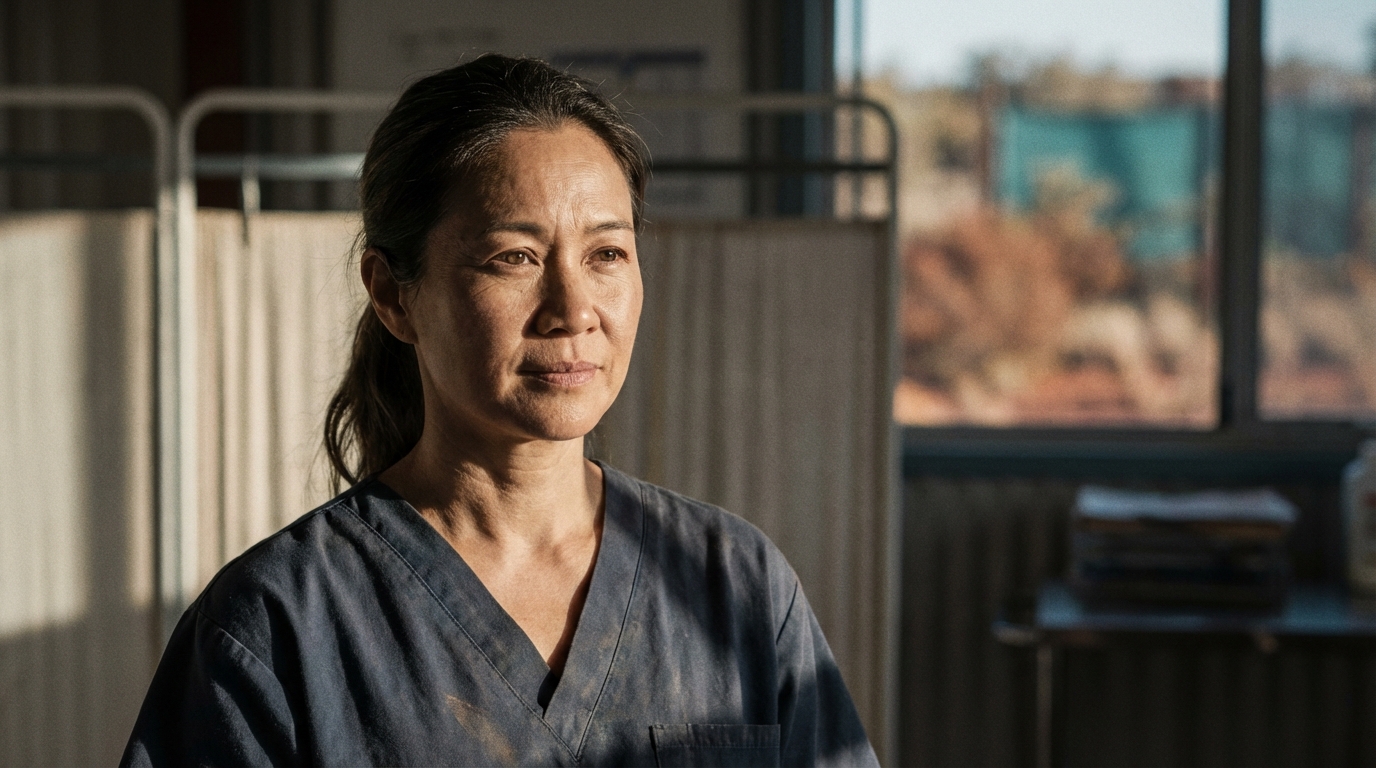
Rebecca Anne Monk (b. 14 February 1972) is a distinguished physician whose life's work in rural and Indigenous healthcare was forged in the crucible of adolescent tragedy. The daughter of a civil engineer and a Hong Kong immigrant café owner, she grew up navigating the cultural intersection of her mother's heritage and the Australian Outback's pragmatic expectations. When her best friend Violet Dallow was murdered by the Silverton Strangler in September 1988, the sixteen-year-old's grief became the foundation for a medical career devoted to healing Australia's most forgotten communities.
Early Years and Cultural Foundation
Rebecca's arrival at 6:42 a.m. on 14 February 1972 brought unexpected joy to the Monk household at 89 Crystal Street, Broken Hill. Her father, John Robert Monk, was a thirty-one-year-old civil engineer who had assumed the family complete after years of careful planning. Her mother, Mei-Lin Huang, was twenty-seven and managing her increasingly successful café whilst caring for their household when she discovered the pregnancy just as morning sickness coincided with Broken Hill's summer heat. The Valentine's Day birth seemed prophetic for a child who would dedicate her life to healing others' hearts, both literally and figuratively.
The household operated as a fascinating fusion of cultures and expectations. John's Australian pragmatism—measured, methodical, and focused on tangible outcomes—merged with Mei-Lin's Hong Kong heritage of fierce determination wrapped in public composure. Dinner conversations switched freely between English and Cantonese, with young Rebecca absorbing both languages as naturally as breathing. The dining table became a classroom where engineering blueprints competed for space with café accounts, where discussions of infrastructure development intersected with stories of Mei-Lin's immigrant journey from the crowded markets of Hong Kong to the red dust of the Australian Outback.
The Golden Dragon Café on Argent Street served as Rebecca's second home and first education in human nature. From the age of four, she occupied a corner booth after school, completing homework whilst observing the complex social dynamics of small-town Australia. Miners discussed union politics over dim sum, schoolteachers gossiped over jasmine tea, and Aboriginal elders found rare welcome in an establishment that treated all customers with equal dignity. This early exposure to Broken Hill's social strata, viewed through her mother's immigrant perspective, developed Rebecca's understanding that healing required addressing more than physical symptoms—a philosophy that would later define her approach to community medicine.
Her younger brother Thomas arrived on 17 March 1975 as a planned contrast to Rebecca's surprise appearance. Where she displayed intense curiosity and verbal precocity, Thomas demonstrated mechanical aptitude and comfortable silence. Their relationship, loving but not particularly close, reflected different interpretations of parental expectations. Rebecca absorbed the pressure to excel academically as a pathway to professional success, whilst Thomas found refuge in the practical skills that connected him to their father's engineering world.
Primary school at Burke Ward revealed exceptional academic abilities that surprised even parents with high expectations. Rebecca did not merely excel; she dominated, consistently achieving marks that prompted teachers to suggest acceleration. Yet social integration proved more complex. Her mixed heritage, obvious intelligence, and mother's "foreign" business created distance from classmates who could not categorise her within Broken Hill's established social structures. The isolation might have been crushing without the discovery of kindred spirits in Violet Dallow, Michelle Richards, and eventually Mandy Glasson.
The Friendship That Defined Everything
The friendship with Violet began during their third year of primary school when both girls, assigned as reading partners, discovered a shared passion for stories that transcended curriculum requirements. Where Rebecca approached literature analytically, dissecting themes and metaphors with precision, Violet responded emotionally, feeling characters' experiences as personal truth. This complementary dynamic—Rebecca's careful logic balancing Violet's passionate intuition—created a bond that would define both girls' adolescent years and, tragically, shape the entire trajectory of Rebecca's future.
At Broken Hill High School, which Rebecca entered in 1984, her academic programme barely contained her intellectual hunger. She consumed advanced texts in science and mathematics whilst maintaining perfect marks in required courses. Teachers alternated between admiration and mild concern at her intensity, wondering whether such drive indicated unhealthy pressure or genuine passion. The truth lay somewhere between—Rebecca genuinely loved learning but also carried an acute awareness of her parents' sacrifices, particularly Mei-Lin's stories of arriving in Australia with nothing but determination.
The friendship circle that crystallised around Violet, Rebecca, Michelle, and Mandy provided essential balance to academic intensity. Their dynamic reflected complementary strengths: Violet's adventurous spirit, Rebecca's analytical mind, Michelle's warm inclusiveness, and Mandy's artistic sensitivity. Together they navigated high school's social complexities, creating a sanctuary where differences became strengths rather than liabilities. Rebecca's home, with Mei-Lin's endless supply of homemade dumplings and John's amusing engineering anecdotes, became the favoured gathering spot where cultural fusion felt natural rather than forced.
Literature remained Rebecca's secret passion despite the public emphasis on science. Jane Austen's social observations resonated with someone navigating between cultures, whilst George Orwell's political allegories reflected her growing awareness of systemic inequalities. The essays she wrote for English class, arguing feminist interpretations of classic texts or challenging colonial narratives in Australian literature, revealed a developing social consciousness that would later influence her medical career's direction toward Indigenous health advocacy.
Physical exploration complemented her intellectual pursuits through hiking expeditions into the surrounding outback. These solitary walks, often lasting entire Saturdays, provided necessary decompression from academic pressure and social complexity. The harsh landscape's indifference to human ambition offered perspective that Broken Hill's claustrophobic social dynamics obscured. Rebecca learned to read the land's subtle signals—which plants indicated water, how weather patterns developed, where dangerous animals sheltered—skills that would prove unexpectedly valuable during her Flying Doctor years.
September 1988 arrived with unusual omens. The dust storms that typically marked spring's arrival held off, replaced by unseasonable rain that turned the red earth temporarily green. Rebecca, focused on final year examinations and university applications, initially dismissed Violet's growing obsession with the disappearance of a local researcher named Sally Harlow as a temporary distraction. A mysterious letter that arrived on 20 September, suggesting a connection between the current disappearance and a historical pattern of vanishings around Silverton, triggered Rebecca's protective instincts. She recognised danger in Violet's determination to investigate but could not resist the puzzle's intellectual appeal.
The Tragedy That Changed Everything
The Girl Guides camping trip to Silverton on 30 September should have been a routine adventure—a bonding experience before final examinations consumed their attention. Rebecca packed with characteristic efficiency: medical supplies beyond the required first aid kit, extra water, a compass despite the designated campgrounds, and a journal for documenting observations. The bus journey's excitement, with friends singing camp songs whilst the red landscape scrolled past the windows, provided no warning of the approaching horror.
That evening began with typical teenage rebellion. The illicit cigarette break, sneaking from cabins after lights out, represented a mild transgression that felt momentous to sheltered girls. Rebecca did not smoke but accompanied her friends from a combination of loyalty and curiosity about human behaviour under peer pressure. A distant fire's glow, spotted through the scrubland, triggered different responses—Michelle's nervousness, Mandy's artistic fascination, Violet's immediate determination to investigate, and Rebecca's analytical assessment of possible explanations.
The encounter with Gordon Richards and Liam Abernathy around their concealed fire shifted the atmosphere from adventure to unease. Gordon's cruel prank with a knife, Liam's stories about murdered backpackers, the way firelight transformed familiar faces into threatening masks—all triggered Rebecca's scientific understanding of danger signals. Her rational mind catalogued concerning behaviours whilst her emotional intuition screamed warnings she could not quite articulate. The walk back to camp, with Violet unusually quiet beside her, felt like crossing from innocence into something darker.
Morning's revelation of Violet's absence triggered a systematic response that would characterise Rebecca's future crisis management. Whilst others panicked, she methodically searched the cabin for clues, questioned witnesses about last sightings, and established a timeline. Her clinical approach masked a tsunami of terror—her best friend had vanished, the patterns suggested a connection to Sally Harlow's fate, and she felt the crushing recognition that warnings ignored had potentially fatal consequences.
The discovery of Violet's body weeks later, posed with the Silverton Strangler's theatrical cruelty, shattered something fundamental in Rebecca's worldview. The friend who had balanced her cautious nature with adventurous spirit, who had made her laugh when academic pressure threatened to overwhelm, who had understood the complexity of straddling cultures—reduced to a headline and a statistic. The funeral, attended by hundreds including strangers drawn by media coverage, felt like a violation of intimate grief. Rebecca delivered the eulogy with composure that amazed observers, not recognising that clinical detachment had become her survival mechanism.
University Years and Finding Purpose
The decision to pursue medicine at the University of Melbourne emerged from complex motivations. Partly she wanted to honour Violet's memory through helping others; partly she needed to escape Broken Hill's suffocating sympathy; partly she sought to challenge herself with a demanding programme that left little time for grief. The application essay, discussing healthcare disparities in rural communities, carefully omitted the personal tragedy that actually motivated her career choice. Acceptance in 1990 with an academic scholarship validated her intellectual abilities whilst providing financial independence from her parents' continued sacrifices.
Melbourne's urban complexity initially overwhelmed someone accustomed to Broken Hill's predictable rhythms. The university's sandstone buildings and manicured lawns seemed to promise transformation into someone unburdened by trauma. Reality proved more complex. Medical school's competitive atmosphere, dominated by privately educated students with generations of medical tradition behind them, reinforced her outsider status. Rebecca compensated through relentless study, arriving at libraries before dawn and leaving after midnight, transforming grief into academic excellence.
Anatomy classes presented an unexpected challenge. The cadavers, respectfully referred to by assigned names rather than "bodies," triggered visceral memories of Violet's posed form described in police reports she had insisted on reading. The first dissection prompted a panic attack that she disguised as a bathroom break, returning with composure that fooled classmates but not herself. Private counselling sessions, paid for with café wages rather than admitting need to her parents, helped develop the compartmentalisation skills essential for medical practice.
Rural health emerged as her specialisation through a combination of principle and pragmatism. Principle because Broken Hill had taught her how geography determined health outcomes; pragmatism because rural medicine scholarships provided financial support whilst competitive specialisations remained dominated by connected insiders. The placement programmes in remote communities—Arnhem Land, Cape York, central Australian missions—revealed healthcare disparities that made Broken Hill seem positively cosmopolitan.
Research into Indigenous health disparities became both an academic focus and a personal mission. The systematic analysis of how colonial structures created ongoing health crises resonated with her understanding of marginalisation developed through her mother's immigrant experience and her own mixed-heritage navigation. Her honours thesis, examining the correlation between cultural discontinuity and chronic disease prevalence, earned a university medal whilst establishing her reputation as a scholar-activist willing to challenge comfortable assumptions.
Friendships during university remained superficial, limited by her inability to discuss the formative trauma. Study group colleagues appreciated her intellectual contributions without accessing emotional depths. Romantic relationships started promisingly but foundered on her inability to trust completely, to believe that presence guaranteed permanence. The few who learned about Violet received a carefully edited version—friend died in an accident, very sad, motivated medical career—that avoided confronting survivor's guilt and ongoing trauma.
Early Medical Career
The internship at Royal Melbourne Hospital beginning in 1997 provided a baptism by fire into medical reality. The emergency department rotations, where academic knowledge met human crisis, revealed an aptitude for remaining calm whilst others panicked. Senior residents noticed her ability to manage multiple critical cases simultaneously, to make rapid decisions with incomplete information, and to comfort grieving families whilst maintaining professional boundaries. The evaluation noting "exceptional crisis management skills" did not recognise that these abilities had been forged in personal tragedy.
The paediatric oncology rotation nearly broke her carefully constructed defences. Children dying despite medical intervention, parents' grief echoing across sterile corridors, the arbitrariness of which patients responded to treatment—all triggered memories of another arbitrary death. Yet something shifted during a night shift when an eight-year-old named Lucy, terminal with leukaemia, asked if dying hurt. Rebecca's honest answer—that medicine would prevent physical pain whilst people who loved her prevented emotional isolation—came from experience rather than any textbook. Lucy's peaceful death two days later, surrounded by family Rebecca had helped prepare, suggested that healing transcended cure.
The residency's broad exposure confirmed rural and emergency medicine as a calling rather than a convenience. Urban specialists' comfortable certainties, supported by immediate access to advanced diagnostics and specialist consultations, contrasted sharply with rural doctors' requirement for comprehensive competence. The memory of Broken Hill's limited resources, where delayed diagnosis or transfer meant death, motivated her mastery of procedures typically left to specialists. Colleagues joked about her over-preparation; she remembered that Violet's death might have been prevented with a faster response.
The Royal Flying Doctor Service position in 2002 represented a homecoming without returning home. Based in Broken Hill but serving vast territory, she could contribute to the community that shaped her whilst maintaining professional distance from personal history. The interview panel, impressed by her clinical competence and rural background, did not recognise her surname's connection to the local café or the teenage tragedy. This anonymity within familiarity provided the ideal balance for processing unfinished grief whilst serving others.
Flying Doctor service demanded skills beyond medical textbooks. Treating patients in aircraft turbulence, making life-or-death decisions with basic equipment, and managing logistics across impossible distances all required innovation and resilience. The Indigenous communities, initially suspicious of the young female doctor, gradually accepted her through consistent presence and cultural respect learned from Mei-Lin's immigrant experience. The elder who named her "Doctor Who Listens" did not know how Violet's silenced voice had taught her the importance of hearing others.
The systematic health education programmes she developed addressed prevention rather than just treatment. Teaching diabetes management through cooking demonstrations, explaining cardiovascular health through storytelling, and creating visual aids that transcended literacy barriers all reflected her understanding that health existed within cultural context. National recognition in 2007 felt hollow compared to an Aboriginal grandmother's comment that "Doctor Bec" had helped her granddaughter believe university was possible.
Loss and Leadership
Her father's death on 14 September 2003 from industrial lung disease struck with bitter irony—a civil engineer who built presumably safe infrastructure, felled by the very particles his projects had disturbed. Rebecca was thirty-one, established in her Flying Doctor role but still processing the foundational trauma of her teenage years. Supporting Mei-Lin through widowhood whilst managing her own unresolved grief created parallel healing processes. John's methodical approach to life, his emotional reserve that had sometimes frustrated her, now seemed like a template she had unconsciously adopted. The engineer's blueprint had become the doctor's diagnostic framework—structured, reliable, and protective against emotional chaos.
Professional success during this period could not fill the personal emptiness. Relationships remained superficial, limited by geographic isolation and emotional unavailability. The few attempts at romance with fellow medical professionals foundered on her inability to prioritise relationship over patient needs. One ex-partner's accusation—that she loved humanity abstractly but could not love individuals specifically—cut deeper than intended because it contained a truth she could not acknowledge.
The decision to pursue postgraduate studies in public health and medical administration reflected an evolving understanding that individual healing meant little without systemic change. The University of Sydney programme, completed whilst maintaining part-time clinical work, provided frameworks for analysing the healthcare failures she had witnessed. Her thesis examining rural hospital funding formulas' inherent biases earned distinction whilst establishing her reputation as a policy advocate rather than just a clinician.
A lecturing position at the University of Adelaide from 2009 to 2012 allowed her to shape the next generation of rural health practitioners. Teaching medical students and supervising clinical training in remote settings brought unexpected satisfaction. The young residents, overwhelmed by responsibility and exhausted by demands, reminded her of her own vulnerability beneath the competent exterior. Her mentoring style—demanding excellence whilst acknowledging humanity—created a loyal following among trainees who appreciated honesty about medicine's emotional toll.
The recruitment by Monash Medical Centre in 2013 offered an opportunity to influence metropolitan healthcare whilst maintaining rural advocacy. The senior consultant position in general medicine provided a platform for implementing changes inspired by rural experience. Her insistence on considering social determinants of health, on involving family in treatment planning, and on recognising cultural factors in diagnosis initially met resistance from colleagues comfortable with traditional approaches. Gradual acceptance came through demonstrated improved outcomes, particularly for marginalised patients others had written off.
Present Day
The appointment as Director of Community Health Outreach Programs at St Vincent's Hospital Melbourne in 2021 represented the culmination of a career trajectory from individual to systemic healing. The position, created specifically for her unique combination of clinical excellence and social advocacy, provided authority to implement comprehensive programmes addressing health inequities. Initial resistance from staff comfortable with the traditional charity model gradually gave way to recognition that genuine community partnership produced superior outcomes.
The programmes developed under her leadership reflect her hard-won understanding that health transcends medicine. Partnerships with housing organisations address homelessness as a health issue; collaboration with food security advocates recognises nutrition as medicine; coordination with mental health services acknowledges trauma's physical manifestations. The statistical improvements in community health markers matter less to her than individual stories of transformation.
Rebecca Monk embodies the paradoxes that define many trauma survivors who transform wound into purpose. She is professionally accomplished yet personally isolated, intellectually brilliant yet emotionally guarded, helping thousands whilst struggling to accept help herself. The awards accumulating—the Order of Australia Medal, the Australian Medical Association Excellence Award, the Human Rights Commission Recognition—validate a career built on the foundation of unresolved grief.
Her relationship with Broken Hill remains complex. Regular returns for community health consultations allow contribution without confronting personal ghosts. The Golden Dragon Café, now managed by Thomas whilst Mei-Lin maintains a symbolic presence at eighty years old, provides neutral ground for family connection. The memoir she has been writing for five years remains unfinished, stuck at September 1988. The clinical voice describing childhood and education fractures when approaching Violet's death, dissolving into fragments that resist coherent narrative.
The cold case review of Violet's murder in 2024 triggered unexpected upheaval. Contact from investigators seeking background information forced confrontation with deliberately suppressed memories. The clinical details she had memorised—strangulation method, body positioning, evidence patterns—suddenly became visceral rather than intellectual. The possibility of resolution after thirty-six years brought not relief but terror that answers might prove more unbearable than questions.
The apartment in Fitzroy now contains one photograph—herself with Violet, Michelle, and Mandy at fifteen, laughing at Michelle's kitchen table. Retrieved from storage during pandemic lockdown when isolation triggered unexpected grief, it sits on the bedside table as a reminder of the capacity for joy that existed before tragedy. Sometimes, particularly on 30 September anniversaries, she talks to teenage Violet, updating her on medical advances, on lives saved, on how her death created meaning through others' healing. The woman who walks toward the hospital for a night shift carries both versions of herself—the brilliant teenager with unlimited potential and the seasoned doctor who learned that healing others does not heal oneself but provides an acceptable alternative to wholeness.







