4338.208 · July 27, 2018 AD
Reasons
Glenda’s world tilts when a golden blur returns joy to the campsite—and a set of keys leads her to something even more precious. As the dust is swept from old memories and new purpose flickers into view, one boy’s quiet determination and one woman’s aching reunion converge to remind them all: not everything that matters is lost in the crossing.
“In Clivilius, you don't find answers—you find reasons. And sometimes, that's enough.”
"What do you make of them?" Kain asked, his tone casual but not without intent, as I squatted beside him. Together, we watched the sheen of wet concrete glisten under the harsh Clivilius sun. He and Jamie worked with steady rhythm, guiding the screed back and forth across the surface of the newly poured slab, the soft rasp of metal on concrete oddly soothing amidst the background silence.
"It looks mostly even. Maybe a bit more over there," I replied, pointing to a slight dip where the mixture hadn’t quite settled. My finger hovered above it without touching—it still felt too raw, too precise to disturb.
"I meant the new people," Kain clarified with a chuckle, glancing up from his work just long enough to catch my expression. His eyes sparkled with quiet amusement, though they missed nothing.
I followed his gaze as it drifted off towards the horizon, where Karen and Chris had wandered. Their figures were small now, nearly swallowed by the shimmering heat haze. Chris had vanished into his new obsession—chasing the invisible trail of fertile ground. Karen had joined him not long after helping with the tent, eager and unhesitating, as if pulled by the same invisible thread.
"They are well educated, especially Karen," I said, my voice thoughtful. I rested my arms on my knees, staring at the path they’d taken. "I can see why Luke chose to bring them here." The words came with ease, though a shadow of caution remained tucked just behind them. Trust in Clivilius was not freely given—not anymore.
"You really think—" Kain began, but he never finished the question.
A sudden burst of barking shattered the calm.
The sharp, familiar cadence cut through the air like music. My head snapped around, eyes already scanning the horizon before my body even reacted. My heart skipped once—then leapt.
I knew that bark.
A wide, unrestrained smile spread across my face before I even saw her. The air itself seemed to change, to hum with recognition. I stood quickly—then ran.
"Lois!" My voice rang out, half-shout, half-laugh. I didn’t care who heard me.
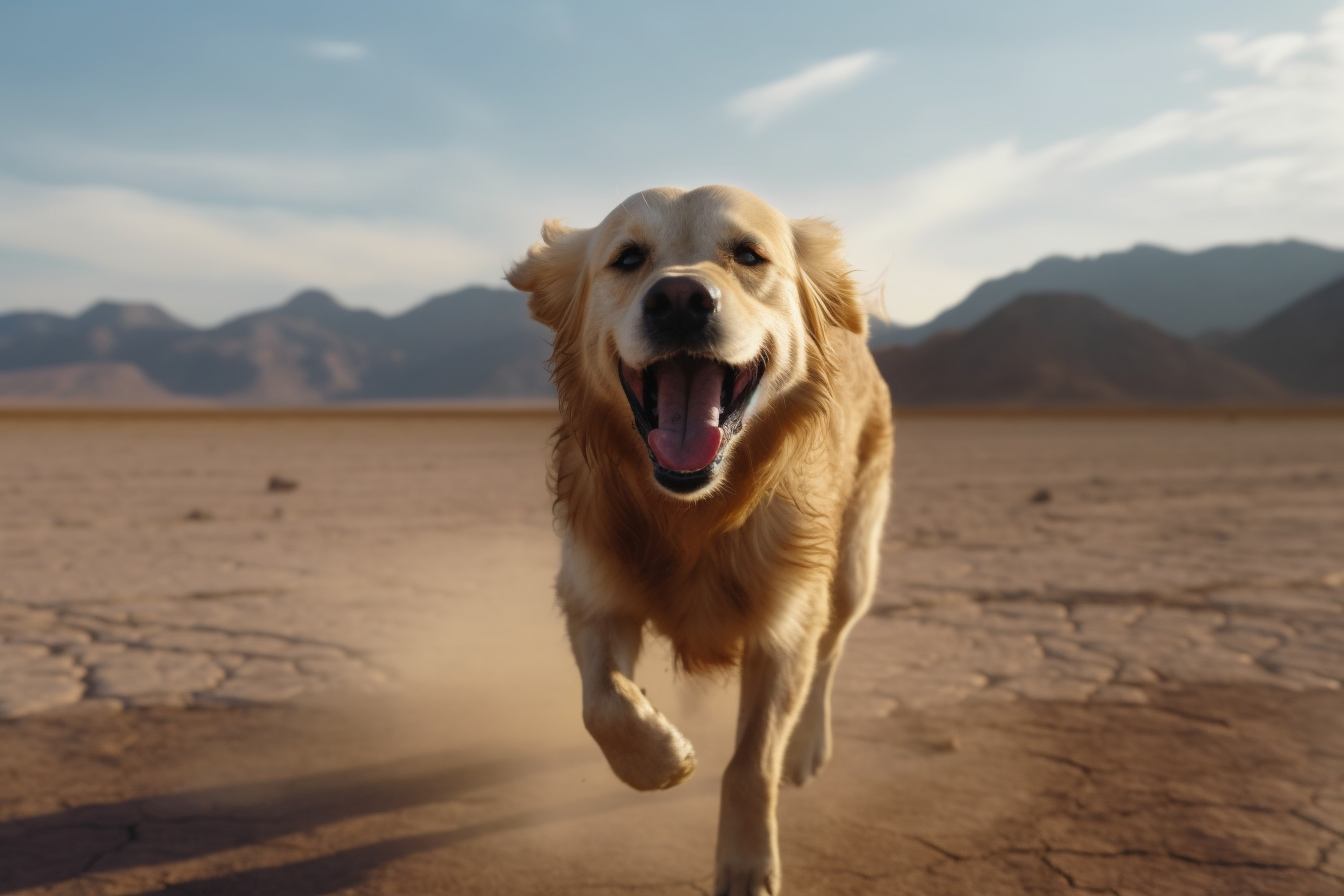
She crested the rise of the nearest hill like some sunlit apparition, her golden coat catching the light in every ripple and bound. Her ears flopped wildly with each leap, her mouth stretched in that unmistakable retriever grin. My chest tightened with joy, and I picked up speed, boots kicking up dry grit as I jogged to meet her.
She didn’t slow—she collided into me with full, joyful force, and I dropped to a crouch just in time to receive the onslaught of her affection. Her tail became a blur of motion, her tongue swiped recklessly across my cheeks, and her paws scrabbled against my arms as if trying to climb into me.
I laughed—loud and unguarded—clapping both hands against her silky, sun-warmed fur. The scent of dust and dog was oddly comforting, a mix of this world and the last. I pressed my forehead briefly to hers, eyes closing for a breath. It was like steadying myself. For the first time in what felt like days, I felt truly grounded.
In a place that defied logic, where every discovery walked the knife-edge between wonder and danger, Lois was a reminder that love—real, loyal, slobbering love—had followed me here too.
As Joel emerged from the tent, Duke and Henri flanking him like a pair of mismatched escorts, I felt an unexpected warmth rise in me. The two Shih Tzus—one bold, one perpetually wary—stuck close to his legs, their small frames oddly dignified despite the dust clinging to their coats.
Lois, however, had no such sense of decorum.
She bounded across the campsite, a blur of golden fur and unfiltered joy, her paws barely touching the ground. The sun lit her from behind, gilding her movement with a halo-like shimmer. Her exuberance was palpable—infectious in the best possible way.
"Lois, down!" My voice cut through the commotion, firm but not scolding. I couldn’t help the affection that crept into the tone. She skidded slightly, slowing just enough to avoid bowling over Joel, who, to my surprise, crouched down with open arms.
Despite everything—his injury, the fatigue etched around his eyes—he welcomed her with quiet grace. His arms wrapped around her neck as she nosed in close, licking at his cheek, her tail thumping the ground like a heartbeat made visible. A soft smile crept across his face as he ran his fingers through her coat, the action unhurried, almost reverent.
The sight tugged at something deep within me—a quiet reminder of how connection, even the simplest kind, could chip away at pain’s hold.
"Seems she likes you," I said, my smile broadening, pleased by the ease between them. Joel didn’t reply, but the way he rested his forehead briefly against her shoulder said enough.
Duke, ever the curious one, began his approach. His little paws made barely a sound on the dry earth as he circled wide, nose twitching. He gave Lois a thorough once-over, the tip of his nose darting cautiously towards her flank. The suddenness of the gesture startled Lois into a comical hop backward, her front paws lifting off the ground in a burst of startled play. But her tail didn’t stop wagging—it picked up pace, a rhythmic signal of unbothered delight.
Henri, true to form, had no intention of partaking. With a theatrical swivel of his head, he executed a swift retreat back into the tent, vanishing into the canvas folds like a stage actor exiting with quiet indignation. No doubt he was headed for the refuge of his bed, where the world couldn’t touch him.
Lois, undeterred by the miniature drama, resumed her jubilant bouncing, circling Duke in playful arcs. Her tongue lolled sideways, her paws barely pausing between movements. Duke watched her with growing fascination, his stance low and alert, every muscle tuned to this strange new energy. He stepped forward again, nose gently nudging her side this time, more confident now.
I stood still, watching this strange, silent choreography unfold—the tentative sniff, the joyful leap, the wary retreat, the open-hearted return. The delicate negotiation of animals. Their world of gestures and instincts, so often overlooked, carried more sincerity than most words ever could.
And in the middle of it all, Joel smiled.
"We need a road," Paul’s declaration cut through the dry afternoon air with the authority of a man who’d decided he'd waited long enough. He was descending the final slope into camp, boots crunching against the loose soil, each step sending up little plumes of dust that drifted and hung in the stillness before settling behind him like a breadcrumb trail.
Lois, ever the diplomat of delight, didn’t hesitate. She broke away from Duke and Joel with a jubilant burst of energy, bounding towards Paul as if he'd returned from war, not just from a short trip over the ridge. Her tail whipped the air in wide, gleeful arcs, ears flapping with every enthusiastic stride. It was the kind of unfiltered joy that only she seemed capable of bringing, and I felt its warmth even from a distance.
Paul’s arm moved suddenly—a lazy, underhanded toss that caught me off guard. The glint of keys spinning mid-air triggered my reflexes, and I reached out just in time to snatch them from the air. The unexpected gesture left me blinking, surprised for a beat before curiosity settled in. I looked down at the keys in my hand, the familiar weight of metal oddly reassuring in this surreal place.
"Ooh, you’re a gorgeous girl," Paul cooed, his voice melting into the affectionate register he reserved solely for dogs. He dropped into a crouch beside Lois, fingers diving into her golden ruff as she wriggled with uncontainable pleasure. Dust rose softly around them, catching the light in lazy spirals.
"My car’s here?" The words slipped out before I could stop them, carried by disbelief. I held up the keys like a question mark, shaking them slightly for emphasis.
"Yeah," Paul replied casually, without lifting his gaze from Lois. His attention was all hers for the moment.
"It got bogged just over the hill," he added after a beat, the remark tossed out like an afterthought.
"We definitely need a road," Kain chimed in with a dry chuckle, finding humour in the absurdity of our circumstances.
"I wouldn’t be laughing if I were you," Paul shot back, his tone light but pointed, a familiar glint in his eye. "You wanna be the one to collect the stuff in it or dig it out of the dust?" It was less a challenge and more a reality check—one delivered with a smirk and a shoulder shrug.
"Honestly," I huffed, exasperation creeping into my voice. "This camp is like living with a bunch of children sometimes." The words were borne of fatigue, yes, but there was no venom behind them. If anything, a thread of fondness wove through the complaint. Children, yes—but they were my children, in a way. My people. My mess.
I turned, keys clenched loosely in one hand, and began to walk towards the direction Paul had indicated. Lois and Duke padded after me, their footsteps quiet in the dust, their presence a steady reassurance against the backdrop of chaos.
"I don’t think she’s got any children," Jamie called out behind me, the tease tossed like a pebble skipping across a still pond.
"I heard that!" I shouted over my shoulder, unable to keep the grin out of my voice. Mock indignation mingled with amusement as I kept walking, boots crunching in rhythm with the wag of tails at my side.
For all the complaints and jabs and missteps, there was something unspoken weaving between us now—a camaraderie carved not just from necessity, but choice. We weren’t merely surviving. We were learning, together, how to live.
As the BMW finally came into view, my heart sank—just a little, but enough to catch my breath. There it was. My once-pristine, charcoal-painted saloon, now wearing a thick coat of ochre dust like a poorly chosen disguise. The layer muted its shine, dulled its contours, and seemed to mock the very idea of keeping anything clean or dignified in this place. The vehicle looked like a relic unearthed from the ruins of civilisation.
With a slow breath, I closed the distance between us. Almost without thinking, my hand reached out, fingers splayed as they came to rest against the bonnet. The heat of the sun still radiated through the fine grit clinging to the metal. I swept my palm across it in a futile gesture—half habit, half longing—but instead of restoring its former gloss, I simply shifted the dust into uneven streaks, drawing a vague arc of fingerprints that only made things worse.
The moment I withdrew my hand, I grimaced at the sight of my now-filthy palm. Of course. No rag in reach, no water, no sense. With a resigned breath, I wiped both hands down the front of my slacks. The fabric, already battle-worn from tent pitching, frying pan wielding, and dog wrangling, accepted the dirt like an old friend. Another layer added. Another mark of this place.
"Fuck! You’ve done a good job, Paul," Jamie’s voice sliced through my thoughts. He crouched by the rear wheel, inspecting the damage with a tone that blended disbelief and dry amusement. Sarcasm, yes—but not cruel. Not quite.
"It all happened so quickly," Paul replied, sounding genuinely put out, as though even he couldn’t believe how swiftly the land had claimed the vehicle. His words carried the faint tension of someone who hadn’t quite forgiven himself yet.
"I bet it did," Jamie shot back, his reply effortless in its scepticism, delivered with the casualness of someone who had seen too many things go wrong, too fast.
Kain chuckled under his breath. The sound was brief, low, but it softened the moment just enough to let the dust settle again.
Turning my attention to the passenger door, I opened it with a faint creak. The hinges groaned, stiff with heat and grit. Inside, a mismatched pile of blankets and pillows had been hastily crammed into the seat. The absurdity of it struck me—luxury car, makeshift linen cupboard.
Movement at the edge of my vision drew my attention—Paul, walking away, his figure retreating over the ridge.
"You’re not staying, Paul?" I called out reflexively, my voice laced with surprise and something else I couldn’t quite name. Concern, perhaps. His timing felt off. Premature.
He paused, his back still to us. "I don’t think Luke’s done yet," he said, his words floating back to us on the dry breeze. The ambiguity landed awkwardly, heavier than the dust. No clarification followed. He just kept walking.
I stood in place for a moment, letting the silence settle around us again. Behind me, I heard the scuff of boots on sandy ground as Kain crouched beside Jamie, both of them now studying the car like a half-sunken ship.
"Think we can dig it out?" Kain asked, the quiet resolve in his tone almost reassuring. He wasn’t one to waste time on lament.
"We’re gonna need more than just our bare hands," Jamie replied, matter-of-fact but not defeated.
I exhaled slowly, my gaze flicking between the car, the hill Paul had vanished over, and the horizon beyond. In Clivilius, even the simplest tasks came layered with meaning, effort, and the strange freight of things unsaid.
"Lois!" My voice rang out across the dusty plain, instinct taking over before I could think. I’d called without thinking, a sharp command edged with concern. The golden blur of her tail was still visible, swaying with purpose as she trotted after Paul, her loyalties torn and choosing movement over stillness. But the call was ignored—or perhaps simply swallowed by the vast, indifferent landscape. The wind stirred gently, carrying no reply.
I stood frozen for a moment, my hands resting on my hips, the keys still warm in my pocket. I watched as Lois’s form grew smaller beside Paul’s retreating silhouette, the two of them gradually dissolving into the shimmering distance beyond the next rise.
"Do you want to carry anything back now? Or wait to see if we can dig this car out?" Jamie’s voice came from behind me, dragging me back into the immediate.
"Hmm," I murmured, non-committal. My gaze lingered one last second on the empty ridge before I turned back to the BMW, leaning in through the open passenger door. My hand reached blindly at first, rifling past a rolled jumper and a loose bag of toiletries before closing around something blessedly familiar—my memory-foam pillow. My fingers tightened around it, the soft give of it instantly comforting in a way that felt absurdly important. I pulled it out with a firm tug. "I’ll take this one for now," I said, hugging it briefly against my chest.
"Joel?" Jamie’s voice shifted, edged with something unfamiliar—alertness, maybe even alarm.
The sound alone prickled at the base of my neck. I turned my head just enough to glimpse his posture change, his body straightening with sudden tension.
"I’ll check on him when I get back to camp," I said, assuming Joel was still resting in the shade, tucked away with Henri. But Jamie didn’t respond. Not immediately.
Then—his voice snapped through the air.
"Joel! What the hell are you doing here?" Urgency, unmistakable now.
I spun round. Too fast. The pillow in my arms slapped against the car door with a dull whump, nearly tumbling from my grasp. I caught it at the last second, fingers tightening instinctively.
There he was.
Joel stood a few metres away, swaying faintly, as if held to the air by sheer will. His face was pale, and his lips cracked, but his eyes—his eyes were resolute. The wind stirred his shirt against his thin frame, and for a heartbeat, he looked like he might vanish altogether.
"Help," he croaked, the word brittle and papery in the wind. But there was something in it. Not desperation. Purpose.
"You need help?" Jamie was already moving, stepping quickly to his side, concern laced through his voice. He reached out, one hand gently pressing against Joel’s shoulder, trying to guide him back.
Joel shook his head—firmly, if not steadily. "Help," he repeated, but this time his trembling finger pointed not at himself… but at the BMW.
I blinked. He wants to help with the car.
Jamie’s jaw tightened. I saw the argument forming behind his eyes. "I don’t think that’s a good idea," he said, his voice lowering. "You should be resting."
I stepped forward, brisk and deliberate, brushing Jamie’s hand aside with a swift but measured motion. "Here, take this," I said to Joel, offering him the pillow. My voice was calm but unwavering. "As long as you are careful, I think some movement will be beneficial."
It wasn’t just about the car. It was about dignity. About the boy who’d emerged from the river broken and bloodless but hadn’t let that define him. He wanted to do something. And I understood that more than I could say.
Jamie’s pout was almost comical, his lips tugging into a line of obvious disapproval as he looked between us. But beneath it, his eyes betrayed something else—love, fear, frustration, all twisted together.
"Are you sure you can manage?" he asked, gently now.
Joel nodded.
A simple gesture, but it landed with the force of conviction.
Hands now free, I turned my attention back to the car, pushing another pillow aside to lean through the rear passenger door. The back seat was a jumbled mess—an improvised packing job that bore all the hallmarks of haste. Blankets, an old parka, three mismatched shopping bags spilling their contents in a chaotic tangle. I sighed, bracing myself as I began to dig through it.
My fingers brushed a hard, rectangular edge beneath a folded raincoat, and I froze. My breath stalled. My hand darted back with more purpose now, parting the layers until it found what it sought.
The case.
A sharp gasp escaped me as I drew it out with both hands, cradling it to my chest. A swell of emotion rose so fast and so unexpectedly that I felt momentarily winded—relief, joy, disbelief all tangled into one overwhelming wave. My violin. I pressed the case gently against me, as though to confirm it was real. It smelled faintly of resin and worn velvet and something so achingly familiar that my eyes pricked unexpectedly.
"This must mean that Luke spoke with Pierre!" The realisation leapt from me, unfiltered, a rush of awe in my voice as I turned to the others. I placed the case gently on the bonnet, fingers trembling slightly as I released the latches.
The lid lifted slowly, and I half expected—ridiculously, longingly—to see Pierre’s warm face smiling up at me from within, as if he’d somehow hidden himself there in spirit. But it was only the violin, nestled in its deep blue lining like something sacred. Untouched. Serene. Waiting.
The sight of it nearly undid me. It was more than an object—it was the echo of home. Of evenings on our verandah in Hobart, of humid nights in Borneo when I played softly while Pierre worked beside me. It was the sound of a world I wasn't sure I'd see again.
"Your husband?" Jamie’s voice broke the quiet, gentle but intrusive all the same.
"Yes," I replied, my gaze still fixed on the violin, though my throat tightened around the single word. Pierre. His name alone conjured the ache that had lodged in my chest since I arrived. "I miss him terribly already." The words barely made it out, spoken more to the violin than to Jamie. They felt too fragile for air.
"How does your violin imply that Luke spoke with Pierre?" Jamie again, his tone carrying that measured scepticism I’d come to expect. Not necessarily unkind, but cautious. Analytical.
I straightened slowly and met his gaze. "I highly doubt that Luke would have known to bring me my violin," I said, my voice steadier now, though coloured with conviction. "This isn’t just a thing I own. Pierre would’ve known what it means to me. What it is to me."
Jamie gave a soft huff of amusement, a smirk curling the edge of his mouth. "You’d be surprised," he said, his eyes narrowing thoughtfully.
His words lingered as I looked down at the instrument once more. Maybe Clivilius wasn’t just strange in its soil and sky. Maybe it was strange in its connections—how people found you. How things that mattered followed.
Returning the violin to its case, I let the lid fall gently shut, the soft click of the latches feeling almost ceremonial—like drawing a curtain on a deeply personal scene. My fingers lingered on the worn leather handle, reluctant to let go. Emotions churned within me, pulling in opposite directions: relief that this fragment of my old life had found its way here… and a sudden, inexplicable spike of anxiety.
"Where is Kain?" The question escaped before I’d even registered the thought fully. It came out too sharp, laced with unease that I couldn’t immediately explain. A flutter of panic stirred in me. His absence had crept in unnoticed, and now that I was aware of it, it gnawed at me, irrational but insistent.
"He went to the Drop Zone to see if there are any more shovels so we can dig this fucking wheel out," Jamie replied. His tone was flat, his words delivered without ceremony—but the clipped vulgarity betrayed his rising frustration. This car, this dust, this day—it was all fraying at the edges.
I tilted my head, the trace of a practical thought sliding in to nudge aside my worry. "Aren’t there shovels near the shed site?" It felt like a reasonable assumption—tools left near where they’d be needed.
Jamie’s expression contorted slightly. His nose wrinkled as if the answer had a foul smell to it. "They’re covered in cement." The words dropped like wet clay. Blunt, messy, and wholly unwelcome.
My brow furrowed. I could feel the disbelief knitting its way across my face. "How the hell did they get… never mind." I let the question trail off. I didn’t want to know. Not really. The answer, however comically tragic, would only underline what I already understood: logic didn’t always survive the transition into Clivilius.
I let out a slow breath and shifted my attention back to the case on the bonnet. My hands reached for it almost instinctively, drawing it towards me until I could wrap my arms tightly around its familiar form. I held it close, holding to the solid, known shape of it.
A gentle warmth unspooled in my chest, spreading along my spine like a balm against the chaos. Lois’s return, tail wagging and eyes bright, had been one unexpected blessing. And now this—my violin. Not merely an object, but a tether to the man I loved, to music, to memory. These weren’t just things. They were messages, of a sort—reminders that the world I came from hadn’t fully let go of me.
A silent thank you formed in my mind, delicate and unspoken. Directed to Luke, wherever he might be. Whether intentional or incidental, his choices had sent these comforts my way. And in doing so, he’d stitched something steady into this unruly patchwork of uncertainty.
Here, where nothing felt certain, I had been handed not answers, but reasons. Reasons to keep hoping. Reasons to stay human.
