Rajesh "Raj" Patel
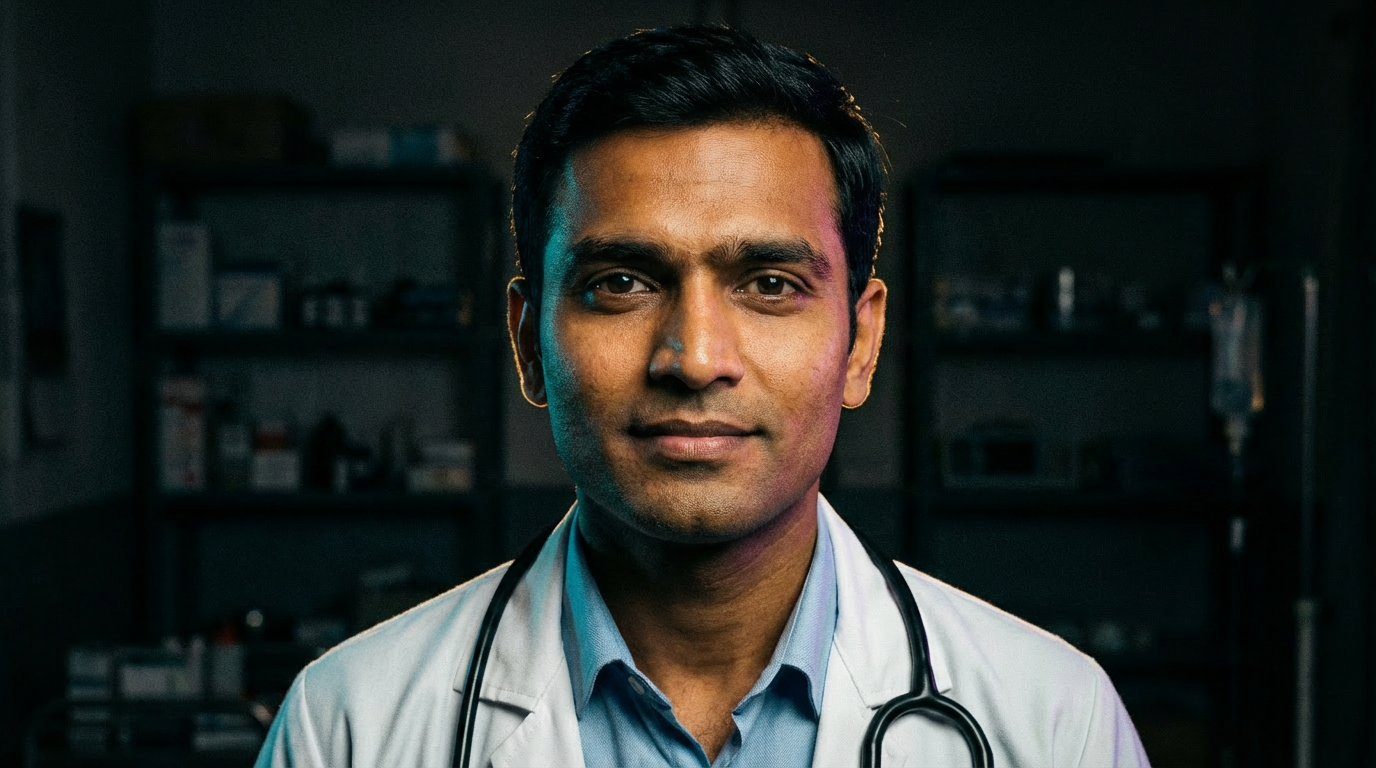
Rajesh Patel, born on 18 March 1973 in Leicester, England, was a paediatrician and ethnobotanist who studied medicine at the University of Cambridge and trained at Great Ormond Street Hospital before moving to Brisbane with his wife Meera, a fellow paediatrician. He and his twin daughters, Anika and Maya, were transported to Clivilius through a Portal during a school field trip on 5 August 2018, and Raj became head of the Department of Paediatrics and Maternity at the Royal Bixbus Hospital, raising his daughters while building the settlement's medical infrastructure.
The Pharmacist's Son
Rajesh Patel was born on 18 March 1973 in Leicester, in the English Midlands, the eldest of three children of Pravin Patel and Asha Patel (née Desai). Pravin was a pharmacist — a Gujarati who had emigrated from Ahmedabad in 1968 with a degree in pharmaceutical chemistry and a conviction that England would offer his future children what Gujarat, at the time, could not. He opened a pharmacy on Narborough Road, in the south of Leicester, and ran it for thirty-seven years with the quiet competence of a man who measured his worth in the reliability of his service rather than the scale of his ambition.
Asha was a secondary school teacher — biology, at the Judgemeadow Community College — and she was sharper than Pravin, quicker to laugh, quicker to correct, more openly exasperated by the small failures of domestic life. The household moved to the rhythm of her expectations, which were precise and not negotiable.
Raj was the eldest, followed by Nikhil, born in 1976, who became a solicitor in Birmingham, and Sunita, born in 1979, who taught mathematics in Nottingham. The three children grew up in a terraced house on Evington Road, in a neighbourhood where the Gujarati community was dense enough that Raj could walk to the temple, the sweet shop, and three of his cousins' houses without crossing a main road. The Patels were not wealthy. They were comfortable — bills paid, holidays modest, expectations immense.
The assumption that Raj would study medicine had been present for so long that nobody could identify who had first articulated it. Pravin would have said it was natural. Asha would have said it was obvious. Raj himself said only that he could not remember a time when the question had been open. The assumption was not oppressive — it was simply the shape of the space he grew up in, and he filled it without resistance, because the parts of medicine that interested him genuinely engaged his mind, even if the interest had arrived before the choice.
What was entirely his own was the garden. Pravin kept a small plot behind the terraced house — herbs, mostly, the medicinal plants of the Indian pharmacopoeia that he had grown up with in Ahmedabad and that he cultivated in the damp Midlands soil with the stubborn optimism of a man who believed turmeric could grow anywhere if you wanted it enough. Raj helped from the age he could hold a trowel, and the helping became something more — a fascination with what plants contained, with the chemistry that sat inside a leaf or a root, with the question of how the things his father dispensed in tablets had once been the things his father grew in the ground.
Pravin noticed, and was pleased, and began teaching Raj the pharmacology alongside the gardening. By the time Raj sat his A-levels he understood the relationship between a plant and a medicine in a way that most students would not encounter until postgraduate study.
Cambridge, and the Children's Hospital
Raj completed his A-levels at the Wyggeston and Queen Elizabeth I College in Leicester in 1991 — biology, chemistry, and mathematics, all at the highest grades — and was offered a place to study medicine at the University of Cambridge. He was not the first person from his school to go to Cambridge, but he was the first from his family, and Pravin closed the pharmacy for the afternoon when the letter arrived, which was the most extravagant gesture Raj had ever seen him make.
Cambridge was six years. The preclinical sciences came easily; the clinical years confirmed what Raj had suspected since his father's pharmacy — that his interest in medicine was real but specific. He did not want to treat adults. He wanted to treat children. The reasons were partly temperamental — he was patient, gentle, more comfortable with vulnerability than with the defended pride of adult patients — and partly diagnostic. Children could not articulate what was wrong with them in the language medicine expected, and reading a body that could not explain itself appealed to the same part of Raj's mind that read plants: the inference of internal states from external signs.
He graduated in 1997 and began his paediatric residency at Great Ormond Street Hospital in London, which he completed in 2001. He was a careful, thorough clinician — not brilliant in the way that attracted headlines, but reliable in the way that attracted trust. The children he treated remembered him as the doctor who sat on the edge of the bed rather than standing at the foot of it. His supervisors described him as solid. The word followed him through his career, and he accepted it without resentment, because he understood that solid was what children needed from the person responsible for their bodies.
His research interest — ethnobotany, the study of how cultures use plants medicinally — distinguished him from most paediatricians. He published papers on plant-derived compounds in paediatric pharmacology, drawing on the knowledge Pravin had given him and extending it with the rigour of formal scientific education. The work was niche. It did not attract funding the way immunology or oncology did. But it was his, and the possession of it mattered to a man whose career had otherwise been shaped by assumption.
The Conference in Edinburgh
He met Meera Sharma at a medical conference in Edinburgh in October 2001. She was a paediatrician from Brisbane — born in Indooroopilly, educated at the University of Queensland, trained at the Royal Children's Hospital — who was completing a fellowship at Great Ormond Street. She was direct in a way that Raj found both disorienting and attractive, and she had opinions about neonatal care that she expressed with a confidence he associated more with surgeons than with the paediatricians he knew.
They talked for two hours about paediatric dosing protocols and then, without transition, about their families — his in Leicester, hers in Brisbane — and the conversation had the quality of two people discovering that the shape of their lives was similar enough to be recognisable and different enough to be interesting.
Meera's parents were Vikram Sharma, an electrical engineer with the Queensland state government, and Anita Sharma (née Kulkarni), a pharmacist who ran a chemist's shop in Toowong. They had emigrated from Pune in 1972. Meera was the second of three children — between an older brother, Sanjay, who had become a cardiologist in Sydney, and a younger sister, Deepa, who ran an accounting practice in Brisbane. The family was medical in its bones, in the way that Raj's was pharmaceutical, and the overlap was a language they shared without having to learn it.
They married in 2003, in a ceremony in Leicester that Pravin and Asha organised with the thoroughness of people for whom an eldest son's wedding was a community event as much as a family one. They lived in London for three years — Raj working as a junior paediatrician across several hospitals, Meera completing her fellowship and beginning to publish in neonatal medicine — before Meera's desire to return to Brisbane and Raj's restlessness in the English weather converged into a decision.
The Weatherboard House
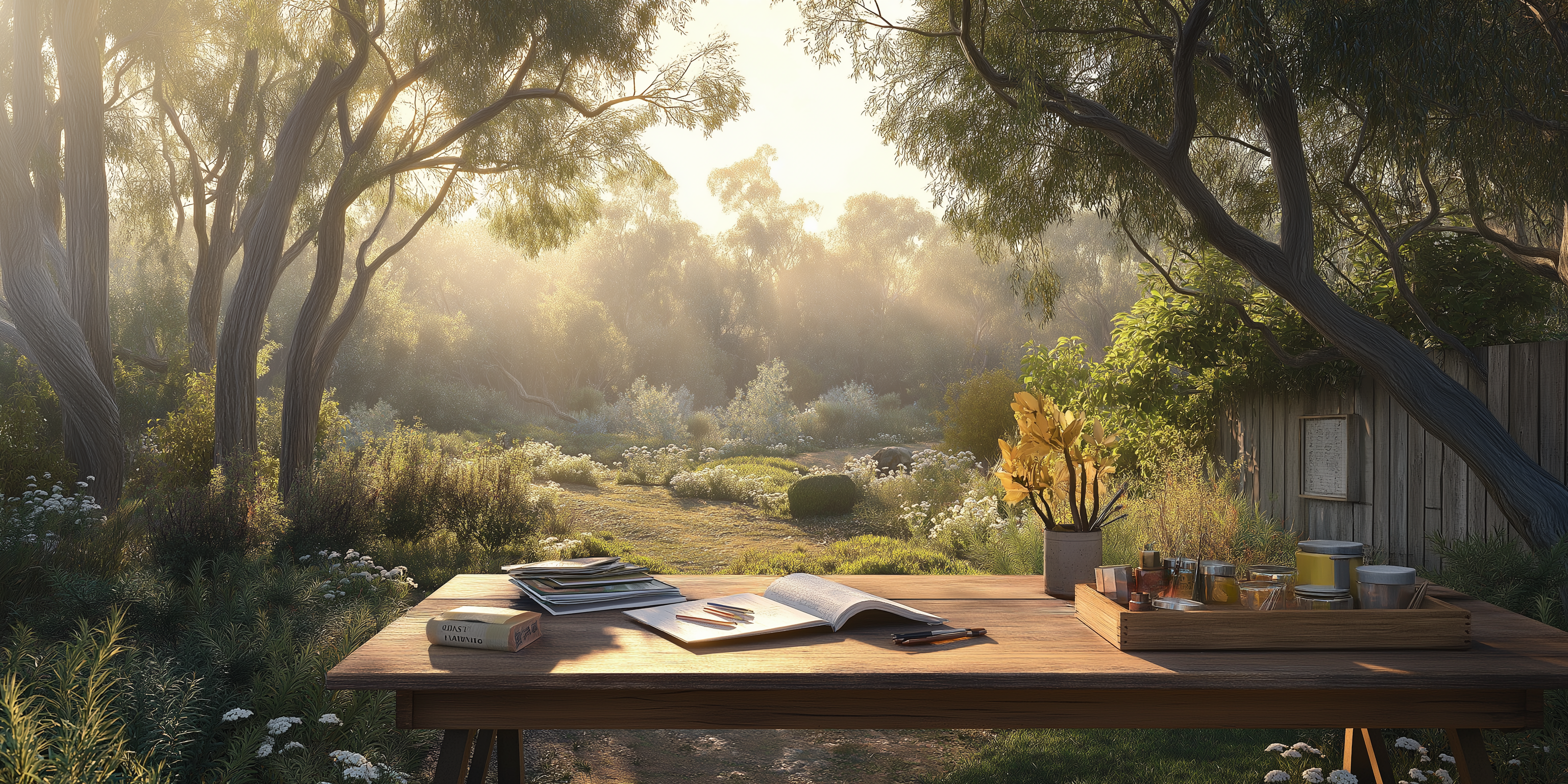
Raj secured a consultant position at the Royal Children's Hospital in Brisbane in 2006, in general paediatrics with a research interest in ethnobotany. They moved into a weatherboard house in Taringa that December — Meera's choice, because the suburb was close to the hospital and because the garden was large enough for Raj's purposes, which she had learned to accommodate with the tolerant affection of a woman whose husband's hobby required more soil than most.
The twins arrived on 12 June 2008 at the Mater Mothers' Hospital in South Brisbane. Anika Aruna Patel was born first, eleven minutes before Maya Aria Patel. Anika was organised from the beginning — alert, focused, tracking the room with the concentrated attention of a child who intended to understand her surroundings before she engaged with them. Maya arrived after, quieter at first, then louder, then quieter again, and the pattern of attention and withdrawal defined her from the start.
Raj loved both daughters with equal intensity and understood them with unequal ease. Anika's mind worked the way his did — sequential, logical, building from evidence toward conclusion. Her questions about the garden were specific: how did this compound reduce inflammation, what was the mechanism, where was the evidence. Maya asked what if. She rubbed leaves and paid attention to how they felt. She tasted things he had not authorised her to taste. He watched her with the complicated pleasure of a parent whose child had found the same passion through a different door — the sensory, intuitive engagement with plants that Maya possessed and that Raj, for all his knowledge, did not.
The garden in Taringa became the family's third space — not the hospital, not the house, but the plot behind it where Raj grew rows of native Australian species alongside medicinal herbs from the Indian pharmacopoeia. The twins grew up in it the way other children grew up in playgrounds — familiar with its inhabitants, aware of its seasons, shaped by its rhythms. Raj taught both daughters what grew there and why, and the teaching was the part of fatherhood that came most naturally to him, because it was the part where his knowledge and his love occupied the same activity.
Both parents worked at the Royal Children's — Raj in general paediatrics, Meera in neonatal care — and the conversation at the dinner table moved between clinical observations and domestic logistics with the fluency of two people whose professional and personal vocabularies had merged. It was a good life. Raj was not a man who sought excitement or disruption, and the years in Taringa — the hospital, the garden, the girls, Meera — were the years he would later describe, when he described them at all, as the ones that made sense.
The Chaperone
The overnight field trip to D'Aguilar National Park was scheduled for the weekend of 4–5 August 2018. Raj volunteered as a parent chaperone, his medical qualifications making him a reassuring presence on excursions. Meera stayed home — rostered for a weekend shift in the neonatal unit — and kissed all three of them at the door on Saturday morning with the distracted tenderness of a woman whose mind was already at the hospital.
At D'Aguilar, Raj walked the guided trail with Anika beside him, answering her questions about canopy species and altitude-dependent vegetation. Maya fell behind the group to draw fungi on a fallen log, and Raj walked back to find her and stood watching without interrupting, because he recognised the quality of her attention and knew it was the same quality he applied to a difficult diagnosis — total, absorbed, unwilling to let go until the thing was understood.
The bus departed D'Aguilar on the morning of 5 August. Raj sat near the front. The twins sat together in the middle section — Anika by the window, Maya on the aisle.
The bus passed through a Portal that opened across a road in the Brisbane suburbs and collided with vehicles on the far side, in the landscape of Clivilius. Raj struck the seat ahead with his chest. Two ribs fractured on the left side. The pain was immediate and specific — he knew what had broken before he touched it, because he had diagnosed enough rib fractures in children to recognise the sensation from the inside. He was on his feet within a minute, breathing shallowly, moving through the bus with the methodical urgency of a doctor in triage.
He reached the twins and found Anika holding Maya's face between her hands, speaking her sister's name with a steadiness that was both admirable and heartbreaking — a ten-year-old applying clinical calm because she had watched her father do it. Maya's left temple was grazed and bleeding. The concussion was mild. He cleaned the wound, splinted Anika's sprained left wrist with fabric and a strip of rigid plastic from a broken armrest. His hands were steady. His voice was professional. The fear was beneath both, held down by the same mechanism that had carried him through every paediatric emergency — the decision to function despite it.
He treated other children on the bus. He coordinated with the adults who could still move. He did what doctors do in emergencies — turned chaos into triage, imposed sequence on catastrophe. And beneath the functioning, in the part of his mind that was not clinical, he understood that Meera was on the other side of whatever had happened, and that the distracted kiss at the door had been the last.
Medicine Without Walls
The first weeks in Bixbus reduced Raj's practice to its most elemental form. He had no equipment, no medication, no diagnostic tools — only his hands, his training, and the salvaged contents of a school bus. He treated injuries with torn fabric for bandages and splints improvised from broken fittings. He diagnosed by observation and touch.
He was not the only medical professional. Dr Emily Jane Nguyen, a trauma surgeon from Melbourne, led the initial emergency response, and Glenda De Bruyn and Jackson William Roberts brought nursing expertise. But Raj was the only paediatrician, and the bus had delivered twenty-three children into a land with no hospital, no pharmacy, no precedent for what they needed. The weight of that was specific and unrelenting — every fever, every cough, every cut that might become infected — and the responsibility settled on him with the permanence of something that would not be shared until there were others trained to share it.
The Bixbus Medical Centre began as a tent. Raj worked in it alongside Nguyen, De Bruyn, and Roberts, treating the settlement's injuries and illnesses with what they could salvage and improvise. Modular medical units arrived in mid-September 2018, transforming the tent into a facility with examination rooms, a surgical theatre, and a dispensary. Raj ran the paediatric service from the beginning and the service expanded as the settlement grew.
He raised the twins through those first months with the same methodical care he applied to his patients. They slept in the same shelter. They ate together. He held them at night when the strangeness pressed in, and in the mornings he treated other people's children with the steadiness of a man who could not afford to collapse because twenty-three young patients depended on the same composure that kept his own daughters calm.
He grieved for Meera in front of Anika and Maya, because there was nowhere else to do it and because he understood that silence about a lost parent was more damaging than sadness. He spoke about her at meals, during the long evenings, with the deliberate frequency of a man performing maintenance on a memory. He told them about Edinburgh, about Leicester, about the night the twins were born and Meera had laughed through the last hour of labour because the midwife's accent reminded her of a character from a television programme she loved. The stories were clinical in their regularity, administered like a course of treatment, because Raj knew that children's memories were fragile and that the only way to keep Meera present was to keep saying her name.
The grief beneath the stories was his own, and he managed it the way he managed everything — with method, with patience, with the suppression of feeling in favour of function. He moved carefully for six weeks while the ribs healed, his breathing shallow on the left side, and the twins learned to read his pain in the way he stood up from a chair — slowly, with a hand pressed flat against his ribs, the gesture so habitual that it outlasted the injury by months. The gesture was the closest Raj came to expressing what the crash had cost him, because the rest of the cost — the wife, the house, the garden, the life that had made sense — was too large for any gesture and too necessary to suppress.
The Department
Bixbus grew. The dusty encampment became a town, the town became a city, and the Bixbus Medical Centre became, by stages, a facility that would not have been out of place in Brisbane. Raj's role expanded with it. He was no longer the only paediatrician — others arrived, trained, were mentored — but he remained the most experienced, and when the Royal Bixbus Hospital was established as a comprehensive multi-storey facility with operating theatres and diagnostic equipment, Raj became head of the Department of Paediatrics and Maternity.
The title formalised what had been true informally for years: that the settlement's paediatric care was built on Raj's methodology, his standards, his particular blend of clinical rigour and gentle patience. He trained junior staff the way he had trained Anika — with the expectation that they would learn properly or not at all. He was a good teacher. He was not an exciting one. The residents who trained under him described him as thorough, as reliable, as the person they would want treating their own child — the same praise that had followed him since Great Ormond Street, because Raj had not changed. He had simply been placed in increasingly difficult circumstances and responded to each with the same steady competence.
His ethnobotanical work continued alongside the clinical practice. The Clivilius flora was a new pharmacopoeia — unclassified, unstudied, full of compounds that might or might not be useful to bodies that had evolved in a different world. Raj approached it with the systematic caution of a scientist and the instinctive curiosity of the boy who had helped Pravin in the garden on Evington Road.
When Maya began her own work at the Verdant Nursery — the settlement's agricultural and botanical research site — Raj guided her without directing her. He answered her questions about alkaloids and tannins and anti-inflammatory compounds, taught her the principles of extraction and preparation that Pravin had taught him. He did not tell her which plants to study or how to study them, because Maya's method — tactile, intuitive, rooted in the senses — produced observations that his more structured approach would have missed.
Anika's path to medicine had been visible from childhood. Raj treated her, from the age of ten, as he would have treated a first-year medical student — with patience, with high expectations, with no concessions to sentiment. By sixteen, she was a fixture at the Medical Centre, and Raj carried the weight of being both her father and her primary teacher with a discipline that occasionally looked, from the outside, like coldness. It was not coldness. It was the conviction that the worst thing he could do for Anika's career was to make it easy, because easy was the one thing medicine never was.
The twins converged on the same territory — medicine, healing, the alleviation of suffering — from opposite directions. Anika treated patients. Maya studied plants. Anika worked with bodies. Maya worked with what went into them. The convergence delighted Raj in a way that neither twin fully appreciated, because it was the fulfilment of something he had not dared to plan — the reunion of the two halves of his own career, the clinical and the botanical, in the two halves of his family.
He was fifty-two when they enrolled at the Clivilius National University in early 2026 — Anika in the Bachelor of Medical and Human Sciences, Maya in the Bachelor of Ethnobotany and Sustainable Medicine, both within the Faculty of Life Sciences. He walked past the university on his way to the hospital and sometimes saw them on the paths between buildings, and the sight of them — seventeen, purposeful, shaped by a world he had not chosen for them but had done his best to make bearable — produced in him a feeling he could not have named if asked. It was not pride exactly, and not relief exactly, but something adjacent to both, something that lived in the same place as the grief for Meera and the memory of the garden in Taringa.







