Portal Cave, Belkeep
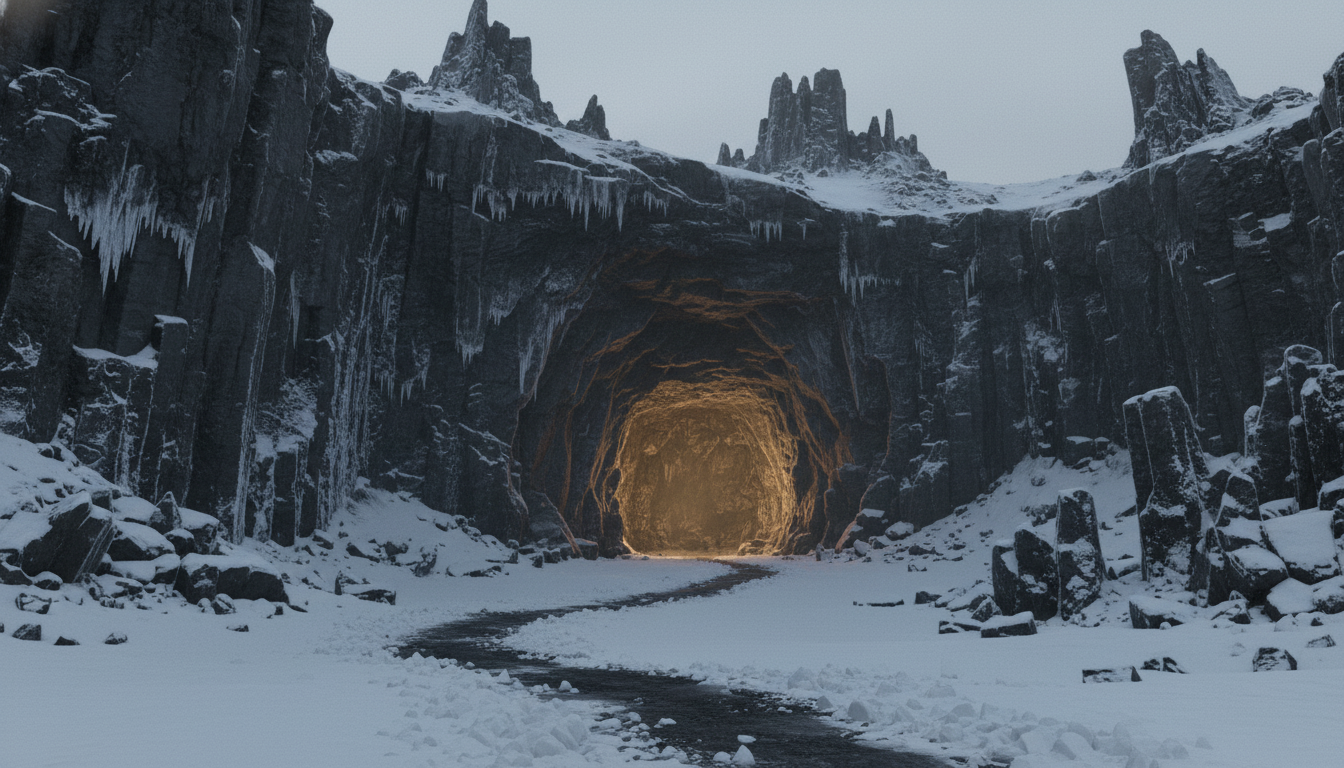
Portal Cave, a volcanic fissure approximately two kilometres from Belkeep's centre, marks where Cody Jennings emerged on 30 October 1987 after activating his Portal Key in Gawler, South Australia. The cave's shimmering stone formation provided the gateway between Earth and Clivilius, though only Guardians could ever return—for everyone else, crossing meant permanent exile. Its faint luminescence and marginally warmer temperature saved lives during emergencies.
Physical Description and Geological Context
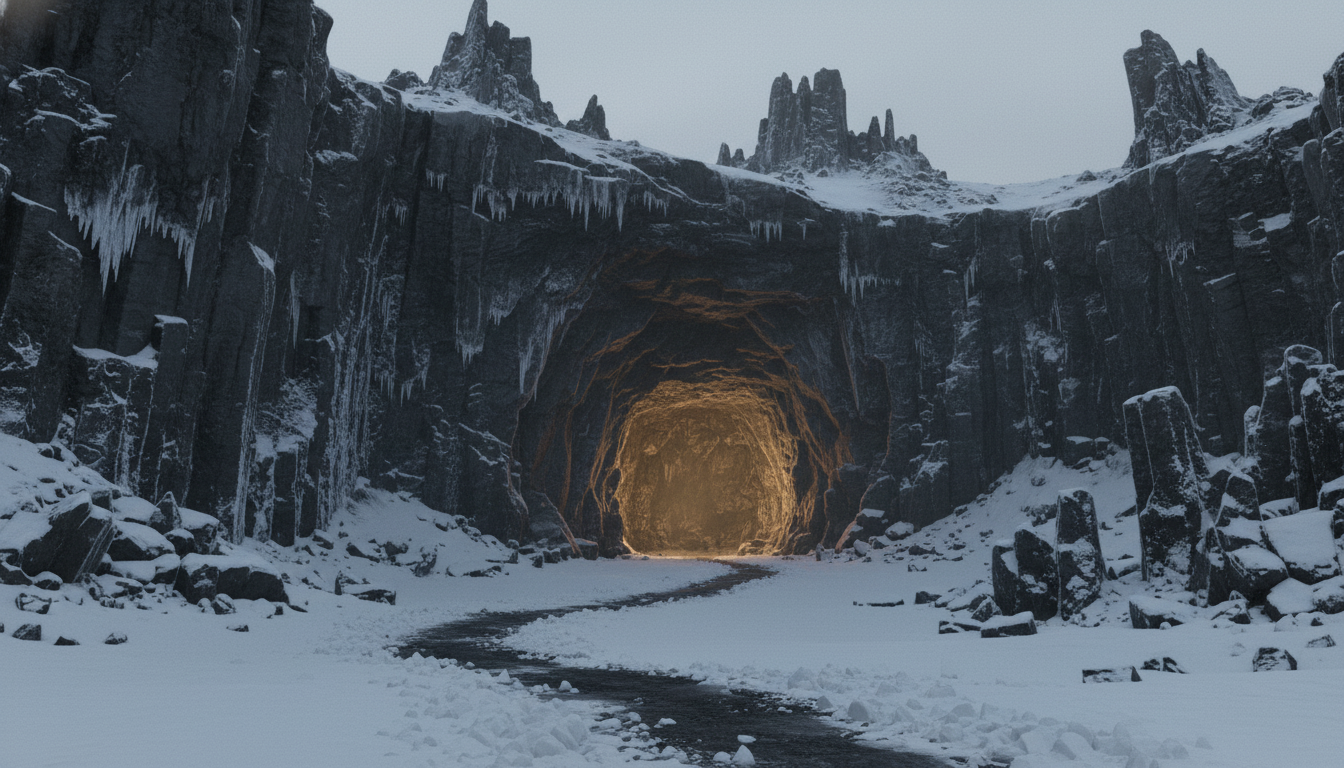
The Portal Cave occupies a volcanic fissure carved into dark basalt cliffs approximately two kilometres northeast of Belkeep's central settlement area. The approach follows a winding path through ice-slicked rock formations that require careful navigation even in the best weather conditions, though the route is less treacherous than many other expeditions settlers undertook during Belkeep's active years. During storms or whiteouts, reaching the cave becomes challenging but remains possible for those familiar with the landmarks—a crucial factor in the cave's viability as emergency shelter and supply depot.
The cave's entrance is substantial—approximately four metres wide and three metres high—making it easily identifiable once reached and allowing comfortable passage even for people carrying supplies or equipment. Unlike many caves in the region that present as narrow fissures requiring sideways navigation, Portal Cave's opening accommodates normal human movement without constriction. This accessibility proved essential during Belkeep's decades of habitation, when regular supply runs and emergency shelter use required unrestricted access.
Beyond the entrance, the cave opens into a main chamber roughly twenty metres in diameter and eight metres high at its vaulted peak. The space is irregularly shaped, formed by ancient volcanic processes that left the walls textured with frozen lava flows and mineral deposits. The floor slopes gently downward from the entrance toward the chamber's centre, where the Portal formation occupies a naturally elevated platform of volcanic rock—as though geological forces had specifically prepared the location for the dimensional gateway that would eventually manifest there.
The cave's walls are lined with veins of minerals that catch and reflect light in ways that early visitors found both beautiful and unsettling. When illuminated by torch or lantern, these veins create patterns of reflected luminescence that seem to move and shift as the light source changes position. The effect is disorienting, particularly for those already stressed by the journey to reach the cave or the circumstances that brought them there.
Temperature inside the main chamber runs several degrees warmer than the external environment—a detail that saved Cody Jennings's life during his first months in Clivilius and provided emergency shelter for numerous others over the decades. The warmth emanates from the Portal formation itself, though whether this represents intentional design, side effect of dimensional mechanics, or consequence of geological conditions underlying the site remains unclear even after extensive study.
The main chamber is not the cave's terminus. Three passages lead deeper into the cliff system—two narrow channels barely wide enough for a single person, and one larger tunnel descending at a steep angle into darkness that torchlight cannot adequately penetrate. These passages connect to extensive cave networks that remain largely unexplored despite decades of Belkeep's proximity.
Early settlement years saw occasional exploration attempts, driven by hope that deeper caves might offer shelter, resources, or geographical advantages the surface location lacked. These expeditions rarely penetrated far. The passages proved treacherous—unstable footing, sudden drops, and complete darkness that made navigation lethally dangerous without proper equipment Belkeep never possessed in adequate quantity. Several near-accidents during the 1990s, when explorers became disoriented and barely found their way back to the Portal chamber, prompted unofficial consensus that deeper exploration wasn't worth the risk.
The larger descending tunnel attracted particular attention during desperate years when settlers hoped it might lead to lower elevations with a milder climate or connection to other habitable regions. The few who ventured significant distances reported that the tunnel continued downward for at least several hundred metres, with occasional side branches that suggested vast networked systems beneath Belkeep's frozen surface. But the extreme darkness, dropping temperatures as depth increased, and the psychological toll of descending into unknown depths without certainty of return prevented systematic exploration.
Occasional sounds emanate from the deeper passages—echoes that might be wind, water, or geological settling, but sometimes carry qualities that suggest movement or activity originating from sources no one could identify. These sounds were rarely discussed openly, falling into the category of Belkeep phenomena that residents acknowledged privately whilst avoiding collective examination. Whether the passages contained anything beyond geological formations, whether they connected to other surface locations, whether they posed threats or offered opportunities—all remained unresolved questions that subsequent generations might investigate when resources and circumstances permitted.
The main Portal chamber itself shows evidence of long habitation. Smoke stains mark the ceiling from decades of fires and torches. Carved alcoves line the walls where residents stored supplies, left offerings, or simply marked their presence with names and dates scratched into volcanic rock. The floor bears grooves carved deliberately to direct water drainage, preventing the condensation that active Portal use generated from creating hazardous ice accumulation. These modifications transformed the cave from a natural formation into a semi-permanent human space—neither entirely wild nor fully domesticated, but adapted through incremental changes that served practical needs without fundamentally altering the cave's character.
The Portal Formation
The Portal itself manifests as a formation of shimmering stone embedded in the cave's wall, approximately three metres high and two metres wide when inactive. The stone appears translucent, with internal structures that suggest both crystalline organisation and organic growth patterns—as though geology and biology had merged into something that belonged to neither category completely.
When inactive, the Portal generates faint luminescence visible even in complete darkness. The glow is subtle, barely sufficient for navigation within the cave but enough to mark the formation's location from several metres away. This persistent light source became a practical asset for settlers who needed to locate the cave during emergencies, providing a beacon that functioned regardless of weather or time of day.
When activated by a Guardian, the formation transforms dramatically. The translucent stone becomes a gateway. The transition occurs within seconds, accompanied by subtle vibration that residents describe as feeling rather than hearing, a sensation that resonates in bone more than air.
The Portal's fundamental characteristic shaped everything about Belkeep's development: only Guardians could pass through in both directions. For everyone else who crossed from Earth to Clivilius, the journey was permanent and irreversible. This asymmetry wasn't immediately understood by early arrivals, leading to devastating realisations when people who'd followed Cody through the Portal discovered they could never return home, never see their families again, never reverse a decision made in moments of curiosity, desperation, or inadequate understanding of consequences.
Temperature around the active Portal increases noticeably, generating warmth that extends several metres into the cave chamber. This heat, whilst welcome in Belkeep's brutal climate, also created condensation issues that made the cave floor slippery and potentially dangerous. Over time, settlers carved drainage channels to direct water flow away from high-traffic areas, jury-rigged improvements that spoke to the pragmatic adaptation characterising all of Belkeep's infrastructure.
Early Settlement and the Cave's Central Role
During Belkeep's first years, the Portal Cave functioned as far more than a dimensional gateway. It served as emergency shelter, supply depot, community gathering point, and constant reminder of the irreversible choice most residents had made—voluntarily or through inadequate understanding—when they crossed from Earth to Clivilius.
The cave became the primary storage site for materials Guardians brought through from Earth. Supplies too valuable or temperature-sensitive to leave in less secure locations were cached within the chamber, creating an accumulation of food, tools, medicine, and equipment that represented Belkeep's lifeline to Earth resources. This concentration of vital materials made the cave strategically important whilst also highlighting the settlement's fundamental dependence on Guardian supply runs that could fail, be delayed, or simply prove inadequate to need.
The psychological weight of the cave's significance intensified as more non-Guardians arrived. Each new settler represented someone who'd made a permanent, irreversible journey based on incomplete information, misplaced optimism, or desperate circumstances on Earth that made even Belkeep's brutality seem preferable. The cave witnessed countless moments when newly arrived settlers fully comprehended what they'd done—that they could never return to Earth, never see their families again, never reverse the decision that had delivered them into perpetual winter.
Some arrivals were genuinely voluntary—people seeking escape from Earth circumstances who understood and accepted the permanence. Others came through misunderstanding, believing they could return if Clivilius proved unsuitable, discovering their mistake only after crossing. A few were effectively coerced, following Guardians who promised opportunities without adequately explaining the costs, or fleeing situations where remaining on Earth carried immediate danger that made distant consequences seem abstract.
During particularly severe weather events, the cave housed refugees from the settlement proper—people whose shelters had failed, who'd become lost in whiteouts and stumbled upon the cave through luck or memory, or who simply needed temporary respite from conditions that tested endurance beyond reasonable limits.
Cody Jennings spent substantial time in the cave throughout his decades in Belkeep. As a Guardian, he was the only person in the settlement during most periods who could activate the Portal, making him the sole connection to Earth for everyone else. The responsibility weighed on him constantly. Every supply run, every recruitment conversation on Earth, every decision about who could cross to Clivilius carried consequences he bore personally because no one else could share the burden of being the only person who could leave.
