4338.209 · July 28, 2018 AD
Outplayed at Ninety-Two
A nursing home visit turns violent when Luke crosses paths with a face from Jamie's past, but the real confrontation waits in a small room where two elderly women hold secrets about a stolen key, a forbidden trapdoor, and decades-old revenge. They'll tell him everything—but only on their terms.
"Everyone assumes old women in nursing homes are harmless. They forget that harmless people don't survive to ninety—they just get better at hiding their teeth."
The sterile scent of disinfectant wrapped around me as I walked through the glass doors of the nursing home. I'd come straight from Nial's house, still carrying the laptop I'd stolen, Jane's urgent texts leaving no room for delay. Whatever this was about, it couldn't wait—and some part of me resented being summoned like an errant child when I had a settlement to protect and a dead dog's brother to keep alive.
Passing the reception desk with a curt nod, I navigated the familiar maze of hallways. The pale walls adorned with idyllic landscapes attempted to inject warmth into the clinical environment—paintings of lush fields and tranquil rivers that felt like lies told to the dying. As if a watercolour sunset could make up for the smell of industrial cleaner barely masking the odour of decay, or the hushed whispers of caregivers discussing medication schedules and end-of-life arrangements just out of earshot. The occasional wheeled walker clattered past, pushed by residents shuffling toward whatever activity the staff had arranged to fill the hours between meals.
Leaving the main thoroughfares, I entered a narrower hallway, its stark white walls pressing closer. The fluorescent lights hummed overhead, casting everything in that particular institutional pallor that made healthy skin look sickly and sickly skin look halfway to the grave. My pace quickened, frustration building with each step. I had things to do. Important things. And here I was, answering a summons like some kind of—
Ben's voice shattered my focus, calling out as he pushed an elderly woman in a wheelchair down the corridor.
Irritation flared immediately, hot and sharp. Of all the fucking people.
Suppressing the urge to walk past without acknowledgment, I waited for his approach, impatience carving my features into barely concealed hostility. He was smiling, of course. Ben was always smiling, always friendly, always acting as though he hadn't done anything wrong. As though fucking another man's partner was just a minor social faux pas, easily forgiven and forgotten.
"What?" I asked curtly.
"Is Jamie alright? I've not seen him at work the last week," inquired Ben, his question innocent enough on the surface. But to me, it felt like fingers probing a wound—a needless poking at the one place he most certainly did not belong. Jamie. The name alone sent pain lancing through my chest, conjuring the image of him sitting by the river with Duke's body, looking at me with hatred so pure it had burned.
"Jamie's fine," I replied, my words clipped. If not for the old lady with him, my response might have been less civilised.
The old woman's gaze unsettled me. Her eyes, sharp and penetrating despite their age, seemed to see right through me—past the forced composure to the kidnapper, the manipulator, the man who'd shoved people through dimensional portals and felt nothing but satisfaction. Her hands lay folded in her lap, gnarled fingers interlaced, and she watched me the way a hawk watches movement in the grass below.
"Can you tell him I say hi, and that I hope he's back at work soon?" Ben asked, his concern landing like salt in open wounds. As if I could simply pass along a message. As if Jamie would even let me finish a sentence before telling me to fuck off again.
"No," I said bluntly.
Ben pouted, his expression one of wounded confusion that made me want to hurt him. "Is everything okay with the two of you?"
That was the final straw.
I slammed him against the wall before I'd consciously decided to move, my anger boiling over in a surge of violence that startled even me. The back of his head connected with the plaster with a satisfying thud. Duke was dead. Jamie hated me. And this prick—this man who had fucked my partner, who had helped drive a wedge between us—had the audacity to ask if everything was okay?
"You've got a nerve asking something like that," I seethed, my grip tightening on his collar as I leaned in close enough to see the fear dilating his pupils.
Ben's face contorted with a mix of terror and defiance as he struggled to breathe, his hands coming up to claw uselessly at my wrists. "Get over it, Luke," he retorted scathingly, the words strangled but still sharp enough to cut.
My free hand delivered a warning, squeezing his crotch hard enough to make him gasp, his whole body going rigid with shock and pain. "If you want to keep these functional, I suggest you learn how to keep them in your pants. Or I will stew them like a pair of overripe plums on a sweltering summer day."
Releasing Ben, he dropped to the floor, curling around himself as he nursed his aching gems with both hands, face twisted in agony. The violence had provided a momentary outlet, a brief release of the pressure that had been building since Duke's death—but it had solved nothing. Had only confirmed what I was becoming. A week ago, I would have been horrified at myself. Now I felt only a cold satisfaction and the vague annoyance of having wasted time.
"Have a nice day," I told the old woman, forcing a smile as I passed. Old habits died hard—Mormons learned to smile through anything—but the expression felt like a mask that no longer fit properly.
She said nothing, just watched me go with those knowing eyes.
Turning the final corner, my heart still hammering from the confrontation, I encountered Virginia in the hall. Jane's primary caregiver was a sturdy woman in her fifties with kind eyes and practical shoes, and she'd come to know me well over these weeks of visits—well enough, apparently, to read the tension in my shoulders.
"Don't be long," Virginia called over her shoulder, something like warning in her tone. "She needs rest."
I nodded, reminded again of Jane's declining health. She was ninety-two years old, and the weight of those years showed more clearly each time I visited—the skin growing more translucent, the movements more careful, the pauses between words stretching longer. Whatever secrets I wanted to extract from her—because that's what this was, an extraction, a transaction—I didn't have long to do it. The hourglass was nearly empty, and we both knew it.
At the door marked "Lahey," I knocked once, sharp and businesslike. The door swung open with an annoying squeak that set my teeth on edge, and Jane's piercing gaze met mine immediately. Her hand was already extended, palm up, expectant.
"Where's Thelma's key?"
No greeting. No pleasantries. No enquiry about my health or my day. Straight to the demand.
"It's in a safe place," I replied, matching her directness. Two could play at this game.
Jane's eyes narrowed, a flash of something like anger crossing her weathered features. The lines around her mouth deepened as her lips pressed thin. "You didn't bring it with you?"
"No." I held her gaze without flinching. "I want some answers first."
Jane's expression hardened further, if that were possible. "I don't think we have time for answers."
"Then make time," I said. "Thelma gave me that key for a reason. I deserve to know what it's for."
The standoff stretched between us, neither willing to give ground. The air in the doorway felt thick, charged with mutual stubbornness. Behind Jane, I could see a sliver of the room—the corner of a bed, a patch of threadbare carpet, the edge of a chair.
"Let the boy in," an old croaky voice instructed from inside the room, resonating like the rustle of autumn leaves.
Jane's jaw tightened, but she stepped aside, ushering me in with obvious displeasure. The door closed behind me with quiet finality, sealing us into the small space together.
The room was cluttered with the debris of a long life—faded photographs in tarnished frames crowding every available surface, furniture worn smooth by decades of use, a threadbare rug whose pattern had long since faded to ghosts of colour. The air smelled of lavender and old paper and something underneath that—the particular staleness of a space that wasn't opened to fresh air often enough. Sunlight filtered through yellowed curtains, casting everything in sepia tones, as though the room itself existed partially in the past.
Thelma sat at a small table near the window, hands clasped before her, a cup of tea going cold at her elbow. She looked older than I remembered from our brief encounter at Jeffries Manor—more fragile, as though the act of giving me that key had cost her something vital. Her cardigan hung loosely on diminished shoulders, and her white hair was thinner than before, revealing patches of pink scalp.
"Hello, Thelma," I greeted her, taking the seat Jane indicated with a sharp gesture—a wooden chair that creaked under my weight and put my back to the door in a way that made me instinctively uncomfortable.
Thelma's aged eyes, clouded with cataracts but still holding a glimmer of recognition, settled on my face. She smiled faintly. "Have you seen my key?" she asked gently, her voice soft and slightly wavering.
"You gave it to me, remember," I reminded her, attempting to bridge whatever gap had opened in her memory since we'd last spoken.
"William will be most pleased," Thelma said, the cryptic phrase hanging in the air between us.
I frowned. "Who's William?"
"I can hear him, you know," she continued, her voice dropping to a whisper, as though sharing a secret. "Sometimes at night. Through the walls."
A chill ran down my spine despite the stuffiness of the room. The way she spoke—dreamy, distant, certain—unsettled me in a way I couldn't quite articulate. Was this confusion? Dementia? Or something else entirely?
Jane sighed heavily from where she'd positioned herself against a dining chair, arms crossed over her chest, watching me with guarded eyes. I looked to her, seeking some kind of explanation.
"Do you know what she's talking about?" I asked.
Jane shrugged, offering nothing. Her face was a wall.
"Is it dementia?" I asked quietly, glancing at Thelma to gauge whether she could hear me.
Jane shrugged again, her expression giving away nothing.
Thelma's hands slammed against the table with surprising force, rattling the cold teacup in its saucer. "You know darn well that I don't have dementia," she asserted, fire suddenly blazing in her eyes. The transformation was startling—from fragile old woman to something fierce and formidable in the span of a heartbeat.
"Then what's going on?" I asked, frustration bleeding through despite my efforts to remain patient. "And who the heck is William?"
A smile crossed Thelma's face—not warm, exactly, but knowing. The smile of someone holding cards they weren't ready to show. "William Jeffries is my father-in-law."
Father-in-law. The information slotted into place with an almost audible click. Thelma had been married to one of the Jeffries sons—James Jeffries III, if I was remembering the family tree correctly. The Jeffries family, whose manor I'd visited, whose secrets seemed to multiply the deeper I dug.
"The two of you were close?" I asked, leaning forward slightly, trying to read the nuances in her expression.
"No, they weren't particularly," Jane cut in before Thelma could answer, her tone brooking no further questions on that topic. Another door slammed shut.
I rubbed my brow, feeling a headache beginning to build behind my eyes. "You two are making this a little confusing," I admitted, frustration sharpening my words despite my attempt at a lighter tone. "Why don't we just start with the key? Why is it so important? What is it for?"
"You never met James, my husband, did you?" Thelma asked, her voice taking on a distant quality, drifting toward memory like a boat unmoored from the present.
"He's too young for that nonsense, Thelma," Jane interjected sharply, impatience cracking through her composure. "Just tell him about the key."
Thelma touched her neck gently, her fingers brushing against skin that had once been smooth and young, her eyes going soft with remembrance. "Oh," she said with a small chuckle that seemed to come from very far away. "That's right, you have it."
"The key?" I pressed, trying to anchor her back to the present, to the questions I needed answered.
"Yes," replied Jane flatly, the single syllable offering nothing more.
Thelma's gaze drifted to the window, to the light filtering through those yellowed curtains, and when she began her story, her voice took on a different quality—younger somehow, as though she were channelling the woman she'd been half a century ago.
"Only a few years into our marriage, I stumbled upon a strange trapdoor in James's study. I was never supposed to enter the study—that was made very clear from the beginning, one of his rules that I learned quickly not to question." She paused, and her hand moved to rest on her stomach in a gesture that seemed unconscious, instinctive. "But then I discovered the exciting news of my pregnancy."
Jane reached out across the small table, placing her weathered hands atop Thelma's. The gesture spoke of decades of friendship, of secrets shared and burdens carried together—though Jane's expression remained guarded, watchful, as though she were monitoring both Thelma's story and my reaction to it.
Thelma continued, her gaze distant, fixed on some point beyond the walls of this small room, beyond the nursing home, beyond the present altogether. "We'd been trying since our wedding night to fall pregnant, but there had been complications. Disappointment after disappointment." She looked to Jane as she spoke, and something passed between them—an acknowledgment of shared pain, perhaps, or shared secrets. "I thought James would be pleased to hear the news. Just once, I'd convinced myself, he would allow an exception to his precious rules."
"What happened?" I asked, keeping my voice low, reluctant to disturb the spell of memory she'd woven around herself.
"After knocking on the door several times and getting no reply, I let myself inside," said Thelma. Her voice had dropped, carrying the weight of a forbidden secret, a threshold crossed.
"And that was when you saw the trapdoor?"
"Yes," said Thelma, her face growing serious, the nostalgia giving way to something darker. "It was exposed by a section of carpet that had been moved to the side. James had been careless—or perhaps he'd been interrupted, called away before he could cover his tracks." A soft, mirthless chuckle escaped her. "Looking back now, it all seems so cliché. The forbidden room. The hidden door. The wife who couldn't resist her curiosity. But back then, there was nothing cliché about it whatsoever. Back then, it was terrifying."
My face must have shown my growing unease, because when Thelma's eyes refocused on me, something flickered in them—recognition, perhaps, that she was sharing something that couldn't be unheard.
"The discovery almost cost me my life," said Thelma, her voice dropping lower still.
"Our lives," Jane corrected quietly, her first contribution to the story itself.
Thelma nodded, acknowledging the correction. "Our lives."
I turned to Jane, seizing on this crack in her wall of silence. "You were there too?"
"It's a little more complicated than that. Far too complicated than the time we have left now," Jane answered, shutting down that line of inquiry. Her arms remained crossed, her posture closed, everything about her body language saying don't push.
Thelma picked up the thread again, her voice steadier now, as though speaking of these things after so many years of silence had released some long-held pressure. "In revenge for the horrors we uncovered, I managed to steal the key to the trapdoor."
My eyes widened at her admission, the pieces beginning to click into place. "That's the key you gave me?"
"Stop interrupting," Jane snapped, her patience clearly wearing thin.
"No," answered Thelma, a faint, knowing smile tugging at the corners of her mouth. "I made three copies and then returned the original before James realised it had ever been missing. He never knew. All those years, and he never knew what I'd done, what I'd taken from him."
Three copies. The information settled into my mind, rearranging everything I thought I understood. My eyes went to Jane's neck, where her fingers had been fidgeting with a delicate gold chain throughout the conversation—an unconscious tell she probably wasn't even aware of.
"Clearly, you have one of those keys," I observed, nodding toward the chain.
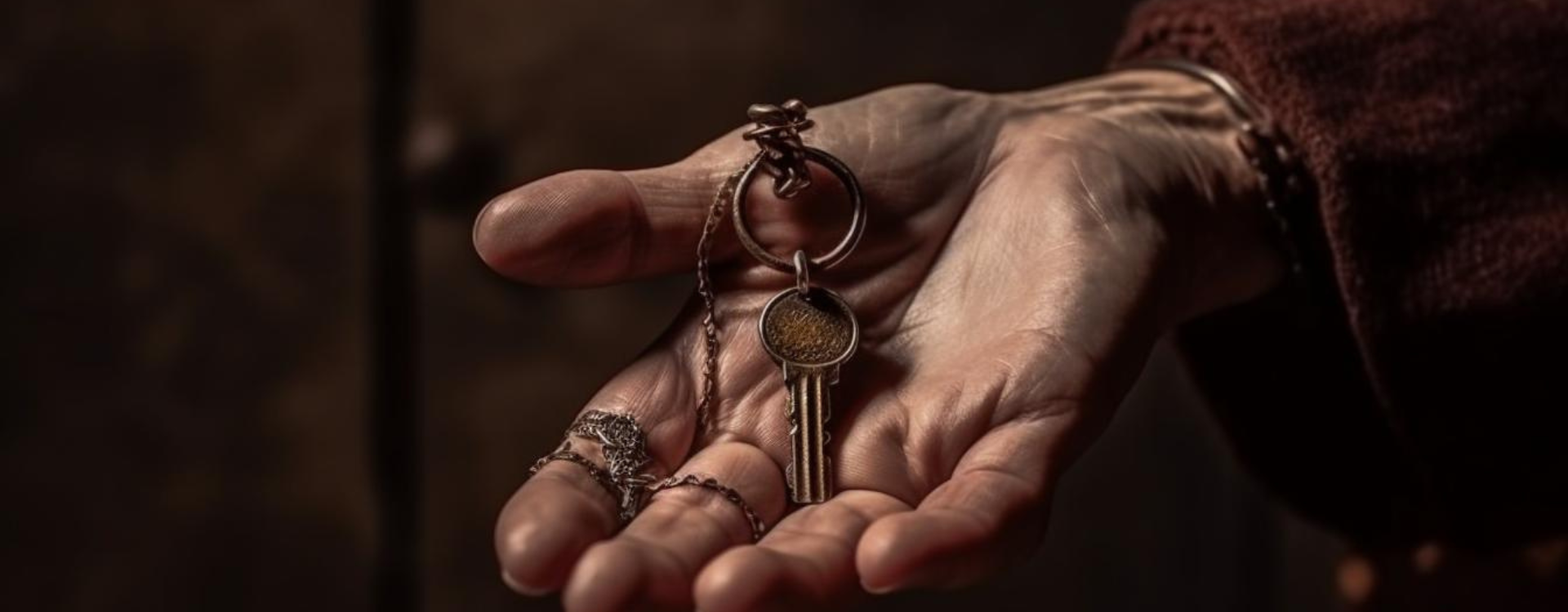
Jane's hand stilled. Slowly, almost reluctantly, she pulled the chain from beneath her collar, revealing an old key dangling from it—identical, as far as I could tell, to the one Thelma had pressed into my palm at Jeffries Manor. She held it in her palm without offering any further explanation, letting me look but making no move to share more than she had to.
"So, who has the third key?" I asked.
"Bob," both women said in unison.
"Bob?" I repeated, certain I'd misheard. "Bob Gangley? The old guy down the corridor that annoys you so much?"
"He's not that bad, really," said Jane, her quick defence carrying a note of something almost like fondness—surprising, given how often she'd complained about him in past visits.
"He's just old, like us," Thelma chuckled softly. "None of the simple things in life seem so simple anymore when you're our age."
Questions crowded my mind, jostling for position, demanding answers. "What happened to the original key? How would making copies satisfy revenge? And revenge for what? What did you find behind that trapdoor?"
The silence that followed my barrage of questions felt thick, oppressive. Jane's expression hardened further, her jaw setting in a way that told me I'd pushed too far, asked too much.
"I think that's enough for today," she said, rising abruptly from her chair. The movement was final, deliberate—a door slamming shut with force.
"But—" I started.
"Come back next week," Jane cut me off, her voice carrying an edge that made absolutely clear this wasn't a request or an invitation. It was an ultimatum. "Bring the key, and we'll tell you more."
There it was. Laid bare. No key, no answers. She'd dangled just enough to hook me, revealed just enough to make me desperate for more, and now she was reeling in the line. I'd been out-played by a ninety-two-year-old woman, and we both knew it.
I looked to Thelma, hoping for some crack in the wall they'd erected, some hint that she might be willing to share more than Jane would allow. But Thelma's expression had shifted back to that distant, dreamy quality, as though she'd retreated from the present into the safer waters of the past.
"Next week," Thelma affirmed quietly, her voice carrying an air of finality.
I stood slowly, recognising a negotiation I couldn't win. Not today. Not without the leverage they wanted. "Okay."
"Promise that you'll bring that key with you," Jane said, her gaze pinning me in place. This wasn't a grandmother's gentle request—it was a demand, with consequences clearly implied if unmet. Her eyes bored into mine, searching for any sign of deception.
I squirmed under that gaze, resenting both the scrutiny and my own helplessness. I wasn't used to being on this side of a manipulation. Wasn't used to being the one manoeuvred into a corner. The key in my wardrobe safe—the key I'd deliberately left at home—felt suddenly significant in its absence, a bargaining chip I wasn't ready to surrender until I understood its true value.
"Yeah, I promise," I said, the words tasting of capitulation.
Jane held my gaze for a long moment, weighing my sincerity, before finally nodding once—a sharp, curt acknowledgment that the deal was struck.
As I left, my mind churned through the fragments I'd gathered. Three keys. Thelma, Jane, and Bob—all connected to something hidden at Jeffries Manor, something terrible enough that discovering it had nearly cost them their lives. A trapdoor in James Jeffries's study. Revenge enacted through stolen keys and carefully guarded secrets. And a name—William Jeffries—that meant nothing to me yet but clearly meant everything to Thelma.
They'd given me just enough to ensure I'd come back. They'd been keeping secrets since before I was born, had survived whatever horrors lay behind that trapdoor, and they weren't about to give up their leverage for nothing.
Next week, I'd bring the key. Not because I'd promised—promises meant less to me now than they once had—but because I needed those answers. Because whatever they were hiding connected to the Jeffries family, to the manor, possibly to the disappearance of the original founding William Jeffries himself back in 1821. Because I couldn't afford to leave stones unturned.
And if there was one thing I'd learned recently, it was that getting what you needed sometimes meant playing along until the moment you didn't have to anymore.
I'd bring their key next week.
But I'd be damned if I'd hand it over before I got every last answer they had to give.







