4344.40 · February 9, 2024 AD
Number Seven
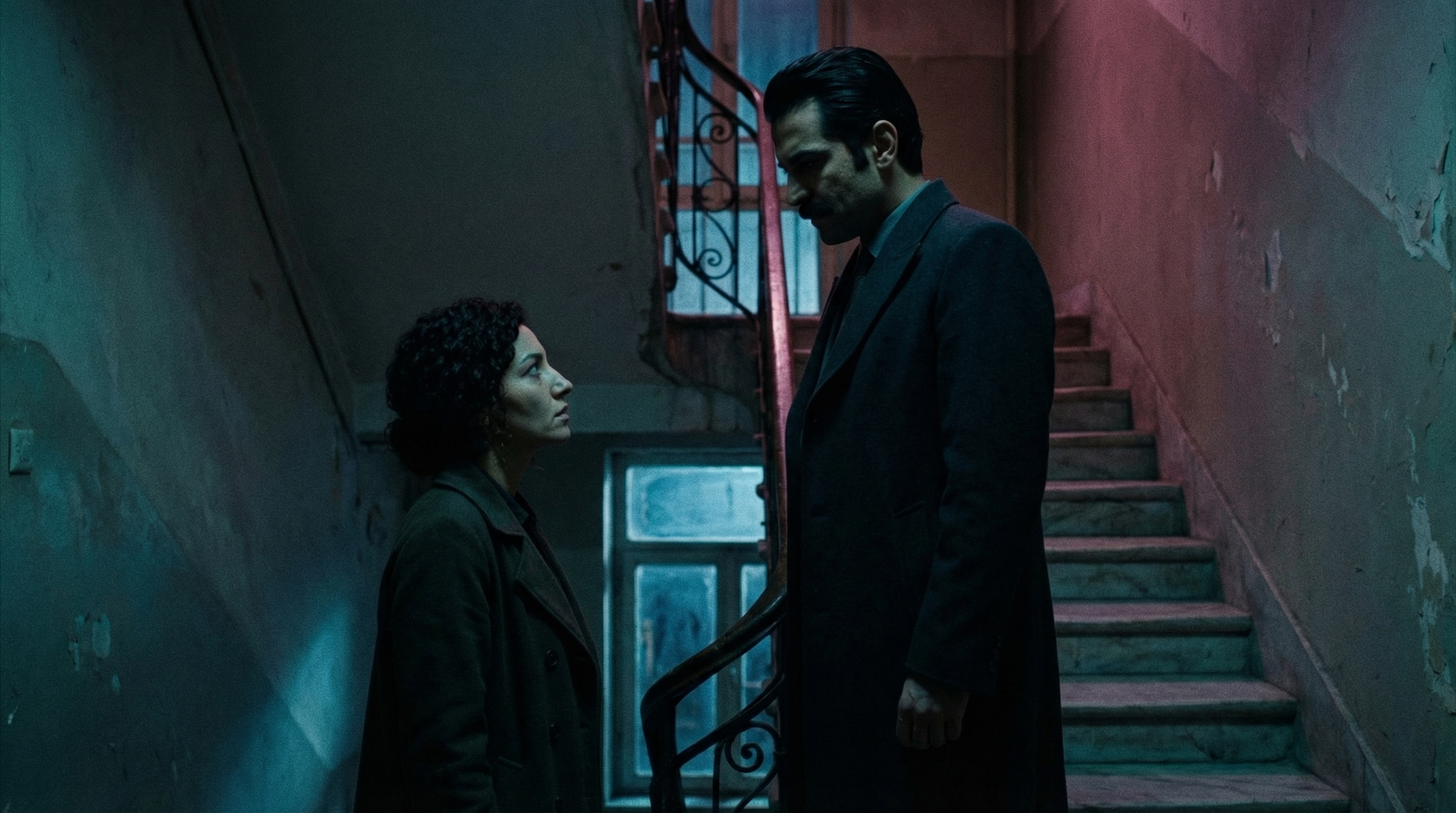
Flat number 7 on the fourth floor of a Cihangir apartment building has not been empty for four years. It has been sanitised. Farhad Rezaei — Iranian property investor, transnational facilitator, the building's owner — descends from it through a darkened stairwell carrying industrial solvent on his overcoat and encounters a tenant whose late rent provides the leverage that the conversation on the landing requires.
The flat had held people three days earlier. Four of them — two men and two women, Afghan nationals whose journey from Nimroz Province through the Iranian border crossing at Mirjaveh and overland to Istanbul had taken eleven days and cost each of them four thousand US dollars, paid to a chain of facilitators whose operational nodes connected Helmand's displacement camps to the Aegean coast. They had waited in flat number 7 for six days whilst the logistics of their onward transit to the Greek border were arranged — six days of enforced stillness in a fourth-floor apartment whose windows they were instructed not to approach and whose lights they were instructed not to use after dark, eating food delivered by a man who spoke Dari with a Tehrani accent and who collected their mobile phones on arrival and did not return them.
The four had been moved two nights ago. A van had collected them from the building's rear entrance — a service door accessible through a narrow lane that ran between the Cihangir building and its neighbour, wide enough for a single vehicle, unlit, invisible from the street. The transit to Edirne, near the Greek border, would take five hours. What happened after Edirne was someone else's operation, someone else's risk, someone else's margin. Farhad Jafar Rezaei's involvement ended when the cargo left Istanbul. The four thousand dollars per head — sixteen thousand total — had already been distributed through the chain: border payments at Mirjaveh, transport costs between Van and Istanbul, the operational expenses of maintaining a residential flat in a gentrified Istanbul neighbourhood as temporary accommodation for people whose presence in the building had to be invisible to the tenants below.
What remained was the cleaning.
Farhad conducted the most sensitive sanitisations himself. The operatives who managed routine turnovers between the flat's different uses — the replacement of bedding, the removal of food waste, the basic restoration of an unoccupied appearance — were adequate for transitions whose forensic sensitivity was low. But the flat had held people for six days. People left traces that routine cleaning did not eliminate: skin cells embedded in fabric, hair caught in drain covers, fingerprints on surfaces that no amount of conventional wiping would remove to the standard that operational security required. Industrial-grade solvents — the kind whose sharpness clung to wool and leather and hands for hours after application — were necessary. Farhad applied them with the methodical thoroughness of someone who understood that the difference between a flat that appeared clean and a flat that was forensically sterile was the difference between an operational asset and a liability.
The work took two hours. The flat was restored to its characteristic condition of apparent vacancy — no bedding, no food, no personal effects, no evidence that the space had been occupied by four frightened people whose names Farhad had not asked and whose faces he would not remember. The windows were sealed. The heating was turned off. The particular held-breath quality of an unoccupied space reasserted itself in the rooms where six days of human habitation had temporarily disturbed it. Number 7 returned to the suspended animation that the building's other residents understood as investment property sitting empty, appreciating in value, waiting for a renovation that would never come because renovation was not what the flat was for.
The descent through the darkened stairwell was interrupted on the landing between the third and second floors. Farhad navigated the building's stairs without the timed light — he had walked them enough times across the twelve years of his ownership to have memorised which step was wider, which section of banister was loose, where the marble had a chip that could catch a toe. The confidence of this navigation was itself a disclosure, had anyone been positioned to observe it: a man who supposedly visited his property intermittently for administrative purposes should not have possessed the muscular familiarity with its staircase that came only from repeated traversal in conditions where turning on the light was inadvisable.
Mira Osman was standing on the landing below. She had been visiting the third-floor tenant — the retired ney musician whose below-market lease predated Farhad's ownership and whose eviction would have generated legal complications that Turkish tenancy protections made disproportionately expensive. Halil Rauf Erdem was a nuisance only in the acoustic dimension — his music, played at volumes calibrated for declining ears, occasionally reached levels that drew the attention of other residents. But Halil Bey asked no questions, noticed nothing, and occupied the floor directly below the operational flat with the oblivious contentment of an eighty-one-year-old widower whose world had contracted to his records and his memories and his daily watering of a jasmine plant that was clearly dying. He was, from Farhad's operational perspective, the ideal downstairs neighbour.
The second-floor tenant was a different calculation. Mira Osman — young, educated, an academic of some kind whose work involved old documents and private collections — was quiet, solitary, and three weeks behind on her rent. The rent lateness was useful. It created the asymmetry that landlord-tenant relationships sometimes produced: the particular vulnerability of a person who owed money to the person who controlled their housing, the implicit leverage that financial obligation provided without requiring explicit deployment. A tenant who was current on their payments occupied a position of contractual equality. A tenant who was three weeks late occupied a position of dependence, and dependence, properly managed, produced the discretion that Farhad's operational requirements demanded from the building's inhabitants.
The conversation on the landing lasted less than two minutes. Its surface concerned rent — the overdue amount, the end-of-month deadline, the mutual understanding between reasonable people. Its subtext concerned the particular Turkish understanding that what happened behind a closed door was not your concern: the social contract of apartment living, weaponised. Farhad mentioned maintenance on the fourth floor — plumbing, he said — and the explanation occupied the space where a credible explanation should have been without actually providing one. The implausibility was not accidental. It communicated that the truth was not being offered and that the absence of truth was the point — that the exchange operating beneath the rent discussion was not about information but about its suppression.
The chemical smell would have been noticeable. Industrial solvents dissipated over hours, not minutes, and the two hours Farhad had spent in the fourth-floor flat had saturated his overcoat and hands with a sharpness that cologne could mask but not eliminate. Whether the tenant on the landing registered it consciously or merely absorbed it as one of the unnamed wrongnesses that the encounter produced was, from Farhad's perspective, immaterial. What mattered was the conclusion of the exchange — the smile, the handshake, the phrase delivered with the lightness of small talk and the weight of instruction: we don't make problems.
Farhad descended the remaining stairs and left through the front door whose resistance in cold weather he managed with the practised shoulder-weight of long familiarity. The February night received him. The Cihangir streets — steep, narrow, populated at this hour only by the cats whose territorial disputes constituted the neighbourhood's unofficial nightlife — offered the anonymity of a residential quarter whose inhabitants were inside, behind their own closed doors, conducting their own private lives with the same expectation of non-interference that Farhad relied upon for his.
The building settled behind him. Eight flats across four floors, each sealed from the others by walls and floors and the assumptions that residential architecture cultivated. On the third floor, Halil Rauf Erdem listened to Münir Nurettin Selçuk at a volume he had been asked to reduce, the ney's breathy melody threading through his flat like the memory of breath. On the second floor, Mira Osman fastened a brass chain whose two loose screws provided approximately two seconds of delay against a forced entry and whose primary function was psychological rather than mechanical — the small gesture of boundary-assertion that people made when the boundaries they actually needed to enforce were invisible and unnamed. On the fourth floor, flat number 7 held its chemically enforced silence: scrubbed surfaces, sealed windows, the particular stillness of a space that had been emptied of people and stripped of the evidence that people had ever been there.







