4338.205 · July 24, 2018 AD
No Stars to Steer By
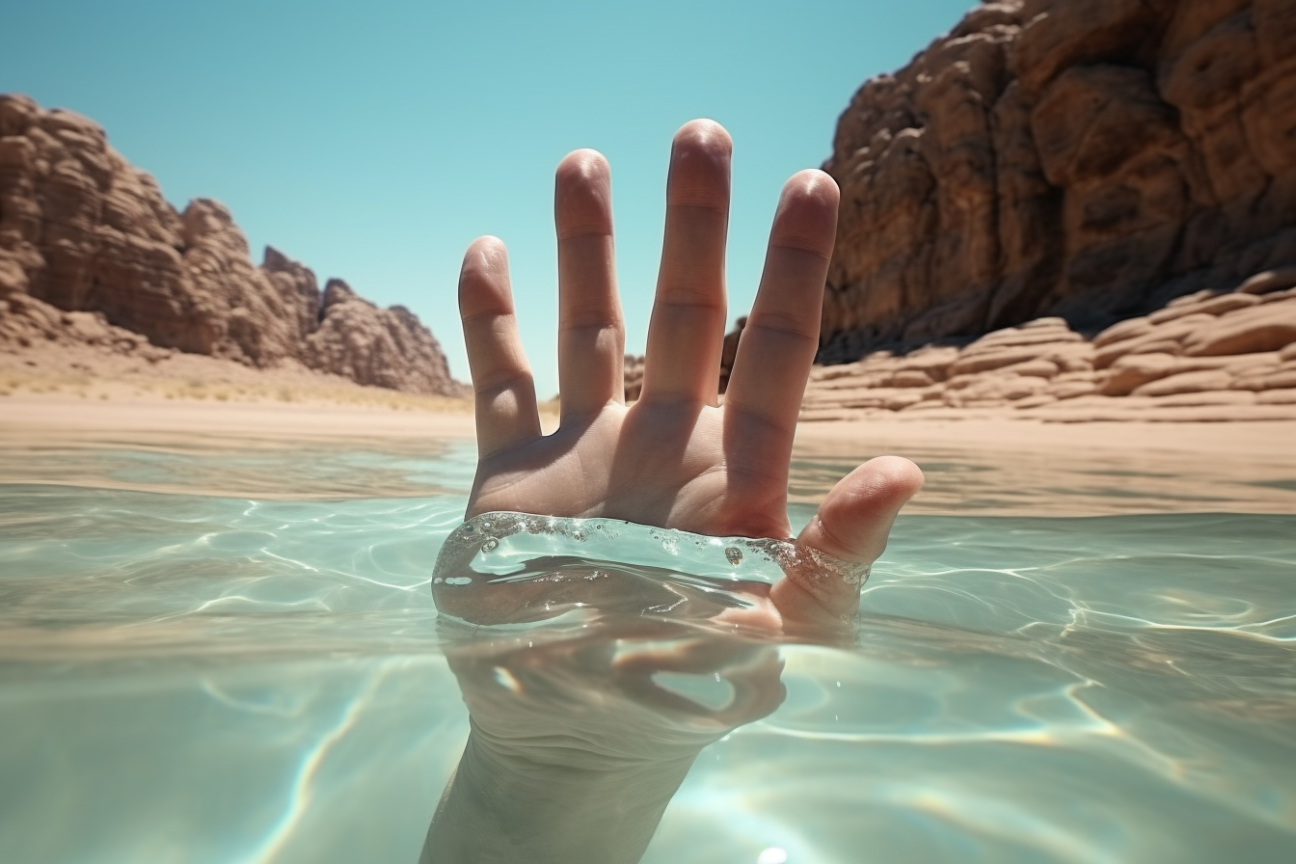
Pizza and wine offer a surreal moment of comfort after Jamie's near-drowning, but Luke's departure through the portal leaves him and Paul to face their first Clivilius night alone—beneath a sky so completely empty of stars and moon that even the darkness feels wrong. As the fire dies and Jamie retreats to the tent, the sum total of their achievements reduces to one shelter, one meal, and the desperate hope of surviving until morning.
"There's something profoundly disorienting about eating pizza in an alien dimension—the cheese tastes exactly the same, but the sky above you has forgotten how to do its job."
The aroma hit me before the campsite came into view.
My feet, still tender from the burning dust and the river's assault, faltered mid-stride as the smell registered—warm, savoury, impossibly familiar. Cheese. Tomato sauce. The particular alchemy of bread and toppings that meant only one thing.
"Oh my God. Food!"
The words escaped before I could contain them, relief and hunger colliding in an exclamation that sounded almost childlike. After the terror of the lagoon, the near-drowning, the endless physical abuse this day had inflicted, the prospect of an actual meal felt like deliverance.
Paul and Luke had arranged themselves in the dust near the fire, their postures suggesting they'd been waiting for some time. The scene that greeted me was bizarrely domestic—two men lounging beside a campfire, pizza boxes open between them, a wine bottle catching the late afternoon light. It could have been a backyard barbecue, a camping trip, any ordinary gathering of friends enjoying the outdoors.
Except nothing about our situation was ordinary. And the normality of the tableau only emphasised how thoroughly abnormal everything else had become.
"And wine," Luke added, his grin carrying a warmth that temporarily softened the edges of my resentment. He lifted the bottle in demonstration, the liquid inside catching firelight with amber warmth.
I surveyed the scene with exaggerated assessment, noting the half-empty bottle and the relaxed postures that suggested they'd been sampling its contents for a while. "Well, you two look like you've given it a fair go already."
The teasing came naturally, a familiar register that felt almost normal despite our circumstances. My stomach chose that moment to announce itself—a growl loud enough to be heard over the fire's crackle, a primal demand that cared nothing for social niceties.
I tightened the towel around my waist, suddenly conscious of how little I was wearing. The thong beneath—Luke's ridiculous green thong—pressed against my skin with its persistent reminder. Revealing it now, letting Luke see that I'd actually worn the damned thing, felt like a vulnerability I wasn't prepared to offer. Better to maintain the towel's flimsy barrier than navigate whatever conversation that revelation might prompt.
I settled into the dust beside Luke, the ground still warm from the day's accumulated heat. The position was intimate by necessity rather than choice—our campsite offered limited seating options, and proximity to the fire meant proximity to each other.
"Well, Luke has," Paul's laughter punctuated his observation, a genuine amusement that acknowledged what we all knew about Luke's relationship with wine. The sound cut through my darker thoughts, offering a moment of levity that felt precious in its rarity.
I reached for a slice of pizza, the cheese still warm, the crust yielding between my fingers with satisfying give. The first bite was transcendent—flavour flooding my mouth with an intensity that seemed disproportionate to its mundane reality. But I'd nearly drowned half an hour ago. I'd spent the day being stripped of dignity in ways I was still processing. A slice of pizza wasn't just food; it was evidence that pleasure still existed, that the world contained more than dust and fear and bodily humiliation.
My gaze drifted beyond our small circle of firelight to where the sun was beginning its descent behind distant mountains. The sky had transformed into something from a painting—oranges bleeding into purples, the kind of sunset that would have been beautiful under different circumstances. Here, it carried a warning I couldn't ignore.
Are we really about to spend a night here?
The question surfaced with the certainty of approaching darkness. Sunset meant nightfall. Nightfall meant hours of unknown vulnerability in a place we didn't understand, couldn't predict, couldn't escape.
Henri surfaced in my thoughts without invitation—his demands for breakfast, his habit of positioning himself precisely where he knew he'd be most annoying. I missed him. The admission surprised me; Henri spent half his time irritating me beyond measure, and Duke the other half. But distance had a way of softening irritations into something closer to affection.
Both of them, actually.
The pang of longing was unexpected and unwelcome. I was trapped in another dimension, had nearly died in a river, was about to spend the night in an alien wilderness—and I was getting emotional about the two dogs I'd left behind. The absurdity wasn't lost on me, but the feeling persisted regardless.
Luke pushed himself to his feet with the fluid motion of someone accustomed to moving through the world without friction. His hand brushed dust from his backside—a gesture so ordinary it hurt—while a familiar mischievous grin spread across his features.
"Well," he announced, the word carrying finality I wasn't prepared for. "I better get back. Don't want Gladys to finish all the wine in the house."
The joke landed flat against my rising anxiety. Gladys. The message I'd written. The secret I'd exposed about Beatrix. All of it crashed back with the force of remembered consequence.
What the hell was Luke telling her?
I shook my head, the gesture expressing more than I could articulate. "So, that's it then?"
The words emerged with an edge I hadn't intended—disbelief and frustration woven together so tightly I couldn't separate them. Luke was leaving. Going back to Earth, to warmth and electricity and familiar walls, while Paul and I remained here in this hostile expanse with nothing but a tent and diminishing firelight.
Luke approached with gentle steps, his movements carrying a solemnity that seemed out of place given his earlier levity. The kiss he pressed to my forehead was soft, tender, laden with everything we weren't saying aloud. I could smell him—a mixture of sweat and dust and something underneath that was uniquely Luke, unchanged by dimensional displacement.
"Yeah," he replied, his voice thick with reluctance that I wanted to believe was genuine. "But I promise I'll be back first thing in the morning."
"Fine."
The response was too sharp, too loaded with the disappointment I was struggling to contain. A single syllable carrying days' worth of accumulated resentment, compressed into something that felt like surrender.
"I wish we could go with you."
The admission escaped raw and unguarded, stripping away the protective layers of sarcasm I usually maintained. For a moment, I was simply a man who wanted to go home, wanted to escape this nightmare, wanted Luke to somehow fix what he had so thoroughly broken.
Luke's lower lip disappeared between his teeth—a visible sign of internal struggle that I recognised from years of reading his expressions. The gesture was achingly familiar, a reminder that beneath the chaos, beneath my anger and his responsibility, we had built something together. Whether that something could survive this remained unclear.
I released a sigh that felt like it originated somewhere deeper than my lungs. The urge to argue, to demand, to insist—it was there, pressing against my ribcage with frustrated energy. But resistance felt futile. Clivilius had made its decree. The Portal had rejected me with scorching finality. No amount of protest would change the fundamental reality of our imprisonment.
"Good night, Luke." Paul's voice cut through the thickness gathering between us, a simple farewell that nonetheless carried our shared resignation.
"Night, Paul." Luke's wave was casual, almost normal, as he turned towards the Portal's distant location. I watched his back recede—the familiar slope of his shoulders, the particular rhythm of his walk—until distance and fading light merged him with the landscape.
The emptiness that followed his departure was almost physical, a void that settled into the space he'd occupied. I reached for another slice of pizza, the action driven by need for distraction rather than hunger. Each bite was a small anchor, a way to occupy my hands and mouth while my thoughts churned with everything I couldn't change.
Paul and I settled into the dust as the last traces of light drained from the horizon. The wine bottle had been reduced to dregs; the pizza boxes sat empty beside us, cardboard monuments to a meal that had offered temporary comfort. The fire's glow waned by degrees, its reach contracting as the fuel diminished.
I watched Paul from the corner of my eye, envying his apparent calm. His posture suggested acceptance, even peace—a serenity that seemed impossible given our circumstances.
Was there a piece of this puzzle that he understood and I didn't, or had he simply resigned himself to a fate beyond our control?
"It's so quiet," Paul observed, his voice filling the silence that had settled around us like something tangible. He stretched as he spoke, the movement casual despite its profound understatement.
I glanced around, registering what he'd articulated. The absence of sound was oppressive—no insects chirping, no birds calling, no distant traffic or wind through trees. Just the fire's diminishing crackle and our own breathing, two human sounds adrift in an ocean of nothing.
"I know," I echoed, my voice carrying both agreement and the unease his words had sparked. Then my gaze lifted to the sky above us, and the observation that followed was almost involuntary. "And dark."
I pointed upward, towards the void that had replaced the sunset. The sky wasn't merely dark—it was empty. The absolute, complete absence of stars created a blackness so total it seemed to press down on us, a ceiling of nothing where familiar constellations should have scattered their ancient light.
Paul tilted his head back, following my gesture. His neck craned as he searched the emptiness, seeking stars that refused to appear. "And no moon either."
The words hung between us, small observations that felt enormous in their implications. Earth's sky was never truly dark—light pollution, stars, the moon's reliable cycle all combined to create a canvas that shifted but never went blank. This sky offered nothing. It was as if someone had hung velvet above us and forgotten to add the decoration.
"What do you think it means?" I couldn't help asking, desperate for some framework that might make sense of what we were experiencing.
"What do you mean?" Paul's response suggested either genuine curiosity or an attempt to understand my line of thinking.
"Well, doesn't the moon usually affect the oceans and tides?" I clung to fragments of scientific understanding, grasping for anything that might anchor this experience to familiar physics.
"I guess," Paul replied, his shrug audible in his voice. "But all we've seen is a river. We don't even know there are any oceans here."
"There has to be!" The insistence emerged sharper than intended, desperation masquerading as conviction. "We have to still be somewhere on Earth, right?"
The question was as much plea as inquiry—a need for reassurance that this nightmare had boundaries, that however strange our situation had become, it remained connected to the world we knew.
"I'm so confused," Paul admitted, his hand rising to scratch at his head in a gesture of genuine bewilderment. "None of this makes any sense."
His words validated my own chaos while offering no resolution. We sat in shared confusion beneath an empty sky, two men marooned on an island of dust in a sea of questions that had no answers.
I rose from our makeshift seating, feeling the day's accumulated exhaustion press down on my shoulders with each movement. The empty pizza box felt light in my hands—cardboard that had briefly contained comfort, now just refuse to be disposed of.
The fire accepted my offering with brief enthusiasm, flames licking at the cardboard with eager tongues before settling back into their dying rhythm. The brief flare of light cast dancing shadows across our camp, momentary illumination that only emphasised how dark everything else had become.
"Kick some dust on those embers when you turn in, won't you?" I requested, casting a glance towards Paul as I prepared to retreat for the night. The fire's visibility still worried me—a beacon that might attract things we couldn't predict, dangers we hadn't imagined.
"Sure," Paul's voice carried reassurance that I chose to accept despite my scepticism about his reliability. "I won't be that far away."
The words offered a sliver of comfort—the reminder that I wasn't entirely alone, that human presence would remain within calling distance even as darkness claimed the landscape completely.
The tent welcomed me with a canvas embrace, its dim interior a stark contrast to the fire's waning light outside. My eyes took moments to adjust, the darkness initially total before shapes began to resolve—the outline of our suitcase, the pale rectangle of the mattress, the rumpled fabric of blankets that promised rest.
Time had become an abstract concept in this place. No clocks, no phones, no reliable celestial markers to track the hours. Just the cycle of light and darkness, reducing existence to its most fundamental rhythm. It was dark. Therefore, sleep was the only remaining agenda.
I rummaged through the suitcase with movements that were more feel than sight. My fingers found the thong's distinctive fabric—that slick, tight material that had been pressing against me for hours—and peeled it away with relief that bordered on physical pleasure. In its place, I pulled on loose-fitting shorts, the soft cotton settling against my skin like a blessing after the thong's persistent constriction.
The mattress received my weight with welcoming give, the surface yielding to my body in ways that spoke to genuine comfort rather than mere absence of discomfort. After hours of dust and rocks and hard-packed earth, the cushioning felt almost decadent. My muscles, which had been clenched and complaining all day, began to unknot by degrees.
I pulled the blanket to my waist, the fabric cool against skin that still carried the day's accumulated grime. Lying there, staring at the tent's dim ceiling, I allowed myself to inventory the day's toll.
We'd accomplished almost nothing. Built one tent. Started one fire. Eaten one meal. The sum total of a day that had felt like weeks, reduced to such meagre progress that frustration and depression competed for dominance in my chest.
This is it, I thought, the realisation arriving with grim finality. This is our life now. Survival measured in tents assembled and fires maintained. Achievement redefined as "didn't die today."
My eyes closed, the lids heavy with exhaustion that extended beyond the physical. The events of the day began to recede—the lagoon's strange sensations, the river's attempt to kill me, Luke's departure and the kiss on my forehead—all of it fading into the background static of a mind preparing for unconsciousness.
Sleep approached like a tide, inevitable and welcome. I hovered at its edge, my consciousness tethered to the present by threads that grew thinner with each passing moment. The tent's canvas walls, the distant crackle of dying fire, Paul's presence somewhere in the darkness outside—all of it dissolved into irrelevance as exhaustion claimed its due.
Just a few hours, I bargained with the universe. Just a few hours of escape.
And then, gently, imperceptibly, I surrendered to the dark.
