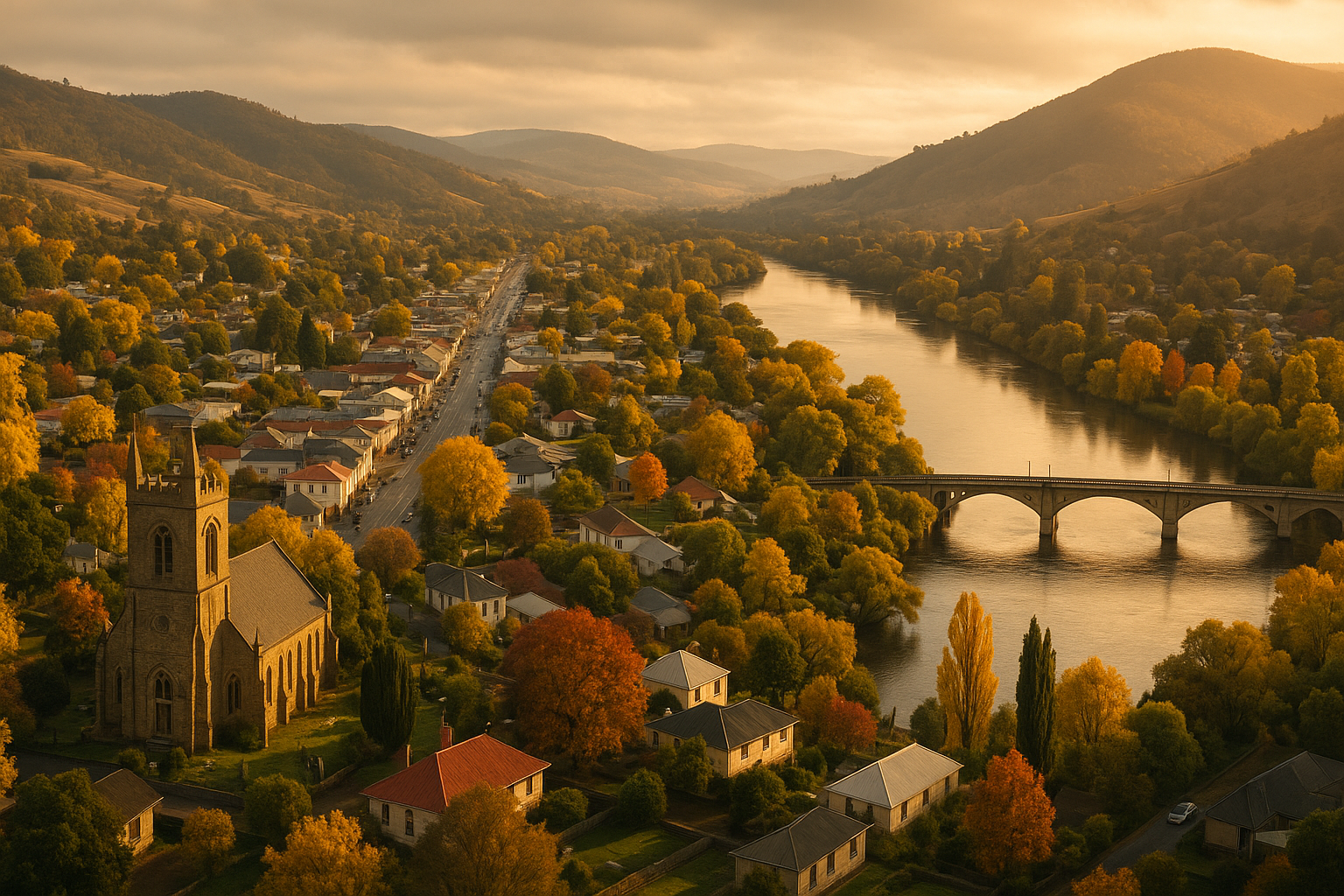
New Norfolk, Tasmania, Australia
New Norfolk is Tasmania's third-oldest European settlement, founded in 1807 when Norfolk Island's displaced population arrived in the Derwent Valley. Nestled 32 kilometres northwest of Hobart along the River Derwent, this historic town of 6,153 residents has evolved from its convict origins into a thriving community celebrated for hop farming, heritage architecture, and antique culture. Its colonial buildings, riverside setting, and layered stories make it Tasmania's gentle heart—a place where resilience quietly flourishes.
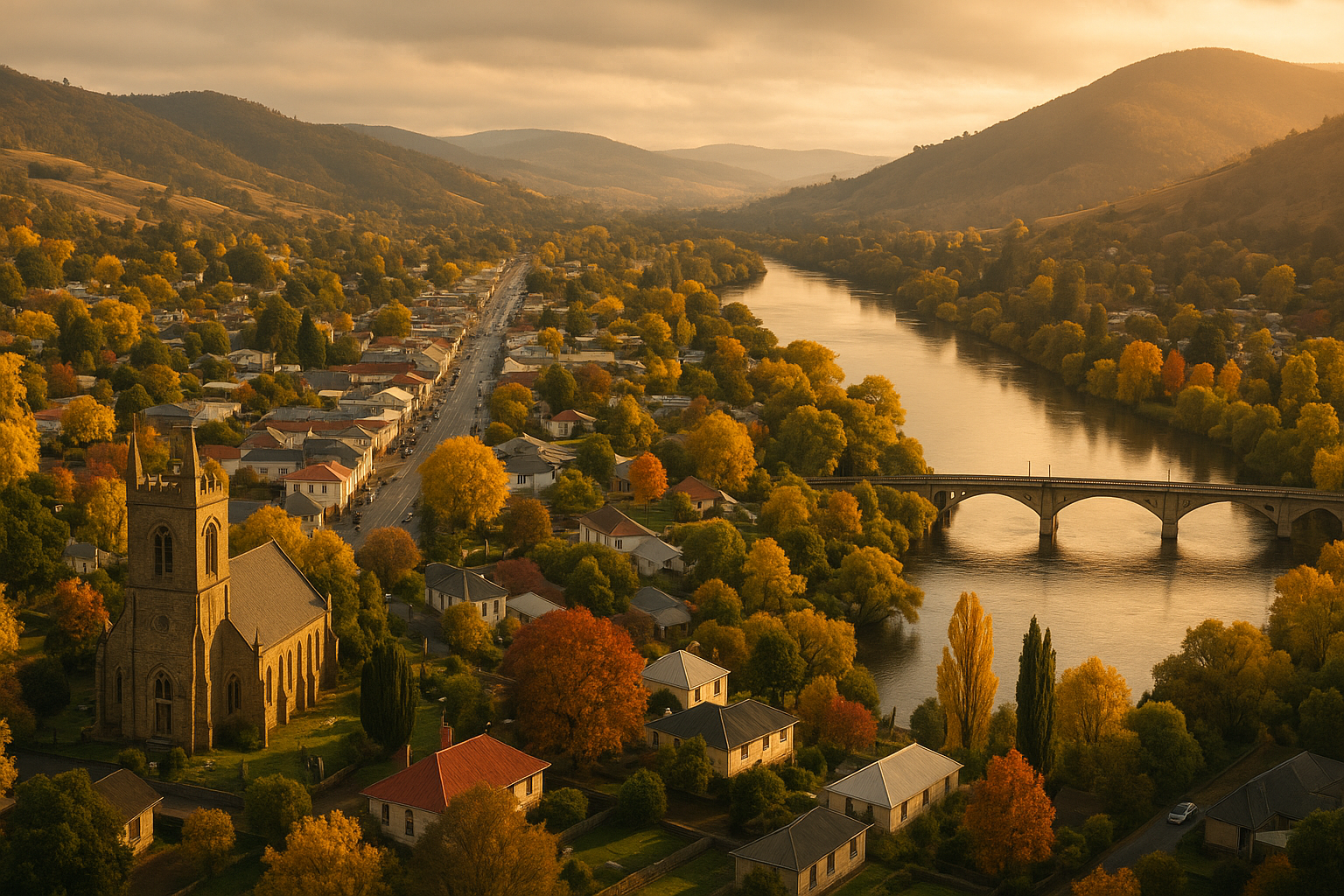
The Land Before Settlement
The fertile valley that would become New Norfolk belonged first to the Leenowwenne people, one of the five clans of the Big River Nation. They called this place Wulawali, living along the timtimili minanya (River Derwent) for tens of thousands of years before European ships carved through Bass Strait. The Leenowwenne understood the river's rhythms, the seasonal movements of game, and the sheltered valleys where winter storms barely penetrated. Their connection to this landscape, forged across millennia, would be severed within a generation of European arrival—though their presence remains embedded in the land itself, in place names slowly being restored, and in the continuing Tasmanian Aboriginal community that maintains connection to Country.
In 1793, explorer John Hayes became the first European to navigate the Derwent River's upper reaches. Sailing aboard the Duke of Clarence with the Duchess of Bengal in company, Hayes followed the river until shallow waters forced him to continue by rowboat. He reached a spot just upstream from present-day New Norfolk, noting the valley's agricultural potential in reports that would influence colonial planning for years to come. Yet it would be another fourteen years before permanent European settlement took root in the fertile soil Hayes had surveyed.
The Norfolk Islanders and a Town Born from Displacement
New Norfolk's founding story begins not in Tasmania but on a tiny Pacific island two thousand kilometres to the northeast. Norfolk Island, established as a secondary penal settlement in 1788, had evolved by 1807 into an unexpectedly successful agricultural community where former convicts and their families had built productive farms, raised families, and created lives that balanced harsh penal origins with hard-won prosperity. When British authorities decided to close Norfolk Island's settlement for strategic reasons, the community faced unwanted displacement.
Between November 1807 and October 1808, 544 souls—soldiers, convicts, and free settlers—were relocated to Van Diemen's Land in a series of embarkations. The offer seemed generous on paper: four acres of Tasmanian land for each acre held on Norfolk Island, houses of similar standard to those left behind, two to four convict labourers to assist with land clearing, and twelve months of provisions from government stores. Yet for families who had transformed Pacific rock into productive farmland, the prospect of starting again in an unfamiliar climate felt less like opportunity and more like exile.
The HMS Porpoise, the vessel that had played crucial roles in early colonial navigation, carried the first contingent. As the ship navigated up the Derwent River past the expanding settlement at Hobart Town, passengers glimpsed their future: a small riverside clearing surrounded by dense bush, with the imposing slopes of Mount Wellington dominating the horizon. They disembarked at what was initially called "The Hills"—a name that acknowledged the dramatic topography surrounding the valley—though locals would soon insist on "New Norfolk" as a deliberate act of remembrance and connection to their lost island home.
Among these arrivals were remarkable individuals whose stories would shape Tasmania's colonial narrative. Betty King (née Elizabeth Thackery), identified on her headstone as "the first white woman to set foot in Australia," was one of ten First Fleeters who would eventually be buried in the Methodist Chapel at Lawitta on New Norfolk's outskirts. These were people who had survived the First Fleet's brutal eight-month voyage in 1788, endured Norfolk Island's isolation, and now faced a third reinvention in Van Diemen's Land. Their resilience would become New Norfolk's founding characteristic.
James Bryan Cullen, an ex-convict First Fleeter who departed Norfolk Island aboard the Porpoise on 26 December 1807, received a land grant of 65 acres along the river's banks—property that would eventually become Glen Derwent, one of New Norfolk's most significant heritage estates. Denis McCarty, a former convict turned police officer, built the settlement's first residence in 1807 and found himself responsible for coordinating the arrival and settlement of over 500 people by late 1808. The task was monumental: families needed shelter before winter, land required clearing, and the fragile colonial economy struggled under the strain of supporting so many new arrivals.
Early Years: Survival, Adaptation, and Stubborn Growth
The first years tested every settler's resolve. The Derwent Valley's climate, though temperate, differed markedly from Norfolk Island's subtropical warmth. Winter brought frosts the Pacific islanders had never experienced. Dense Tasmanian bush resisted clearing with a tenacity that made Norfolk Island's terrain seem cooperative by comparison. There were no roads, no established transport networks—only the river and rough tracks navigable by bullock wagon or on horseback.
By 1807, the European population on the Derwent had become, as one official report grimly noted, "483 starving persons." Food supplies had dwindled so drastically that authorities were sending convicts into the bush to hunt kangaroos for meat rations. The arrival of 544 additional mouths to feed nearly broke the colony's fragile provisioning system. Most settlers required government rations through 1812, a period of dependence that chafed against their hard-won agricultural expertise but proved necessary for survival.
Yet gradually, stubbornly, the settlement took root. The Norfolk Islanders brought skills that would prove invaluable: practical farming knowledge adapted to challenging conditions, experience with communal cooperation born from island isolation, and a determination forged through multiple displacements. They cleared land tree by tree, built homes from local sandstone and timber, and established farms along the river's fertile banks. The Derwent provided both transport and sustenance—a highway for goods traveling to Hobart and a source of fish to supplement limited rations.
In 1811, Governor Lachlan Macquarie visited the growing settlement. Recognising its strategic importance as Tasmania's second significant population centre after Hobart, he ordered surveyors to formally plan a township. With characteristic colonial sentiment, Macquarie named it "Elizabeth Town" after his wife. The gesture was well-intentioned but doomed. The settlers, wanting to preserve their connection to Norfolk Island, persistently used "New Norfolk" in daily conversation and official correspondence until authorities relented. By 1825, the preferred name had achieved official status—a small but significant victory for a community that had already lost too much.
Macquarie also renamed the local stream. Settlers had called it the Thames, a nostalgic echo of England's great river. The Governor rechristened it the Lachlan, after his son. The pronunciation, however, resisted official diktat: locals said "Lacklan" rather than the prescribed "Locklon," and continue to do so today—another quiet act of linguistic resistance that speaks to the community's stubborn independence.
Building a Town: Infrastructure and Institutions
The first road connecting New Norfolk to Hobart was constructed between 1818 and 1819, transforming the settlement's connection to the colonial capital. Prior to this, river transport had been the primary means of moving goods and people—a system that worked during favourable conditions but left the town isolated during droughts when the Derwent ran shallow. The road's completion enabled regular coach service, beginning in 1829, that linked New Norfolk to Hobart's markets and administrative centres with newfound reliability.
St Matthews Anglican Church, consecrated in 1823, stands as Australia's oldest extant Anglican church—a distinction that speaks to New Norfolk's early importance in Tasmania's colonial hierarchy. The church's Gothic Revival architecture, with its lancet windows and modest stone construction, reflected both the settlers' determination to recreate familiar British institutions and the limitations imposed by colonial resources. The building became not just a place of worship but a community anchor, marking births, marriages, and deaths that wove individual lives into the town's collective story.
The Bush Inn, established in 1815 and formally licensed in 1825, claims the title of Australia's oldest continuously licensed hotel operating in its original building—a record it maintains to this day. More than just a watering hole, the Bush Inn functioned as community gathering place, informal court of public opinion, and staging post for travellers navigating between Hobart and Tasmania's interior. Its weatherboard construction, thick walls, and riverside location embodied the pragmatic colonial architecture that prioritised function over ornamentation. In 1888, Australia's first telephone trunk call connected Hobart to the Bush Inn—a technological milestone that positioned New Norfolk at the forefront of communications infrastructure.
By 1827, New Norfolk's population and institutional development had reached sufficient complexity to warrant the establishment of a military hospital, intended initially for invalid and sick convicts from Hobart, Launceston, and outstations. This facility, constructed from sandstone quarried locally and built by convict labour, would undergo multiple transformations over the coming decades. It evolved into the New Norfolk Hospital for the Insane, then the Royal Derwent Hospital—becoming Australia's longest continuously operating mental health facility. The complex, later known as Willow Court after the willow tree planted in its courtyard (reputedly grown from cuttings taken from Napoleon's grave), came to embody both Victorian-era approaches to mental health treatment and the town's capacity to absorb and adapt institutions that other communities might have rejected.
Agricultural Prosperity and the Hop Industry
New Norfolk's economic foundation rested firmly on agriculture. The fertile alluvial soils deposited by millennia of river flooding proved remarkably productive once cleared. Early settlers focused on cattle and sheep, with modest cropping as land was progressively cleared. The valley's sheltered position, reliable rainfall, and moderate temperatures created conditions suited to diverse agricultural production.
The introduction of hop cultivation in 1846 transformed New Norfolk's economic prospects. Hops, essential for beer production, thrived in the valley's climate—cool nights, warm days, and abundant water created ideal growing conditions. The Shoobridge family, arriving in 1849, pioneered commercial hop farming that would dominate the district for generations. They established extensive plantings at Bushy Park, developing cultivation techniques adapted to local conditions and building the characteristic oast houses (hop-drying kilns) that became visual signatures of the Derwent Valley landscape.
Glen Derwent, the former Cullen property purchased by William and Mary Downie in 1854 and renamed to reflect their Scottish heritage, became one of the valley's premier hop farms. The Downies built a substantial oast house in 1870, a structure that remains standing today—testament to the industry's importance and the solid construction methods employed. The cast iron gate valves still visible in paddocks across the property speak to the sophisticated irrigation systems that sustained hop cultivation through Tasmania's variable summers.
By the 1850s, Tasmania dominated Australian hop production, and New Norfolk stood at the industry's heart. The first recorded hop harvest appeared in Tasmania's agricultural returns in 1854, though cultivation had begun years earlier. For seven decades, the Shoobridge properties maintained continuous hop production—a remarkable feat of agricultural persistence that shaped not just the valley's economy but its social structure, seasonal rhythms, and collective identity. Hop-picking season brought the community together in shared labour, temporary workers swelled the town's population each autumn, and the distinctive smell of drying hops became New Norfolk's olfactory signature.
Industrial Expansion and Modern Development
The arrival of the Derwent Valley Railway in 1887 marked another transformative moment. The narrow-gauge line, initially connecting Bridgewater to New Norfolk across 18 kilometres, was progressively extended until reaching 74 kilometres to Kallista by 1936. The railway primarily served rural and logging areas, carrying timber products, agricultural goods, and passengers between the valley's scattered settlements and Hobart's markets.
Traffic increased dramatically in 1940 with the establishment of the Boyer paper mill (originally Australian Newsprint Mills, later Norske Skog) downstream from New Norfolk. Constructed during the Second World War to reduce Australia's dependence on imported newsprint, Boyer became one of Tasmania's major industrial employers. The company acquired substantial land holdings, built housing for employees, and developed community facilities including Boyer Oval, tennis courts, and badminton centres. The mill's establishment contributed significantly to Tasmania's industrial capacity and provided stable employment for generations of Derwent Valley families.
Boyer adapted through the decades as the paper industry evolved, modernising operations to improve efficiency and environmental performance. Despite challenges posed by declining print media consumption, the facility continues operating as Australia's sole manufacturer of newsprint, magazine, and book paper—a survivor in an industry where many mills have closed. The mill's ongoing operation represents both economic necessity and symbolic persistence, employing hundreds and anchoring New Norfolk's industrial identity.
The 1995 floods that devastated much of Tasmania severely damaged sections of the railway line beyond New Norfolk, leading to permanent closure of those segments. The Derwent Valley Railway Preservation Society, formed in 1990, worked to maintain heritage passenger train services until 2005. Ongoing negotiations aim to restore tourist train operations, transforming the railway from working infrastructure into heritage experience—a shift that mirrors New Norfolk's broader evolution from industrial centre to heritage tourism destination.
The Antiques Capital and Cultural Renaissance
By the late 20th century, New Norfolk had earned unofficial designation as "Tasmania's Antiques Capital"—a reputation built on the concentration of quality dealers and the town's architectural heritage providing atmospheric settings for antique commerce. The Drill Hall Emporium, housed in a converted 19th-century military building on Stephen Street, exemplifies the fusion of heritage preservation and commercial enterprise that characterises contemporary New Norfolk. Its theatrical displays of furniture, decorative objects, and curiosities attract collectors and tourists alike, transforming what might have been a declining regional town into a destination.
Willow Court, the former asylum complex, underwent adaptive reuse that converted institutional buildings into antique centres, cafés, and arts spaces. The Willow Court Antique Centre, occupying the old Olga Ward, became one of Tasmania's largest antique venues. The precinct's Georgian and Victorian architecture, the haunting institutional history that clings to sandstone walls, and the deliberate embrace of that complex past create an atmosphere that retail alone could never achieve.
Timeless Treasures Antique Emporium, operating from 2006 to 2015 in a converted sandstone church on Stephen Street, became another expression of New Norfolk's capacity for transformation. Co-founded by Beatrix Cramer and Brody Taylor, the shop's theatrical presentation of colonial-era artefacts, mourning jewellery, and Tasmanian ephemera made browsing feel like archaeological exploration. The shop's closure following Brody's murder and subsequent legal difficulties added another layer to New Norfolk's accumulating stories of loss, resilience, and the precarious nature of small businesses operating on passion and expertise rather than secure capital.
The proliferation of antique shops—including Flywheel on High Street, Ring Road Antique Centre, and numerous smaller dealers—transformed New Norfolk's commercial district. Visitors browsing for colonial furniture or vintage collectables discovered the town's heritage buildings, its riverside setting, and the Saturday market on High Street that locals proudly call "Tasmania's Friendliest Market." The antiques trade catalysed broader heritage tourism, encouraging preservation of historic buildings and revival of traditional events.
The Agrarian Kitchen, established in the Willow Court precinct, elevated New Norfolk's culinary reputation dramatically. Named Restaurant of the Year in 2024—the first Tasmanian restaurant to achieve this distinction—the Agrarian Kitchen demonstrates how heritage architecture, local produce, and culinary excellence can create experiences that transcend simple dining. The restaurant's success encouraged other heritage properties to develop hospitality offerings: Glen Derwent, Tynwald, and Woodbridge on the Derwent all converted into luxury accommodation with restaurants and wedding venues, each capitalising on Georgian and Victorian architecture whilst providing contemporary amenities.
Contemporary Character and Enduring Threads
Today's New Norfolk, with its population of approximately 6,153, balances heritage preservation with contemporary development. The Mills, a $500 million residential and community project, represents the largest development in the town's modern history—an ambitious attempt to create new residential capacity whilst respecting the valley's character. The project's success or failure will substantially shape New Norfolk's next chapter, determining whether growth enhances or erodes the qualities that make the town distinctive.
The town centre retains much of its colonial character. High Street's Victorian shopfronts house contemporary businesses alongside antique dealers. St Matthews Church still holds services, its bluestone foundations as solid as when Norfolk Island exiles laid them. The Bush Inn continues pouring beer for locals and tourists who marvel at its continuity. Arthur Square, New Norfolk's village green, provides rare public space where war memorials acknowledge military service and community gatherings mark seasonal celebrations.
The Derwent River remains central to the town's identity and daily life. Its banks provide walking trails, fishing spots, and vantage points for watching seasonal changes. The Esplanade connects heritage buildings and provides access to riverside parks. The river's moods—placid in summer, occasionally flooding in winter—continue shaping New Norfolk's rhythms as they have for millennia.
The hop industry, whilst diminished from its 19th-century dominance, persists through boutique growers and heritage preservation. Several historic oast houses have been restored and converted to alternative uses. The Tynwald Park oast house, established in 1867, operates as a museum dedicated to hop-growing history—transforming working industrial architecture into educational resource. These conversions acknowledge that whilst hops no longer dominate the valley's economy, the industry's cultural significance deserves preservation and interpretation for future generations.
New Norfolk High School, established to serve the valley's educational needs, continues providing secondary education for local students. The New Norfolk District Hospital, though modest compared to Hobart's major facilities, maintains essential healthcare services. The New Norfolk Police Station, housed in red brick premises that echo the railway station's 1901 materials, continues protecting a community where historic crimes occasionally resurface in whispered conversations and where contemporary policing must balance rural expectations with urban-influenced protocols.
Tasmania Police K9 Breeding Centre, located in New Norfolk's rural outskirts, represents another thread in the town's fabric—where pastoral landscape accommodates specialised facilities that support statewide operations. The breeding centre's presence, training police dogs for deployment across Tasmania, connects New Norfolk to law enforcement operations whilst maintaining the agricultural character that defines the valley.

