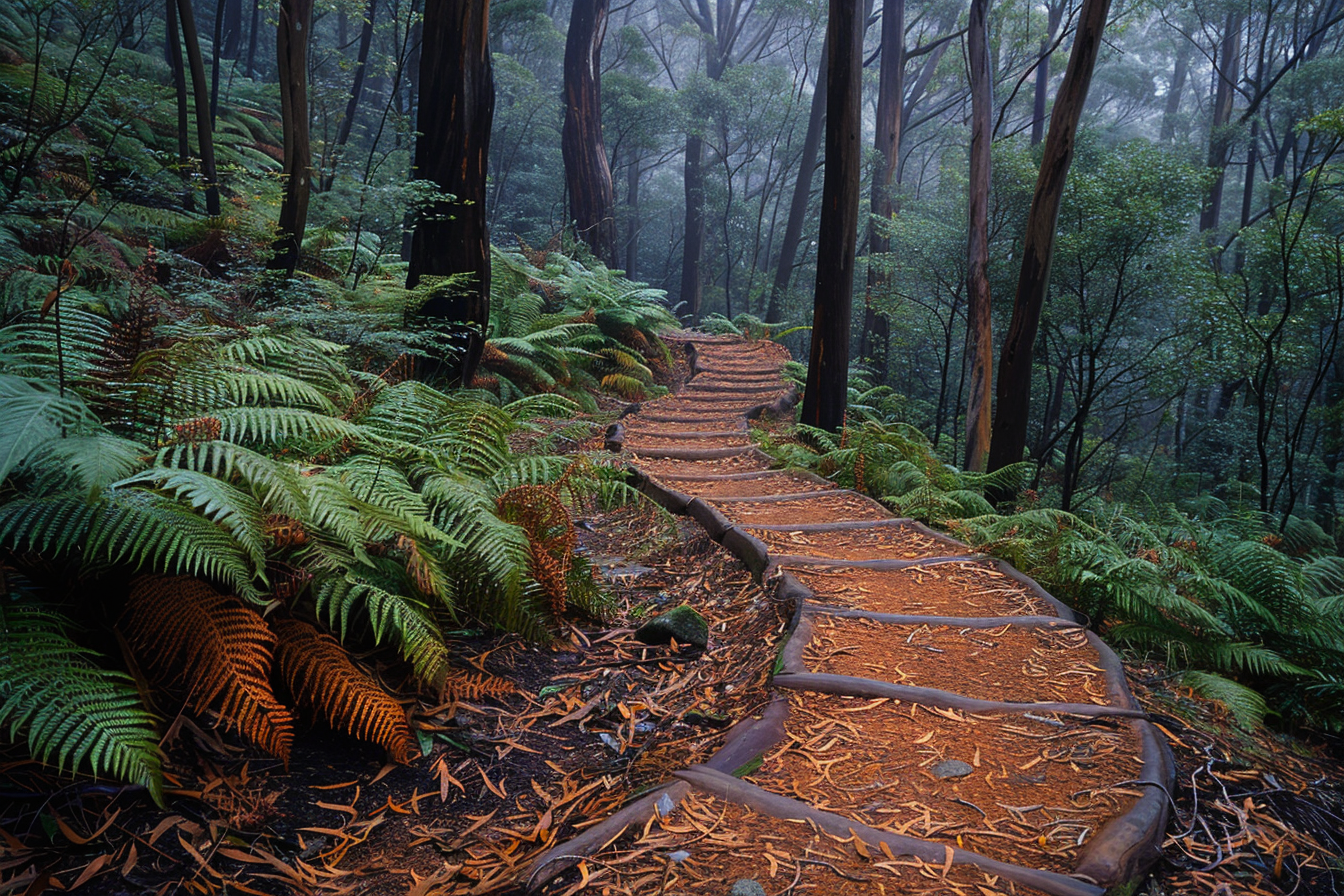
Myrtle Forest, Tasmania
Myrtle Forest, known for its stunning myrtle beech trees and rich biodiversity, became infamous in 2018 after a series of mysterious events unfolded within its depths. The forest was the site of a high-speed chase on 30 July, the discovery of abandoned evidence, and ultimately the tragic death of Detective Sarah Lahey during a covert police operation on 8 August. Linked to the disappearance of Detective Karl Jenkins and a broader conspiracy involving inter-dimensional portals, Myrtle Forest has since become a place of haunting beauty and unresolved mysteries, where the natural and the enigmatic coexist in unsettling harmony.
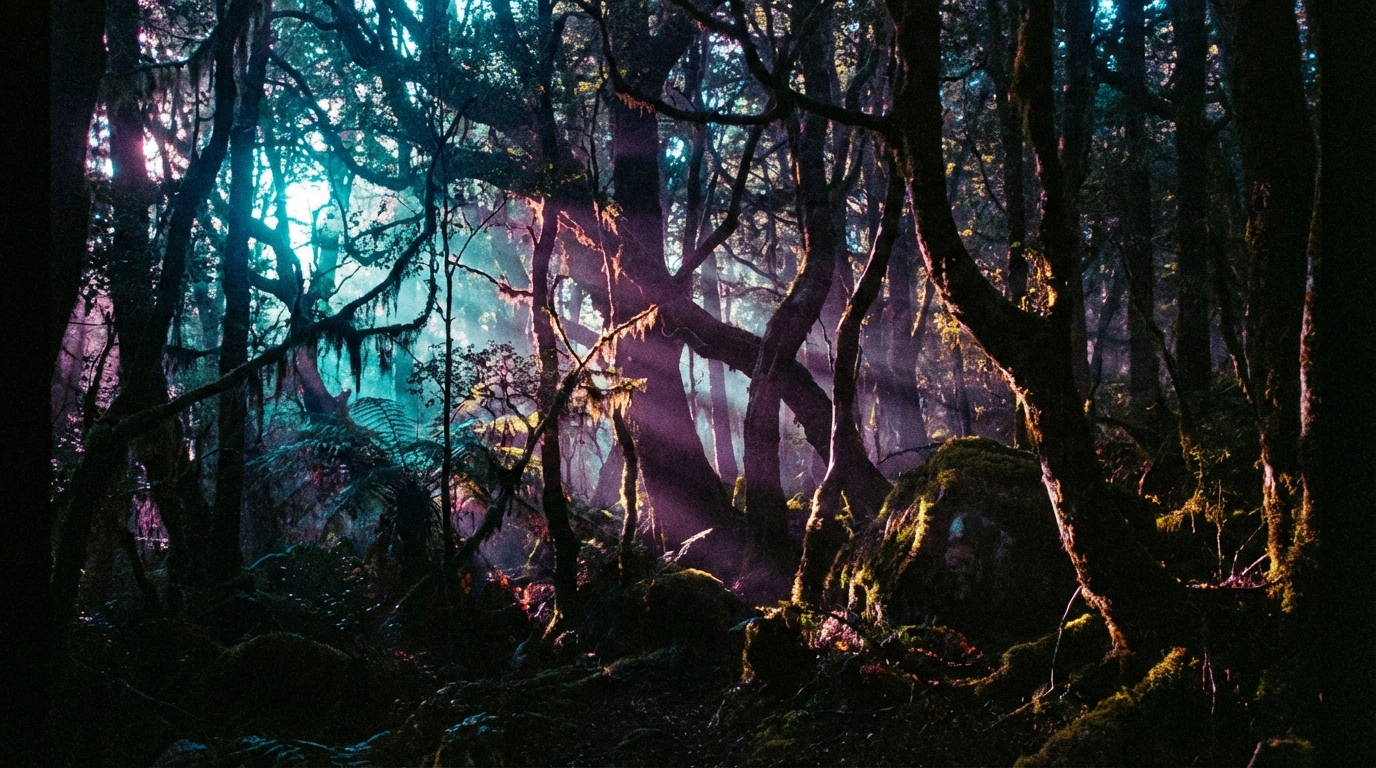
A Sanctuary Transformed
Myrtle Forest, located within Wellington Park on the outskirts of Hobart, Tasmania, is renowned for its majestic myrtle beech trees (Nothofagus cunninghamii) that form an imposing, interlocking canopy. Beneath these towering trees lies a dense understorey of ferns, fungi, and other native flora, thriving in the cool, moist climate. This temperate rainforest has long been a sanctuary for wildlife and holds deep significance for the Palawa people, who have regarded it as a place of cultural and spiritual importance for thousands of years.
For centuries, the forest served as a place of quiet beauty, drawing hikers, birdwatchers, and conservationists alike. The Myrtle Forest Trail winds through the lush landscape, offering an immersive experience of Tasmania's wild nature. The forest existed peacefully as part of Wellington Park's protected wilderness—a place where Hobart residents could escape urban life, where families could introduce children to nature, and where the ancient rhythms of the natural world provided respite from contemporary concerns.
Yet beneath its tranquil exterior, Myrtle Forest would become known as a place of dark intrigue—home to some of Tasmania's most troubling modern mysteries, forever altered by the events of mid-2018.
The High-Speed Chase
The forest first gained wider public attention in connection with a dramatic series of events that unfolded on 30 July 2018, starting with a high-speed chase through the nearby town of Collinsvale. Detectives Karl Jenkins and Sarah Lahey, both highly regarded members of the Hobart Police, were in pursuit of two suspects believed to be involved in a broader conspiracy linked to missing persons and illicit activities. The chase, conducted through violent storm conditions, led Jenkins and Lahey deep into Myrtle Forest, where they discovered the suspects' abandoned silver Honda Civic near the start of the Myrtle Forest Walking Trail.
What should have been a routine investigation quickly took a sinister turn. Fresh tyre tracks and footprints were found leading into the forest, but as Jenkins and Lahey followed the trail, they were confronted by an eerie absence of further clues. The suspects had vanished, leaving behind nothing but a trail of mystery. The vehicle, registered to Gladys Cramer—a woman who would become central to the unfolding conspiracy—sat with its engine still warm and doors left open, testament to a hasty abandonment.
Although Jenkins and Lahey pressed forward into the dense undergrowth, the leads grew cold. The suspects seemingly disappeared without a trace, swallowed by the forest's towering myrtle beech trees and impenetrable vegetation. For detectives accustomed to urban investigations where evidence trails could be followed through CCTV footage and witness statements, the forest proved frustratingly opaque—a wilderness that absorbed secrets as readily as it absorbed rainfall.
During the investigation of the abandoned vehicle and surrounding area, Sarah Lahey made a crucial discovery: a silver bracelet bearing the initials "G.C." near the trail entrance. This piece of evidence would prove significant in connecting Gladys Cramer to the unfolding events, though its full implications wouldn't become clear until later. Photographs captured the tyre tracks leading to the wooden toilet block, documenting the suspects' route before weather conditions could erase the evidence entirely.
But the real mystery was what had happened to the suspects themselves. Unknown to the investigating detectives, the wooden toilet block—a mundane piece of park infrastructure—had served as something far more extraordinary: a Portal between dimensions. Luke Smith and Adrian Pafistis, the fleeing suspects, had used this Portal to transport themselves and their vehicle to Clivilius, leaving behind only the silver Honda as evidence of their ever having been there. The forest had witnessed an inter-dimensional crossing, though the officers searching its paths had no framework for understanding what had truly occurred.
The failure to locate the suspects during that initial search left the investigation in an unsettling limbo and set in motion a chain of events that would have devastating consequences. The case consumed Jenkins and Lahey, pulling them deeper into a conspiracy that connected to Jamie Greyson and Kain Jeffries's disappearance, to Jeffries Manor's dark history, and to mysteries whose full dimensions they were only beginning to comprehend.
The Escalating Investigation
In the days following the chase, Myrtle Forest remained at the periphery of an investigation that was rapidly expanding in scope and complexity. The abandoned vehicle had been thoroughly processed, the bracelet sent for forensic analysis, and witness statements collected from residents who had observed the high-speed pursuit through Collinsvale's streets. Yet crucial questions remained unanswered: where had the suspects gone, how had they escaped such a thorough search, and what was their connection to the broader pattern of disappearances plaguing Tasmania?
Only days after the failed pursuit in Myrtle Forest, tragedy struck at Jeffries Manor—a grand estate not far from the forest, steeped in its own dark history. Whilst investigating the disappearance of Kain Jeffries and Jamie Greyson, Jenkins and Lahey were drawn to the manor, where Jenkins himself would disappear under equally mysterious circumstances. The manor, which had been at the centre of various local rumours for years, now became the site of another inexplicable vanishing, this time claiming one of the investigators himself.
Sarah Lahey, who had been Jenkins's partner and confidante, found herself at the heart of the investigation into his disappearance. As she probed deeper into the tangled web surrounding the Jeffries family, questions about her own involvement began to surface. The situation escalated when forensic evidence began to link Lahey to the unexplained death of Cody Jennings, a key figure tied to the case. By early August, Lahey had transformed from investigator to person of interest, her own actions during and after the Myrtle Forest chase coming under intense scrutiny.
The discovery of Gladys Cramer's bracelet in Myrtle Forest took on new significance as investigators pieced together the connections between various suspects and witnesses. Gladys, an unassuming woman known primarily for her artistic pursuits and love of wine, had somehow become entangled in events that spanned police corruption, missing persons, stolen bodies, and now—though investigators didn't yet understand this—inter-dimensional travel. Her silver Honda sat in the police evidence yard, a physical remnant of that July day when everything had started to unravel.
A Covert Operation Turns Tragic
On 8 August 2018, Myrtle Forest once again became the stage for a police operation, but this time with Detective Sarah Lahey herself as the target. Detective Sergeant Alexander Stout, who had taken over the investigation into Karl Jenkins's disappearance, launched a covert operation designed to confront Lahey and finally uncover the truth behind Jenkins's vanishing, the death of Cody Jennings, and the broader conspiracy they suspected was unfolding.
The serene wilderness of Myrtle Forest became the stage for what was meant to be a controlled arrest, but the operation spiralled into tragic confrontation. The forest's remoteness—the same quality that made it attractive to bushwalkers seeking solitude—now served law enforcement's grimmer purposes, providing a location where sensitive police work could be conducted away from public observation.
At the centre of this fateful encounter was Gladys Cramer, whose presence in the forest with Sarah Lahey suggested a relationship between the two women that extended beyond the bracelet discovered earlier. In the thick of Myrtle Forest's dark, towering trees, tensions boiled over. The exact sequence of events would later be reconstructed from witness testimony, forensic evidence, and incident reports, but the outcome was undeniable: Lahey, confronted by her colleagues and cornered by her own unravelling secrets, became involved in a confrontation that escalated beyond anyone's control.
During the chaotic exchange, a wine bottle shattered—whether dropped, thrown, or used as a weapon would be subject to later investigation. Blood spilled amongst the ferns that carpeted the forest floor. In the violence and confusion, Sarah Lahey sustained fatal injuries to her neck. Despite the immediate response from officers present at the scene, despite the urgent calls for medical assistance, the severity of the wound meant that time was already running out.
Paramedics Scott Fleming and Kristy Lawson arrived at approximately 4:45 PM, their journey from Hobart frustrated by the forest's access limitations. They found Detective Sarah Lahey gravely wounded, her injuries immediately recognisable as life-threatening. Despite aggressive intervention—airway management, haemorrhage control, CPR, and fluid resuscitation—the catastrophic nature of the neck trauma meant their efforts were ultimately futile. At 4:50 PM, barely five minutes after the paramedics' arrival, Scott Fleming pronounced Detective Sarah Lahey dead at the scene.
The ancient myrtle beech trees that had sheltered the Palawa people for millennia, that had witnessed centuries of natural cycles, now stood as silent witnesses to a police detective's violent death. The forest, which had always been indifferent to human concerns, absorbed this tragedy with the same equanimity with which it absorbed autumn storms and falling trees.
The Aftermath and Investigation
Detective Inspector Sienna Blackwood and Detective Constable Angus Whitehall arrived shortly after Lahey's death, taking charge of a scene that was both a tragedy and a complex crime scene. The arrest of Gladys Cramer occurred amidst the chaos—she was placed in handcuffs whilst still in shock, her clothing stained with blood, her face bearing the expression of someone who had witnessed something that would haunt her for the rest of her life. She was charged with manslaughter, obstruction of justice, and involvement in the theft of Cody Jennings's body from the morgue, though the full truth of what had occurred in those final moments remained elusive.
Crime Scene Services descended upon Myrtle Forest at approximately 5:30 PM, led by Senior Constable Lachlan Gillespie and supported by forensic scientists Archer Donovan and Hazel Lockhart. The systematic documentation of the scene would take hours, working under portable lighting as winter darkness descended over the forest. Every shard of broken glass from the wine bottle, every blood spatter pattern on leaves and bark, every disturbed section of undergrowth was photographed, measured, and catalogued with meticulous attention to detail.
The evidence collected painted a picture of violence in a place accustomed only to natural processes. The shattered wine bottle—later determined to be a Shiraz—bore fingerprints belonging to multiple individuals. Sarah Lahey's service weapon was recovered, its presence raising questions about whether it had been drawn, whether shots had been fired, whether the confrontation had included the threat of lethal force from multiple directions. Personal items scattered across the forest floor told the story of a struggle: a mobile phone with a cracked screen, keys still attached to a Tasmania Police lanyard, evidence bags that had been dropped in the chaos.
Dr Malcolm Lovell, the forensic pathologist, conducted a preliminary examination before Sarah Lahey's body was respectfully placed in a body bag and transported to the Forensic Science Service Tasmania facility for comprehensive autopsy. His initial assessment confirmed what the paramedics had already concluded: the neck wound had severed major blood vessels, leading to rapid exsanguination that no medical intervention could have reversed once the injury had been sustained.
For the Hobart Police, Myrtle Forest became symbolically significant in ways extending beyond its role as a crime scene. Sarah Lahey's death represented the loss of one of their own under circumstances that raised uncomfortable questions. Had the covert operation been properly planned? Should confrontation have occurred in such a remote location? What had Lahey known about Karl Jenkins's disappearance that died with her? The forest had witnessed the fatal encounter but offered no testimony beyond the physical evidence painstakingly collected and analysed.
With both Sarah Lahey dead and Karl Jenkins still missing, the police were left to piece together a puzzle with crucial elements forever lost. The connections between the abandoned vehicle on 30 July, Jenkins's disappearance at Jeffries Manor, the deaths of Cody Jennings and Sarah Lahey, and the broader conspiracy involving Luke Smith, Gladys Cramer, and others were clear, but the full picture remained frustratingly incomplete.
Myrtle Forest Today
In the years following 2018, Myrtle Forest has gradually reclaimed its primary identity as a conservation area and recreational resource, though the memory of recent events continues to inform its cultural significance. The Myrtle Forest Walking Trail remains popular with bushwalkers and nature enthusiasts who appreciate the temperate rainforest's beauty without necessarily being aware of the human drama that once unfolded along the path.
For locals familiar with the case, the forest carries a certain haunting quality—an awareness that beauty and tragedy coexist, that places of spiritual sanctuary can also witness human violence. Some avoid the area entirely, finding it impossible to separate the natural beauty from the knowledge of what occurred there. Others feel drawn to it precisely because of its history, seeking to understand how a place of such peace could become the site of such darkness.
Conservation efforts continue unabated, with Parks and Wildlife Service Tasmania maintaining the walking track and monitoring the forest's ecological health. The wooden toilet block remains, though to casual visitors, it appears as nothing more than a basic park facility, its true significance known only to a very few.
The official case files on the events of July and August 2018 remain active, though progress has stalled in the absence of new evidence. Karl Jenkins is still listed as a missing person, his fate unknown to anyone in law enforcement. Sarah Lahey's death has been officially classified, though debates continue about the circumstances surrounding the fatal confrontation. Released on bail, Gladys Cramer vanished without ever serving a day of her sentence, carrying with her secrets that will likely never be fully revealed.
Myrtle Forest remains a symbol of both Tasmania's natural splendour and its darkest secrets. For every visitor who walks its trails marvelling at the towering myrtle beech trees and lush undergrowth, the shadows of past events linger—an unsettling reminder that even in the most beautiful of places, mysteries can take root and tragedies can unfold. The forest stands as it has for centuries, indifferent to human drama, absorbing our stories and secrets whilst maintaining its own ancient rhythms, a place where the natural world and human mysteries intersect in ways both profound and unsettling.


