Miriam Elara Ashcroft
Miriam Elara Ashcroft (14 March 1828 – 7 September 1891) was a Viennese-born architect and former member of the Guardian Order whose presence at Ashwood Manor on the evening of 10 July 1873 determined the foundational character of Killerton Enterprises more decisively than any investor's capital or any partner's professional credentials. Publicly designated the firm's legal advisor, she served in reality as the Guardian Order's representative and as the moral — and at times deliberately amoral — intelligence that held the dual mission together during its most vulnerable years.
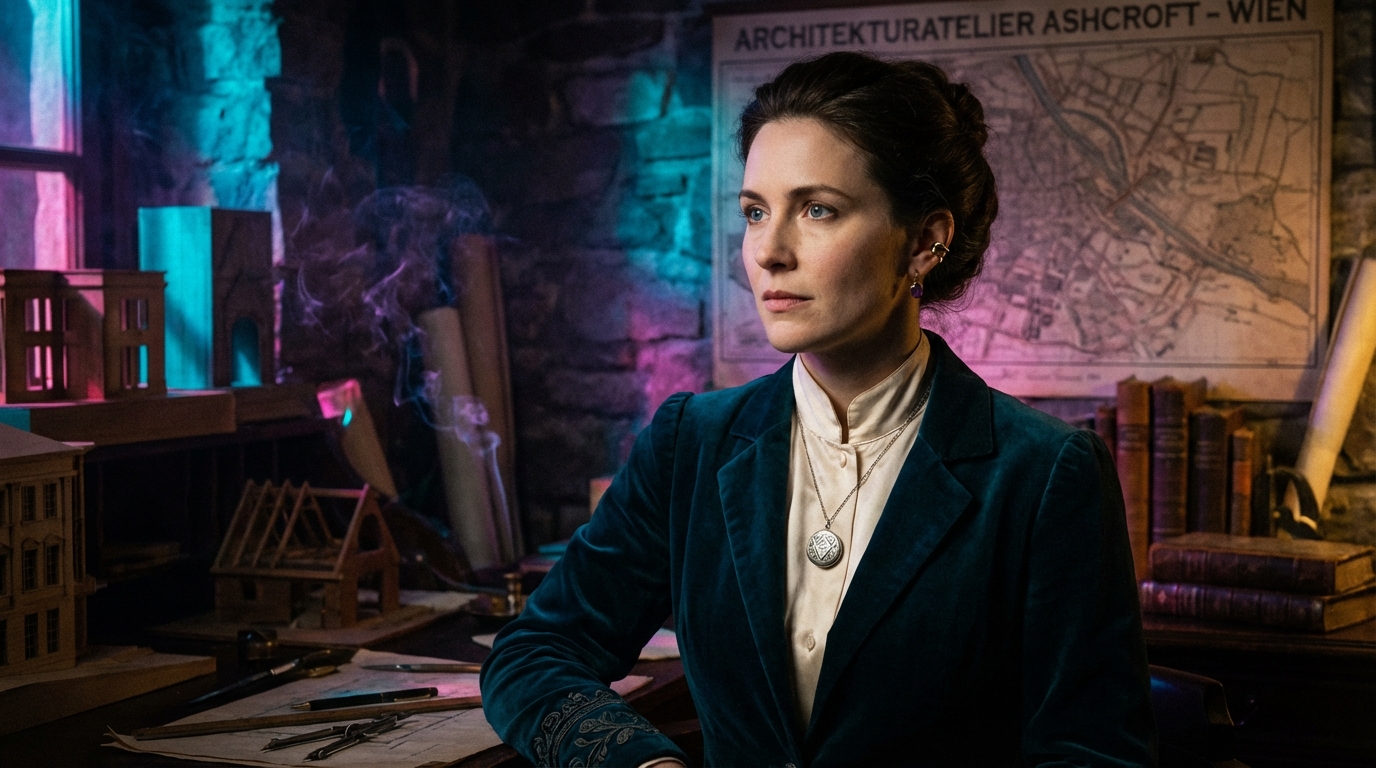
Vienna: The Formation of Miriam Elara Ashcroft
Miriam Elara Ashcroft was born on 14 March 1828 in Vienna, Austria, the only child of Heinrich James Ashcroft and his wife Elara, née Voss. Heinrich was an English architect who had made his professional life on the continent — trained in London but drawn to Vienna in his twenties by the extraordinary building programmes that the Habsburg court and its associated institutions were sustaining through the 1820s, and who had found in the Austrian capital both the commissions that sustained him and the woman whose intelligence and classical formation he could not imagine living without. Elara Voss was the daughter of a Viennese scholar whose library occupied three rooms of his house on the Schottenring and who had raised his daughter as a reader, a linguist, and a precise observer of the world around her — a formation that Miriam inherited so completely that it was impossible in later life to distinguish what she had absorbed from her father's professional world and what from her mother's intellectual one.
Vienna in the late 1820s and 1830s was a city of extraordinary layered complexity — the political heart of the Habsburg Empire, a crossroads of European cultures and languages, a city in which German, Hungarian, Czech, Italian, and a dozen other linguistic registers competed and merged in the coffeehouses and boulevards of the Ringstrasse era. The accent that Miriam developed growing up in this environment — German-inflected English from her father, Viennese German from her mother, French from the tutors that Heinrich's professional success could afford, and Italian absorbed from the architectural vocabulary of the buildings she walked through daily — was already, before she was twelve years old, an accent that no single listener could comfortably assign to a country. It would remain so for the rest of her life.
Architectural Formation
Heinrich trained his daughter in drawing from the time she could hold a pencil, and Miriam's eye for proportion, line, and structural logic emerged with such consistency through her childhood that her father's colleagues noted it before she was ten. This was not the genteel accomplishment of a professional man's daughter — it was a working draughtsman's capability, trained on the observation of the Baroque and Neoclassical buildings of Vienna's built landscape and developed through the disciplined daily practice that Heinrich required of the apprentices in his studio, to which Miriam had unrestricted access from early childhood.
Her formal education in architecture culminated with admission to the École des Beaux-Arts in Paris in 1847, at nineteen — an admission obtained against considerable institutional resistance, secured through the combination of a portfolio that was impossible to dismiss and her father's connections to French architectural circles developed through two decades of continental practice. She studied in Paris from 1847 to 1851, formally one of the first women to complete the full curriculum, practically navigating the persistent antagonism of an institution not yet prepared to regard her presence as anything other than an anomaly. She graduated with the distinction that her technical ability had always made inevitable, and returned to Vienna to work alongside her father until his death in 1853.
The Portal Key: 3 April 1853
The senior Guardian who came to Vienna in the spring of 1853 was a man named Edmund Rale, operating within the Order's European network, and he had been watching Miriam's career with focused attention for several years before Heinrich's death gave him his opening.
What he needed — what the Order needed at that specific moment — was an architect of the highest demonstrable capability who could design and supervise the construction of concealed spaces within legitimate buildings: hidden chambers, integrated vaults, structurally embedded preservation infrastructure that left no trace in professional records and was indistinguishable, to any external inspection, from ordinary construction. The person who could do this had to work across multiple national contexts without attracting the suspicion that a single-nationality operator would generate, had to possess the legal fluency to manage the contractual architecture that sustained the cover, and had to be capable of operating with absolute discretion over sustained periods. Miriam was, at the moment of Heinrich's death, the only person Rale had identified across three years of systematic search who met all four requirements simultaneously — and she had just lost the one institutional anchor that might have kept her from accepting what he was offering.
He presented her with the Portal Key on the evening of 3 April 1853, in the study of Heinrich's house on the Schwindgasse. The binding ritual drew her blood, confirmed the ancestral authentication that CLIVE required of all who crossed between dimensions, and transformed the inert device into a living connection. She underwent the binding with the same focused, technical attention she brought to the examination of a structural drawing — understanding what was happening, why it was happening, and what the work ahead would require, without being either overwhelmed by it or dismissive of its weight. CLIVE's greeting, when she crossed for the first time later that evening, came as it always came: intimate, certain, addressed to her specifically. Welcome to Clivilius, Miriam Ashcroft. She stood in the still, barren light of an alien world for a long time before she stepped back through.
The Guardian Order Years: 1853–1873
For the following twenty years, Miriam operated within the Guardian Order's European network as one of its most capable and unusual members. Her architectural training gave her a practical value that purely intellectual Guardians could not provide — she could design and supervise the construction of the hidden chambers, the concealed vaults, the structurally integrated spaces within legitimate buildings that the Order's preservation mission required. She moved between London, Vienna, Paris, and eventually Boston, accumulating the kind of multi-city professional presence that her designation as a peripatetic architect made entirely legible to the ordinary world.
Her relationship with Edmund Rale — her Guardian Atum, the mentor who had inducted her and who remained her most significant point of connection to the Order's senior structure — was characterised by a quality of mutual professional respect that occasionally shaded into something more complicated. Rale was a man of considerable intelligence and considerable moral rigidity, who had accepted the Order's harsher operational necessities as permanent facts of Guardian life and who had never developed — or perhaps had long since suppressed — the capacity to revisit those acceptances in light of what they actually required. Miriam had accepted the same necessities at her induction. She revisited them more often than Rale found comfortable, and the tension between them — never quite resolved, never quite rupturing — shaped the quality of her relationship to the Order throughout these years.
It was Rale who directed her to Francis Killerton in 1873 — who identified, in the young man returning from Mesopotamia with six artefacts whose nature the Order had been anticipating for decades, the opportunity for a preservation infrastructure that the Order had been planning but not yet executing. She was dispatched to Boston to manage the relationship, to ensure that the dual mission Francis was proposing remained aligned with the Order's purposes, and to attend the gathering at Ashwood Manor that would formally initiate the arrangement.
Ashwood Manor: 10 July 1873
She arrived last, as she had intended to arrive — the timing designed to enter a room that had already settled into a dynamic before being unsettled by a new presence. The effect was precisely what she had calculated. The assembled team — Cartwright, Stanton, Holloway — registered her entrance with the quality of attention that was more than social courtesy: they felt, each in their own way, that the evening had shifted register in a way they could not yet account for.
Her public introduction as legal advisor was accepted because it was plausible. Her actual function — representative of the Guardian Order, architect of the dual mission's concealed infrastructure, the person who would determine whether the commitment in that room was genuine or needed to be managed by other means — was revealed gradually, in the second part of Francis's presentation, with the particular quality of controlled disclosure that she had practised across two decades of Order work. She spoke with the authority of someone who was not performing confidence but simply had it, in the uncomplicated way of a person who has been doing difficult things for a long time and has ceased to find the difficulty impressive.
Later, when the others had gone and Francis sat across from her at the mahogany table with the look of a man who had just understood that the enterprise he was building had dimensions he had not fully grasped, she told him what the Order required and what the consequences of inadequate commitment would be. She told him plainly because clarity was more useful than comfort in such moments, and because she had learned across twenty years that the people who needed to be managed into obligations were rarely the people an operation could depend on. What she wanted from Francis was understanding — complete, unequivocal understanding of the stakes — because only that would produce the quality of commitment the dual mission required.
The Architect of Killerton Enterprises' Hidden Spaces
The concealed infrastructure of Killerton Enterprises — the hidden chambers in the Civic Center, the secure archival vaults, the structural spaces integrated into successive KE buildings that could serve purposes the public plans did not record — was Miriam's architectural work as much as it was Emily Stanton's visible design. The two women operated in a complementary division that was never formally agreed upon but that emerged naturally from their respective formations: Emily's sustainable construction philosophy shaped what the buildings showed the world, and Miriam's Guardian-trained understanding of concealment and structural secrecy shaped what they contained beneath that surface.
A letter Emily wrote to Miriam in October 1874, from the redwood grove near Prairie Creek where the founding partners had gathered on the first day of that month, described the moment as "an alignment of time and purpose... a vow beneath giants not to build in defiance of nature, but in its image." The letter was addressed to "architect Miriam Ashcroft" — the professional designation that their working relationship had produced, the acknowledgment of the dimension of Miriam's contribution that the "legal advisor" cover could not contain and that Emily, whose own professional title had long been underpublicised, recognised and named directly.
Miriam attended the Redwood retreat, standing in the dense green silence of the grove with the founding team and feeling, as she occasionally felt in those years, the particular quality of a moment whose significance was being generated rather than simply witnessed. She had been in many such moments across twenty years of Guardian work. This one was different — not because of its scale, which was modest compared to what the Order was doing across multiple continents, but because of the quality of the people she was in it with. Francis's intellectual integrity. Theodore's crafted precision. Samuel's structural honesty. Emily's quiet, sustainable ferocity. And beside her, an unspoken acknowledgment between the two women that they both knew more about what was being built than any of the others around them.
The Separation from the Guardian Order
The formal break between Miriam and the Guardian Order came in 1882 — not as a dramatic expulsion or a single defining confrontation, but as the accumulated consequence of a disagreement with the Council that had been building since the mid-1870s. The specific point of contention was the Order's direction regarding the KE artefacts — the six objects from Uruk that Francis had returned with in 1873, whose preservation was the secret heart of the dual mission. The Council had concluded, by the early 1880s, that the artefacts required relocation to a more secure and more exclusively Order-controlled facility. Miriam's position — developed across nine years of working intimately with the objects, observing their relationship to the people around them, and understanding their significance in terms that the Council's administrative perspective did not fully register — was that relocation would sever the connection between the artefacts and the living enterprise that had been built to preserve them, and that this severing would be a form of the very loss the Order existed to prevent.
The Council overruled her. Miriam refused to facilitate the transfer. The Order classified her as a former member.
She retained her Portal Key. She retained her crossing access. She retained everything that the bloodline had given her and the binding had confirmed. What she no longer had was institutional standing within the Order that had been the framework of her professional life for nearly thirty years. She was, for the first time since April 1853, operating without the Order's structure around her — and found, with the particular equanimity of a person who has long suspected that the structure had ceased to serve the purposes that originally justified it, that she managed the loss rather better than she had anticipated.
She continued her work with Killerton Enterprises. The artefacts remained where they were.
The San Francisco Years
Miriam's life in San Francisco through the 1880s was quieter than the founding decade had been, in the way that enterprises tend to quiet once their foundations have proved sound. She maintained a residence in the city's Western Addition — a neighbourhood whose architectural variety and demographic diversity suited someone whose formation had been cross-cultural from the beginning — and continued her involvement with KE's concealed infrastructure projects as the firm expanded its operations.
Her relationship with each of the founding partners evolved across these years in ways their respective characters shaped. Theodore Cartwright, having long since worked through his initial wariness of her, developed the professional respect for her architectural judgment that his standards required him to extend wherever he found it demonstrable. Samuel Holloway, whose own moral seriousness had never been entirely comfortable with the harder edges of the dual mission's requirements, engaged with her through the 1880s with the particular quality of a man who has made his peace with complexity without entirely ceasing to notice it. Francis — whose gratitude toward her, and whose residual discomfort with the conversation in which she had threatened his team's lives, had settled into a relationship that was warmer than the latter suggested and more clearly bounded than the former implied — consulted her on matters that required both Guardian knowledge and architectural judgment, and trusted both dimensions of her response.
She formed the closest and most genuinely equal relationship of these years with Emily Stanton — the two women whose work was most deeply intertwined in the physical fabric of what KE was building, who wrote to each other with the characteristic directness of two people who had been operating in understated roles too long to bother with understatement between themselves.
Death: 7 September 1891
Miriam Elara Ashcroft died at her Western Addition home on 7 September 1891, at the age of sixty-three. She had been ill through the preceding weeks — a fever that her physician attributed to one cause and that those who knew her Guardian history understood might have had dimensions that conventional medicine was not equipped to assess. Alexander James Greene, whose own health had been declining through tuberculosis for several years, visited her during the final days. Emily Stanton came from Boston.
She died having lived two professional lives simultaneously for nearly forty years — the visible one, as architect and legal counsel and sometime academic presence in the city's intellectual circles, and the invisible one, as Guardian and Order representative and eventually as the person who had put the Order's claims behind her and chosen, in the most literal available sense, to build rather than to manage. The artefacts she had refused to surrender remained in the vaults she had designed. The buildings she had shaped contained within them the spaces whose purpose was precisely what Francis had described on the evening he first gave it words: the preservation of ancient knowledge within the living body of a contemporary enterprise, for the use of whoever came after with the capacity to understand both.
She was buried in San Francisco, in the same Laurel Hill Cemetery where Alexander Greene would be interred the following February. There was no official public notice of her death in the Guardian Order's records. She was no longer their member to notice.







