Millie Smith
Millie Smith was a Border Collie whose life became inseparable from Jerome Smith's. Born in February 2015 on a sheep property in South Australia's Mid North region, she endured eighteen months of abuse before her rescue by the RSPCA in October 2016 and her adoption by Jerome in May 2017. Within the Smith family home in Craigmore, she slowly rebuilt her capacity for trust. An epilepsy diagnosis in early 2018 deepened her bond with Jerome, who became the anchor of her small, ordered world. Following the Smith family's crossing to Clivilius in August 2018, Millie was eventually reunited with Jerome in Bixbus, where she continued as his closest companion.
Birth and Early Life
Millie was born in February 2015, one of six puppies in a litter whelped on Thornbury Downs, a sheep property approximately twenty kilometres east of Clare in South Australia's Mid North region. Her mother, Jess, was a proven working dog who had served the Henderson family for seven years, and her father was a neighbouring property's stud dog brought in specifically for his strong herding bloodlines.
The Hendersons had operated Thornbury Downs for three generations, running merino sheep across twelve hundred hectares of undulating pastoral country. Border Collies had always been essential to their operation—intelligent, tireless workers capable of managing mobs across the property's scattered paddocks. Millie's litter represented the continuation of this tradition, with most puppies already spoken for by neighbouring farmers before they were weaned.
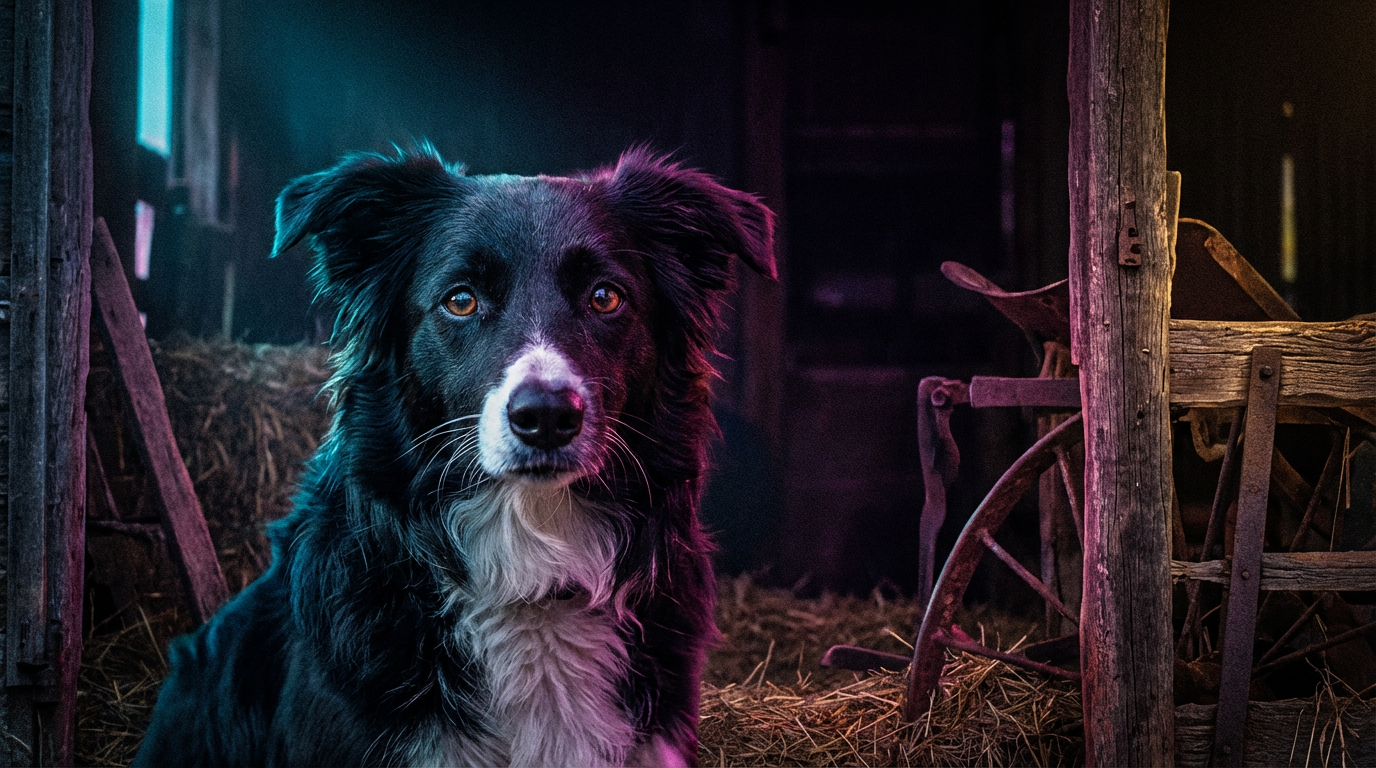
Millie distinguished herself early as the most alert of the litter, her black and white markings particularly striking against the golden stubble of the lambing paddock where she spent her first weeks. She possessed the classic Border Collie colouring—predominantly black with a white blaze running down her face, a white chest and collar, and four white socks that made her appear perpetually ready for formal occasions. Her eyes held the intense, intelligent gaze characteristic of the breed, watching everything with an alertness that suggested she was constantly processing and learning.
By eight weeks, five of her littermates had departed to their new homes on working properties across the region. Millie remained—not because she was unwanted, but because the Hendersons had initially intended to keep her as Jess's eventual replacement. However, the prolonged drought that had gripped South Australia since 2013 continued to tighten its hold on the Mid North, and by the time Millie was twelve weeks old, the Hendersons faced difficult decisions about the property's future.
Sale and First Owner
In May 2015, the Hendersons made the painful decision to reduce their flock by half and sell several working dogs they could no longer justify feeding. Millie, at fourteen weeks old, was advertised through the local Clare newspaper and sold for three hundred dollars to a man named Darren Quilty.
Quilty was a thirty-four-year-old electrician living on a five-acre hobby farm outside Gawler, approximately ninety minutes south of Thornbury Downs. He had purchased the property eighteen months earlier with vague aspirations of rural self-sufficiency and had decided a Border Collie would complete the picture he had constructed of his new lifestyle. He had no sheep, no livestock of any kind beyond a few chickens, and no understanding of what a working breed required.
For Millie, the transition was jarring. She had spent her first months in constant motion—following her mother across paddocks, learning to read the movements of sheep, burning energy in the purposeful work her genetics demanded. Quilty's property offered none of this. The five acres were mostly bare paddock with a neglected house and a series of ramshackle sheds. There were no animals to herd, no tasks to complete, no outlet for the intelligence and drive that defined her breed.
Initially, Quilty made efforts to engage with Millie. He took her for walks, threw balls in the yard, allowed her inside the house during evenings. But a Border Collie's needs cannot be met with occasional attention. Millie began to exhibit the behaviours common to understimulated working dogs—she dug holes in the yard, chewed through furniture, barked incessantly, and paced the fence line for hours. Her desperate attempts to burn mental and physical energy manifested as destruction, and Quilty interpreted this as defiance.
Escalating Abuse
By the time Millie was eight months old, Quilty's frustration had curdled into cruelty. He began confining her to a small wire run beside the shed—a space barely three metres by two, with a corrugated iron roof that turned it into an oven during summer and offered little protection from winter rains. Her water bowl was filled irregularly, her food provided in unpredictable quantities. The walks ceased entirely.
When Millie's distressed barking disturbed Quilty or his occasional visitors, he responded with violence. He struck her with whatever was at hand—his open palm at first, then a rolled newspaper, then a length of PVC pipe he kept beside the run specifically for this purpose. Millie learned to associate human approach with pain. She learned that her voice brought punishment. She learned that there was no escape from the wire walls that had become her entire world.
The isolation was perhaps as damaging as the physical abuse. Border Collies are profoundly social animals, bred over generations to work in partnership with humans. Millie spent weeks at a time with no meaningful contact—only Quilty's sporadic appearances to deliver food or punishment, often both in the same visit. Her world contracted to the dimensions of the wire run, her rich intelligence turning inward with nothing to occupy it but fear and confusion.
She stopped barking. She stopped approaching the wire when footsteps sounded. She pressed herself into the corner furthest from the gate and watched with eyes that had learned to expect nothing good from human presence. The playful, alert puppy who had bounded through Thornbury Downs' paddocks became a shadow of herself—hypervigilant, withdrawn, and profoundly traumatised.
Rescue
Millie's rescue came in October 2016, eighteen months after Quilty had purchased her. A neighbour whose property bordered Quilty's had grown increasingly concerned about the dog she occasionally glimpsed in the wire run—the visible ribs, the untreated sores, the way the animal cowered whenever anyone approached. After several months of internal debate, she contacted the RSPCA's animal cruelty hotline.
The inspector who attended Quilty's property found Millie in conditions that warranted immediate seizure. She was underweight, dehydrated, and suffering from an untreated skin infection caused by prolonged contact with her own waste in the confined run. More concerning than her physical state was her psychological condition—she would not make eye contact, flinched violently at any movement, and had to be carried to the inspector's vehicle because she was too terrified to walk on a lead.
Quilty was issued a fine and banned from owning animals for five years—penalties that seemed inadequate given the suffering he had caused, but which at least ensured Millie would never return to his care.
Rehabilitation at the Shelter
Millie arrived at the RSPCA's Lonsdale shelter in late October 2016, a twenty-month-old Border Collie whose physical wounds would heal far more quickly than her psychological ones. The veterinary team addressed her immediate medical needs—treating the skin infection, implementing a careful refeeding protocol to restore her weight, and assessing her overall condition. Physically, she was expected to make a full recovery within weeks.
Behaviourally, the prognosis was less certain. Millie exhibited classic signs of severe abuse trauma. She startled at sudden sounds, cowered when staff entered her enclosure, and refused food if anyone remained nearby while she ate. She would not engage with toys, showed no interest in other dogs, and spent most of her time pressed into the corner of her kennel, watching the world with wary, wounded eyes.
The shelter's behavioural team began working with her slowly, using techniques designed for severely traumatised animals. They sat quietly in her enclosure without demanding interaction, allowing her to approach on her own terms. They tossed treats towards her corner rather than expecting her to take food from their hands. They kept their voices low, their movements slow, their expectations minimal. Progress was measured not in days but in weeks—the first time she did not flinch when someone entered her kennel, the first time she sniffed an offered hand, the first time she tentatively wagged her tail.
By February 2017, Millie had progressed enough to be listed as available for adoption, though with extensive notes about her special needs. She required an experienced owner who understood trauma, a quiet household without young children, and someone willing to invest months—potentially years—in her continued rehabilitation. The shelter staff knew that finding such a home would be difficult, that many potential adopters would be discouraged by her requirements. But they also saw what lay beneath her fear: an intelligent, loyal dog capable of profound connection if given the chance.
Adoption
Jerome Smith first encountered Millie in April 2017. He was in his second year of studying zoology at the University of Adelaide and had been volunteering at the Adelaide Hills Wildlife Haven for several months. His interest in animals extended beyond wildlife—he had grown up with dogs and had been considering adoption since moving back to his parents' home in Craigmore whilst completing his degree.
Something in Millie's watchful stillness spoke to Jerome. Where other potential adopters saw a difficult case, he saw a creature who had survived profound trauma and was cautiously, tentatively, testing whether the world might yet offer something other than pain. He began visiting her regularly, sitting in her enclosure with a book, making no demands, simply allowing her to grow accustomed to his presence.
The shelter staff noticed the change in Millie during these visits. She began positioning herself closer to where Jerome sat. She started watching him with something other than fear—a cautious curiosity that gradually warmed into anticipation. When his visits were delayed, she seemed restless, checking the kennel entrance more frequently than usual.
After six weeks of regular visits, Jerome completed the adoption process. In mid-May 2017, Millie left the shelter and entered the next chapter of her life.
Integration into the Smith Household
The Smith family home in Craigmore presented Millie with an entirely new environment to navigate. Noah and Greta Smith, Jerome's parents, welcomed the new addition with the understanding that her integration would require patience. Jerome's younger brother Charles, then sixteen, was instructed to give Millie space and allow her to approach on her own terms.
The early weeks were challenging. Millie spent much of her time in Jerome's room, venturing into the broader house only when the space was quiet and activity minimal. She startled at the television, flinched when doors closed, and retreated to her bed whenever visitors arrived. Mealtimes were conducted in Jerome's room with the door closed, the only environment where she felt secure enough to eat.
Jerome maintained the patient approach that had won her trust at the shelter. He established consistent routines—meals at the same times, walks along the same routes, quiet evenings in predictable patterns. He read to her, not because he believed she understood the words but because the steady rhythm of his voice seemed to calm her. He celebrated small victories: the first time she ate while he remained in the room, the first time she approached Greta without cowering, the first time she wagged her tail at the sound of his car in the driveway.
By late 2017, Millie had transformed. The cowering, traumatised dog who had arrived six months earlier had been replaced by a companion who followed Jerome through the house, greeted family members with cautious enthusiasm, and had even begun to exhibit the playful intelligence characteristic of her breed. She learned that the Smith household operated according to reliable patterns, that food appeared consistently, that hands reached out to offer comfort rather than pain. She learned to trust again.
Life with the Smiths
Beyond her bond with Jerome, Millie's place in the household settled into patterns Greta had not invited but had learned to accommodate. The dog stationed herself in the kitchen during meal preparation, waited at the glass door for family members to return, and followed Greta from room to room with the assumption that her presence was welcome. Greta tolerated this with the practised forbearance of a woman who had never been especially fond of animals and who regarded the arrival of a dog in her house — Jerome's dog, Jerome's decision, Jerome's responsibility — as one of the minor costs of loving her son.
What softened Greta's tolerance into something closer to amusement was Millie's bearing. The dog moved through the house with an air Greta found distinctly monarchical — chin lifted, gaze measured, the apparent conviction that she occupied a social rank above every other member of the household. Greta took to calling her, privately and with dry satisfaction, "Queen Esther in fur." Esther because Esther was a queen, and because Greta's catalogue of queens drawn from scripture was short and readily accessible. The nickname was mockery, not endearment — the kind of joke Greta made when something in her house had begun putting on airs she could neither condone nor entirely suppress. Millie, untroubled by the distinction, continued to preside.
Sunday mornings became a particular ritual. As the family prepared for church, Millie stationed herself by the front door with unwavering hope that this might be the week she was included in their outing. Each Sunday, she watched them leave, her tail drooping slightly as the door closed. Each Sunday, she waited by the window until they returned, greeting them with the theatrical indignation of the unjustly abandoned. The family found her persistence both amusing and touching—a testament to how fully she had come to consider herself one of them.
Her relationship with Charles developed more slowly. The teenager's unpredictable energy and tendency toward loud music initially unsettled her, but over time she came to understand that his chaos was benign. She learned to tolerate his rougher affection, even seeking him out occasionally when Jerome was absent, though she never fully relaxed in his presence the way she did with Jerome or Greta.
With Noah, Millie maintained a respectful distance that suited them both. His quiet authority reminded her, perhaps, of something from her past—not threatening, but warranting caution. She accepted his occasional pats with polite tolerance and removed herself when he settled into his study for the long hours of ecclesiastical work that filled his evenings.
Diagnosis
In early 2018, Millie's life took an unexpected turn. She suffered her first epileptic seizure—a terrifying event that transformed an ordinary afternoon into crisis. Her body convulsed violently, legs paddling against nothing, eyes rolling back, consciousness retreating to some unreachable place. The episode lasted only minutes but felt eternal to those who witnessed it.
The veterinary examination that followed confirmed the diagnosis: idiopathic epilepsy, a condition with no identifiable cause and no cure. Millie would require daily medication to manage the seizures, and even with treatment, breakthrough episodes were likely. The condition would not shorten her life significantly, but it would require vigilant management and carry the constant possibility of sudden crisis.
For Millie, the seizures were experiences of profound vulnerability. She had no understanding of what was happening to her body during episodes—only the terrifying loss of control, the confusion of the postictal period, and the exhaustion that followed. She learned to recognise the subtle warning signs that sometimes preceded seizures: a particular restlessness, a heightened sensitivity to stimuli, a vague unease that she could not articulate but that her behaviour communicated clearly.
Jerome learned to read these signs as well. He created protocols for managing episodes—clearing the area around her, speaking in low, reassuring tones, timing the duration, knowing when veterinary intervention was necessary. The experience deepened their bond even as it revealed Millie's fragility. Each seizure was a reminder of how much could be lost, how quickly ordinary life could fracture into emergency.
The Severe Seizure of 31 July 2018
The seizure that struck Millie on 31 July 2018 exceeded all previous episodes in both intensity and duration. The convulsions were more violent, the postictal confusion more profound, the recovery more prolonged. Jerome rushed her to the veterinary clinic, where the staff—who had come to know Millie well over the preceding months—assessed her condition with evident concern.
The veterinarian recommended keeping Millie overnight for close monitoring, a precaution that separated her from Jerome for the first time since her adoption. The clinic, which had become a place of relative comfort through repeated visits and carefully cultivated positive associations, now became the site of an unfamiliar solitude. Millie spent the night in a clinical enclosure, surrounded by the sounds and smells of other animals in distress, waiting for the familiar presence that had anchored her through every previous crisis.
For Millie, the separation was disorienting. She had rebuilt her world around Jerome's reliable presence, and his absence triggered old uncertainties that she had thought long buried. She waited through the night with the patience she had learned during her months at the shelter—the same patient endurance that had sustained her through far worse circumstances—trusting that morning would bring reunion.
Entry to Clivilius
The following day, 1 August 2018, events unfolded that would alter the trajectory of Millie's life in ways she could not comprehend. While she remained at the veterinary clinic recovering from her seizure, the Smith family crossed through a dimensional Portal into a world called Clivilius. Jerome, caught up in the sudden, disorienting sequence of his brother Luke's arrival and his parents' immediate departure through the Portal, followed his family without the opportunity to retrieve Millie first.
The days that followed were ones of separation unlike any Millie had experienced. Eventually, Millie was reunited with Jerome in Bixbus. The transition to this new world was, for Millie, less conceptually jarring than it might have been for a human. She did not understand dimensional boundaries or parallel worlds; she understood only that she had been separated from her person and was now restored to him. The landscape was unfamiliar—the red earth of Bixbus, the absence of familiar smells and sounds—but Jerome's presence made it navigable.
Life in Bixbus
In Bixbus, Millie adapted to yet another new environment with the resilience that had carried her through every previous transition. The settlement's early days were chaotic—humans establishing infrastructure, navigating survival in an unfamiliar landscape—but Millie found her place within the Smith family's household, which remained her primary anchor regardless of which world contained it.
Her relationship with Jerome continued to deepen. In a world stripped of the distractions and obligations of Earth life, their bond became even more central to both their experiences. Millie accompanied Jerome as he contributed to the settlement's development, her presence a reminder of the life they had left behind and the continuity that persisted despite dimensional displacement.
The Bixbus Wildlife Sanctuary, which Jerome helped establish as part of Project Terra Nova, became a new landscape for Millie to explore. She served as a companion during Jerome's long hours at the sanctuary, her calm presence a counterpoint to the challenges of establishing conservation efforts in an unfamiliar world.
Her epilepsy continued to require management, though the specific details of veterinary care in Bixbus differed from what had been available on Earth. Jerome maintained his vigilance, adapting his protocols to the resources available, ensuring that Millie received the care her condition demanded even in circumstances far removed from the Adelaide clinic where she had first been diagnosed.







