Maya Aria Patel
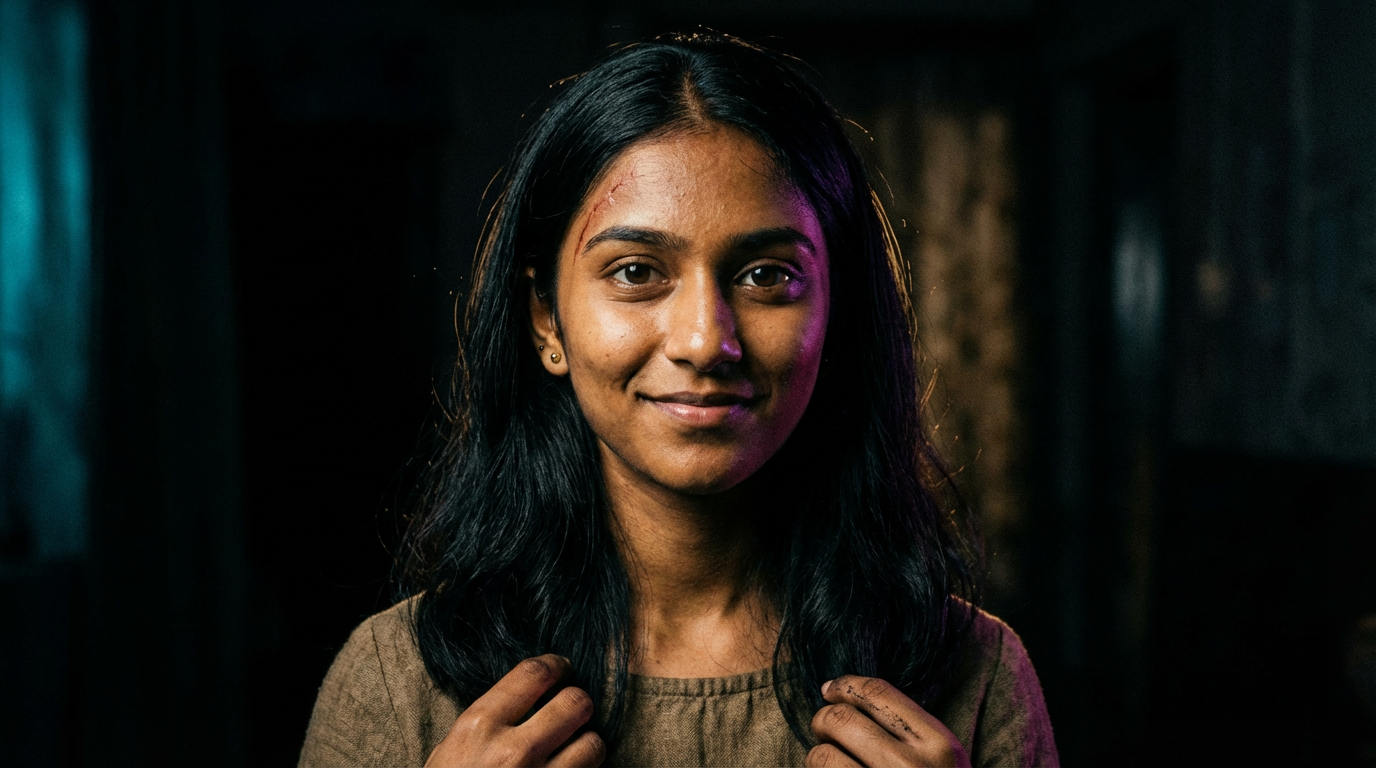
Maya Aria Patel, born on 12 June 2008 in Brisbane, was the younger of twin daughters of Rajesh Patel, a paediatrician and ethnobotanist, and Meera Patel, a neonatal specialist. She was ten when the school bus carrying her, her twin Anika, and their father passed through a Portal into Clivilius. Drawn to plants through Raj's medicinal garden, Maya became a junior ethnobotanical researcher at the Verdant Nursery and enrolled in the Bachelor of Ethnobotany and Sustainable Medicine at the Clivilius National University at seventeen.
The Younger Eleven Minutes
Maya Aria Patel was born on 12 June 2008 at the Mater Mothers' Hospital in South Brisbane, eleven minutes after her twin sister, Anika Aruna Patel. Their father was Rajesh Patel, a paediatrician known to everyone as Raj, and their mother was Meera Patel (née Sharma), also a paediatrician. The family lived in a weatherboard house in Taringa, where the back garden was not a garden in any ornamental sense but a research plot — rows of native Australian species alongside medicinal herbs from the Indian pharmacopoeia, tended by Raj with the attentiveness of a man whose interest in plants was as serious as his interest in patients.
Raj was from Leicester, in the English Midlands, the eldest of three children of Pravin Patel, a pharmacist, and Asha Patel (née Desai), a secondary school teacher. The Patels were Gujarati — Pravin had emigrated from Ahmedabad in 1968 — and Raj had grown up in a household where education was assumed and medicine was the particular assumption that had settled on him before he was old enough to question it. He had studied medicine at the University of Cambridge, completed his paediatric residency at Great Ormond Street Hospital in London, and met Meera at a conference in Edinburgh in 2001.
Meera was from Brisbane. Her parents, Vikram Sharma and Anita Sharma (née Kulkarni), had emigrated from Pune in 1972 — Vikram an electrical engineer with the Queensland state government, Anita a pharmacist who ran a chemist's shop in Toowong. Meera had grown up in Indooroopilly, studied medicine at the University of Queensland, and taken a fellowship at Great Ormond Street before returning to Brisbane with Raj in 2006. They married in 2003 and settled in the Taringa house six months before the twins arrived — Raj at the Royal Children's Hospital in general paediatrics, Meera in neonatal care.
Maya was the second twin, the one who arrived after Anika had already been placed on Meera's chest, and the secondness shaped her in ways that were difficult to separate from temperament. She was not less confident than Anika — she was differently confident, possessed of a certainty that operated through feeling rather than analysis, through the body rather than the mind. Where Anika organised and tracked and filed, Maya drifted and noticed and absorbed. Her room was not neat. Her pencils were not sharpened to the same length. She lost things — shoes, hair ties, library books — with a regularity that exasperated Anika and amused Meera, who recognised in Maya's scattered attention the same sensory openness that had drawn her own mother, Anita, to the textures and smells of pharmacy.
The garden was Maya's territory from the age she could walk to it. Raj had planted it as a research interest — an extension of his ethnobotanical work, a living catalogue of species he was studying for their medicinal properties — but Maya encountered it as something else entirely. She did not see rows of specimens labelled with their Latin names. She saw colours, textures, smells, the way a leaf felt between her fingers, the particular green of new growth against the darker green of maturity. She rubbed leaves and sniffed her fingers. She pressed petals against paper and studied the stains they left. She tasted things Raj had not authorised her to taste and was sick once, at four, from a leaf that was not toxic but was astringent enough to upset a small stomach, and the experience did not deter her but refined her method.
Raj watched this with the complicated pleasure of a parent whose child had found the same passion through a different door. He had come to ethnobotany through medicine — through the intellectual question of how plants could treat disease. Maya came to it through the senses — through the physical reality of the plants themselves, their weight and colour and scent, the way they grew and changed and responded to water and light. The approaches were complementary, and Raj, who taught both daughters about the garden's inhabitants, found that Maya's questions were different from Anika's. Anika asked how. Maya asked what if.
Colour, Not Curriculum
The twins entered Brisbane Grammar School in Prep in 2014. Maya adapted, though not in the way Anika did. Anika found the structure satisfying. Maya found it tolerable. She sat where she was told and completed the work that was set, but her attention was allocated on the basis of interest rather than obligation, and the allocation was uneven. Art engaged her completely — she drew with the absorbed concentration of a child whose visual world was rich enough to demand expression. Creative writing engaged her when the prompt allowed invention. Mathematics engaged her not at all.
Her teachers described her as imaginative, warm, and inconsistent. She produced work that was either exceptional or adequate, with nothing in between, and the variable was always the same: whether the subject permitted her to bring her own perception to the material. In science, she excelled when the work was observational — drawing specimens, recording what she saw in the school garden, noticing things other children walked past. She struggled when the work was procedural, when the method mattered more than the observation, when the answer was supposed to be singular and specific.
She had friends easily and in abundance. Maya's warmth was instinctive — she laughed readily, listened without judgement, remembered details about people's lives that they had mentioned once and forgotten they had shared. She drew people to her the way some children draw attention: not by seeking it but by being genuinely interested in whoever was in front of her. The friendships were broad rather than deep, a wide net of affection cast across the year level, and the breadth suited her temperament, which was generous but not possessive.
Her relationship with Anika was the anchor beneath the breadth. Anika kept Maya organised — literally, practically, with the systematic care of someone who could not tolerate disorder. Maya kept Anika human — pulled her out of her head, reminded her to laugh, softened the edges that Anika's analytical intensity could sharpen. They were not the twins who dressed alike and spoke in tandem. They were the twins whose differences were so pronounced that adults sometimes forgot they were related until they saw them together, at which point the complementarity was obvious, the way two halves of something only make sense when placed side by side.
On professional development days, when the school closed and Raj brought both twins to the Royal Children's Hospital, Maya wandered to the hospital garden while Anika shadowed their father through the wards. The garden was small — a courtyard with raised beds maintained by volunteers — but Maya sat among the plantings and drew what she found with the same attention she gave to Raj's garden at home. She sketched rosemary and lavender and the native grasses that bordered the walkway, and she labelled the drawings not with botanical names but with her own descriptions: "the one that smells like rain," "the grey one with soft fur on the leaves."
The Lavender Bag
The overnight field trip to D'Aguilar National Park was scheduled for the weekend of 4–5 August 2018. Raj volunteered as chaperone. Meera stayed home, rostered for a weekend shift in the neonatal unit. Maya packed coloured pencils, a notebook with unlined pages, and a small muslin bag of dried lavender she had prepared from the garden — harvested, dried, and sewn into the fabric herself, with the imperfect stitching of a ten-year-old and the deliberate care of a child who believed that lavender kept bad things away.
At D'Aguilar, Maya drew. She drew the bark of a scribbly gum in enough detail to show the tracks of the larvae beneath. She drew the understorey — ferns, mosses, the network of roots exposed where the trail cut through a bank. She found a cluster of fungi on a fallen log and spent twenty minutes rendering their gills in coloured pencil while the other children moved ahead. Raj, walking back to find her, stood and watched without interrupting, because he recognised the quality of her attention and knew it was the same quality he applied to a difficult diagnosis — total, absorbed, unwilling to let go until the thing was understood.
The bus departed D'Aguilar on the morning of 5 August. Maya sat on the aisle in the middle section, beside Anika at the window. The lavender bag was in her jacket pocket, the notebook on her lap, open to the fungi drawing she had not finished.
The bus passed through a Portal that opened across a road in the Brisbane suburbs and collided with vehicles on the far side, in the landscape of Clivilius. Maya was thrown sideways. The left side of her head struck the window with a force that split the skin at her temple and sent a concussion rippling through her skull — a blurring, a ringing, a sensation of the world tilting and not coming back to level. She slumped against the glass, conscious but uncertain of everything except pain.
Anika's hands were on her face. Anika was saying her name. The voice was steady in a way that Maya registered even through the fog of the concussion, and the steadiness was what kept her anchored — not to understanding, because she did not understand what had happened, but to the knowledge that Anika was there and Anika was functioning and that meant the situation, however terrible, was not total.
Raj reached them within minutes, his own ribs fractured, his breathing shallow. He examined Maya's head — pupils, responsiveness, orientation — with the clinical precision of a paediatrician and the barely controlled fear of a father. The concussion was mild. The graze at her temple was superficial. He cleaned it with water and pressed a folded cloth against it and told her to stay still, and Maya stayed still, not because she understood the medical reason but because her father had asked and because the world was still tilting and stillness was the only thing that made sense.
The lavender bag was in her pocket. She pressed her hand against it through the fabric and the smell reached her — faint, familiar, from the garden in Taringa that she would never see again — and the smell was the last thing from her old life that she held before the new one began.
Roots in Strange Soil
The concussion resolved in ten days. The graze healed in a week, leaving a thin scar at Maya's left temple that faded over the years but never disappeared entirely — a line she could feel with her fingertip, fine as a thread, the only mark Clivilius had left on her body.
Maya entered the Learning Grove in September 2018, ten years old. Jenny Triffett placed her in an ability group that accommodated her strengths — strong reading, vivid writing when the subject engaged her, adequate numeracy — and did not attempt to impose the consistency that Maya's temperament could not sustain. Her artwork was the best in the school. Her science writing was detailed and perceptive when the topic was observational. Her mathematics was a mutual endurance between Maya and the curriculum.
The afternoon practical sessions drew her to the Verdant Nursery from the first week. The nursery was where the settlement grew the food and medicinal plants that sustained Bixbus, and it was the closest thing in Bixbus to the garden in Taringa — rows of living things, tended and studied, their properties catalogued and their uses tested. Maya knelt in the soil and examined the flora with the same sensory attention she had given to Raj's plants at home. She rubbed leaves. She smelled roots. She tasted, cautiously, the species that the adults had identified as safe, and she recorded what she found not in the systematic tables that Anika would have used but in drawings annotated with descriptions that were part observation, part intuition, part poetry.
The transition to Bixbus School gave the interest a formal channel. Her mornings were academic — art and English strong, science strong when observational, mathematics a persistent and mutual disappointment. Her afternoons were spent at the Verdant Nursery, where her role had shifted from curious visitor to something approaching a junior researcher. She maintained a collection of pressed specimens — leaves, roots, bark, flowers — mounted on salvaged paper and annotated in her own hand with the properties she had observed or that Raj had helped her identify. The collection grew into a reference that the nursery supervisors consulted, because Maya's descriptions captured qualities — texture, scent, the way a crushed leaf changed colour over minutes — that written scientific notes failed to convey.
The Intuitive Science
By thirteen, Maya's work had acquired a seriousness that surprised the adults who remembered the scattered girl who lost her shoes. She was developing a systematic catalogue of medicinal flora — not a database in any formal sense, but an illustrated compendium that combined her drawings, her sensory observations, and Raj's pharmacological knowledge into something that was neither pure art nor pure science but was useful in ways that both disciplines could recognise.
Raj guided her without directing her. He answered her questions about alkaloids and tannins and anti-inflammatory compounds. He taught her the principles of extraction and preparation that his own father, Pravin, had taught him in the pharmacy in Leicester. He did not tell her which plants to study or how to study them, because Maya's method — tactile, intuitive, rooted in the senses — produced observations that a more structured approach would have missed.
Her relationship with Anika had evolved from childhood complementarity into something more nuanced. They were seventeen and they were approaching the same territory — medicine, healing, the alleviation of suffering — from opposite directions. Anika treated patients. Maya studied plants. Anika worked with bodies. Maya worked with what went into them. The convergence was not competitive. It was collaborative, occasionally, when Anika mentioned a symptom she was seeing at the Medical Centre and Maya recognised it as something one of her preparations might address, and the collaboration delighted Raj in a way that neither twin fully appreciated.
Maya's social world remained wider than Anika's. She maintained friendships across the settlement with the same generous, undemanding warmth she had shown since childhood. She was the twin people sought out when they needed to talk, because Maya listened the way she observed plants — with patience, without judgement, with an attention that made the speaker feel that what they were saying mattered. The listening was not performative. It was the same quality that made her a good botanist: a willingness to be present with what was in front of her, without rushing toward analysis or solution.
She grieved for Meera differently from Anika. Anika's grief was precise — specific memories preserved with clinical fidelity, catalogued and maintained like medical records. Maya's grief was sensory. She remembered her mother's hands — the way Meera held a cup of tea, the way she tucked Maya's hair behind her ear, the warmth of her palm against Maya's forehead when checking for fever. She remembered smells — Meera's coconut oil, the hospital antiseptic that clung to her clothes, the jasmine incense Meera lit on Sunday mornings. The memories were not organised. They arrived unbidden, triggered by a gesture or a scent, and when they arrived they were overwhelming in a way that Anika's methodical recollections were not, because Maya had no system for containing them.
Raj kept Meera present for both of them — stories at meals, details repeated and reinforced — but Maya received the stories differently from Anika. Where Anika listened for facts, Maya listened for feeling. She remembered the way Raj's voice changed when he spoke about the night the twins were born, the softening that meant the memory was not just recalled but relived, and the softening taught her something about loss that Anika's precision did not — that grief was not a catalogue but a landscape, and you did not walk through it in a straight line.
The Faculty of Life Sciences
Maya enrolled at the Clivilius National University in early 2026, at seventeen, in the Bachelor of Ethnobotany and Sustainable Medicine within the Faculty of Life Sciences. The programme was built for the question she had been asking since she first knelt in the soil at the Verdant Nursery: what could the plants of this world do for the bodies that had come from another? The coursework gave her the scientific frameworks she had lacked — phytochemistry, pharmacognosy, the systematic study of plant-derived compounds — and it gave her a vocabulary for what she had been doing by instinct for eight years.
Her mornings were spent at the university. Her afternoons remained at the Verdant Nursery, where her illustrated compendium had become a reference document and where her experimental work — testing extracts, documenting dosages, recording outcomes — had the rigour of her father's clinical methodology filtered through her own sensory intelligence. She was not the most organised student in her cohort. She was the one whose observations other students copied, because Maya saw things in the plants that formal training alone did not reveal.
Anika enrolled in the same intake, in the Bachelor of Medical and Human Sciences. The twins ate lunch together when their schedules aligned and walked home to the quarters they shared with Raj through a city that neither of them, at ten, could have imagined. Maya carried the lavender bag in her pocket still — the muslin worn thin, the scent long faded, the stitching she had done at ten coming apart at one seam. She carried it not because it smelled of lavender but because it smelled of the garden in Taringa, which was the last place she had been fully happy, and because carrying it was a way of carrying the girl who had made it, the girl whose mother had been alive and whose world had been whole and whose hands had not yet learned that some things could not be sewn back together.







