
Margaret Anne Glasson (née Wilson)
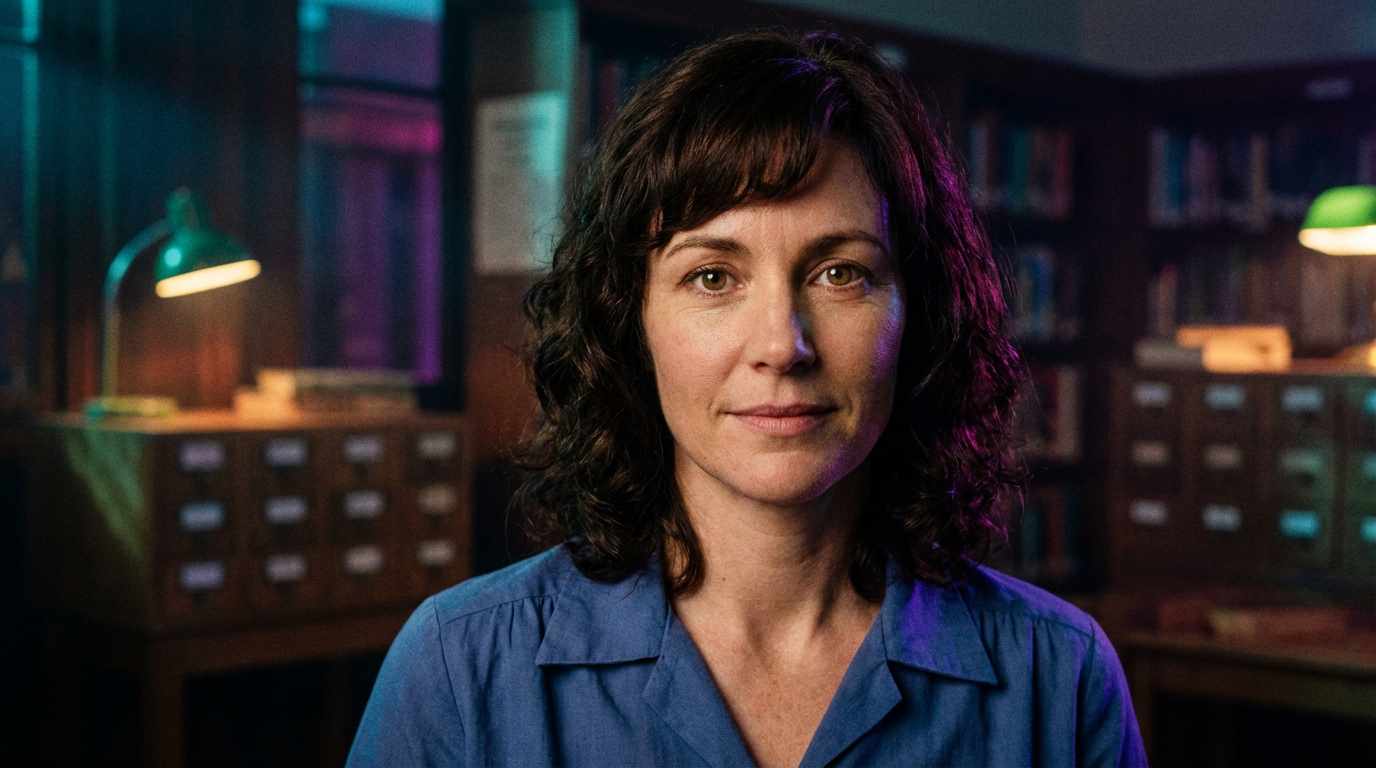
Margaret Anne Glasson (née Wilson) (b. 12 November 1951) is a retired Broken Hill schoolteacher whose life became defined by the quiet art of holding others together. The daughter of a railway worker and a teacher, she carried her mother's conviction that education could transform lives into three decades of devoted service at Broken Hill South Primary School. Her marriage to police officer Barry Glasson in 1971 brought both partnership and profound strain—particularly after the 1988 murder of their daughter Mandy's best friend thrust the family into the shadow of the Silverton Strangler investigation.
Early Years and Family
Margaret Anne Wilson arrived into the world on a crisp spring morning, 12 November 1951, at Broken Hill District Hospital. Her father, Thomas Henry Wilson, had spent the night pacing the corridors in his railway worker's boots, still dusty from his shift at the locomotive yards. Her mother, Ellen Louise Wilson (née Patterson), endured the labour with characteristic stoicism, later remarking to friends that childbirth was considerably less exhausting than managing a classroom of thirty-five eight-year-olds.
The Wilson household occupied a modest weatherboard cottage on Iodide Street, in the shadow of the mullock heaps that defined Broken Hill's skyline. Thomas worked long hours maintaining the locomotives that connected this isolated outpost to the distant coast, his hands perpetually stained with grease and his conversation peppered with union grievances. Ellen taught at Broken Hill North Public School, cycling to work each morning in all weather, her basket laden with exercise books and the patient conviction that every child deserved someone who believed in them.
Margaret was their second child. Her brother John had arrived three years earlier in 1948, a practical boy who would eventually follow his father into the railway workshops, finding satisfaction in engines rather than ideas. Margaret proved different from the start—a quiet, watchful child who preferred her mother's classroom to the rough games of the neighbourhood children. She would sit cross-legged beneath Ellen's desk during school holidays, absorbing the rhythms of instruction and correction that would later shape her own career.
Two more children followed: Stephen in 1955, who possessed an early talent for argument that would eventually carry him into local politics, and Mary in 1958, the baby of the family whose golden curls and infectious laughter made her everyone's favourite.
Mary's death from pneumonia in the winter of 1963 shattered something fundamental in the Wilson household. She was only five years old. Margaret, then eleven, watched her mother age a decade in a single season, observed her father retreat into silence and longer shifts at the yards. The loss taught Margaret early lessons about grief's weight and the inadequacy of words to carry it. She learned instead to show love through presence, through steadiness, through the small daily acts that hold families together when language fails.
Education and Calling
Margaret attended Broken Hill Public School before progressing to Broken Hill High School in 1965. She was not a brilliant student in the conventional sense—her marks in mathematics remained stubbornly average—but she possessed what her English teacher, Mrs Dorothy Flanagan, described as "an unusual capacity for understanding what lies beneath the surface of things." She excelled in subjects that required empathy: English literature, social studies, history. Her essays demonstrated a mature appreciation for human complexity that impressed her teachers whilst occasionally unsettling them.
During her high school years, Margaret found her voice through the school newspaper, where she wrote thoughtful pieces about local history and educational inequality. She joined the debating team, discovering that whilst she lacked the theatrical flourish of natural orators, her arguments carried the weight of genuine conviction. She also volunteered as a tutor for younger students struggling with literacy—work that confirmed her growing certainty about her future path.
Ellen Wilson watched her daughter's development with quiet pride, recognising the same vocation that had drawn her own life into teaching. When Margaret announced her intention to apply for Armidale Teachers' College, Ellen simply nodded and handed her the application forms she had already collected.
Margaret departed for Armidale in February 1969, travelling by train through landscapes that shifted from red desert to green pastoral country. The college proved transformative. Here she encountered educational theories that gave language to instincts she had always felt—the importance of patience, of meeting children where they were rather than where the curriculum demanded they should be. She specialised in primary education with particular attention to literacy development, drawn to the moment when symbols on a page suddenly resolve into meaning for a struggling reader.
She graduated in December 1970, returning to Broken Hill with her certificate and a determination to make a difference in the community that had shaped her.
Love and Marriage
Margaret secured a position at Broken Hill South Primary School in January 1971, joining the staff as a nervous but capable young teacher assigned to a Year 3 classroom. She threw herself into the work, arriving early to prepare lessons and staying late to provide extra support for students who needed it. Her colleagues noted her gift for reaching children whom others had dismissed as difficult, though they also observed that she had little social life beyond the occasional staff function.
Everything changed at the Australia Day celebrations on 26 January 1971.
The community gathering in Sturt Park drew most of Broken Hill's population, including a young police constable named Barry Leonard Glasson. Margaret noticed him first—or perhaps it was mutual, that recognition across a crowded space that romance novels describe and real life occasionally delivers. He was twenty-one, serious-faced and broad-shouldered, already developing the air of contained authority that would define his career. She was nineteen, still uncertain of her place in the adult world, still carrying the weight of her sister's death like a stone she couldn't put down.
Their courtship proceeded with the cautious formality of that era. Barry invited her to coffee at the Silver City Cafe. Margaret invited him to attend a school concert. They walked the streets of Broken Hill in the cool of evening, speaking of families and ambitions and the peculiar satisfaction of work that served others. Barry's conversation revealed a man who saw the world in terms of order and justice, rules and consequences. Margaret offered a gentler perspective, suggesting that people were more complicated than the crimes they committed or the mistakes they made.
By June, Barry had met Thomas and Ellen Wilson, enduring Thomas's pointed questions about career prospects and union membership whilst Ellen quietly observed the way this young officer watched her daughter. By August, the couple's future seemed settled without any formal proposal—an understanding between two people who had found in each other something they hadn't known they needed.
They married on 14 October 1971 at St Patrick's Catholic Church, the ceremony attended by both families and half the police district. Margaret wore her mother's wedding dress, let out and altered by Ellen's patient hands. Barry, in his dress uniform, managed to smile for the photographs despite his natural reserve. The reception at the Broken Hill Town Hall featured Ellen's fruit cake and Barry's brother Michael's good-natured teasing, the laughter carrying late into the spring evening.
The newlyweds established themselves in a rented cottage on Chloride Street, a modest dwelling that would eventually become their permanent home. Margaret continued teaching; Barry continued policing. They settled into the rhythms of marriage, learning each other's silences and habits, building a partnership that neither had quite expected to find.
Motherhood and the Middle Years
Mandy Elizabeth Glasson arrived at 11:42 on the morning of 5 June 1972, after seventeen hours of labour that left Margaret exhausted and Barry pacing the hospital corridors in an agony of uselessness. When the nurse finally placed the squalling infant in Margaret's arms, she felt a fierce protectiveness that surprised her with its intensity. This small creature, red-faced and demanding, was hers to shape and shelter and eventually release into a world that didn't always treat its daughters kindly.
Motherhood complicated Margaret's carefully balanced life. She took leave from teaching for Mandy's first year, returning part-time in 1973 when finances demanded it. The challenge of managing an infant, a household, and a classroom stretched her capacity for organisation to its limits. Barry, promoted to senior constable the year after Mandy's birth, worked increasingly unpredictable hours. Margaret learned to manage alone, to prepare meals that could be reheated, to explain her husband's absences to a daughter who didn't understand why her father missed bedtime stories.
Yet there was joy too—abundant and unexpected. Mandy proved to be an extraordinary child, curious and creative, possessed of an artistic eye that Margaret recognised as different from her own more practical talents. She encouraged her daughter's drawing, supplied endless paper and coloured pencils, pinned artwork to every available surface. When Mandy's teachers complained about her challenging questions and independent spirit, Margaret heard echoes of her own school reports and felt a complicated pride.
The 1970s and early 1980s passed in the blur familiar to working mothers everywhere: school concerts and parent-teacher conferences, summer holidays at relatives' homes in Adelaide, Christmas mornings and birthday parties, illnesses nursed through and milestones celebrated. Margaret's career progressed steadily if unspectacularly. By 1980, she had earned a reputation as one of Broken Hill South Primary's finest teachers, particularly valued for her work with struggling readers. She developed literacy programmes that were adopted across the district, finding in this administrative work a satisfaction she hadn't anticipated.
Her relationship with Barry evolved through these years, deepening in some ways whilst developing fractures in others. His promotions brought greater responsibility and longer absences. The cases he worked left marks she could see but couldn't touch—a darkness behind his eyes after certain investigations, nightmares he refused to discuss. Margaret learned not to ask about the locked study where he reviewed case files late into the night, though she worried about the cost this work exacted from him, from them, from their family.
The Shadow Falls
The year 1988 began with a heatwave that had old-timers comparing it to the legendary summer of 1939. Mandy, now sixteen, had grown into a striking young woman with her father's sharp features and her mother's watchful eyes. Her friendship with Violet Dallow, formed in the early days of high school, had deepened into something Margaret recognised from her own adolescence—that fierce bond between girls who see the world differently and find in each other permission to be strange.
Margaret liked Violet. The dark-haired girl possessed an intensity that might have alarmed other mothers, but Margaret saw beneath it a genuine seeking after truth, a refusal to accept comfortable lies. When Violet and Mandy embarked on their explorations of abandoned mine sites and historical mysteries, Margaret worried about safety whilst secretly admiring their courage. She had been that kind of girl once, before loss and responsibility taught her caution.
The disappearance of Sally Harlow in early September sent ripples of unease through the community. Barry, now a detective sergeant, came home less frequently and spoke even less when he did. Margaret watched him retreat into the investigation, recognising the signs of a case that had taken hold of him. She maintained the household routines, ensured Mandy ate properly and completed her schoolwork, absorbed the anxiety her husband brought home like a sponge absorbing water.
When Violet vanished from the Girl Guides camp on 30 September, Margaret's careful composure finally cracked.
She was marking assignments at the kitchen table when Barry telephoned from the camp, his voice stripped of everything but professional necessity. Mandy's best friend was missing. Search parties were being organised. Mandy was safe but distraught. Margaret set down her red pen with exaggerated care, as though sudden movements might shatter the fragile membrane between ordinary life and catastrophe.
The days that followed exist in Margaret's memory as a fever dream of activity and helplessness. She comforted Mandy whilst fighting her own terror. She coordinated with other parents, organised meals for search volunteers, maintained an appearance of capability whilst feeling anything but capable. Barry barely came home, his absence a presence that filled every room.
The discovery of Violet's body on 5 October 1988 delivered the blow Margaret had been bracing for. She heard Mandy's scream from the kitchen—that sound, like something tearing irreparably—and understood that her daughter's childhood had ended in that moment. She held Mandy for hours whilst the girl sobbed and raged, offering no false comfort, no promises that everything would be all right. Some things could not be made all right. Some losses could only be carried.
Holding the Centre
The aftermath of Violet's murder tested Margaret's marriage and her sanity in equal measure. Barry became consumed by the investigation, his obsession with catching the Silverton Strangler displacing everything else in his life. He worked eighteen-hour days, missed meals, missed conversations, missed the gradual transformation of their daughter from grieving teenager into something harder and more determined. Margaret found herself alone with Mandy's pain, with her own fear, with a husband who had become a stranger haunting their home.
She learned during these months that strength sometimes meant enduring rather than acting, holding space for others' suffering without demanding resolution. She continued teaching, finding in her classroom an anchor when everything else felt unmoored. Her students needed her attention, her patience, her belief in their potential. This simple fact—that children required what she could provide—kept her functional when functionality seemed impossible.
Mandy's grief evolved into investigation, her need for answers mirroring Barry's but directed through different channels. Margaret watched her daughter's artwork transform, becoming darker and more powerful, processing trauma through images when words failed. She encouraged this expression, recognising art as Mandy's path through the darkness even when the images disturbed her. Better to create than to collapse. Better to make something from pain than to be unmade by it.
The tension between Barry and Mandy became Margaret's constant burden. Father and daughter were too alike in their relentless pursuit of truth, too different in their methods, too wounded by the same loss to offer each other comfort. Margaret mediated endless arguments, translated each to the other, absorbed the frustration neither could express directly. She became the bridge their family required, though the weight of spanning that gap sometimes threatened to break her.
The Long Aftermath
Years passed without arrest, without closure. Barry's promotions continued—senior sergeant, then inspector—but these achievements felt hollow against the unsolved case that defined his career. The Silverton Strangler became the ghost that haunted the Glasson household, present at every family dinner, sleeping between husband and wife, following Mandy into adulthood.
Margaret retired from teaching in 2006, after thirty-five years in Broken Hill's classrooms. Her farewell assembly drew former students from across Australia, men and women who credited her with their love of reading, their confidence in themselves, their belief that someone had once seen their potential. She accepted their tributes with characteristic grace, deflecting praise whilst privately treasuring the evidence that her work had mattered.
Barry's retirement in 2011 brought challenges Margaret had anticipated and some she hadn't. She had imagined travel, grandchildren perhaps, the gentle unwinding of lives well-lived. Instead, she found herself sharing space with a man who couldn't stop investigating, who had transformed their garage into an office filled with files and timelines and unanswered questions. She learned to work around his obsession, creating space for her own interests—gardening, reading, volunteer work with literacy programmes—whilst accepting that some parts of her husband were no longer available to her.
Her relationship with Mandy healed slowly through the years, the distance created by trauma gradually closing as both women aged into understanding. She attended every exhibition of Mandy's artwork, standing in galleries filled with images of loss and memory, proud and pained in equal measure. They spoke more honestly now than they had when Mandy was young—about Violet, about Barry, about the choices they had each made to survive.







