Mack William Smith
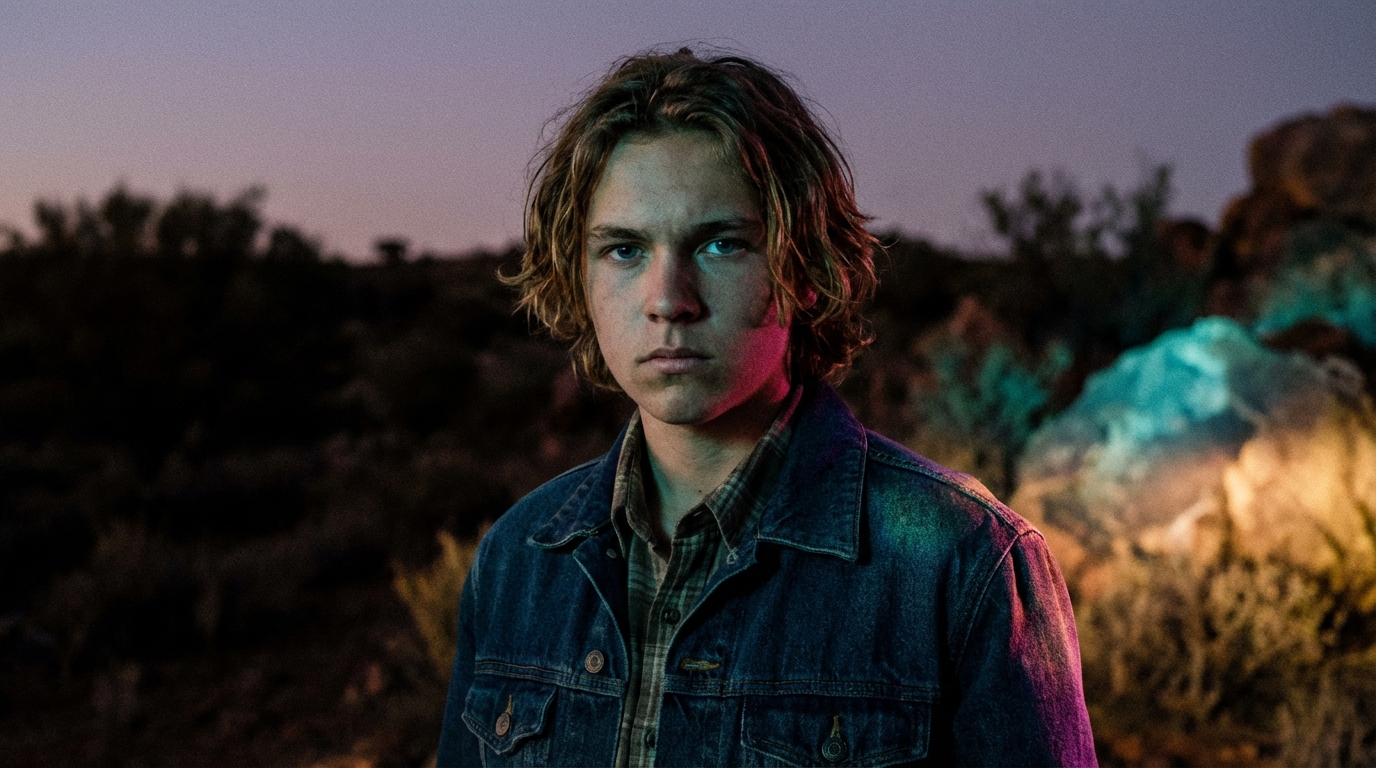
Mack William Smith (born 2009) is a curious and adventurous boy whose love for science, experimentation, and outdoor exploration defined his early childhood in Broken Hill. With dreams of starting a band and a fierce protectiveness towards his younger sister Rose, Mack's world transformed dramatically in July 2018 when his father's disappearance triggered a harrowing journey through the Australian outback that exposed him to mysteries beyond comprehension and forced him into premature maturity.
Early Life and Family Background
Mack William Smith was born 12 October 2009 at the Broken Hill Base Hospital in New South Wales, the first child of Paul Samuel Smith and Claire Elizabeth Smith (née Clift). His arrival brought joy and fresh purpose to his parents' marriage, representing the beginning of the family they had envisioned building together in the remote mining town of Broken Hill. The name "Mack" carried strength and straightforwardness, whilst "William" honoured family tradition, creating an identity that would prove prophetic—solid, dependable, capable of shouldering burdens beyond his years.
From his earliest days, Mack exhibited the curiosity and physical fearlessness that would come to define him. He was the kind of infant who pulled himself up early, determined to explore rather than wait for development to bring the world to him. As a toddler, he dismantled everything within reach—not from destructiveness but from genuine need to understand how things worked, how pieces fit together, what made objects function as they did. Claire and Paul learned quickly to childproof their home not just for safety but to protect belongings from Mack's investigative enthusiasm.
The arrival of his sister Rose Abigail Smith in February 2012, when Mack was almost two and a half years old, initially disrupted his position as the centre of parental attention. Yet Mack adapted with grace unusual for a young child, his natural protectiveness emerging almost immediately. He wanted to hold the baby, to help feed her, to be included in her care. As Rose grew from infant to toddler to curious six-year-old, the siblings developed a bond characterised by genuine affection mixed with typical sibling dynamics—Mack alternately delighting in Rose's company and finding her presence annoying, protecting her fiercely whilst sometimes teasing her mercilessly.
The Smith household in Broken Hill operated around rhythms of music and dance. Paul, a talented pianist, filled their home with compositions ranging from classical pieces to improvisations inspired by the harsh beauty of the outback landscape. Claire ran a successful dance school that had become central to Broken Hill's cultural life, her students ranging from young children taking their first ballet steps to adults seeking fitness through movement. Mack absorbed this creative environment, developing appreciation for both his father's music and his mother's physical expression whilst forging his own interests that leaned more towards science and mechanics than arts.
Personality and Interests
Mack's defining characteristic was his insatiable curiosity about how the world worked. From an early age, he approached life as one enormous experiment waiting to be conducted. His bedroom became a laboratory of sorts, filled with dismantled toys, collections of interesting rocks and insects, notebooks filled with observations about everything from weather patterns to the behaviour of the family's Kelpie, Charlie. When Paul bought him a beginner's science kit for his sixth birthday, Mack used it so intensely that components wore out within months, necessitating upgrades to more sophisticated equipment.
The backyard of the Smith home transformed under Mack's enthusiastic experimentation. He built elaborate contraptions from found materials—ramps for testing velocity, catapults for understanding trajectory, miniature weather stations for tracking the outback's dramatic climate shifts. These weren't mere play; Mack approached each project with methodical seriousness, formulating hypotheses, testing variables, recording results in careful handwriting that improved steadily as he grew older. Paul, himself inclined towards systematic thinking despite his musical career, encouraged this scientific bent, helping Mack understand principles behind his observations whilst being careful not to overwhelm the boy's natural enthusiasm with too much formal instruction.
Physical fearlessness complemented Mack's intellectual curiosity. He was the kind of child who climbed the tallest trees in Broken Hill's parks, jumped from rocks into swimming holes without hesitation, and approached new physical challenges with confidence that sometimes worried his mother. Claire, whose dance training made her acutely aware of injury potential, tried to temper Mack's daredevil tendencies whilst respecting his need for physical adventure. The compromise they reached involved Mack agreeing to basic safety precautions—wearing helmets when biking, checking water depth before jumping, telling adults where he was going when exploring—in exchange for freedom to pursue his adventures.
Mack's relationship with the family dog Charlie was particularly significant. The Kelpie became Mack's constant companion for outdoor explorations, following the boy through scrubby bushland, swimming alongside him in local water sources, and serving as patient audience for Mack's endless scientific observations. Mack taught Charlie tricks using principles of behavioural conditioning he'd read about, documenting the dog's learning process with the same careful attention he brought to all his experiments. For Mack, Charlie represented ideal friendship—uncomplicated loyalty, enthusiasm for adventure, and complete tolerance for long monologues about whichever topic currently fascinated him.
Beyond science, Mack possessed creative inclinations that manifested through art and music. He enjoyed painting and drawing, particularly creating detailed illustrations of his scientific observations—meticulous renderings of insects, landscape sketches annotated with geological notes, diagrams of his experimental apparatus. With Paul's encouragement, he'd begun learning guitar, dreaming of one day starting a band with friends. The comic book he'd created with his father—featuring a superhero based on himself who solved problems through combination of scientific knowledge and physical courage—remained one of his proudest achievements, its pages filled with adventures that blended his fascination with mechanics, his love of action, and his emerging understanding of storytelling.
Family Relationships
Mack's relationship with his father Paul was characterised by shared intellectual interests and comfortable masculine companionship. They conducted experiments together, with Paul explaining principles behind observations whilst encouraging Mack to form his own hypotheses and test them systematically. Paul taught Mack to play piano, though the boy's interest remained casual compared to his father's passion—Mack enjoyed music but lacked Paul's deep emotional connection to performance. They attended local football matches together, worked on household repairs as a team, and shared easy conversation that didn't require constant talking to feel connected.
Yet even Mack, young as he was, sensed something not quite right between his parents. The careful politeness with which they spoke to each other, the way conversations ended abruptly when he entered rooms, his father's increasing time spent in his study rather than with the family—all of it registered in Mack's observant mind. He didn't understand the complexities of adult relationships or the fractures in his parents' marriage, but he felt the tension like background static, creating low-level anxiety he couldn't quite name or address.
With Claire, Mack shared physical affection and practical partnership. She was the parent who managed daily logistics—getting him to school, coordinating activities, ensuring homework completion, maintaining household routines. Mack appreciated his mother's efficiency and warmth even when her rules sometimes constrained his adventurous impulses. He attended her dance classes occasionally, not from particular interest in dance but from desire to be included in her world, to understand what brought her such obvious joy when teaching movement to others.
The relationship with Rose defined much of Mack's daily experience. As older brother, he felt responsible for her wellbeing in ways that went beyond parental instruction. When Rose struggled with something, Mack helped. When she was frightened, he comforted. When other children were unkind to her, he defended. This protectiveness wasn't performance or duty—it was genuine instinct, love expressed through action rather than constant declaration. Rose, for her part, adored Mack with the intensity particular to younger siblings who view their older brother as impossibly capable and endlessly interesting.
Mack spoke often of his uncle Luke Smith, his father's younger brother who lived in Tasmania with his partner Jamie Greyson. Though geographic distance meant they saw each other infrequently, Luke had made a strong impression during visits to Broken Hill and when Mack's family had travelled to Tasmania. Luke told stories about his travels, his mystical experiences, his unconventional worldview that fascinated Mack even when the boy didn't fully understand what his uncle was describing. Luke represented possibility, adventure, a life lived according to internal compass rather than conventional expectations—exactly the kind of model that appealed to Mack's independent, curious nature.
The World Fractures
In the days following Paul's disappearance, Mack watched his mother transform from capable, organised woman into someone frightened and barely functional. Phone calls went unanswered. Messages received no replies. Paul's family in Adelaide claimed ignorance about his whereabouts. The careful façade of normal family life that had been maintained despite underlying tensions collapsed completely, leaving Mack and Rose adrift in confusion and mounting fear.
When Claire relocated them to Queensland, Mack understood that something fundamental had broken. He helped Rose pack her belongings, trying to maintain calm for his sister's sake whilst his own mind churned with questions that had no answers. Where was Dad? Why had he left without explanation? Would he come back? Was this somehow Mack's fault?
Crossing to Clivilius
The crossing through the Portal represented the most traumatic experience of Mack's young life. The motorhome materialised in Clivilius with violent force, the impact throwing Claire from the doorway. Before Mack could process what was happening, a silver car arrived, crashing into their vehicle. Then a bus, hurtling through the dimensional threshold with catastrophic momentum. Metal screamed. Glass shattered. Claire fell. And Mack was trapped in the wreckage.
When Mack emerged from the destroyed motorhome, he found his father and grandmother Greta—also impossibly present in a place that shouldn't exist.
Rose was alive and physically unharmed, but traumatised by her abduction and the horrifying journey that had brought them all to Clivilius. Claire clung to life despite devastating injuries, her survival dependent on primitive medical facilities that couldn't adequately address the severity of her trauma. The family was reunited but shattered, brought together in the worst possible circumstances in a world that shouldn't exist.
The weeks following the catastrophic crossing tested Mack in ways no nine-year-old should experience. His mother lingered between life and death, creating constant background fear that he might lose her completely. Rose, traumatised and confused, needed comfort and stability that Mack tried to provide despite his own terror and confusion. Paul, consumed with guilt about the choices that had led to this disaster, was emotionally unavailable even when physically present. Greta did her best to care for all of them, but the magnitude of the situation exceeded any individual's capacity to make it bearable.
Mack watched his parents' marriage disintegrate in real-time. Claire, when conscious and coherent, could barely look at Paul without rage and grief overwhelming her. She blamed him—rightfully—for requesting that Beatrix bring the children to Clivilius, for the decisions that had led directly to Rose's abduction and the family's forced relocation to another dimension. Paul accepted this blame with silence that spoke volumes, unable to defend choices he himself recognised as catastrophically selfish. The careful distance that had characterised their marriage in Broken Hill transformed into open hostility tempered only by exhaustion and shared trauma.
For Mack, adapting to Clivilius required suppressing his natural curiosity in favour of immediate survival. He learned to navigate the Bixbus settlement. He helped construct shelters, assisted with supply distribution, made himself useful in ways that gave him purpose when everything else felt meaningless.
Rose's Death and Its Aftermath
The events of 21 August 2018 destroyed whatever fragments of childhood remained to Mack. Rose was near the Portal area with Greta and Charlotte when a new Guardian's crossing coincided with violence on the Earth side of the dimensional threshold. The details remained somewhat unclear—traumatised witnesses provided conflicting accounts—but the essential facts were undeniable: gunfire during the crossing sent a bullet through the Portal aperture. Rose, in a moment of childlike spontaneity, broke free from Greta's hand and ran towards the Portal, giggling. She tripped. The bullet struck her forehead. Death was instantaneous.
The grief that followed was complicated by rage—at Paul for bringing them to Clivilius, at Luke for creating the circumstances that led to Paul's crossing, at Beatrix for abducting Rose in the first place, at the nameless forces that had sent bullets through dimensional thresholds. But most of all, Mack felt guilt. He'd promised to protect Rose. He'd failed. The logical part of his mind understood that a nine-year-old couldn't prevent bullets from crossing between dimensions, couldn't control circumstances beyond anyone's ability to predict or manage. But logic provided no comfort against the crushing weight of having failed in the one responsibility that mattered most.
Claire's reaction to Rose's death was complete psychological collapse. The physical injuries from the crossing had been healing, but losing Rose destroyed something essential that couldn't be repaired through medical intervention. Whether she would survive long-term—either physically or psychologically—remained uncertain. She withdrew into silence, unable or unwilling to engage with Mack or Paul or the reality of where they were and what had happened.
For Mack, his mother's retreat meant losing both parents simultaneously. Paul, consumed by guilt and grief, threw himself into building Bixbus with intensity that left no energy for actual parenting. Greta provided what care she could, but she too was shattered by Rose's death—the child had been in her care, had broken free from her hand, had died whilst Greta was meant to be protecting her. The trauma reverberated through all of them, creating isolation even when physically together.
Life After Loss
In the months and years following Rose's death, Mack existed in a state of suspended development. He was physically present in Bixbus, participating in community activities, contributing to the settlement's ongoing construction and maintenance. But emotionally, psychologically, he remained trapped in that moment when Rose fell, when the bullet crossed between worlds, when childhood ended in blood.
His relationship with Paul was complicated by shared grief and mutual blame that neither fully acknowledged. Paul tried to engage with his surviving child, to provide some semblance of parenting, but the guilt he carried made genuine connection difficult. Mack watched his father build Bixbus with desperate focus, understanding intellectually that Paul was trying to make Rose's death mean something by creating a community worth the sacrifice. But understanding doesn't translate to forgiveness, and forgiveness wouldn't change the fundamental fact that Rose was gone and nothing Paul built in Clivilius will bring her back.
Mack formed relationships with other children in Bixbus—bonds forged through shared trauma rather than natural childhood friendship. They understood each other in ways adults can't, carrying their own stories of forced relocation, of families torn apart, of lives interrupted by circumstances beyond their control or comprehension. Yet even amongst these peers, Mack maintained emotional distance, unwilling or unable to fully invest in connections that feel fragile, temporary, likely to end in further loss.
His memories of Broken Hill took on a dreamlike quality—that life feels simultaneously impossibly distant and painfully immediate. He remembers exploring with Charlie, conducting experiments in the backyard, the comfort of familiar routines and known landscapes. He remembers his parents before the fractures became chasms, when their marriage problems existed as background tension rather than open warfare. He remembers Rose's laughter, her endless questions, her trust that he would protect her from anything that might harm her.
That trust haunts him most of all. Rose had believed absolutely in her big brother's ability to keep her safe. She had followed him on adventures secure in the knowledge that Mack would ensure nothing truly bad happened to her. And when she needed protection most, when bullets flew through impossible doorways, Mack had been powerless. No amount of scientific knowledge or physical courage could have prevented what happened, but that intellectual understanding provided no relief from the crushing sense of having failed in the most important responsibility he'd ever held.







