Lizbeth Wilson
Born in Lanark in 1692 to a physician father and herbalist mother, Lizbeth Wilson displayed from childhood an uncanny ability to read people and perceive patterns others could not see. Recruited to the Guardian Order at eighteen, she rose to prominence through her work preserving endangered knowledge—from Alexandria's scattered treasures to the revolutionary ideas of the Enlightenment. Her daughter Helen's rejection of the Guardian path, followed by her early death, left Lizbeth to raise a grandson in secret while redirecting her mentorship toward the Stewart sisters, whom she guided from Elspeth's birth until their transformation into the founders of New Edinburgh. She died in 1778, having shaped destinies across two worlds.
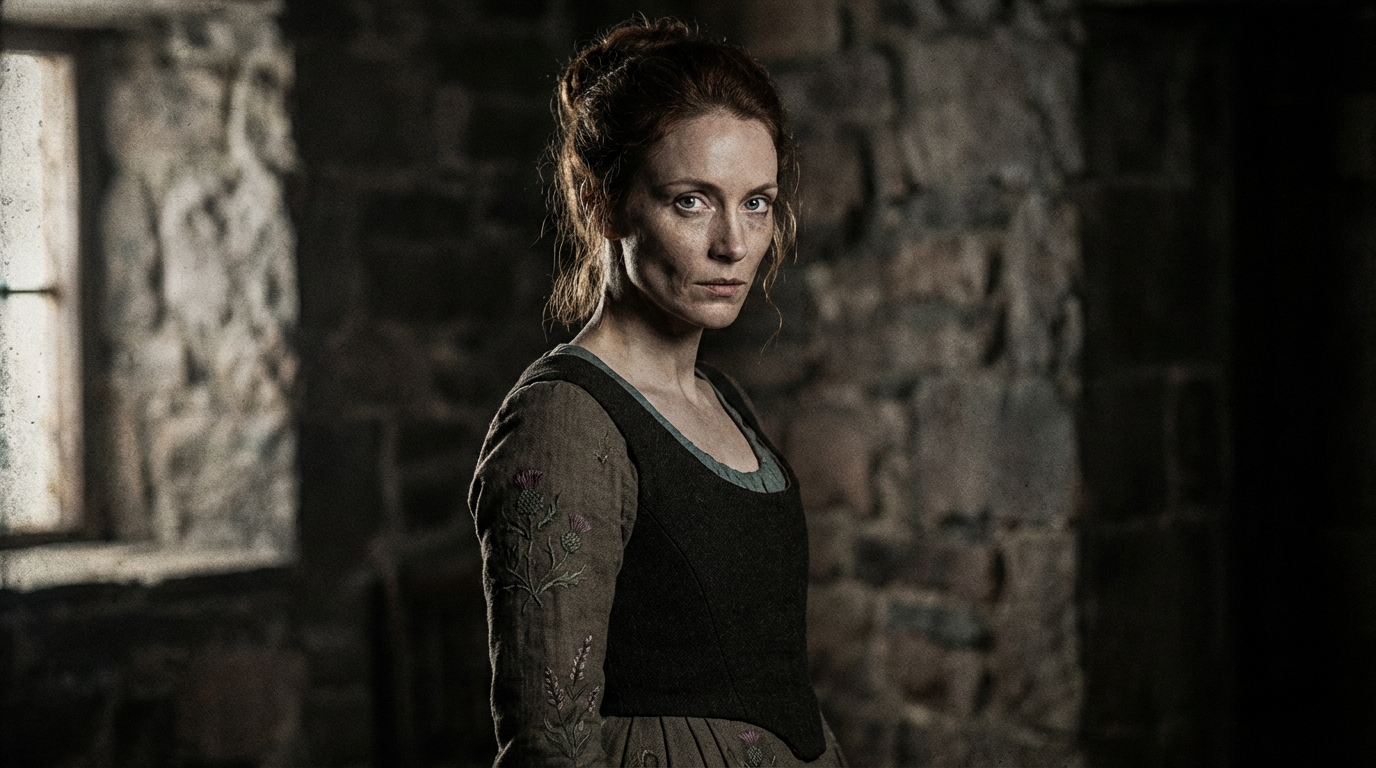
The Healer's Daughter
Lizbeth Wilson was born on 22 September 1692 in Lanark, a market town in the Scottish Lowlands whose history stretched back to the days of William Wallace. Her father, Ewan Wilson, was a physician trained in Edinburgh who had returned to his hometown to serve the community where he had grown up. Her mother, Margaret, came from a long line of herbalists whose knowledge of plants and healing had been passed down through generations of women—practical wisdom that complemented and sometimes surpassed what Ewan had learned from books and lectures.
The Wilson household was a place where learning was valued above almost everything else. Ewan kept a library remarkable for a country physician, filled with medical texts, natural philosophy, and histories. Margaret maintained gardens where medicinal herbs grew alongside vegetables, and she taught her daughter to identify plants by sight and smell, to understand their properties and applications. Between them, Lizbeth's parents provided an education few girls of her station could expect—one that nurtured both empirical observation and intuitive understanding.
From early childhood, Lizbeth displayed abilities that went beyond what instruction could explain. She seemed to know what people were thinking before they spoke, to perceive the shape of events before they occurred. Her grandfather Angus, who lived with the family until his death when Lizbeth was twelve, told her stories by the fireside that blended history with legend, truth with possibility. He recognised something in his granddaughter that others might have feared—a sight that extended past the merely visible, an understanding that reached into realms most people never suspected existed.
Recognition
The Guardian Order had existed for millennia, its members scattered across the world and throughout time, united by bloodline, purpose, and sacred principles that had been established in an ancient city most people had never heard of. They worked in shadows, preserving knowledge that powerful interests wished destroyed, guiding events toward outcomes that served humanity's long-term flourishing. They were not rulers or conquerors but stewards—caretakers of truths too important to be left to chance.
In the early years of the eighteenth century, a member of the Order came to Lanark. His name was Alastair MacLeod, and he had been watching Lizbeth Wilson from afar, observing the girl's abilities and assessing whether she might be suitable for recruitment. What he saw impressed him: intelligence, certainly, and the intuitive gifts that often marked those of Guardian bloodlines, but also something rarer—a moral clarity that did not waver under pressure, a commitment to truth that remained steady even when truth proved inconvenient.
On Lizbeth's eighteenth birthday, in September 1710, Alastair revealed himself and the Order he represented. He explained what Guardians were and what they did, the responsibilities they carried and the sacrifices they made. He offered Lizbeth a choice: to continue her ordinary life in Lanark, marry some suitable young man, and live out her years in comfortable obscurity; or to join an ancient fellowship dedicated to preserving knowledge and shaping the course of human events.
For Lizbeth, there was no real choice at all. She had known since childhood that she was meant for something beyond the ordinary, that her abilities existed for purposes greater than personal advantage. She accepted Alastair's invitation and began her training as a Guardian.
The Scholar's Wife
The years that followed were ones of learning and growth. Lizbeth travelled to Edinburgh, where the Order maintained connections with the city's intellectual community, and immersed herself in studies that expanded her understanding of both realms Guardians served. She learned the history of the Order, the principles that guided its actions, the skills required to navigate the complex landscapes of knowledge and power. Her natural abilities, refined through practice and instruction, developed into something formidable.
In the early 1710s, Lizbeth met Callum Montgomery. He was a historian and archivist from an established Edinburgh family of scholars, a man whose passion for preserving the past matched her own dedication to shaping the future. They were drawn together by their shared love of knowledge, though they approached it from different directions: Callum believed that truth should be recorded and made available to all, while Lizbeth had learned that some truths required careful handling, that knowledge in the wrong hands could cause more harm than ignorance.
Their courtship was intellectual before it became romantic, a meeting of minds that gradually deepened into something more. When they married, both understood that theirs would be an unusual union. Lizbeth's work with the Order required absences and secrecies that Callum could not fully share, while his own research into Jacobite genealogies and suppressed Scottish histories carried dangers that made discretion essential. They accepted these limitations as the price of the lives they had chosen.
In April 1720, Lizbeth gave birth to their only child—a daughter they named Helen. The pregnancy had been unexpected, the birth uncomplicated, and the infant healthy. Callum doted on the girl with the fierce devotion of a man who had not expected to become a father, while Lizbeth watched her daughter with the complex emotions of a Guardian who understood that children of their bloodline often faced difficult choices.
Two years later, in 1722, Callum Montgomery died unexpectedly. The official cause was illness, though some whispered of other possibilities—his research into inconvenient histories had made enemies. Lizbeth never spoke of what she believed had happened. She simply continued her work, raising her daughter alone while pursuing the duties that the Order required.
The Treasures of Alexandria
In 1725, Lizbeth participated in one of the most significant preservation efforts in Guardian history. The Great Library of Alexandria had been destroyed centuries before, but fragments of its collection had survived—scattered across the Mediterranean world, hidden in monasteries and private collections, preserved by those who understood their value even when they could not fully comprehend their contents. Over the centuries, Guardians had worked to locate and protect these remnants, but by the early eighteenth century, many were at risk of being lost forever.
The operation that Lizbeth helped coordinate required years of preparation and involved Guardians across multiple countries. Ancient texts and artefacts were identified, authenticated, and carefully transported to secure repositories where they could be preserved for future generations. Some of these materials were brought to Clivilius itself, placed in archives that would survive regardless of what happened on Earth.
Lizbeth's role was primarily organisational—identifying sources, coordinating movements, ensuring that the complex logistics of the operation proceeded without attracting unwanted attention. But she also worked directly with some of the materials, her training in herbalism and medicine proving unexpectedly useful in preserving fragile manuscripts and understanding texts that dealt with ancient healing practices.
The experience reinforced convictions that would guide her for the rest of her life: that knowledge was precious and fragile, that its preservation required dedication and sacrifice, and that the work of Guardians mattered in ways that most people would never understand.
A Daughter's Rejection
As Helen Montgomery grew into adulthood, the tension between mother and daughter became increasingly apparent. Lizbeth had raised Helen with the skills a Guardian would need—languages, codes, the philosophy that guided the Order's actions. She assumed that her daughter would follow the path she herself had walked, that Helen's obvious intelligence and inherited abilities would naturally lead her toward Guardian service.
Helen had other ideas. She had absorbed her father's belief that knowledge should be shared rather than hoarded, that ordinary people deserved access to their own histories regardless of what powerful interests preferred. She saw in the Guardian Order a form of control that troubled her—wisdom gatekeepers deciding which truths were too dangerous for common consumption, interventions from shadows that shaped lives without consent.
The confrontation, when it came, was quiet but decisive. Helen informed her mother that she would not become a Guardian, that she intended to use her skills for purposes her father would have recognised—preserving knowledge, yes, but sharing it openly, helping people in the present rather than manipulating abstractions in the future. She would become a healer and a historian, working among Edinburgh's poor rather than among the Order's elite.
Lizbeth accepted her daughter's decision with the controlled composure she brought to everything. If she was disappointed—and she was—she did not allow disappointment to damage their relationship. She continued to love Helen, continued to support her work even when she disagreed with its premises. But something changed between them, a distance opening that would never fully close.
Watching the Stewarts
In the spring of 1738, Lizbeth received word through Guardian networks that a child of significant potential had been born in Edinburgh. The circumstances of the birth were unusual—the infant had arrived at 11:11 in the evening, and she bore a circular birthmark that some Guardians recognised as a sign of particular destiny. Her parents were Angus and Morag Stewart, a blacksmith and his wife who had no idea that their daughter might one day bridge two worlds.
Lizbeth was forty-five years old, established in Guardian circles, respected for her work and her judgment. She made enquiries about the Stewart family and learned of their circumstances—the Highland connections, the quiet integrity that characterised both parents, the modest but stable household in Edinburgh's Grassmarket. She filed the information away and watched.
Over the following years, she observed the Stewart family from a distance. She saw Angus working at his forge, creating metalwork that displayed genuine artistry alongside practical function. She saw Morag managing their household with efficiency and warmth, raising daughters who would grow into capable young women. And she saw Elspeth—the firstborn, serious and watchful, displaying from early childhood the qualities that marked potential Guardians: intelligence, compassion, and an instinctive understanding of people and situations.
What Lizbeth also saw, though she did not initially understand its significance, was a connection forming between the Stewart household and her own daughter. In the late 1730s, Helen Montgomery began frequenting the Grassmarket, ostensibly for her healing work among the poor. But her visits gradually centred on a particular forge, on conversations with a particular blacksmith whose quiet intelligence matched her own.
Secrets and Shadows
Lizbeth knew of Helen's affair with Angus Stewart before either of them acknowledged it to themselves. Her Guardian-trained perception read the signs clearly—the frequency of Helen's visits, the way her daughter spoke of the blacksmith, the subtle changes in Helen's demeanour that spoke of emotional involvement beyond the professional. She did not intervene, though intervention was within her power.
Why she chose to let events proceed as they did remains unclear. Perhaps she recognised that her daughter was an adult capable of making her own choices, even choices that would cause harm. Perhaps she saw in the situation something that served Guardian purposes—a connection between her bloodline and the Stewart family that might bear fruit in ways not immediately apparent. Perhaps she simply understood that attempting to control her daughter's heart would only drive Helen further away.
When Helen became pregnant in 1742, Lizbeth knew immediately who the father was. She watched her daughter withdraw from Edinburgh society, arrange for the birth among distant relatives, and return with an infant son named Robert Angus. She watched Angus Stewart's guilt transform his relationship with his wife and daughters in ways none of them understood. And she watched the Stewart household expand that same autumn, when Morag gave birth to another daughter—Effie, conceived at approximately the same time as Robert.
The parallels could not have been accidental, and Lizbeth did not believe they were. Guardian philosophy held that events were interconnected in ways ordinary perception could not grasp, that patterns revealed themselves to those trained to see them. The fact that her grandson and Angus Stewart's legitimate daughter shared a conception suggested connections that would unfold across generations.
Loss and Purpose
The Jacobite Rising of 1745 brought chaos to Scotland and tragedy to the Stewart family. Lizbeth watched from Edinburgh as Charles Edward Stuart's army marched south and retreated north, as the government's vengeance following Culloden destroyed Highland culture and displaced thousands. She watched her daughter throw herself into healing work among the refugees flooding Edinburgh, treating the sick and wounded without regard for her own safety.
When Helen contracted typhus in late August 1746, Lizbeth rushed to her daughter's side. For two weeks she sat vigil, applying every remedy she knew, calling upon Guardian knowledge that had preserved countless lives over millennia. None of it mattered. On 8 September 1746, Helen Montgomery died, twenty-six years old, leaving behind a four-year-old son and a mother who had outlived the child she had raised.
Robert was brought to Lizbeth's household, where she would supervise his upbringing for the next decade. The arrangement was presented as charity—a respectable family taking in the orphaned child of a distant connection. In reality, Lizbeth was raising her own grandson, the illegitimate son of a blacksmith whose legitimate daughters she had been watching for nearly a decade.
The grief she carried for Helen was profound but contained. Guardians learned to manage loss, to continue functioning through circumstances that would break ordinary people. But Helen's death changed something in Lizbeth's approach to her work. She had failed to guide her daughter toward the Guardian path, had watched Helen choose a different road and die young upon it. The Stewart sisters—Elspeth, Effie, Katrina, and Violet—represented a second chance.
The Apple in the Grassmarket
On 8 September 1750—exactly four years after Helen's death—Lizbeth witnessed a scene in Edinburgh's Grassmarket that crystallised everything she had been watching for. Twelve-year-old Elspeth Stewart intervened to help a hungry boy who had stolen an apple from a merchant's stall, stepping between child and angry seller without hesitation, paying for the fruit from her own meagre funds.
The act was small in itself, but Lizbeth saw in it the qualities that defined true Guardians: compassion that translated immediately into action, courage that did not calculate personal cost, an instinctive commitment to justice that overrode social conventions. She had seen these qualities in Elspeth before, glimpsed from a distance, but now she witnessed them directly, confirmed them with her own eyes.
She approached Elspeth that day, their first direct interaction after more than a decade of observation. The conversation was brief—an elderly woman complimenting a young girl on her kindness—but it established a connection that would deepen over the following years. Lizbeth began to mentor the Stewart sisters, providing them with knowledge and resources that their modest circumstances could not otherwise afford, preparing them for roles they did not yet understand they were destined to fill.
The Light of the Enlightenment
Throughout the middle decades of the eighteenth century, Lizbeth maintained connections with the intellectual movements transforming European thought. The Scottish Enlightenment was flowering in Edinburgh, producing thinkers whose ideas would reshape philosophy, economics, and governance. Guardian networks had long cultivated relationships with individuals whose work advanced human understanding, and Lizbeth was positioned perfectly to serve as a bridge between the Order and this remarkable generation.
Her connections with figures of the Enlightenment were discreet but significant. She ensured that revolutionary ideas found receptive audiences, that manuscripts reached publishers who would disseminate them widely, that thinkers facing persecution found refuge and support. The work was less dramatic than the Alexandria preservation effort but equally important—seeds planted that would grow into forests of changed thought across both realms.
In all of this, Lizbeth demonstrated the Guardian philosophy at its best: not controlling minds but creating conditions where transformative ideas could flourish, not dictating conclusions but ensuring that people had access to the information needed to reach their own. The Enlightenment's emphasis on reason, evidence, and human dignity aligned with the principles the Order had upheld for millennia.
The Stewart Sisters Become Guardians
In April 1762, Lizbeth's years of patient cultivation reached their culmination. Elspeth Stewart was twenty-three years old, a young woman of remarkable capability who had been working as an apprentice at Moira MacKenzie's Emporium for nearly a decade. She had absorbed the education Lizbeth had quietly provided, developed the skills and character that Guardian service required.
On 23 April, Lizbeth placed a Portal Key into Elspeth's hands—the same kind of artefact that had transformed her own life more than fifty years before. She explained what Guardians were and what they did, offered Elspeth the same choice she herself had been offered in Lanark: ordinary life or extraordinary purpose. Elspeth chose as Lizbeth had known she would.
Over the following weeks, the other Stewart sisters followed. Effie received her Portal Key on 28 April, Katrina on 19 May. Each ceremony was both an ending and a beginning—the culmination of years of preparation, the start of lives that would reshape the relationship between Earth and Clivilius.
Lizbeth served as their mentor through the establishment of New Edinburgh, the settlement in Clivilius that Elspeth founded and led. She provided guidance, resources, and the accumulated wisdom of her decades as a Guardian. But she also gave them freedom to make their own choices, to shape their settlement according to their own vision rather than following templates imposed from above.
In July 1762, she extended the Guardian mantle one final time, to William Brodie—a complicated young man whose skills as a thief would prove surprisingly useful in the early struggles of New Edinburgh. It was an unconventional choice, one that some Guardians questioned, but Lizbeth had learned to trust patterns that others could not perceive.
Death
Lizbeth Wilson died on 18 November 1778, at the age of eighty-six. She passed peacefully in Edinburgh, surrounded by those she had mentored and served, her final years devoted to ensuring that the work she had begun would continue without her.
The Stewart sisters came to her bedside in her final days—Elspeth, Effie, Katrina, and Violet, the women she had watched since childhood and guided into their extraordinary destinies. They sat with her as she faded, listening to her final instructions and receiving her blessing. Whatever private thoughts she shared with them in those hours remained private, spoken in the intimacy of approaching death.
Robert Stewart, her grandson—now thirty-six years old and established as an archivist and genealogist—was also present. He had never learned the full truth of his grandmother's role in shaping his life, never understood how her Guardian duties had intersected with his mother's affair with Angus Stewart. But he felt the weight of what he was losing, the sense that her death closed a door to mysteries he would spend his remaining years attempting to unlock.







