4338.206 · July 25, 2018 AD
Lines in the Dirt
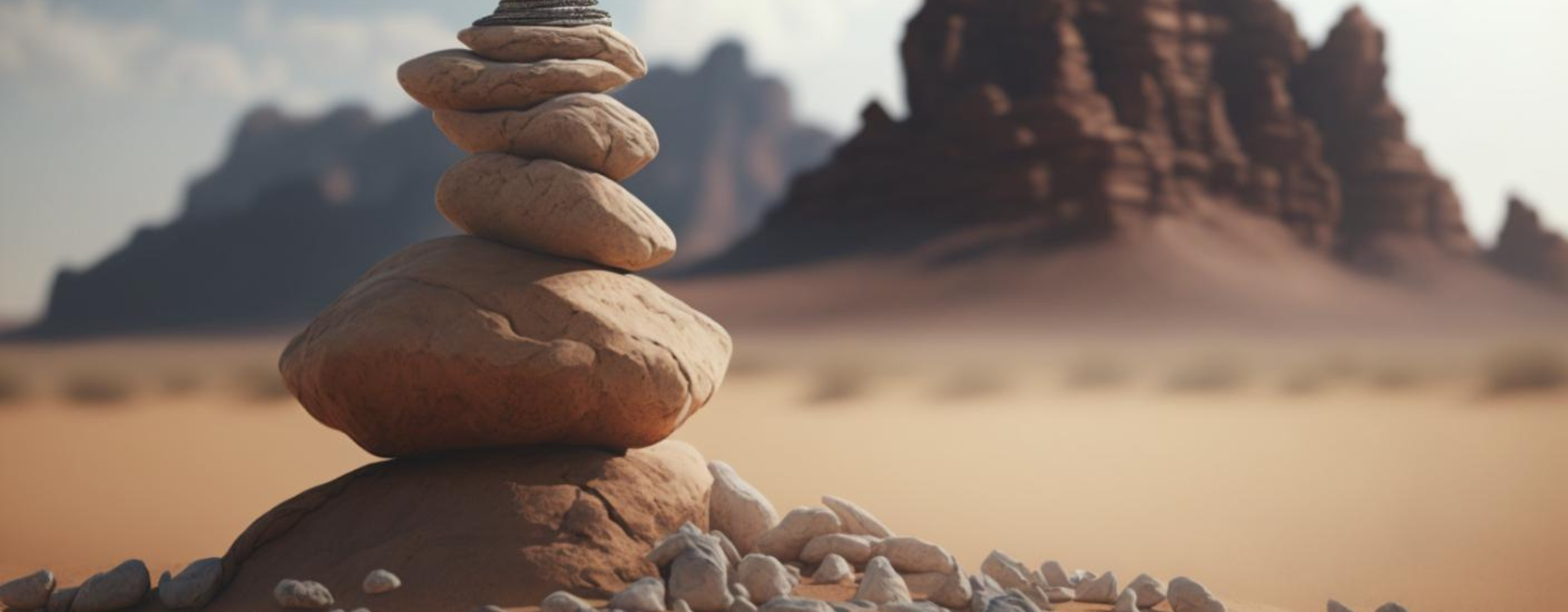
When Jamie sits down beside Paul with nothing else to do, Paul seizes the fragile opening to suggest they mark a delivery area near the portal—absurd and random, but something. As they drag rocks and draw lines in the dust, creating the first deliberately made mark on Clivilius, something shifts between them. They're not just surviving anymore. They're building. Together.
"I called it 'The Clivilius Delivery Drop Zone' with the solemnity of a man naming his firstborn—Jamie called it 'Drop Zone' and somehow made my grandiose declaration useful."
The sound of soft footsteps approaching snapped me back to the present. I had been lost in the river's endless conversation with itself, watching the water carry my thoughts downstream to wherever thoughts go when we stop paying attention to them. I didn't turn to acknowledge Jamie's arrival — I wasn't sure I had the energy for another confrontation, another rejection, another reminder that my hopes for this place were mine alone.
Jamie settled himself beside me, his body folding into the dust with a resignation that seemed to mirror something I had heard before. In his voice, perhaps. Or in my own heart.
"There's nothing else to do."
The words hung between us — a flat declaration, an admission of defeat, an unexpected olive branch. He had come to me. He had sat down. He had spoken first. After his earlier dismissal, after announcing his intention to flee the moment Luke returned, Jamie was here. Beside me. Acknowledging, however obliquely, that we were in this together.
I continued to stare across the river, watching its gentle flow cut a path through the endless brown. The water moved with such certainty, such clear purpose, while everything inside me felt muddied and confused. Jamie's words echoed a sentiment I knew too well — the paralysing weight of purposelessness, the terrifying freedom of having nothing required of you and no one expecting anything. It was the kind of freedom that could destroy a person faster than any obligation.
Yet I wasn't ready to concede. The absence of Luke weighed heavily on us both, a silent spectre of uncertainty that loomed over our makeshift encampment. Where was he? When would he return? What supplies would he bring — if any? Jamie's resolve to leave once Luke appeared was clear, but my own thoughts on the matter had shifted since our earlier conversation. The vision I had tried to sell him hadn't died with his rejection. It had simply retreated, waiting for another opening.
And perhaps this was it.
"Well," I ventured, grasping for a semblance of optimism, testing the waters with the cautious toe of someone who had already been burned. "We could do with a place near the Portal where Luke can deliver things. We can then work out what to do with them."
The suggestion was a shot in the dark — less a plan than a desperate attempt to inject purpose into our waiting. To give us something to do that wasn't sitting and staring and slowly going mad with uncertainty.
"Well, that seems a bit random," Jamie observed, and I could hear the slight uptick at the end — not quite a question, not quite mockery, but somewhere in between. The tone of a man who had expected nothing and received exactly that.
I couldn't help but chuckle at the absurdity of my own suggestion. Here we were, stranded, our survival dependent on supplies that may or may not arrive through a Portal we didn't understand, and my grand contribution was to suggest we... what? Draw a square in the dirt? Pile up some rocks?
"It does a bit, doesn't it?"
The laughter felt strange in my throat — rusty, like machinery that hadn't been used in too long. When had I last laughed? Before the darkness, certainly. Before Rose's voice had called me into fire. Before the dust had tried to strip the skin from my bones. Laughter belonged to a different version of me, one who still believed the world made sense.
But then something unexpected happened. Jamie smiled.
It was rare and fleeting — there and gone in less time than it takes to draw a breath — but it was real. A genuine expression of shared humanity in the vastness of Clivilius. For just a moment, we were two people finding something absurdly funny in an absurd situation.
Both of us then returned to our silent contemplation of the river, its steady flow a reminder that time kept passing whether we participated or not. But the quiet between us had changed. It was no longer oppressive, no longer charged with the tension of opposing intentions. Something had shifted — a mutual acknowledgment of the challenges ahead and the fragile hope that, somehow, we might find a way to navigate them. Together.
"I guess it would give us something to do," Jamie conceded, and there was something in his voice that hadn't been there before. A hint of reluctant acceptance. A crack in the door that he had so firmly shut earlier. The opening was all I needed — a sliver of common ground from which we could build. I seized it like a drowning man seizes a thrown rope.
"And not just finding a good spot. Getting Luke to leave whatever he brings through the Portal in a single spot will give us something to do, to move it."
The plan was forming as I spoke, taking shape from nothing the way clouds form from empty sky. A tangible task. A structure for our days. It wasn't much — hauling supplies from one location to another — but it was something. It was the beginning of something.
"And," Jamie interjected, and I was startled to hear enthusiasm colouring his tone. He was warming to the concept, I realised. Actually engaging with it rather than simply tolerating my rambling. "Luke is very intelligent, but he can also be a bit of a scatterbrain."
The observation surprised a laugh out of me — genuine this time, without the rusty hesitation of before. Jamie knew Luke. Had lived with him, loved him, been driven mad by him. And he was right. My brother was brilliant in ways that defied easy categorisation, but that often came with untidy consequences.
"Totally," I agreed wholeheartedly, the word carrying more warmth than I had intended. "I don't think it's wise for us to trust Luke to establish a settlement properly."
The words were out before I could consider their weight — a candid admission of what we both knew, a recognition that if this place was going to become anything worth having, it would be because we made it so. Not Luke with his grand visions and scattered execution, but us. Paul and Jamie. The responsible ones. The ones who stayed behind while Luke disappeared through Portals and left us to wonder if he would ever return.
To my surprise, Jamie's response was not verbal but physical. He rose to his feet in a single fluid motion — decisive, purposeful, alive in a way he hadn't been moments ago — and extended his hand to help me up.
I stared at the offered hand for a moment, caught off guard by the gesture. After holding me while I sobbed, after pulling me from fire, after dismissing my dreams and declaring his intention to flee — now this. A hand extended in something that looked remarkably like partnership.
I accepted it and stood, wincing as my burned foot protested the shift in weight. For a brief moment, I watched Jamie's back as he walked away, a silent figure moving with a purpose that hadn't been there an hour ago. Something had changed. Something I had almost given up hoping for.
"Well, you coming then?" Jamie called back over his shoulder, his voice carrying a blend of challenge and invitation that felt entirely new. "It was your idea after all."
The tease was evident — a playful nudge that broke through the residual tension and solidified whatever fragile alliance we had just formed. I found myself grinning, a wide, involuntary reaction that spread across my face before I could consider whether it was appropriate. In that moment, the path forward seemed a little less daunting. The prospect of working together not just a necessity but a source of hope.
Progress, indeed.
By the time I had hobbled over to the Portal, my foot complaining with every step like an overtired child, Jamie was already deeply engrossed in his task. He was dragging a small rock through the dust, leaving a line behind him that cut through the endless brown like a declaration of intent. His focus was almost intimidating — the concentration of a man who had found purpose after too long without it.
The line he was creating was the first deliberately made mark on Clivilius. Not a footprint accidentally left, not damage from the storm, but a conscious choice to impose human will on alien soil. It seemed both profound and absurd — two men drawing shapes in the dirt like children at a beach, pretending that their sandcastles mattered against the tide.
But it did matter. That was the strange truth of it. Every empire had started with someone drawing a line and declaring that this side was theirs. Every city had begun with a boundary, a demarcation, a statement that here, at least, chaos would not reign unchecked.
Taking my cue from Jamie's determined efforts, I set about gathering larger rocks from the surrounding area. Each stone felt significant as I lifted it, heavier than its physical weight suggested. These were the building blocks of something new — small piles placed in each corner and at regular intervals along each edge of our designated site. The physical act of defining our space lent reality to our plans, transformed abstract hope into something solid I could touch.
My foot screamed with every step, the burns from last night's fire making their grievance known in increasingly creative ways. But the pain was almost welcome now — proof that I was alive, that I was doing something, that I wasn't simply waiting to die in a collapsed tent while the dust erased all evidence of my existence.
"There," I announced, a sense of accomplishment threading through my voice as I wiped the sweat from my brow. The task had been more arduous than I had anticipated, the sun beating down on us with an intensity that seemed to underscore the seriousness of our endeavour. But we had done it. We had created something from nothing — a bounded space, a defined area, the skeleton of infrastructure that might one day support the civilisation I kept dreaming about.
"Looks alright," Jamie observed, his gaze sweeping over our newly marked territory with a nod of approval. The simplicity of his acknowledgment felt like victory — not effusive praise, not false enthusiasm, but genuine acceptance that what we had made was worth making. Then he looked at me with something approaching curiosity.
"You got a name for it?"
The question caught me off guard. A name. Of course it needed a name. Everything needed a name — that was how humans claimed ownership, how we transformed the foreign into the familiar, how we convinced ourselves that we belonged in places we had never belonged before. Without a name, it was just lines in the dirt. With a name, it became real.
"Hmm," I hesitated, the weight of the question prompting me to pause and consider. A name wasn't just a label. Whatever I chose would become the first official designation in Clivilius — the first thing we had named since the settlement itself. It needed to be right.
"Yes," I finally declared, a burst of inspiration cutting through the uncertainty. The name formed in my mind with the satisfying click of a puzzle piece finding its home. "The Clivilius Delivery Drop Zone."
A surge of pride lifted my words as I announced it. The name felt fitting — a tribute to our efforts, a nod to the practical purpose of the site and its significance in our bid to establish a foothold. It was official. It was formal. It was exactly the kind of name that would go on a plaque someday, assuming we survived long enough to make plaques.
Jamie's laughter, sudden and unexpected, cut through my moment of triumph like a pin through a balloon.
"What?" I couldn't help but ask, a mix of hurt and curiosity colouring my voice. I had expected scepticism, perhaps. Even indifference. But laughter? The name wasn't that ridiculous. It was descriptive. It was clear. It explained exactly what the place was for.
"Nothing. It's as good a name as any." Jamie assured me, though he was still chuckling in a way that suggested he found something genuinely amusing about my ceremonial approach to nomenclature. "But I'll just call it Drop Zone. It's easier."
"Drop Zone," I repeated, rolling the abbreviated name around in my mind. It was succinct. It was direct. And somehow, it felt right for the rugged simplicity of our lives in Clivilius. We weren't building a corporation with formal naming conventions and branding guidelines. We were two men trying not to die, marking a square in the dirt where supplies could be left.
"I like it!"
The admission came easily, without the sting of wounded pride I might have expected. Jamie had taken my idea and made it better — simpler, more practical, more likely to actually be used. And in doing so, he had done something more important than improve a name. He had collaborated. He had engaged. He had shown that maybe, just maybe, he was starting to see what I saw.
The Drop Zone stretched before us, marked by stones and lines in the dust, the first tangible evidence that we were trying to build something rather than simply survive. It wasn't much. A square in the dirt. Some rocks piled at corners. A name that would probably never appear on any official document.
But it was ours. We had made it together.

