Lake Gunlah, Belkeep, Clivilius
Lake Gunlah, a vast frozen expanse at Belkeep's heart, transformed from hoped-for resource into mass grave and psychological burden. Named optimistically in 1987, the lake claimed dozens of lives through treacherous ice whilst offering nothing in return. By 2011, Chief Lewyyd Drikarsus declared it off-limits for unsanctioned travel. Following Belkeep's 2030 designation as a research zone, the lake now serves scientific investigation—its brutal honesty preserved through systematic study rather than lived tragedy.
Location and Physical Description
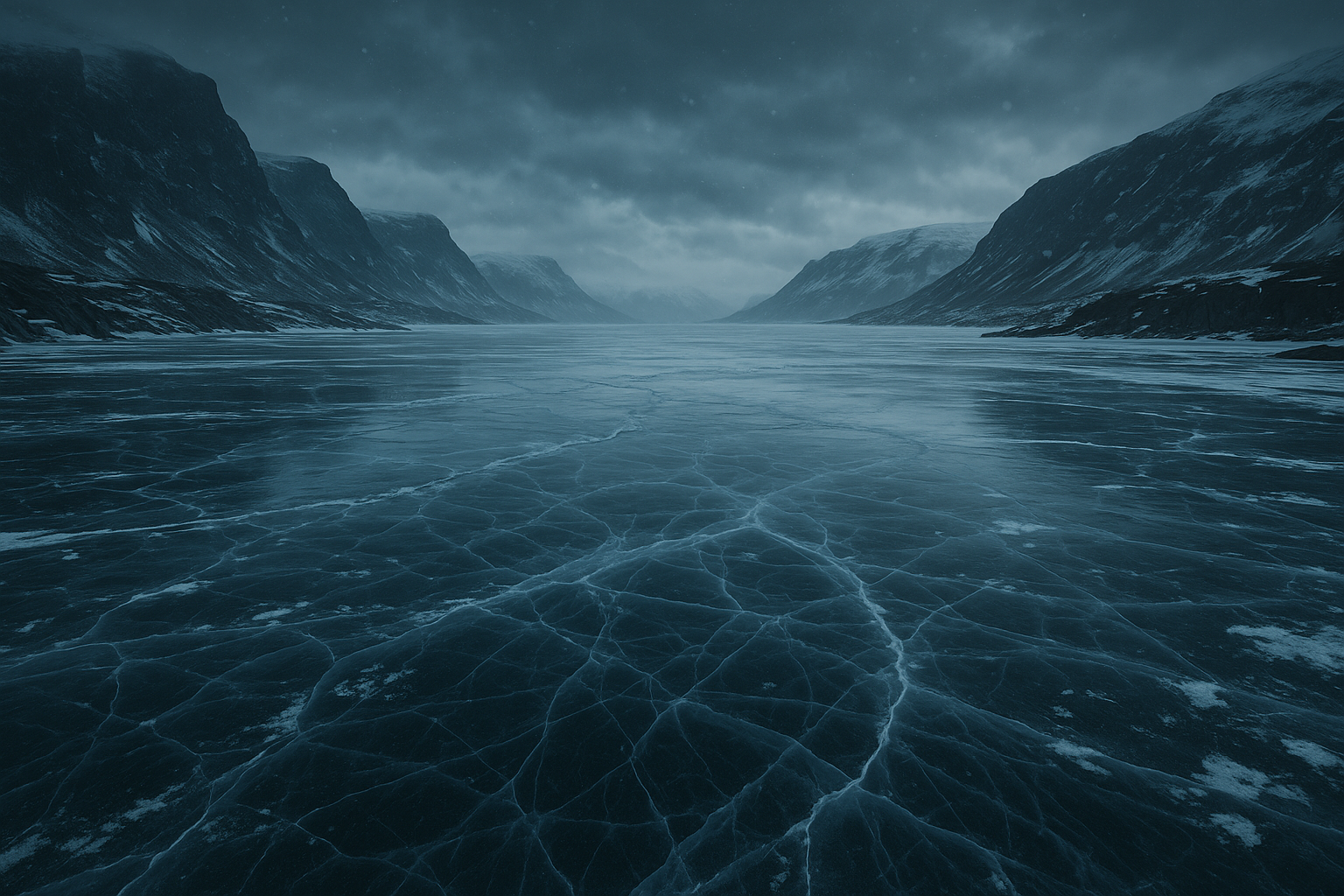
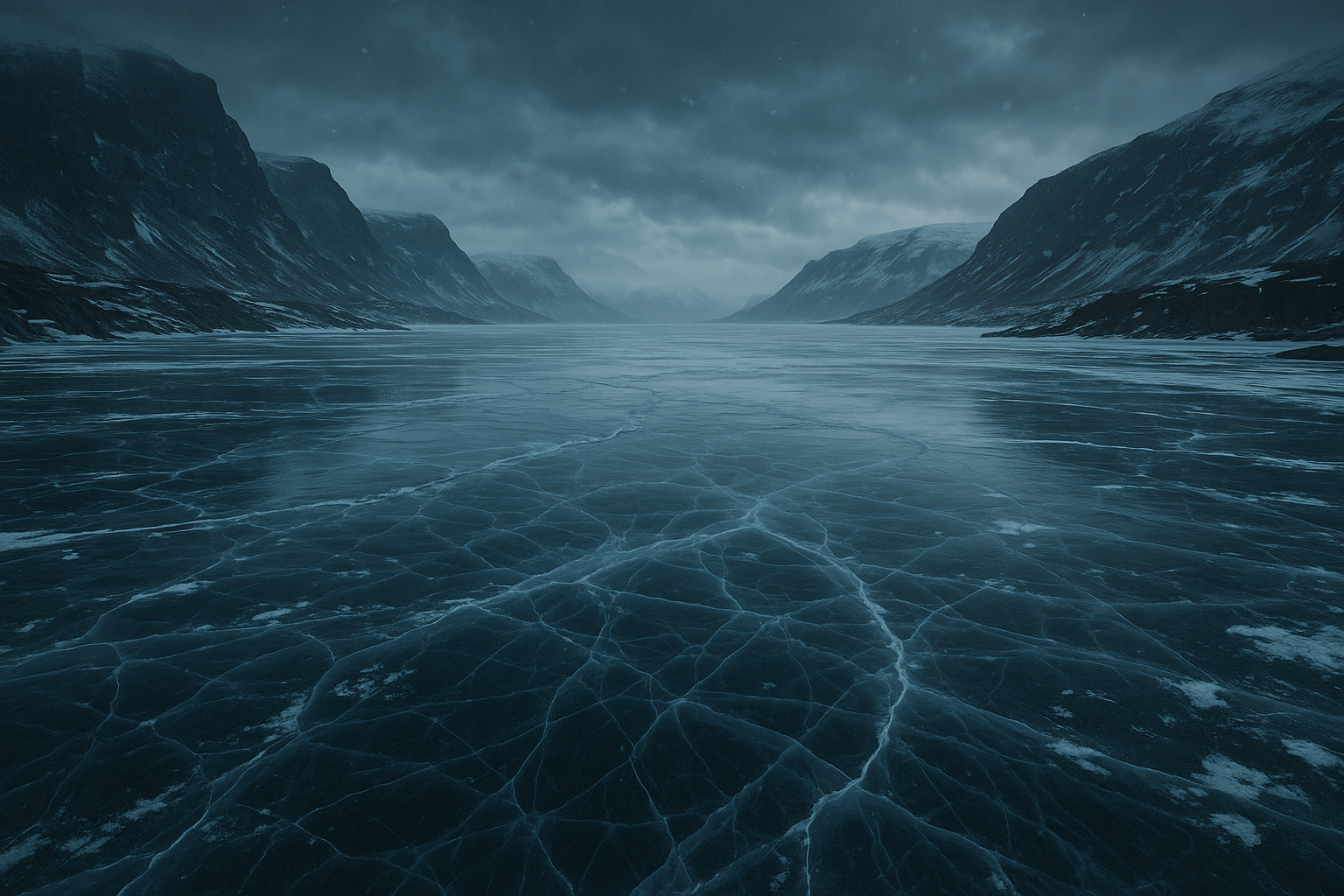
Lake Gunlah lies at the geographical and psychological heart of Belkeep, dominating the settlement's landscape with the same implacable presence that defines everything else about this frozen outpost. Situated in a wind-carved basin between glacial cliffs and granite ridgelines, the lake occupies a vast natural depression that remains frozen nearly year-round, its waters locked beneath ice that conceals as much as it reveals.
The frozen surface extends for kilometres in every direction, a deceptive expanse of white that appears uniform from distance but proves treacherously variable upon closer examination. Thick ice capable of supporting human weight exists alongside thin patches that shatter without warning, creating zones of lethal unpredictability that shift with temperature fluctuations, wind patterns, and factors no one in Belkeep has successfully learned to predict.
The lake's perimeter is uneven and jagged, defined by broken stone shelves, black ice ridges, and occasionally collapsing snow ledges that make even approaching the edge a calculated risk. Mist and snowfall regularly obscure visibility across the surface, whilst storms sweeping in from the surrounding seas cross the basin with violence amplified by the open expanse. During the rare moments when weather permits clear views, the lake presents a stark beauty—vast, unmarked whiteness extending to distant cliffs—that makes its deadliness feel almost like betrayal.
During Belkeep's infrequent and minimal summer thaws—periods when temperatures rise barely above freezing for days rather than weeks—the lake emits a pungent, briny odour suggesting subsurface connection to the nearby sea. The smell carries associations with rot and organic decay that residents find deeply unsettling, a reminder that beneath the frozen surface exists an entirely different ecosystem they cannot access or understand.
Attempts to map or sound the lake's depths have failed repeatedly. Early efforts using weighted lines produced inconsistent results, suggesting either extreme depth or underwater formations that prevented accurate measurement. Later attempts using more sophisticated equipment—borrowed, improvised, or jury-rigged from available materials—resulted in equipment losses that the settlement could ill afford. By the mid-2010s, such explorations had ceased not because questions were answered but because resources couldn't justify continued investigation.
Historical Context and Human Interaction
When Cody Jennings first activated his Portal Key on 30 October 1987 and stumbled into the frozen valley that would become Belkeep, Lake Gunlah presented itself as potential asset rather than threat. The vast body of water—even frozen—suggested possibilities that desperate early settlers seized upon with optimism born from necessity rather than evidence. Perhaps it would provide fresh water when melted. Perhaps fish populations existed beneath the ice. Perhaps the frozen surface could serve as a transportation route, connecting different areas of the settlement more efficiently than overland travel through deep snow.
The lake was named after Gunlah Vensh, a mythical figure from southern Australian folklore that Cody half-remembered from childhood stories—a character associated with stillness before transformation, with frozen potential awaiting the right conditions to manifest. The name reflected hope that the lake might transform from obstacle into resource, from threat into ally, if only settlers could understand and properly utilise it.
Within two winters, that hope had frozen as solid as the lake itself.
The first deaths occurred in early 1988, when a small group attempting to cross the ice to reach caves on the eastern bank broke through a thin patch and drowned in water so cold that hypothermia claimed them within minutes. Recovery of the bodies proved impossible—the ice reformed too quickly, and the location of the break couldn't be reliably determined after fresh snowfall obscured all markers.
More deaths followed with grim regularity throughout the early 1990s. Entire families attempting to relocate to supposedly better shelter on the lake's far side disappeared, their absence discovered only when they failed to return and search parties found nothing but empty ice and unanswered questions. Individuals fishing through augured holes fell through weakened ice surrounding their own excavations. Children playing too far from shore ventured onto sections that couldn't support their weight.
The term "Gunlah Crossing" emerged during this period, evolving from neutral description into euphemism for final acts of desperation. When someone was said to be "considering a Gunlah Crossing," it meant they had reached the point where lethal risk seemed preferable to continued endurance of Belkeep's conditions. Some crossings were genuine attempts to reach specific destinations. Others were less ambiguous about their intent.
The lake became a mass grave in all but name, claiming dozens of lives over two decades whilst offering nothing in return. Fish populations proved sparse and difficult to access. The water, when melted, carried mineral content that made it unsuitable for drinking without treatment processes the settlement lacked resources to implement properly. Transportation across the surface remained lethally unpredictable regardless of season, ice thickness, or weather conditions.
By 2011, Chief Lewyyd Drikarsus officially declared the lake off-limits for unsanctioned travel. The edict was both a practical governance and symbolic acknowledgement: Lake Gunlah would never be the asset early settlers hoped it might become. It was a permanent hazard rather than potential resource, and policy needed to reflect that reality regardless of how it contradicted founding optimism.
Symbolic and Psychological Significance
By the late 2010s, Lake Gunlah had transcended its physical presence to become something far more complex in Belkeep's collective consciousness. Its silent, frostbitten expanse embodied the psychological weight borne by the settlement's residents—the accumulated grief, the exhausted hope, the stubborn endurance that kept people functioning when rational calculation suggested they should simply surrender.
Cody Jennings, in private journals discovered after his death in 2018, wrote extensively about the lake's symbolic resonance:
"The lake freezes over each year, but it's not only water that freezes. It's hope, memory, even time. It catches our reflections, then shatters them back."
The passage reveals how thoroughly Lake Gunlah had infiltrated Belkeep's emotional landscape. It wasn't merely dangerous geography to be avoided—it was a mirror, metaphor, and monument to everything the settlement had endured and lost.
The lake became the focal point for unofficial mourning rituals that governance neither sanctioned nor suppressed. Residents gathered at the shore for silent vigils marking deaths, disappearances, and anniversaries of loss. These gatherings followed no formal structure—people simply appeared, stood in silence for varying durations, and departed without discussion. The practice acknowledged what official channels couldn't adequately address: that grief in Belkeep was constant, communal, and required expression even when words failed.
Children developed their own relationship with the lake, daring one another to walk progressively closer to the edge, testing courage through proximity to acknowledged danger. Adults generally permitted this behaviour despite its risks, recognising that children needed to develop their own understanding of threats they would live alongside indefinitely. The games occasionally resulted in injuries—falls on ice, mild frostbite from extended exposure—but rarely proved fatal, and the psychological function they served seemed to justify the risk.
A quieter tradition emerged during the coldest months, when the ice reached its maximum thickness and the lake's surface appeared most stable. Individuals would push small carved tokens beneath the ice through cracks or deliberately augured holes—objects resembling animals, abstract shapes, or representations of things lost or desired. The practice was never formally explained or collectively acknowledged, operating instead as a private ritual that enough people performed to become a recognisable pattern.
Most residents, when asked, dismissed the token-leaving as mere folklore or superstition without deeper meaning. Others, particularly children like Krid Louwa, ascribed genuine significance to the practice—believing the tokens carried wishes, prayers, or messages to some destination beyond the ice, beyond Belkeep, perhaps even beyond Clivilius itself. Whether anyone truly believed in the efficacy mattered less than the psychological function: it provided action when action felt otherwise impossible, created agency in circumstances that denied it, and transformed the lake momentarily from threat into potential conduit for hope.
Environmental and Scientific Observations
Despite decades of observation by Guardians, settlers, and the few individuals with scientific training who arrived through the Portal, Lake Gunlah remains poorly understood. The combination of hostile conditions, limited equipment, and resource scarcity prevented comprehensive study, leaving fundamental questions about the lake's nature unresolved.
Limited drilling operations conducted in the early 2000s—using improvised equipment that barely qualified as scientific instruments—suggested the water body lies atop volcanic stone. Temperature readings from the deepest points reached indicated geothermal activity heating the lake's lowest depths, potentially explaining rare incidents of midnight steaming observed from shore and the occasional cracking roar heard from beneath the ice when thermal expansion created internal stress.
However, the 2014 and 2016 equipment losses—incidents where drilling operations resulted in catastrophic gear failure and the loss of irreplaceable tools—rendered further exploration impractical. The settlement simply couldn't afford to lose more resources investigating questions that, whilst scientifically interesting, offered no practical benefit to survival. Knowledge about the lake's precise depth or thermal properties wouldn't make it less dangerous or more useful.
The lake's mineral content presents another unresolved mystery. Water samples collected through ice holes revealed salinity inconsistent with standard freshwater lakes but insufficient for marine classification. The chemical composition suggested mixing of fresh and salt water, potentially through underground passages connecting the lake to the distant sea. Some residents developed elaborate theories about vast subterranean networks linking Lake Gunlah to other bodies of water across unexplored regions, though these remained pure speculation unsupported by evidence.
Biological sampling proved equally inconclusive. Fish existed within the lake—this much was confirmed through occasional catches and underwater observation when conditions permitted—but species identification, population estimates, and ecological relationships remained unknown. The fish appeared adapted to extreme cold and low light conditions, suggesting the lake's ecosystem functioned independently of surface conditions, but comprehensive study never materialised.
The Lake During Belkeep's Transition (2027–2030)
The discovery of Belkeep by Bixbus in 2027 and the subsequent relocation programme between 2028 and 2030 transformed Lake Gunlah's role once again. As population declined and the settlement's purpose shifted from habitation to research, the lake became the object of a more systematic scientific investigation than had ever been possible during active settlement.
Researchers from the Clivilius Environmental Research Authority (CERA) and Clivilius National University (CNU) conducted comprehensive surveys using equipment and methodologies that previous residents could only have imagined. Ice cores extracted from various locations across the lake's surface provided climate data spanning centuries, offering insights into long-term temperature patterns and precipitation cycles that contextualised Belkeep's brutal conditions within broader environmental history.
Bathymetric mapping using sonar and ground-penetrating radar finally revealed the lake's true depth—far greater than early settlers had estimated, with underwater formations suggesting complex geology shaped by ancient volcanic activity and glacial erosion. The confirmation of geothermal vents along the lake bed explained both the thermal anomalies and the unusual chemical composition, whilst also suggesting why complete freezing never occurred even during the coldest periods.
Biological surveys documented seventeen distinct fish species, twelve of which were previously unknown to Clivilius science. The ecosystem proved remarkably robust despite appearing barren from surface observation, sustained by chemosynthetic bacteria around the geothermal vents and complex food webs adapted to perpetual darkness and near-freezing temperatures.
Yet even comprehensive scientific understanding couldn't erase the lake's accumulated symbolic weight. Researchers noted in their reports that working beside Lake Gunlah carried a psychological impact disproportionate to physical conditions. The knowledge of how many deaths the ice had claimed, the awareness of the grief concentrated around its shores, the recognition that this beautiful, deadly expanse had shaped an entire community's identity—all of this created an atmosphere that scientific objectivity couldn't entirely dispel.
Current Status and Research Focus
Following Belkeep's designation as a Remote Research and Heritage Zone in 2030, Lake Gunlah became the focal point for multiple ongoing research initiatives. The lake's unique characteristics—perpetual ice cover with geothermal activity beneath, extreme isolation from other water bodies, and ecosystem adapted to conditions that resist human habitation—offer scientific value that justified continued study despite logistical challenges.
Climate research centres on ice cores that preserve atmospheric data and environmental conditions across centuries, providing baseline information about the region's long-term climate patterns. The lake's relatively undisturbed state makes it ideal for this work—unlike regions with more human activity or variable conditions, Lake Gunlah's consistency allows researchers to isolate specific climate signals without confounding variables.
Biological research focuses on understanding how complex ecosystems sustain themselves in extreme conditions. The lake's chemosynthetic organisms and their adapted predators provide models for life in environments previously considered nonviable, offering insights relevant to astrobiology and extreme environment colonisation.
The Slates for the Lost memorial site, located on the northeastern shore overlooking the lake, remains under active conservation by the Clivilius Historical Foundation. The juxtaposition of memorial and water body that claimed so many lives creates a powerful emotional landscape that researchers report affects them despite professional detachment. Several described the experience of working beside Lake Gunlah whilst visible to the slate field as "conducting science whilst ghosts watch"—a phrase that circulated through academic publications and shaped how subsequent researchers approached fieldwork.
