
Kevin Arthur Hodgman
Kevin Arthur Hodgman, born 8th August 1990 in Hobart, Tasmania, was a historian, educator, and published author whose work did more than most to make Tasmania's colonial past legible to the people living inside its consequences. Raised in a West Hobart household shaped by literature and music, educated at Hutchins School and the University of Tasmania, and marked by losses he carried without sufficient explanation, Kevin built a careful and quietly significant career as both scholar and teacher — and lived, through the late 2010s and beyond, with the unresolved weight of his sister's disappearance running beneath everything else.
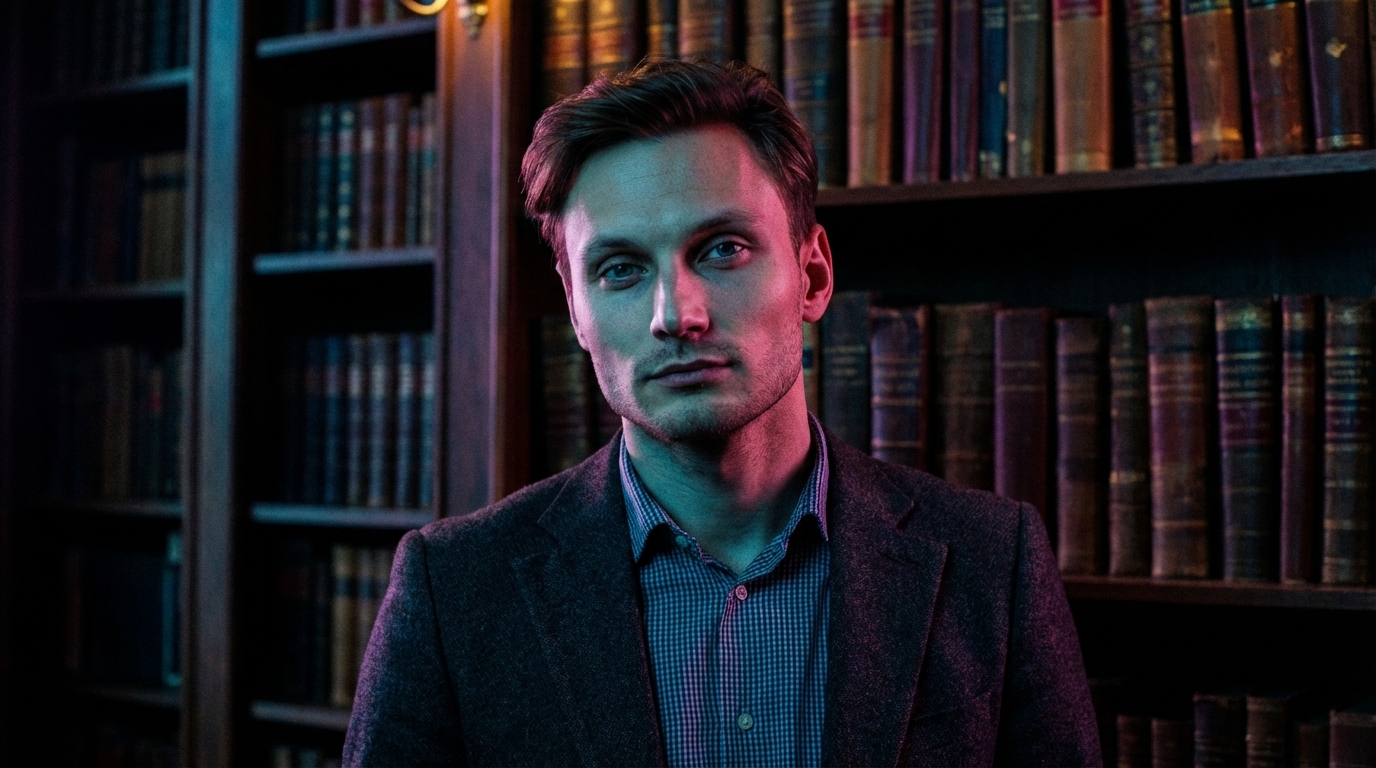
The Hodgman Household
Kevin Arthur Hodgman was born on 8th August 1990 at the Royal Hobart Hospital, the second of three children born to Wayne Thomas Hodgman and Rowena Margaret Hodgman (née Turner). The family home was in West Hobart, in a double-fronted Federation house on a street that climbed steeply enough to give a clear view of the Derwent on fine days, purchased by Wayne in the early years of his appointment at the University of Tasmania with the combination of academic salary and careful saving that such acquisitions required in Hobart even then. The house was full of books — shelved, stacked, spread across the stairs in configurations that Rowena periodically reorganised without expecting to resolve — and full of music: her concert grand occupied the front sitting room and oriented the household's daily rhythms around its practice schedule as naturally as the kitchen oriented them around mealtimes.
Wayne was a professor of literature at UTAS, specialising in colonial Australian poetry and narrative form — a scholar whose passion for the primary text was undimmed by the institutional machinery through which he transmitted it, and who was known among his students for the ability to make a nineteenth-century poem feel as though it had been written for the room he was standing in. At home he was a reader of military history, a grower of unreliable tomatoes, and a conversationalist whose intellectual energy operated at a register his children absorbed as simply the atmosphere of normal life. Rowena had trained as a concert pianist at the Queensland Conservatorium before returning to Hobart and had since sustained a parallel career as both performer and private teacher — giving recitals across Hobart's performance calendar, assessing students' commitment with a directness that was occasionally startling and consistently productive. She was warmer than Wayne in her surface expression and more exacting in her underlying standards, a combination that Kevin would identify, in later years, as among the most formative things his upbringing had given him.
Jenny Alexandra arrived four years before Kevin, in April 1986, and had established herself as the household's most theatrically engaged presence long before Kevin was old enough to register her as distinct from the general texture of family life. She was drawn to performance and emotional narrative in the specific way of someone who had identified her vocation early and was simply waiting for the structures that would let her pursue it properly. Robert Timothy came four years after Kevin, in 1994, and settled into the youngest-child position with the cheerful adaptability of someone who had arrived into a household already in full swing and decided this was an advantage. Robert's temperament was practical and outward-facing in ways that distinguished him from both his siblings; he eventually found his professional home in structural engineering, which Wayne regarded with affectionate incomprehension and which Rowena suspected was evidence of her own father's genes skipping a generation and landing somewhere more useful.
Kevin grew up as the middle child in both the chronological and temperamental sense — not the performer Jenny was, not the pragmatist Robert became, but the observer and accumulator: the one who read across everything, asked questions slowly and carefully, and had the quality of being interested in something before he had found the name for it. Wayne recognised the shape of the mind early and fed it without directing it, which was its own form of pedagogy and one that Kevin, much later, tried to replicate in his own teaching.
Hutchins School
Kevin entered Hutchins School in Sandy Bay in the early 2000s and found in it an educational environment that suited him more than he had expected a single-sex school to. Hutchins had a particular atmosphere compounded of genuine academic rigour, a strong sporting tradition that Kevin engaged with moderately, and an institutional self-confidence that was not always warranted and was occasionally useful. He was a student who did the academic work seriously and the social performance of school life selectively — well-regarded by teaching staff, quietly present among peers, not the figure around whom the school's social organisation assembled itself.
History absorbed him from the first year it was taught as a discipline rather than a collection of dates and events. The subject that interested him was not the parade of significant figures and their decisions but the texture of ordinary life within other times — what people ate, how they moved through cities, what the gap between official record and daily experience looked like when held against each other. He was fortunate to encounter, in Years 9 and 10, a teacher who recognised this orientation and fed it with primary source material outside any syllabus: convict records, colonial land grants, the particular richness of Tasmanian archival material as a historical resource. That teacher's influence was not something Kevin ever adequately expressed, but it shaped the direction of everything that followed.
He completed his TCE in 2008 with strong distinctions in History and English and solid results elsewhere — the profile of a student who had decided what mattered and allocated his effort accordingly. The Hutchins background gave him things he later had complicated feelings about: a confidence in institutional settings that came partly from genuine intellectual engagement and partly from the privilege of the environment; a network of acquaintances that extended across Hobart's professional landscape; and an increasing awareness of the gap between the Hobart that Hutchins represented and the Hobart whose history he was most drawn to write.
University of Tasmania (2009–2012)
Kevin enrolled in the Bachelor of Arts in History at the University of Tasmania's Sandy Bay campus in February 2009 and arrived with the sense of someone who had been waiting for the right framework for something forming for several years. The university environment suited him as it suited people who were genuinely interested in the material rather than primarily focused on the credential: the tutorials that ran over time, the lecturers whose reading lists exceeded the official requirements, the library stacks as a genuinely productive space.
He met Linda Patterson in the first semester, in a tutorial for a unit on colonial Tasmanian history, in the way that such meetings happened in small-group academic settings: through the sustained proximity of shared intellectual work and the gradual realisation that the conversation was easier and more interesting with this particular person than with most others. Linda's approach to the material was different from his — more grounded, more attentive to the practical and procedural, less inclined toward speculative extension — and the difference was more productive than convergence would have been. They were together through the remaining years of the degree with the settled ease of a relationship that had established itself quickly and not found cause to doubt the decision.
Kevin graduated with First Class Honours in November 2012, his honours thesis examining the representation of convict labour in Tasmanian colonial newspaper archives — work that had drawn him repeatedly into the Tasmanian Archive and Heritage Office reading rooms during the previous summer and established both his methodology and his professional contacts for the years ahead. He and Linda married in June of that year, in the Huon Valley, between the end of their final semester and the graduation ceremony, in a ceremony small enough to be unhurried and warm enough to be remembered.
The Archives and the Deferred Qualification (2012–2016)
Kevin's first professional role was at the Tasmanian Archive and Heritage Office, beginning in late 2012 as an archival assistant — cataloguing, digitisation support, and the careful management of physical collections that formed the raw material of everything he had written academically. The work was slow, precise, and genuinely absorbing: the materialness of the past, the handwriting of clerks dead for a hundred and fifty years, the quality of attention that archival work both demanded and rewarded. He was good at it, and found it satisfying in ways he had not necessarily expected of a first professional role.
Wayne died of cancer in April 2013. He had been diagnosed the previous autumn, and the illness moved more quickly than the initial prognosis had suggested, giving the family less time than they had been trying to prepare for. Kevin's first year of marriage and first year of professional life were conducted against the background of a deterioration he watched during visits to the West Hobart house and in phone calls with Rowena that grew shorter and more careful as the months passed. Wayne died at sixty-two, at home, with Rowena and all three children present. He had been the primary intellectual interlocutor of Kevin's life — the person whose framework for understanding things had been most formative and most present — and the absence was of a kind that did not diminish with time in the way that people who had not experienced it tended to suggest it would.
Elizabeth was born in April 2014. Kevin completed a Graduate Diploma of Education through 2014 and 2015 — a qualification deferred twice previously and now undertaken with the practical purpose of formalising the sessional teaching work at UTAS that had been expanding alongside his archival role. Michael arrived in June 2016. The household reconfigured around two young children with the methodical efficiency of two people who had established, across several years of marriage, that logistics were manageable if approached honestly.
Published Work and the Academic Career
Kevin's transition from archival work to a primarily academic role was gradual rather than abrupt. He maintained his position at the Archive and Heritage Office through 2016 while his UTAS sessional commitments expanded, and when a fixed-term lectureship became available in the School of Humanities in 2017 he applied with the measured confidence of someone who had been doing the substantive work informally long enough to know the appointment would accurately reflect rather than overstate his contribution. The contract was renewed in 2019 and again in 2021, and in 2022 he moved to a continuing position — the kind of professional stability that arrived later than his record warranted and was received with considerably less ceremony than the waiting had deserved.
Echoes of the Past: A History of Hobart was published in 2018 by a Hobart academic press and received the reception that serious local history earned when it was done well: strong reviews in academic and general press, broader readership than the genre usually managed, and adoption as supplementary reading across several UTAS courses almost immediately. The book's approach — grounding the city's official history in the material conditions and daily lives of the people who built and inhabited it rather than in the decisions of administrators — reflected Kevin's long-standing conviction that the most important histories were the ones that the official record had most consistently failed to keep. Tales of Tasmanian Pioneers followed in 2020 and Voices of Van Diemen's Land in 2022, each extending the project and each reaching a readership that confirmed the approach was not purely academic in its appeal.
Kevin served as president of the Hobart Historical Society from 2019 to 2023, a role he took on with the practical intention of making the organisation more useful and the community-facing intention of extending historical literacy beyond the academy. During his tenure he initiated a programme of historical walking tours, public lectures, and school outreach workshops that were received with the kind of engagement that suggested the gap between professional history and public curiosity had always been bridgeable and had mostly been a failure of effort rather than of interest. He received the Tasmania Heritage Award in 2021 for this work — an acknowledgement he accepted with the quiet appreciation of someone who found institutional recognition less motivating than the work itself and was still glad to have it.
From 2022 he developed a mentorship strand within the UTAS history department, providing structured guidance to postgraduate students in the early stages of research careers. The work drew on what he understood about the gap between the degree and the profession — the period of provisional decisions and uncertain positioning that he himself had navigated — and he approached it with the attentiveness of someone who had found the absence of a mentor, after Wayne's death, specifically consequential.
Jenny
Jenny had married Nial Triffett in June 2015 — a fencing contractor, steady and unpretentious, whom Kevin had liked immediately in the way he tended to like people who were exactly what they appeared to be. Kevin attended the ceremony as the brother of the bride, gave a short and genuine speech, and settled into the role of brother-in-law with the ease of someone adding a person to a household dynamic that was already comfortable.
Nial disappeared in late July 2018. Then Jenny disappeared.
From Kevin's perspective, the explanation for either disappearance never cohered into something he could construct a narrative around, which was the specific torment for a person whose entire professional life was the construction of narratives from incomplete evidence. The police investigation into Nial's disappearance produced no satisfying conclusion. Jenny's own disappearance, in the weeks that followed, was investigated, documented, and eventually filed into the category of unresolved cases that institutions maintain in lieu of answers. Kevin had Linda's proximity to the investigation — she was at the front desk at Liverpool Street and saw the official machinery from the inside — and the proximity did not make it more legible. It made it more textured in its incompleteness.
He did not stop looking for an explanation. He was a historian; the looking was structural, built into how he moved through the world. But the looking produced nothing that resolved, and the weight of it became something he carried differently as the years passed — less as an active investigation and more as a permanent condition, the way certain losses settle into the architecture of a life rather than remaining as events within it.
Family and Later Life
Linda and Kevin purchased a house in Lenah Valley in 2020 — not far, in the geography of inner Hobart, from the West Hobart streets he had grown up in, which was either continuity or inertia depending on how you looked at it, and which he regarded with the equanimity of someone who had examined the question and decided that proximity to Rowena was more important than the symbolism of distance. Rowena remained in the West Hobart house, active in both performance and teaching, and was the consistent presence in Elizabeth and Michael's upbringing that grandparents become when they are close enough to be relied upon and self-possessed enough not to impose.
Kevin helped Elizabeth with her convict history project in 2025 with the slightly excessive enthusiasm of a father whose professional knowledge had finally found a domestic application, and managed, with some effort, not to write the whole thing himself. Michael remained more interested in the Hobart Hurricanes than in colonial land grants, which Kevin accepted as evidence that the historical impulse was not genetically transmissible and which Linda regarded as entirely healthy.
He continued teaching, writing, and moving through Hobart's historical and academic life as a figure who had accumulated, over the course of a working career, the particular kind of authority that came not from institutional rank but from sustained and visible commitment to a place. He was known in the ways that mattered to him: by his students, by his readers, by the community he had spent years trying to engage. He remained, through all of it, a man who had written carefully about other people's losses and lived with his own unresolved one running alongside everything else.







