Kenneth Oliver Jennings
Kenneth Oliver Jennings, born on 29 January 1978 at the Jennings Family Farmhouse in Gawler, South Australia, was the fifth child of Brian Edward Jennings and Patricia Anne Jennings (née O'Connor). A prodigious pianist who began playing at the age of three, he left the farm at eight to study at the Sydney Conservatorium of Music and went on to build an internationally acclaimed career as a concert pianist and composer whose work drew deeply on his rural origins.
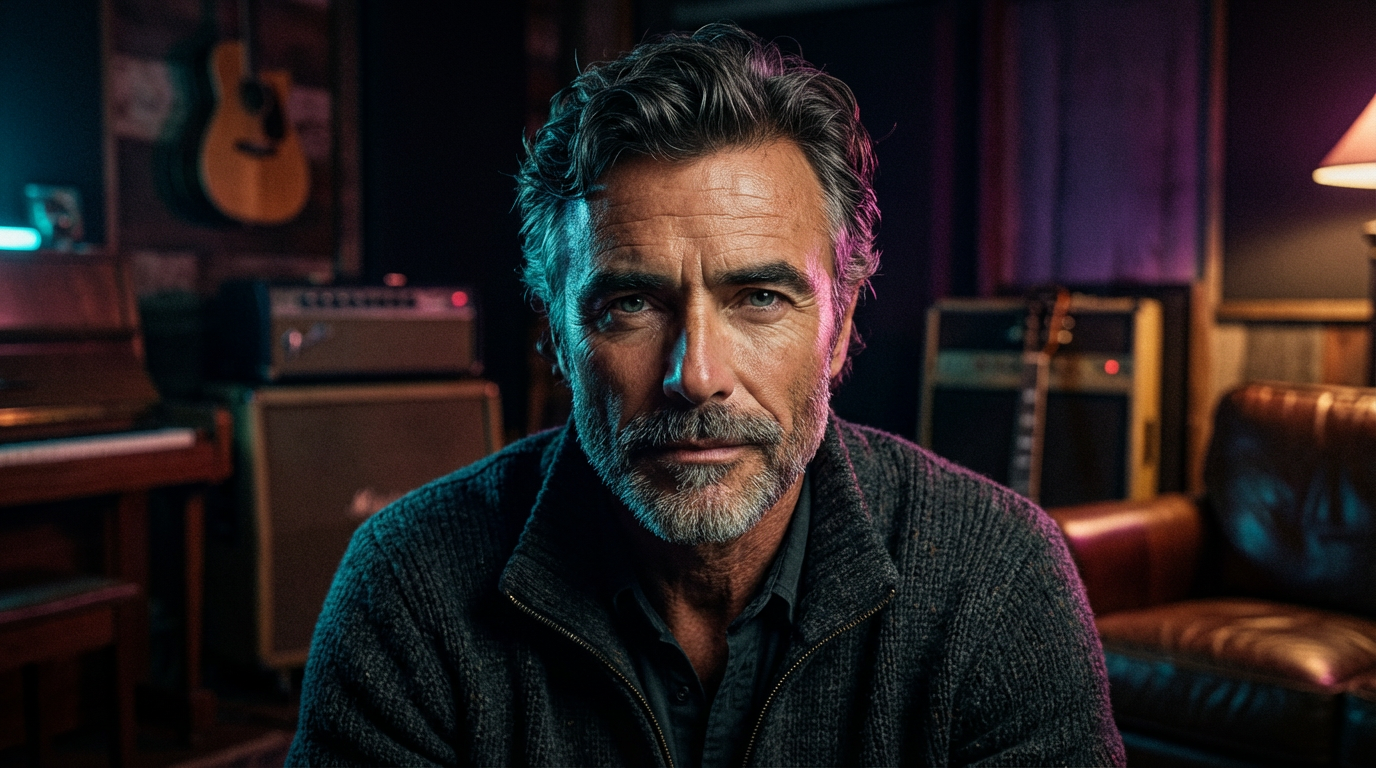
A Birth at the Farmhouse
Kenneth Oliver Jennings was born on 29 January 1978 at the Jennings Family Farmhouse in Gawler, South Australia, the fifth of seven children born to Brian Edward Jennings, a farmer and mechanic, and Patricia Anne Jennings (née O'Connor), a former education student who had become the matriarch of the family's farming household. Unlike most of his siblings, Kenneth did not arrive at the Hutchinson Hospital but in the farmhouse itself—his first breaths drawn in the very rooms where generations of Jennings had lived and worked, cradled by the same weathered timber and familiar sounds that had shaped his father's own journey.
By the time of Kenneth's birth, the Jennings household was already a busy and established operation. His elder siblings—Cody (1968), Anne (1970), Catherine (1973), and Janice (1975)—had created a lively domestic world, and Brian, then thirty-two, was at the height of his farming capability, managing a property that had expanded to over one hundred acres through careful acquisition and modernisation. Two more children would follow Kenneth: Raymond (1980) and Tania (1982), completing a family of seven whose individual paths would eventually carry them into remarkably different lives.
Kenneth's early years on the farm were shaped by the same rhythms that had governed Jennings children for generations—the cycles of planting and harvest, the communal meals around the farmhouse table, the expectation that every pair of hands contributed to the property's upkeep. Yet from the outset, Kenneth was different. Where his siblings gravitated towards the practical and the physical—the workshop, the paddocks, the animal pens—Kenneth was drawn to something that the farm could accommodate but not explain: music.
The Old Upright Piano
The instrument that would define Kenneth's life was an old upright piano that occupied a corner of the Jennings farmhouse. It was not an extraordinary instrument—a modest piece of furniture that had served the household for years without attracting particular attention. But when three-year-old Kenneth first placed his small fingers on its keys, something happened that his parents recognised immediately as significant. The sounds he produced were not the random noise of a toddler exploring an object; there was intention behind them, a searching quality that suggested the child was listening to what the piano could do and trying to make it do more.
Patricia, whose own love of learning had survived the sacrifice of her teaching ambitions, was the first to recognise that Kenneth's fascination with the instrument was not a passing phase. She encouraged his exploration of the piano with the same intellectual curiosity she brought to everything, understanding that her son's relationship with music was not something to be managed or directed but nurtured and protected. Brian, a practical man whose own gifts lay in mechanics and agriculture, observed his youngest son's absorption in the instrument with a mixture of pride and quiet bewilderment—the farmer who could diagnose a failing engine by ear watching a child coax melodies from an upright piano in the front room.
By the age of five, Kenneth had begun formal piano lessons, and his instructors quickly confirmed what his parents had suspected: the boy possessed an extraordinary and unusual talent. His technical facility developed with a speed that outpaced his teachers' expectations, but it was the emotional quality of his playing—an expressiveness that seemed beyond his years—that marked him as genuinely exceptional. At six, he gave his first public performance at a local school event, displaying a natural composure before an audience that would serve him throughout his career.
Kenneth's childhood on the farm, though increasingly oriented around the piano, was not isolated from his siblings' world. He participated in the communal life of the household, attended the Gawler Australia Day celebrations with his family in 1981, and absorbed the values of hard work, community, and mutual obligation that Brian and Patricia instilled in all their children. The farm's landscapes—its wheat fields, orchards, and the quiet stretches of countryside that surrounded the property—became the raw material of an imagination that would later express itself through composition. The sounds of rural life, the rhythms of agricultural work, and the particular quality of South Australian light and space would find their way into Kenneth's music long after he had left the farm behind.
The Ash Wednesday Fires
In February 1983, when Kenneth was five years old, the Ash Wednesday bushfires tore through the South Australian landscape with devastating force. The Jennings Family Farm avoided direct destruction, but embers scorched fencing and blackened paddocks across the property, and the threat to neighbouring properties demanded an immediate community response. Brian and five-year-old Kenneth spent fourteen hours assisting neighbours near One Tree Hill, battling spot fires and helping to move livestock from the path of the blaze. Their efforts were later acknowledged with a community bravery citation.
For Kenneth, the experience of the fires—the intensity, the urgency, the sight of his father working without rest to protect others' property—left an impression that extended beyond the immediate crisis. It was his earliest encounter with the fragility of the world he inhabited and the principle, central to his father's character, that obligation to one's community was not optional but fundamental. The memory of those fourteen hours would surface in Kenneth's later compositions, lending a quality of urgency and vulnerability to works that might otherwise have been purely pastoral.
Departure for Sydney
The decision to send Kenneth to Sydney at the age of eight was among the most significant and painful that Brian and Patricia made as parents. Kenneth's talent had outgrown what Gawler could offer. His local instructors, however capable, could not provide the level of training that a prodigy of his calibre required, and the Sydney Conservatorium of Music represented the best opportunity available in Australia for a child of his abilities.
On 14 February 1986, Kenneth left the Jennings Family Farm to live with his maternal aunt and uncle, Margaret and Thomas O'Connor, in Sydney. The O'Connors—Patricia's siblings—provided a stable and loving household, but the separation from his parents and six siblings was a rupture that shaped Kenneth profoundly. He was eight years old, leaving behind the farm that had been his entire world—the piano in the front room, the wheat fields whose rhythms he had absorbed into his musical consciousness, the family whose nightly gatherings around the dinner table had been the fixed point of his existence. For Brian, who watched his son pack a small suitcase with the quiet anguish of a father who understood that musical genius could not be contained within farm boundaries, the departure carried the weight of generational sacrifice.
The household Kenneth left behind felt the absence acutely. His sisters Janice, then ten, and Catherine, thirteen, had helped care for him as an older sibling's duty; his younger brothers Raymond, five, and Tania, three, lost a presence in the house that could not be replaced. The farm's first great departure—preceding Cody's increasingly mysterious absences by more than a year—became a reference point for the family's understanding that love sometimes required accepting distance.
The Sydney Conservatorium and the Making of a Musician
At the Sydney Conservatorium of Music, Kenneth entered an environment utterly unlike the one he had known on the farm. The Conservatorium's rigorous programme demanded not merely technical proficiency but a depth of musical understanding that would have challenged students twice Kenneth's age. Under the guidance of renowned piano instructors, he refined his technique, broadened his repertoire, and began developing the distinctive style that would characterise his mature work—a blend of classical rigour with contemporary sensibility, technical brilliance married to deep emotional resonance.
Kenneth thrived. He participated in numerous recitals and competitions throughout his years at the Conservatorium, consistently earning high praise for his emotive interpretations of classical pieces and emerging as one of the most promising young pianists in the Australian music scene. His instructors noted not only his extraordinary technical facility but the unusual maturity of his musical intelligence—an ability to inhabit a piece of music from within, to understand its emotional architecture as well as its formal structure.
As he entered his teenage years, Kenneth began composing his own works. These early compositions drew explicitly on his childhood experiences, evoking the landscapes and rhythms of rural South Australia with a specificity that gave them an unusual authenticity. The rustle of wheat fields, the quality of light over open paddocks, the particular silence of the Australian countryside at dusk—these became recurring motifs in Kenneth's music, lending his compositions a pastoral quality that distinguished them from the work of his urban-raised contemporaries. The farm boy from Gawler was transforming his displacement into art, using distance to clarify what proximity had made invisible.
Honours and the International Stage
Kenneth graduated from the Sydney Conservatorium of Music in 1996 with a Bachelor of Music, awarded first-class honours. His final recital, featuring both classical masterworks and original compositions, drew standing ovations and critical acclaim. He was eighteen years old and already regarded as one of the most significant young pianists to have emerged from the Australian music scene in a generation.
The years that followed his graduation saw Kenneth embark on an international touring career that would establish his reputation beyond Australia. His debut international tour included performances in London, Vienna, and Tokyo, where his interpretations of Chopin and Rachmaninoff left lasting impressions on audiences and critics alike. Reviewers consistently highlighted his ability to combine technical brilliance with deep emotional resonance, to evoke vivid imagery through his playing, and to connect audiences to the pastoral themes of his compositions in ways that felt immediate and genuine rather than affected.
Kenneth's career developed rapidly through the late 1990s and early 2000s. He performed at major concert halls across the world, including the Sydney Opera House and Carnegie Hall, building a reputation as a pianist of rare sensitivity and range. His original compositions, which continued to draw on rural Australian themes whilst incorporating increasingly sophisticated contemporary influences, earned him recognition not merely as a performer but as a significant creative voice in his own right.
The Death of Brian Jennings
The sudden death of Brian Jennings on 18 November 1997 struck Kenneth with a force compounded by distance and circumstance. He was nineteen years old, barely a year into his post-Conservatorium career, when his father suffered a fatal heart attack whilst working on the farm. Brian was fifty-two. The man who had first recognised Kenneth's extraordinary gift, who had supported the agonising decision to send his eight-year-old son to Sydney, who had quietly endured the pain of that separation because he understood that his child's talent demanded it—that man would never witness Kenneth's international acclaim, never sit in a concert hall and hear the wheat-field melodies his farm had inspired translated into art that moved audiences across the world.
Brian's death deepened Kenneth's connection to the farm and to the music it had given him. The compositions that followed carried a new weight—the pastoral themes that had previously evoked nostalgia and beauty now bore the additional burden of grief and the awareness that the landscape he drew upon was inseparable from the people he had lost. His music became, in a sense, a living memorial to his father and to the values Brian had embodied: persistence, devotion, the quiet dignity of work completed without fanfare.
Sophia Andersen and Family Life
In 2005, at the age of twenty-seven, Kenneth met Sophia Andersen during a collaborative performance in Melbourne. Sophia was a talented violinist whose dedication to her craft and whose warmth of temperament complemented Kenneth's own. Their shared passion for music provided the foundation for a relationship that developed with the steady assurance of two people who recognised in each other not merely attraction but genuine compatibility of values and purpose.
Kenneth and Sophia married in 2007 in a ceremony held on the Jennings Family Farm—a deliberate choice that anchored their union in the landscape and heritage that had shaped Kenneth's art. The wedding brought Kenneth's two worlds together: the international concert career he had built and the rural roots that sustained it. His siblings gathered at the farm for the occasion, and the property that had witnessed so many of the family's milestones—births, departures, funerals—added a wedding to its long chronicle.
The couple had two children: Craig, born in 2009, who showed an early aptitude for the cello, and Aria, born in 2012, who began piano lessons under her father's guidance. Kenneth and Sophia divided their time between their home in Melbourne and the Jennings Family Farm, where Kenneth had built a recording studio that served the dual purpose of facilitating his own composition work and providing a space to mentor young musicians. The studio at the farm represented a closing of the circle that Kenneth's departure had opened in 1986—the prodigy who had left Gawler to pursue music returning to create music in the very place that had first inspired it.
The Death of Patricia and Cody's Withdrawal
Patricia Jennings died on 5 September 2002, aged fifty-five, following a battle with cancer. For Kenneth, then twenty-four and increasingly established in his concert career, the loss severed his last direct parental link to the woman who had first recognised his three-year-old fingers finding music on the old upright piano. Patricia's encouragement—her intellectual curiosity, her instinct to nurture rather than direct her son's talent, her belief that music was a form of learning as valid as any academic pursuit—had been the foundation upon which Kenneth's entire career was built. Her death coincided with a deepening fracture within the family, as Cody, the eldest sibling, responded to their mother's passing by retreating further into the pattern of mysterious absence that had troubled the Jennings household for years. Cody sent a final letter to his siblings expressing his love and instructing them not to search for him—a communication that offered no explanation and left Kenneth, like his other siblings, to grieve a mother whilst absorbing the secondary loss of a brother who had chosen distance over shared mourning.
Mentorship and the Return to Gawler
From 2007 onwards, Kenneth balanced his international performing career with an increasing commitment to music education and the nurturing of young talent. He conducted masterclasses and workshops at universities and music schools across Australia, sharing the knowledge and technical expertise he had accumulated over two decades of professional performance. His teaching, like his playing, was characterised by a combination of exacting standards and personal warmth—he demanded rigour from his students but delivered his critiques with the same emotional sensitivity that informed his interpretations of Chopin and Rachmaninoff.
The recording studio at the Jennings Family Farm became the centre of Kenneth's mentoring work. Young musicians travelled to Gawler to work with him in an environment that was deliberately removed from the pressures of urban conservatoriums and commercial recording studios. Kenneth believed that the farm's atmosphere—its quietness, its connection to the land, its distance from the competitive anxieties of the professional music world—provided a context in which students could develop their artistry without distraction. It was an approach that owed as much to his own experience of growing up amongst wheat fields and orchards as to any formal pedagogical theory.
His sister Anne, who managed the farm following Brian's death, welcomed Kenneth's presence and the cultural dimension it brought to the property. The farm that had once been purely agricultural had evolved under Anne's stewardship into something more complex—a working property that also served as a site of community education and family continuity. Kenneth's studio and mentoring work added another layer to this evolution, connecting the farm to the world of classical music in a way that Brian, for all his practical vision, could never have anticipated.
The Accumulation of Loss
The years between 2018 and 2023 brought a sequence of losses that tested the resilience of the surviving Jennings siblings. Cody was found dead at a suburban house in Tasmania on 31 July 2018 under circumstances that remained unexplained to his family. His memorial service was held on 5 November 2018 at the Jennings Family Farm, attended by Kenneth and the remaining siblings in an atmosphere of grief compounded by bewilderment—they mourned a brother whose death they could not fully understand and whose life, in its later years, had become opaque to them. For Kenneth, who had been ten years old when Cody was already a young man of eighteen, the relationship had always carried the asymmetry of a significant age gap; yet Cody's loss was no less real for having been conducted, in many ways, from a distance.
Janice died on 8 November 2019, aged forty-four, after contracting a rare form of meningitis at the Royal Adelaide Hospital where she had served as a Clinical Nurse Specialist for over two decades. Her death struck the family with particular cruelty—the sister who had helped care for Kenneth in his earliest years, who had witnessed his first tentative notes on the farmhouse piano, taken by a disease contracted in the very environment where she had devoted her working life to the care of others. The silence her absence created was one that Kenneth, as a musician, understood in a way that perhaps only a musician could—the particular quality of emptiness left when a familiar voice ceases.
Raymond was killed in a car accident on 14 February 2023, aged forty-two. His death, caused by a drunk driver, was the most sudden and violent of the losses the family had endured. Raymond, who had inherited Brian's love of mechanics and engines, had been the sibling whose temperament most closely mirrored their father's practical, hands-on approach to life. His death reduced the surviving Jennings siblings to four: Anne, Catherine, Kenneth, and Tania.
The Composer's Inheritance
Kenneth Oliver Jennings's career as a concert pianist and composer had, by the time of Raymond's death, spanned more than a quarter of a century. His body of work—encompassing both performances of the classical repertoire and original compositions—bore the unmistakable imprint of the landscape and the family that had produced him. The wheat-field melodies that had characterised his earliest compositions had deepened and darkened over the years, absorbing the weight of accumulated loss whilst retaining the essential quality that had always distinguished his music: an authenticity rooted not in artifice but in lived experience.
He remained an avid reader with a keen interest in history and philosophy, disciplines that informed his musical interpretations and compositions with an intellectual depth that complemented his emotional sensitivity. His playing continued to be marked by the ability to inhabit a piece from within, to find in the formal structures of classical music the same human truths he had first encountered as a child on the Jennings Family Farm—truths about persistence, about the relationship between beauty and loss, about the way a landscape could shape a life and a life could, in turn, give voice to a landscape.
Kenneth divided his time between Melbourne and the farm, between concert halls and the recording studio he had built amongst the paddocks and orchards of his childhood. Craig and Aria were growing into their own musical identities, carrying forward a tradition that had begun with a three-year-old's fingers finding their way across the keys of an old upright piano in a farmhouse on the outskirts of Gawler. Of the seven Jennings siblings, four survived. Kenneth remained the one who had travelled furthest from the farm and yet, through the medium of his art, had never truly left.







