Karl Jenkins Residence, South Hobart
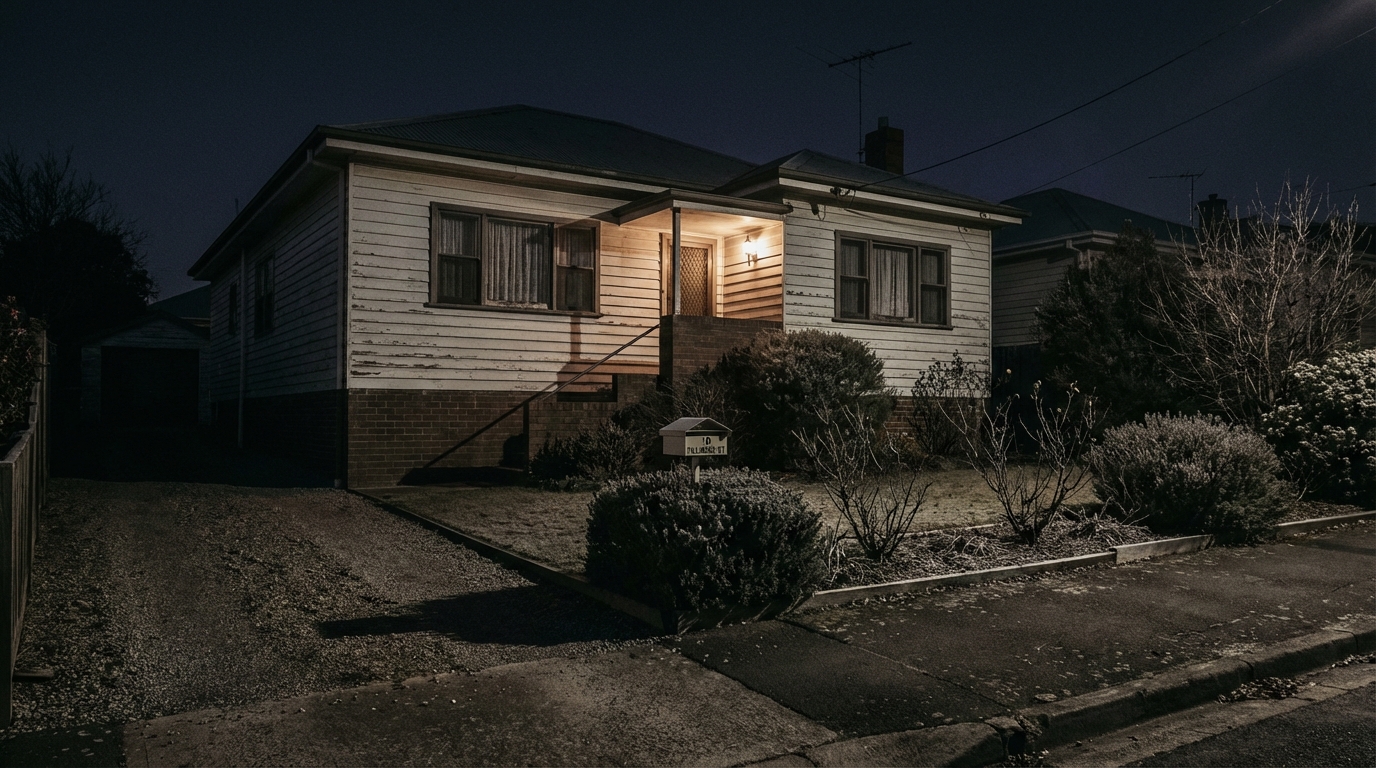
The modest weatherboard house at 10 Pillinger Street, South Hobart, was reflective of Senior Detective Karl Matthew Jenkins's internal landscape—sparse, functional, and deliberately stripped of sentiment. Within its single-storey weatherboard walls, every surface and object resembled the man who inhabited it: a detective whose dedication to order masked profound emotional isolation, whose methodical pursuit of justice left little room for comfort, and whose final days in July 2018 would see this sanctuary transform into the stage for his psychological unravelling.
The Architecture of Isolation
Karl's selection of this particular residence in November 2003, upon his transfer to Tasmania Police, was characteristically practical. The house at 10 Pillinger Street represented modest post-war construction typical of South Hobart's working-class housing stock—a single-storey weatherboard structure built in the early 1950s when returned servicemen required affordable accommodation. Its simple rectangular floor plan, timber frame construction, and unadorned functionality appealed to a man who valued substance over style.
Located on the lower slopes of Mount Wellington where South Hobart's residential streets climbed steadily toward the bushland, the property occupied a position that provided both accessibility and isolation. The house sat within reasonable walking distance of the central police facilities whilst Pillinger Street's quiet character ensured solitude. The neighbouring properties housed long-term residents who maintained a polite distance—perfect conditions for someone seeking proximity without connection, accessibility without intrusion.
The weatherboard exterior required minimal maintenance beyond occasional painting, though Karl's attention to such matters proved sporadic at best. The house's cream-coloured weatherboards showed wear that suggested functional neglect rather than deliberate deterioration—a man who maintained professional standards meticulously whilst his personal environment slowly degraded through simple inattention. The small front garden had been reduced to a lawn requiring only occasional mowing, with the native shrubs planted by previous owners left to survive through benign neglect rather than cultivation.
Interior Layout and Function
The house's interior followed the standard post-war configuration: the front door opening directly into a modest living room, a narrow hallway leading to two bedrooms (one of which Karl used for storage and overflow case materials), a compact kitchen at the rear, and a small bathroom fitted with a combination bath-shower. The entire structure occupied perhaps 80 square metres—adequate for a single occupant requiring only functional shelter rather than a comfortable home.
Karl had made no modifications to the original floor plan, accepting the house's limitations as appropriate to his needs. The living room served primarily as an extension of his office work—case files dominated the small dining table pushed against one wall, reference materials filled the simple bookshelves flanking the bricked-up fireplace, and occasional maps or flowcharts would appear taped to the walls when investigations required visual organisation. The sofa remained perpetually positioned for optimal viewing of wall-mounted materials rather than the small television that sat largely unused in the corner.
The main bedroom contained only the essentials: a queen bed with military-precise hospital corners, a bedside table supporting a lamp and alarm clock, and a wardrobe holding his collection of near-identical suits and shirts. The window overlooked the rear garden, though the curtains remained drawn more often than open—Karl's preference for controlled lighting over natural illumination reflecting his broader approach to environmental management. The second bedroom had become a repository for archived case files and materials he couldn't quite justify discarding, with boxes stacked in systematic precision that transformed the space into an unofficial records room.
The kitchen embodied functional minimalism. The basic appliances—refrigerator, electric stove, kettle—occupied their designated positions alongside minimal cookware and a single set of dishes. The bench space served more often for spreading case documents than food preparation, though the same stained coffee mug Karl had used since Brisbane occupied a permanent position beside the sink. The small Formica table and two chairs suggested a capacity for companionship the house had never actually hosted.
The Rear Garden and Jargus's Domain
The rear garden, accessed through a weathered wooden door from the kitchen, provided the house's most significant outdoor space. The previous owners had established basic landscaping—a lawn surrounded by raised garden beds now largely overtaken by hardy perennials that survived despite minimal attention. A corrugated iron fence separated the property from the neighbours, providing privacy that Karl valued without requiring the maintenance that formal hedging would demand.
This space became essential following Jargus's arrival in November 2017. Karl installed additional secure fencing and a gate, transforming the garden into a safe exercise area where his exceptional German Shepherd partner could move freely during daylight hours whilst Karl worked. The detective added a simple weatherproof kennel near the back door, though Jargus rarely used it—the dog preferring to remain inside with Karl or patrolling the secure perimeter.
The neighbours would occasionally observe Karl in the garden with Jargus during rare moments of downtime, the detective's normally rigid posture relaxing slightly as he worked through training exercises or simply sat on the back steps whilst the dog explored. These moments represented perhaps the only genuine peace the house witnessed—man and dog existing together without the weight of cases, investigations, or the isolation that otherwise defined the residence.
Professional Sanctuary
The house's primary function was as an extension of Karl's office at the station. Case files dominated every surface not required for basic living—stacked on the kitchen bench, spread across the dining table that had never hosted a shared meal, piled on the sofa where Karl reviewed evidence late into the night. Reference books on criminal psychology, forensic science, and investigative methodology filled the living room shelves, their spines cracked from repeated consultation.
The walls remained bare of personal photographs or decorative touches. Instead, occasional maps of Tasmania marked with investigation sites, or flowcharts tracking criminal networks, would appear and disappear as cases progressed. The residence functioned less as a home than as a secondary incident room, a place where Karl could continue working without the interruption of colleagues or the pretence of work-life balance that he'd never managed to achieve.
His neighbours—a retired couple to the left, a young family to the right—rarely saw him. Karl left early via the front door, returned late through the back gate to avoid unnecessary interaction, and maintained the kind of silence that made him almost ghostlike in their awareness. The occasional bark from Jargus provided the only evidence of life within those weatherboard walls, though even the German Shepherd had learnt to mirror his handler's disciplined quiet.
The house's timber construction meant sounds travelled more readily than brick would have permitted, yet Karl's existence proved so uniformly quiet that the neighbours barely registered his presence. No music, no television volume, no visitors creating conversation or laughter—just the occasional sound of movement, running water, or Jargus's claws on the worn floorboards providing evidence that 10 Pillinger Street remained occupied rather than abandoned.
The Partnership with Jargus
The arrival of Jargus in November 2017 represented the most significant change to the house's atmosphere since Karl's occupancy began. The exceptional German Shepherd, selected from Tasmania Police's K9 breeding programme, required accommodations that softened the residence's rigid austerity—if only slightly. A dog bed appeared in the main bedroom beside Karl's own, positioned to allow Jargus to maintain watch even whilst resting. The food and water bowls occupied a corner of the kitchen with military precision, cleaned and refilled on an exact schedule.
Yet Jargus brought more than just physical changes. His presence introduced a warmth that Karl could accept because it came without the emotional demands he couldn't meet. The dog's loyalty was absolute, his companionship unconditional, his needs simple and predictable. In caring for Jargus—the morning feeds, the evening walks through South Hobart's streets, the grooming sessions that Karl performed with characteristic thoroughness—the detective found perhaps the only genuine connection he could sustain.
The weatherboard house, previously silent except for Karl's solitary movements, acquired a new acoustic character with Jargus's presence. The click of dog claws on the floorboards, the gentle sounds of drinking and eating, the occasional whine when Jargus sensed Karl's stress levels rising—these domestic sounds transformed the space without fundamentally altering its austere character. The neighbours reported that the house seemed somehow less empty after the dog arrived, though Karl himself remained as isolated as ever.
Living Patterns
Karl's daily routine within the house followed patterns as predictable as police procedure. He woke at 5:30 AM without need for an alarm, his internal clock calibrated by years of discipline. Coffee—black, strong, prepared in the same stained mug he'd used since Brisbane—accompanied his review of overnight reports accessed via laptop at the small kitchen table. Breakfast, when he remembered it, consisted of toast or cereal consumed whilst reading case files.
The bathroom's combination bath-shower ran for exactly seven minutes each morning, Karl's efficiency extending even to personal hygiene. His wardrobe—those near-identical suits and shirts organised by subtle gradations of wear—reflected the same minimalist approach. Everything had its place, its purpose, its justification for inclusion in his carefully curated existence.
The evenings followed similar patterns when he returned—which grew increasingly rare as cases consumed more time. Dinner often came from takeaway containers eaten whilst reviewing evidence at the dining table. The sofa faced not the television but the wall where Karl would pin case materials, studying patterns and connections until exhaustion forced him to the bedroom. Sleep came fitfully in the single bed, his mind continuing to process evidence even in dreams that increasingly featured crime scenes and missing persons.
The house's timber construction amplified sounds in the stillness—the creaking of floorboards as Karl moved from room to room in the early hours, the ticking of the kitchen clock marking time he should have been sleeping, the rustling of papers as he reorganised case materials seeking patterns that eluded conventional analysis. Jargus, attuned to his handler's moods, would often rise and pad silently to wherever Karl had stationed himself, offering a presence that demanded nothing beyond acknowledgement.
July 2018: The Fracturing
The promotion to Senior Detective and transfer to Major Crimes represented everything Karl had worked toward, yet the house at 10 Pillinger Street showed no evidence of celebration. The morning of 28th July found him in a state the weatherboard walls had never witnessed—sprawled on the bathroom floor, retching into the toilet, with the aftermath of his promotion celebration at Salamanca rendering him more vulnerable than he'd been since childhood. The modest bathroom seemed to spin, the careful order momentarily meaningless against the chaos of his hangover and, worse, the blank spaces in his memory.
Sarah Lahey's call that morning—pulling him to the station despite his condition—marked the beginning of the investigation that would consume his final days. The Jeffries case, with its missing persons and contradictions, became an obsession that transformed the house into something approaching madness. The case materials spread beyond their usual boundaries, covering the living room floor, the hallway, even encroaching into the bedroom. Karl's methodical organisation gave way to frantic connection-seeking, with red string appearing between pins on his walls like the physical manifestation of his deteriorating control.
The weatherboard house that had sheltered his isolation now became a prison for his obsession. He would pace the worn floorboards late into the night, with Jargus watching with concerned canine intelligence as his handler circled between rooms, connecting evidence that might not connect, seeing patterns that might exist only in his fragmenting consciousness. The walls that had witnessed his professional dedication now observed his professional disintegration.
The Final Days
Between 29th July and 2nd August, the house existed in a strange suspension. Karl maintained his routines—feeding Jargus, brewing coffee, showering precisely—whilst knowing everything was ending. Sergeant Claiborne's summons on 30th July, delivered in just four words, confirmed what Karl already knew. His career, his carefully constructed professional identity, was collapsing.
Yet he continued preparing for each day with the same precision, as if maintaining the house's order might somehow restore his own internal discipline. The case files covering his walls grew more elaborate, the connections more desperate. Sleep became impossible; Karl would find himself standing in the back garden at 3 AM, with Jargus beside him, both man and dog alert to dangers that seemed to press in from the bush-covered slopes behind the property.
The weatherboard house that had witnessed fifteen years of disciplined professional dedication now observed its occupant's disintegration. The simple structure couldn't contain what was happening to Karl—his mind expanding beyond the boundaries of conventional investigation, his consciousness fragmenting under pressures that exceeded human tolerance, his reality becoming increasingly unmoored from the material world the house's weatherboard walls represented.
2nd August: The Empty Room
The morning of Karl's disappearance began like any other in the house. The coffee brewed, Jargus was fed, the shower taken. He dressed in his usual suit, checked his service weapon, gathered his badge and identification. There was no note left behind, no indication that he wouldn't return. The coffee mug sat unwashed in the sink, Jargus's water bowl was full, and the case files remained spread across every surface like an unfinished equation.
When Detective Sergeant Alexander Stout and his team searched the residence on 4th August, they found it exactly as Karl had left it. The newspaper on the front porch remained uncollected, Jargus waited anxiously for his handler's return, and the spartan interior held no clues to Karl's whereabouts. The house's weatherboard walls seemed to echo with absence, with the timber frame creaking in the winter wind as if the structure itself mourned the detective who had occupied it for fifteen years.
Evidence and Intrusion
The subsequent search on 6th August revealed the house had been violated in Karl's absence. His belongings—the few personal items he'd retained—had been methodically removed. Yet foreign evidence remained: fingerprints belonging to Beatrix Cramer on surfaces throughout the bedroom, long silver hairs that matched her DNA scattered across his most private space. The house that had been Karl's fortress of solitude had been breached, transformed into a crime scene where Karl himself was the victim.
The investigation would never determine how Beatrix accessed the weatherboard house or why she had been there. The property's simple construction—timber-framed with basic locks on doors and windows—offered multiple potential entry points for someone determined to gain access. Her fingerprints on the bedroom furniture, her hair on the pillowcases, suggested an intimate intrusion into a space Karl had protected so carefully. The violation of his residence represented a final insult to the detective who had valued privacy above all else—even in absence, even in probable death, his sanctuary had been compromised.
The weatherboard walls that had sheltered Karl's isolation now witnessed a police investigation into his disappearance. Forensic teams moved through the rooms where he'd lived alone, photographing evidence, collecting samples, documenting the sparse existence he'd maintained. The house's simple structure offered no hiding places, no secret spaces—just functional rooms revealing through their very austerity the profound isolation of the man who'd inhabited them.
