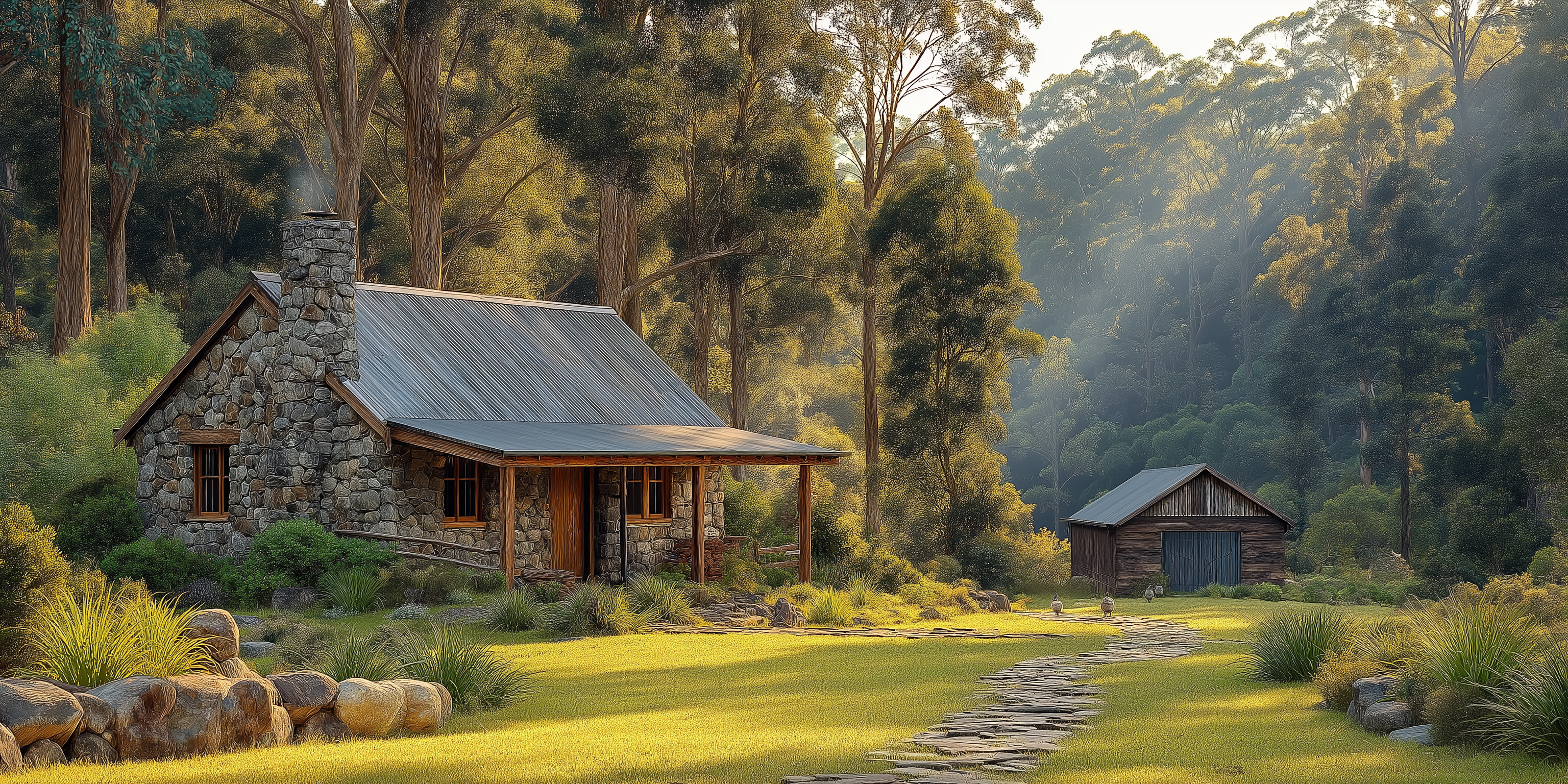
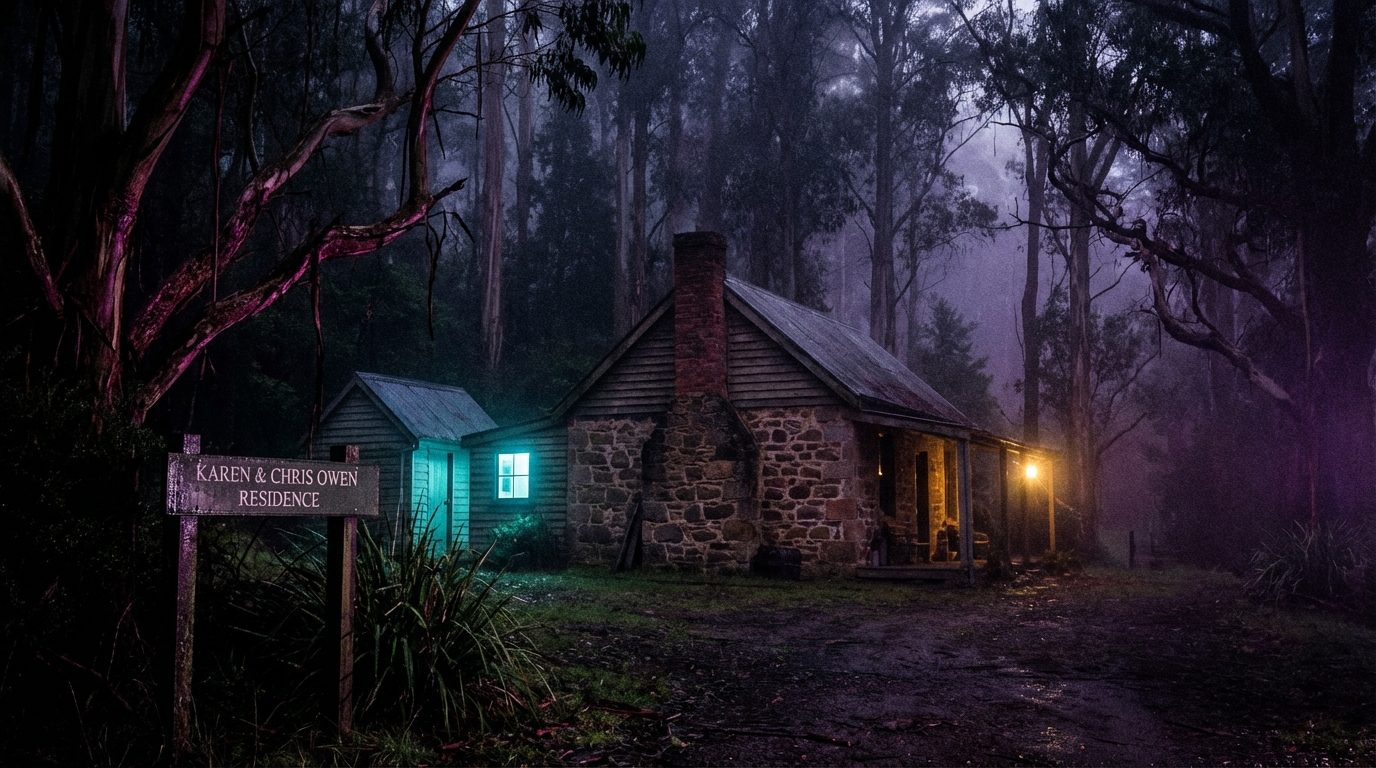
Karen & Chris Owen Residence, Collinsvale
The Owen residence in Collinsvale, Tasmania, stands as a testament to its occupants' lifelong commitment to environmental conservation and sustainable living. This colonial-era cottage, thoughtfully renovated by Karen and Chris Owen in the early 2000s, blends nineteenth-century Tasmanian architecture with modern ecological sensibilities. Following the couple's mysterious disappearance on 27 July 2018, the property became the focal point of a police investigation that uncovered disturbing evidence but no trace of its owners.
Location and Setting
Nestled on a remote property in Collinsvale, a quiet rural township in the verdant foothills of kunanyi/Mount Wellington, the Owen residence occupies a site of considerable natural beauty approximately twenty-five kilometres northwest of Hobart. The township itself, originally known as Sorell Creek, was first inhabited by the Palawa people before European settlement began in the mid-nineteenth century. Named after James Collins, an enterprising farmer who established a successful homestead in 1840, Collinsvale evolved into a thriving agricultural community renowned for its apple orchards and fertile valleys.
The property sits at the edge of a vast native forest, its position reflecting the couple's desire to live in harmony with the Tasmanian landscape. The surrounding bushland teems with native wildlife, including potoroos that nibble on grasses near the barn and various bird species attracted by the carefully curated native plantings. The remoteness that once provided the Owens with peaceful seclusion would later complicate the police investigation into their disappearance, with the nearest neighbour, Meredith Clarke, situated over a kilometre away across a heavily wooded ridge.
Architectural Character
The cottage presents a picture of understated charm, reflecting both the simplicity and the complex lives of its occupants. Built during Tasmania's colonial era, its foundations were laid by settlers in the nineteenth century, with the original structure featuring weathered stone walls that speak to the island's pioneering past. The stonework, though aged, remains resilient—a tribute to the craftsmanship of early Tasmanian builders and the enduring quality of local materials.
When Karen and Chris Owen moved to the property in the early 2000s, they undertook a thoughtful renovation that respected the cottage's historical character whilst incorporating modern sustainable design principles. Chris, with his background in environmental conservation and sustainable building practices, handpicked cedar beams harvested from nearby forests to ensure the property's harmony with its environment. The cedar cladding that now complements the original stonework was selected for both its aesthetic warmth and its sustainable sourcing.
The house itself appears small and modest from the outside, yet possesses an undeniable allure. With three small bedrooms and a rustic charm throughout, the cottage retains its original stone hearth, which Karen often used as a gathering place for friends and visitors during the cooler Tasmanian months. The building seems almost to have grown out of the earth, so seamlessly does it blend with its natural surroundings—an architectural embodiment of the Owens' philosophy that human habitation should complement rather than dominate the landscape.
Interior Character
Upon entering the cottage, the scent of surrounding eucalyptus trees mingles with the earthy notes of timber floors, creating an immediate sense of connection to the natural world beyond the walls. The interior is filled with subtle reminders of the couple's lifelong work in conservation, with every object having a purpose or a story. The home is not cluttered but rather thoughtfully arranged, reflecting the methodical minds of its occupants.
Bookshelves line the walls throughout the cottage, filled with volumes on environmental science, entomology, and local history. These collections represent decades of accumulated knowledge, from Karen's scholarly works on insect ecology to Chris's practical guides on regenerative land use. The books serve not merely as decoration but as working references, their spines worn from frequent consultation.
Pinned to a softwood panel near the kitchen window is Karen's insect collection, which she curated over many years. The collection features some of Tasmania's rarest species, each specimen carefully preserved and labelled with scientific precision. This display represents both her professional expertise as an entomologist and her personal passion for understanding nature's smallest architects.
A large oak table dominates the living room, hand-crafted by Chris's father, Jonathan Leonard Owen, who taught physics at Hobart High School until his death in 2009. This table served as the heart of the home, where the couple frequently hosted guests ranging from fellow conservationists to curious visitors interested in learning about the local ecosystem. The table witnessed countless discussions about environmental policy, research findings, and community initiatives, becoming as much a symbol of the Owens' welcoming nature as of their family heritage.
Gardens and Grounds
The property's exterior reveals the Owens' love for both beauty and sustainability in equal measure. Chris designed much of the garden himself, carefully curating native flora to attract wildlife and maintain the biodiversity of the region. His approach reflected decades of professional experience in regenerative land use, applying the same principles he advocated in his consulting work to his own home.
A vegetable garden lies to one side of the house, where rows of neatly cultivated produce thrived under the Owens' attentive care. This garden provided sustenance for the couple and fostered the self-sufficient lifestyle they championed in their professional work. The produce grown here supplied ingredients for Chris's cooking—he was an avid cook who took pride in foraging and growing ingredients for their seasonal, low-impact meals.
The property featured a permaculture garden designed according to principles Chris had studied and taught throughout his career. A greywater-fed wetland system demonstrated practical water recycling, whilst a wild pollinator refuge provided habitat for the native insects Karen studied professionally. These features transformed the property from a simple residence into a living laboratory and demonstration site for sustainable living practices.
Beyond the cultivated areas, the dense bushland takes over, teeming with native Tasmanian wildlife. The transition from garden to forest is gradual and intentional, reflecting the Owens' belief that domestic spaces should integrate seamlessly with wild habitats rather than impose artificial boundaries upon them.
The Barn and Outbuildings
The barn, situated a short walk from the house, is a relic from the previous century. Built from Tasmanian oak, this weathered structure holds tools, spare fencing, and farming equipment accumulated over generations of rural use. More than a functional outbuilding, the barn serves as a symbol of the Owens' rural life and their intrinsic connection to the land.
In recent years, the barn had also become a refuge for occasional injured wildlife that Karen or Chris would nurse back to health before returning them to the wild. This practice extended their conservation work beyond professional boundaries into their daily domestic life, with the barn's quiet spaces providing shelter for recuperating animals away from the bustle of the main house.
An outdoor washroom stands as a quaint structure nestled at the edge of the garden, surrounded by the lush greenery that thrived under Karen's attentive care. The path to it is well-trodden, the earth beneath familiar from years of daily use. This practical addition reflects the couple's preference for outdoor living and their comfortable relationship with the elements.
Animals and Wildlife
The property is home to various domestic animals that the Owens raised as part of their sustainable lifestyle. Domestic ducks and geese frequent the grounds, the latter often being a source of humour—and on occasion, frustration—for the couple. These birds were affectionately raised by Karen and Chris, intended to help maintain the land in a more natural way through their grazing and pest control activities.
A curious black cat prowls the underbrush, keeping watch for stray mice and adding to the property's complement of working animals. The cat's presence, like that of the geese and ducks, reflects the Owens' philosophy of integrating domestic animals into their land management practices rather than keeping pets purely for companionship.
Wild visitors are equally welcome on the property. Potoroos—small marsupials native to Tasmania—regularly nibble on grasses near the barn, their presence a testament to the habitat quality the Owens maintained. The native plantings attract numerous bird species, whilst the pollinator refuge supports populations of native bees and other beneficial insects that Karen documented in her research.
Daily Life at the Property
The couple's mornings were often spent together, completing small projects around the property. These tasks might include repairing a retaining wall, maintaining the barn, or simply sitting under the shade of a towering eucalyptus tree, sipping coffee whilst listening to the sounds of the forest. Their lifestyle, though peaceful, was never sedentary; both Karen and Chris were frequently called away for conservation projects across Tasmania, and their absences were always understood by the community to be tied to their environmental commitments.
The property functioned as a research site, teaching hub, and experimental ecological space. Fellow conservationists visited regularly to learn from the Owens' practical demonstrations of sustainable living. The cottage hosted workshops, informal seminars, and countless conversations about environmental policy and practice. In this way, the residence extended the couple's professional influence beyond academic institutions and into the community of practitioners who shared their values.
The Owens became known in local circles not only for their environmental expertise but for their integrity and commitment to living what they taught. Their home embodied their philosophy that sustainability is not merely an abstract principle but a daily practice expressed through countless small decisions about how to dwell upon the land.
The Events of July 2018
On the morning of 27 July 2018, the peaceful routine of the Owen residence was irrevocably disrupted. Karen and Chris had spent the early hours replacing rotten wood on a retaining wall that had collapsed under the weight of time and neglect. The task complete, they awaited the arrival of Luke Smith, one of Karen's acquaintances from the local bus route, who was expected for breakfast.
Luke arrived late, carrying with him a mysterious object. What followed defied all rational explanation. The object activated a portal in the living room—a swirling vortex of rainbow colours that appeared across the back of the door. Karen, investigating the phenomenon, was pulled into the kaleidoscopic gateway. Chris, returning from the outdoor washroom, witnessed his wife disappearing into the colours and threw himself after her, desperate to catch her hand before she vanished forever.
Both Karen and Chris were transported to Clivilius, a dimensional realm unknown to Earth's authorities. They would later refer to this event only as "the accident"—a deliberate understatement that underscored its singular and disorienting nature. Their cottage, designed as a sanctuary for nurturing knowledge and wounded wildlife, had become an unwitting gateway between worlds.
The Investigation
Three days after the Owens' disappearance, on 30 July 2018, their neighbour Meredith Clarke contacted emergency services. Clarke reported that she had not seen the couple since Thursday the 26th. Clarke also reported unusual activity at the property: a white unmarked truck making repeated visits at odd hours, and complete silence from the usually noisy geese.
Senior Detective Karl Jenkins and Detective Sarah Lahey of the Tasmania Police Southern Division arrived at the property to conduct a welfare check. They found the front door open and freshly picked daisies on the front verandah—curious clues suggesting recent activity. Inside, a disturbing blood trail leading from the dining room to the coffee table heightened concerns for the couple's safety.
The investigation took a tense turn when Detective Lahey, whilst inspecting the barn, encountered one of the property's protective geese. In the chaos that ensued, she accidentally discharged her firearm, fatally wounding the animal—an incident requiring a Use of Force Report. The tragedy held a bitter irony: the creature that the conservationist couple had raised to help maintain the land naturally became a casualty of the very investigation into their disappearance.
The detectives launched a comprehensive forensic examination of the cottage and its surroundings, collecting blood samples and exploring leads connected to similar missing persons cases. The case was designated Case File 018-062: The Owen Investigation, and remains open. The local community of Collinsvale was shaken by the disappearance of such influential figures, whose groundbreaking research in insect conservation and sustainable agriculture had garnered significant grants and global collaborations.
Subsequent Events at the Property
In the days following the Owens' disappearance, their property became the site of further extraordinary events. On 28 July 2018, a man named Nial arrived at the cottage to discuss a job offer with Luke Smith. Examining an unusual artwork in the hallway, Nial was unexpectedly pushed through what appeared to be a canvas but was in fact another portal to Clivilius. The cottage that once hosted conservation discussions had become a threshold between dimensions.
On 30 July, whilst police investigated the property, Luke Smith conducted a daring operation to intercept a fence delivery intended for the Owens. Evading police detection, he transported the supplies through a portal to Clivilius, where they would support the developing settlement of Bixbus. The Owens' empty home had transformed from environmental haven into clandestine operations base, its very absence of owners enabling activities that would have astonished its conservation-minded occupants.
Luke also attempted to recruit Adrian Pafistis at the property, demonstrating the portal in the shed. Adrian fled in panic, dismissing what he had witnessed as hallucination. The sanctuary that Karen and Chris had carefully curated—where every object held purpose and story—now harboured secrets that challenged the very nature of reality.


