4338.208 · July 27, 2018 AD
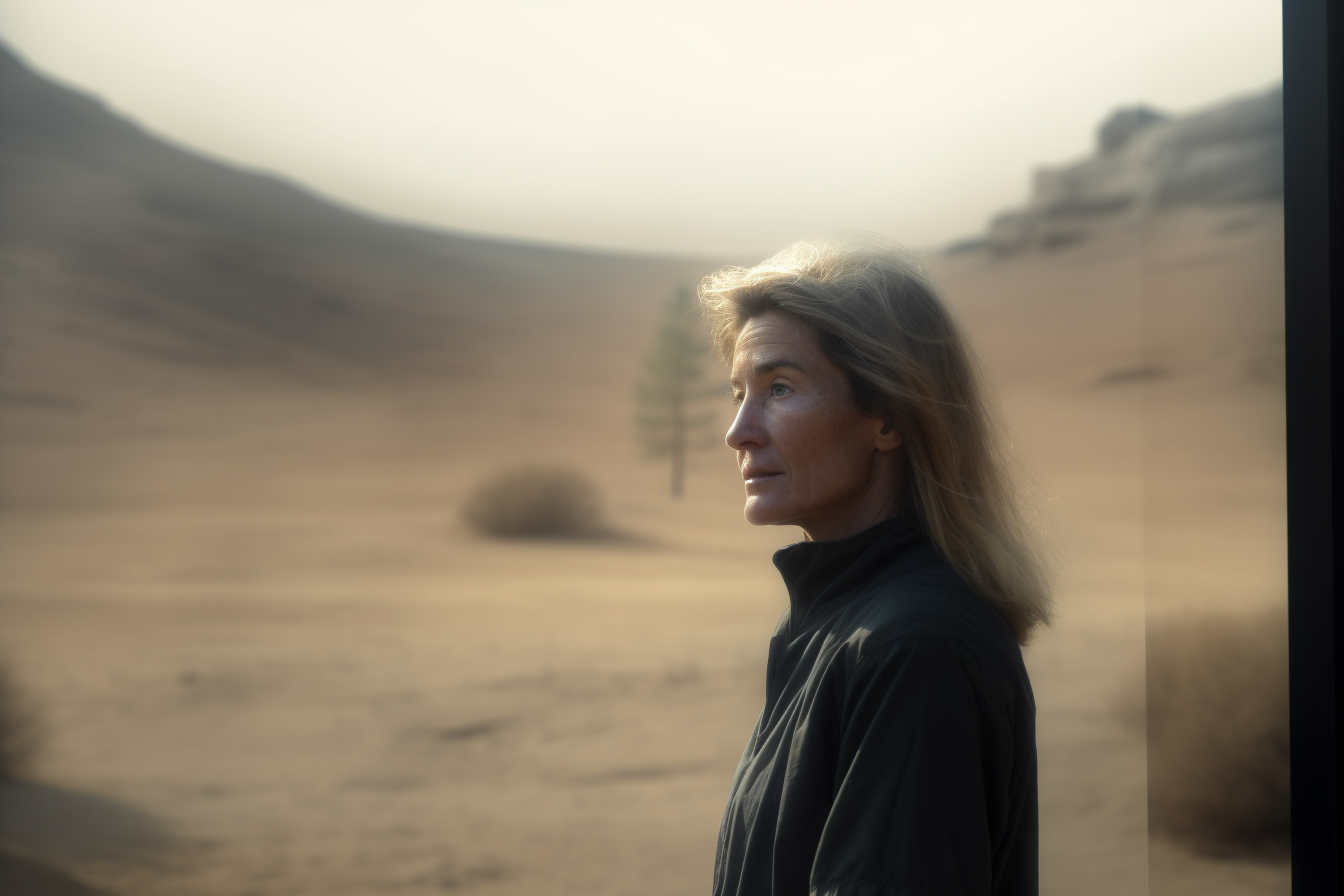
Karen
When a new pair arrives through the Portal—conflicted, confused, and unsettlingly informed—Glenda is forced to weigh instinct against hospitality. As questions about Luke, the world beyond, and a so-called “facility” surface, the strangers’ presence threatens more than the camp’s routine—it may unravel the truths they thought they understood.
“There’s a difference between curiosity and danger. Most people cross it without even noticing.”
The voices, loud and carrying moments before, softened as I neared the Portal. The wind turned slightly, dragging with it the scent of warm sand and the ever-present tang of minerals from the lagoon behind. Cresting the final dune, my boots disturbing the fine dust beneath them, I spotted two figures—silhouetted against the dormant, translucent Portal.
A man and a woman crouched before it, seemingly transfixed. Their presence here, so sudden and out of place, instantly put my senses on high alert. Every muscle in my body tensed as instinct warred with curiosity. New arrivals were rare—and rarely without consequence.
"Hello?" I called out, my voice deliberately steady but edged with caution, as I began to jog lightly down the sandy slope.
"Hey! Over here!" the woman called back, her tone bright but strained by adrenaline. She shot upright, flapping her arms in large, unmistakable waves that reminded me for a split second of a child signalling from across a school field.
"Hello!" I echoed, my pace slowing. The last few metres I covered with deliberate calm, aware of how much rested on me. We still didn’t know what—or who—this place let through. And after Joel, I wasn’t inclined to take any chances.
I scanned the two of them quickly, my eyes drinking in details. The man was noticeably shorter and leaned slightly towards the woman, his balance subtly reliant on her. Mother and son? The idea surfaced and faded as I drew closer. No—something in their posture, the way they moved together, dismissed that theory.
Once I was within speaking distance and nothing felt immediately threatening, I decided to take the lead. "I’m Glenda," I offered, extending a hand with cautious warmth. The urge to chuckle nearly escaped me as the dynamic between them became clearer. Husband and wife, not mother and child—my mistake was a reminder not to jump to conclusions.
"Oh, stop it!" the woman snapped playfully, swatting the man across the back of his head. The sound was light, the kind of affectionate scolding that only came from years of knowing someone. I hadn't caught what he'd whispered, but her reaction was enough to soften the edges of my guardedness.
"I’m Karen," she said, gripping my hand firmly. There was something formidable about her, not just physically—though she was broad-shouldered and stood a full head taller than Chris—but in the way she carried herself. Confident. Steady. Not afraid.
"And this is my husband, Chris." She nodded towards the man beside her.
"Nice to meet you, Chris," I said, extending my hand towards him. His handshake wasn’t as forceful, but it was honest. Calloused fingers and weathered skin—these were hands that had known hard work. There was a quiet resilience in his manner, a humility that mirrored something deeply familiar.
Like Luke's.
The comparison struck unexpectedly, a flicker of recognition in the way Chris stood slightly behind Karen, much as Luke often did in his own quietly capable way. It brought with it a sudden twist of concern—Where was Luke, anyway? He should have been the first to greet new arrivals. The fact that he wasn’t here stirred something uneasy in me.
"Where is Luke?" I found myself asking, the question escaping with more urgency than I’d intended. A thread of unease ran behind my words, stirred by the absence of the one person who always seemed to be at the helm of our arrivals.
"I don’t think he’s coming," Chris replied, his voice oddly flat.
Karen gave a noncommittal shrug, her expression unreadable. Neither of them seemed entirely certain of what had just happened—let alone where Luke fit into it all. The vagueness, the void where clarity should have been, settled a chill in me.
"He didn’t arrive with you?" I pressed, eyebrows arching as I took in the blankness that passed between them.
"No," Karen replied, her voice softer now, the edge of her initial composure beginning to wear thin. "I don’t think this is how he meant for things to happen." Her words carried the charge of something bigger—an implication that Luke’s hand in this event had been more deliberate than accidental, even if the outcome wasn’t.
"It was an accident?" I asked, stepping a little closer, my eyes searching hers for a clearer answer, for something I could grasp amidst the abstract swirl of coloured lights and unintended arrivals.
Karen inhaled deeply, bracing herself as though replaying the moment in her mind required effort. "I don’t really understand it, but Luke made the most beautiful colours appear on the back of the living room door." Her gaze softened with the memory. "I wanted to touch it, but he told me not to."
My mouth opened to ask the obvious—then why did you?—but Chris beat me to it.
"He did?" Chris interjected, a note of defensiveness sneaking into his tone, as if he’d already anticipated where the blame was heading.
"Yes," Karen said pointedly, her glare slicing through the air between them. There was a sudden, unspoken history in that look, the kind that hinted at long-standing patterns and barely-contained frustrations. "And then you came bursting through the door and then, well, here we are."
Her voice sharpened on the last words, the accusation now hanging fully formed between them.
"You’re blaming me for this?" Chris shot back, baffled and affronted. His posture straightened, as if the accusation had physically struck him.
"Well, if you had just come through the kitchen like you usually do, this wouldn’t—" Karen’s words dissolved mid-sentence, her arms folding across her chest in a motion that conveyed both defence and resignation. It was the start of an argument I could see spiralling far beyond this moment, fed by the strangeness of the situation and their shared disbelief.
"Excuse me, excuse me!" I interrupted, raising my voice and lifting both hands in a bid to defuse the tension building between them. The familiarity of their squabble, transplanted into this new world, was almost surreal—but it wasn’t the time. "I don’t think this is really anybody’s fault."
"Of course it is. It’s Luke’s fault!" Chris declared, his tone surging with the self-assurance of someone who had found a scapegoat. The words dropped with finality, a loud pronouncement against the morning’s otherwise still air.
Karen and I exchanged a glance—hers weary, mine uncertain. In the pause that followed, neither of us spoke. It was as if Chris’s outburst had temporarily stunned us both.
"Accident or not," Chris continued, though his voice had softened now, its edges dulled by the emotion that lingered behind it, "it was ultimately Luke’s carelessness that got us in this situation."
The silence that followed felt deeper than the words themselves.
Karen’s response was almost imperceptible—a faint downward tilt of her head, her eyes lowering to the ground between her boots. Not quite agreement, not quite surrender, but a wordless concession to the complicated chain of events that had delivered them here. It was a look I recognised: the moment when acceptance began to settle in, whether you were ready for it or not.
And behind it all, a shared truth none of us voiced: the Portal, and the choices surrounding it, were beginning to look a lot less random than they used to.
"When can we go back home?" The question from Chris, though directed at me, hung in the air like a fragile balloon, swollen with the desperation of someone still grasping for the familiar. His voice carried the raw edges of disbelief, as if asking the question aloud might undo what had happened—or at least prompt a sensible answer. I’d heard the question before. Each time, it stung in the same way—a reminder of all we’d left behind and all we might never reclaim.
Before I could form a reply, Karen’s voice cut in.
"We’re not."
Her words landed with precision, like a blade drawn without warning. The sharpness of her tone pre-empted me entirely, stopping me short. It wasn't just that she had spoken out of turn; it was what she had said—uttered without flinch, without hesitation, as if she had already walked a few paces further down the path of acceptance than the rest of us.
How does she know that? The thought gripped me as I turned to look at her properly. Her face was set, her gaze steady—not resigned, exactly, but resolved. Her certainty had the unnerving clarity of someone who had long made peace with a truth the rest of us were still resisting.
"This is our home now," she said, not as a suggestion, not as a possibility, but as a statement of fact. The finality in her voice was unmistakable. Her words closed the conversation on returning with the quiet clang of a door locking shut.
"It is?" Chris and I spoke in unison, our voices overlapping in mutual disbelief. The question tumbled out of me involuntarily, shaped by confusion and the echo of the life I’d left behind.
I studied her carefully now, trying to read between the lines, to catch the fragments of unspoken truth in her expression. Just how much has Luke told her about this place? The puzzle pieces in my mind rearranged themselves again, and none of them quite fit. Her acceptance was too swift, too settled. This wasn’t the shocked rambling of someone newly displaced—it was the conclusion of someone who already knew more than she let on.
Karen’s brow furrowed, and I could almost see the cogs turning behind her eyes. Her voice dropped a register, tinged with something more intimate—nostalgia, perhaps, or the prelude to a confession.
"Do you remember the times that we sat in bed at night and I used to joke about all of those crazy dreams Luke told Jane and I about on the bus?" she asked, her gaze shifting to Chris, though her words rippled through me just the same.
Dreams? The word latched onto my thoughts like a burr, irritating and persistent. Luke had dreams about this place? That single detail lit a small fire in my mind. If he’d seen Clivilius before in dreams—or visions, or whatever they had been—then he hadn’t stumbled here by chance.
Chris’s response was slow in coming, but when it did, it was thick with dawning comprehension. "Yeah," he said, his brow twitching as old memories reassembled themselves in a new and startling light. The disbelief in his voice faltered, beginning to erode beneath the force of what Karen had just suggested.
His eyes widened, not with fear exactly, but with that particular flavour of astonishment reserved for moments when life tilts on its axis and nothing quite looks the same again.
I found myself captivated by the unfolding conversation, momentarily frozen in place, as though any sudden movement might disrupt the fragile revelation crystallising before me. There was something sacred in the air—an unseen shift as the line between myth and memory began to blur. The expressions, the tone, even the dust beneath our feet seemed caught in the pull of whatever it was that Karen had started to articulate.
Karen bent down gracefully, her movements unhurried and intentional, as if performing a ritual she didn’t yet fully understand but instinctively respected. Her fingers curled into the dry soil, lifting a small mound of dust into her palm.
"Hold your hands out," she instructed Chris, her voice low and calm, with a subtle authority that brokered no resistance. Something in her tone stilled the air. It was not a command, but neither was it a request. It carried the weight of something she felt needed to be shown.
Chris hesitated—a flash of uncertainty crossing his face—but then extended his hands, palms up, his fingers slightly trembling. Whether from the surrealness of the moment or the emotions rising within him, I couldn’t say.
"I think it may actually all be real," Karen said, almost reverently, her eyes fixed on the dust. Her voice was quieter now, reflective, as though the realisation itself was still settling inside her. She let the dust fall slowly from her hand. The motion was mesmerising. The fine grains slipped through her fingers and drifted gently into Chris’s open palms—simple dirt, and yet it seemed to carry the truth with it.
A physical act, almost ceremonial. A gesture that turned speculation into something tangible.
"Shit," Chris breathed, the word slipping out in disbelief, his wide eyes fixed on the dust now resting in his hands. The curse didn’t feel vulgar. It felt like the only word he had left—a release valve for the disbelief rising in him like a wave he could no longer contain.
Karen looked up, and her gaze landed squarely on me. The composure she’d shown earlier was replaced with something more urgent, almost feverish. Her eyes burned with questions—an ache to understand, to orient herself, to place the pieces of this new world into some coherent shape.
"How many people are there? Are we close to the capital? And what about the facility?" The words spilled from her in rapid succession, her voice rising with each one. They struck me like arrows from nowhere, each question landing with unexpected force.
I blinked, stunned. My mouth opened slightly, but nothing came out at first. Capital? Facility?
The words looped in my mind, clanging against the stark reality I knew. My brows furrowed, and I could feel my confusion painting itself plainly across my face. I had no answers to offer her—not to these questions, not with the knowledge I had.
"What facility?" I finally managed to ask, my voice quiet, wary. The word felt strange, even alien in the context of our simple camp, our daily rituals of survival. It clashed with the fire pits, the tents, the handmade splints and soaked bandages. It didn’t belong.
"You know, the breeding facility," Karen replied, as though the clarification should have illuminated everything. But instead, it plunged me deeper into a fog of disbelief. Breeding facility? My thoughts skidded to a halt. The idea struck a chord that was both foreign and deeply unsettling.
I searched my memory, desperate for a connection. Capital—that I recognised faintly, something from long-ago conversations with my father, a whisper of a name with no defined shape. But breeding facility? That was a complete unknown. No one had ever mentioned such a place. Not Luke. Not my father. Not anyone.
What the hell is Karen talking about?
More importantly, how does she know about any of this?
A dozen questions formed, but before I could ask even one, Chris spoke.
"I don’t think Glenda knows what you’re talking about," he said gently, his words a careful attempt to puncture the tension. He glanced at me, and I caught a trace of sympathy in his expression—as if he, too, had only just realised the implications of what Karen knew.
His voice steadied the moment, holding it before it spiralled into hysteria. And though I was grateful for it, his statement also underscored a deeper truth—Karen had knowledge none of us did, and suddenly, I wasn’t sure if that made her a valuable ally… or a threat.
I'll ask her later. The thought landed with quiet finality, settling into my mind like a promise made in the quiet aftershock of revelation. I'll ask her about everything. There was so much I didn’t understand—so many pieces missing from a puzzle that seemed to grow more intricate with each new arrival. Karen and Chris might hold fragments I hadn’t even known to look for, hints of a wider world that existed just beyond the ragged edges of my current knowledge.
But as the present settled back onto me, the hope that had briefly warmed me dimmed and went out. Whatever mysteries Karen hinted at—capitals, facilities, dreams—they belonged to a scale of existence that felt a world away from the grit and sweat of our daily survival. Our world was small, harsh, and immediate.
"There’s only a few of us. We’re just a tiny settlement," I admitted, my voice quiet but unflinching. The confession came with its own quiet cost, as though by saying it aloud, I was acknowledging the fragility of everything we’d built. No grand cities. No advanced facilities. Just a scattering of tents and the desperate hope that tomorrow wouldn’t bring something worse.
Karen nodded slowly, but it was her next words that startled me.
"Take us."
The request—no, the invitation in her voice—carried an undercurrent of emotion I hadn’t expected: excitement, maybe even wonder. For a moment, I saw her not as someone disillusioned, but as someone intrigued. Someone who, despite the rough landing into this world, still dared to hope.
It stirred something in me… though not quite enough.
"Sure," I replied, the word leaving my mouth with a soft nod. Not warm, not cold. Just… neutral. Pragmatic. There was no reason to turn them away—they posed no threat, not outwardly. But a part of me remained guarded, bracing not just for what they might find when they reached our camp, but for what I might learn in the process. Karen and Chris came with stories and questions that could ripple through the fragile balance of our group. Still, they deserved to see where they had landed.
The three of us began the walk back. The silence between us stretched long but not uncomfortable, punctuated only by the crunch of our feet disturbing the thick layer of dust that blanketed the dry earth. Every step stirred the powdery soil into little clouds that clung to our ankles, rising like ghosts in the early light.
Karen and Chris followed quietly behind me, their presence a subtle pressure at my back. Though they said nothing, I could sense the anticipation hanging between them, thick and electric, like the pause before something breaks. My mind raced with unspoken questions, each step giving birth to a dozen more, looping endlessly back to one central truth: Luke had brought us all here, but none of us really understood why.
As we crested a rise and the camp came into distant view, I found myself tensing, wondering what they would see. Would they recognise it as a lifeline? Or just another form of exile?
And somewhere, buried beneath my practical concerns, was a deeper unease: Karen knew too much. Or at least, more than she should.
