4338.208 · July 27, 2018 AD
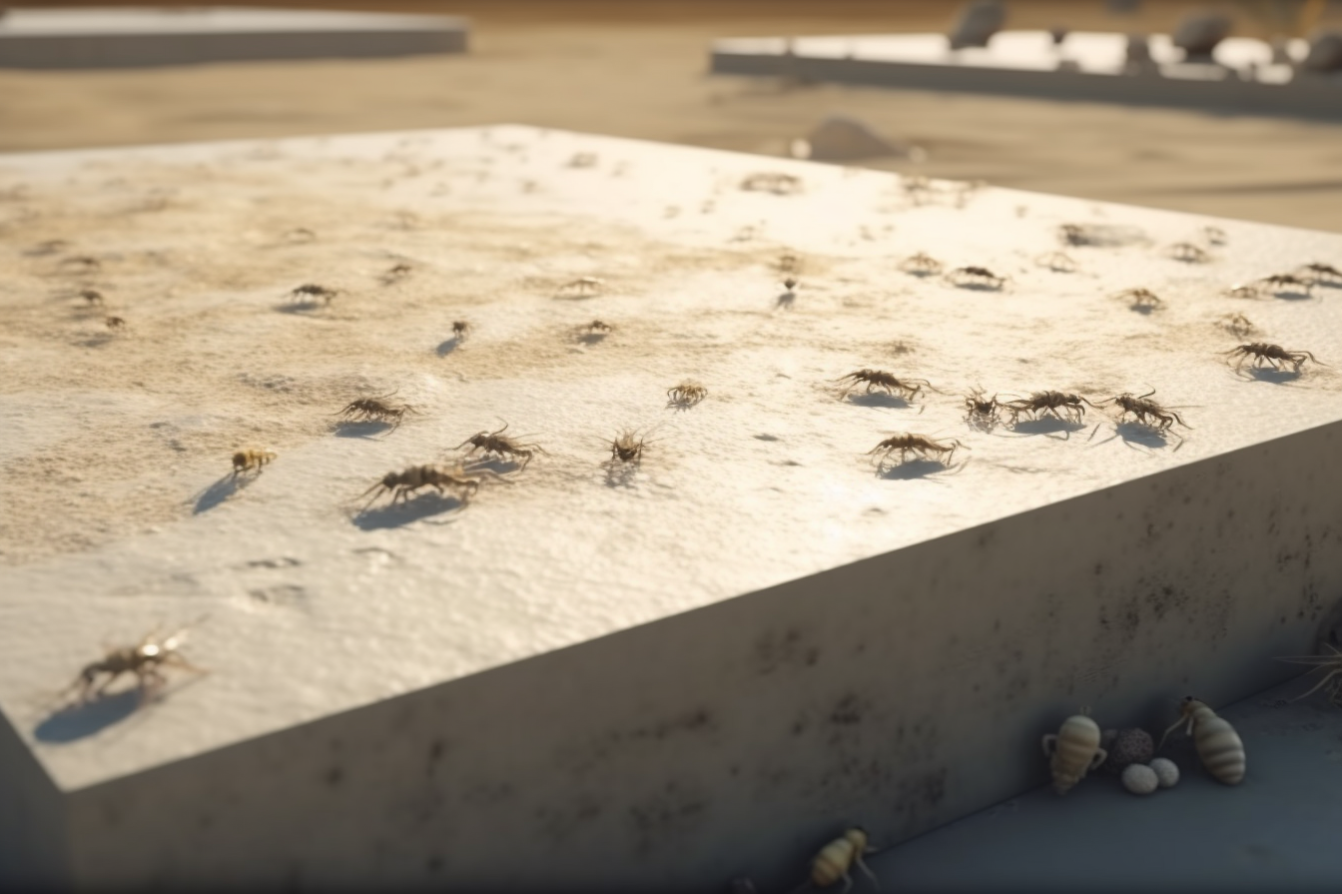
Insects, Not Bugs
Two newcomers arrive with unsettling calm and talk of masterpieces, while the group carefully skirts around questions they're not ready to answer. As plans for concrete and sheds take shape, Kain volunteers for a solo run—because sometimes solitude is the only thing that makes sense.
"New people bring new problems. That's not pessimism—that's just maths."
"That was bloody awesome," I exclaimed, slapping Paul a high-five as we met at the front of the dust-covered ute.
The grin on my face felt foreign after everything that had happened — the fear, the confusion, the bone-deep exhaustion of the past day. But for those few minutes tearing across the landscape, none of it had mattered. Just speed and noise and the simple joy of doing something reckless for no good reason.
The ute stood before us like a monument to our stupidity, its white paint barely visible beneath a thick coating of red-brown dust. The stuff clung to every surface, filled every crevice, turned the whole vehicle into something that looked like it had been dredged up from the bottom of a dried riverbed.
"Apart from clogging the engine!" Paul laughed, his face still flushed with the residual excitement.
"Come on," I said, giving his shoulder a friendly shove. "You gotta admit, even that was fun."
It had been. The panic of the engine dying, the desperate blowing into the air filter, the relief when it finally coughed back to life — all of it had felt more alive than anything else since I'd fallen through that portal. Like we'd actually accomplished something, even if that something was nearly destroying the only working vehicle we had.
"We have two new guests," Glenda's voice cut through our celebration, the words carrying a note of reservation that immediately set my nerves on edge.
I turned toward her, my good mood deflating like a punctured tyre. Two figures stood nearby — a tall woman with a lanky frame and sharp features, and a shorter man beside her with thinning hair and a solid, earthy build. They watched us with expressions that mixed uncertainty with something harder to read. Determination, maybe. Or just the particular blankness of people who'd recently had their world turned upside down.
I knew that look. I'd been wearing it myself for two days.
"I wouldn't call them guests," Uncle Jamie said from the edge of the tent's canopy, his voice carrying that familiar edge of cynicism. Henri sat at his feet, ears pricked toward the strangers. "They're not going anywhere."
The words landed in my stomach like a fist.
I didn't need the reminder. Didn't need to think about Brianne right now, about the baby growing inside her, about all the things I was missing while I stood here covered in dust on the wrong side of reality. The likelihood that I'd never get back to them — never hold my daughter, never see Brianne's face again — was a thought I kept shoving into a box at the back of my mind. Every time it escaped, it threatened to swallow me whole.
Paul stepped forward, breaking the tension with the kind of easy social grace I'd never possessed. "I'm Paul," he said, extending his hand toward the man with a welcoming smile.
The man took it, his grip firm. "Chris Owen," he replied, his voice calm and measured. "And this is my wife, Karen."
Karen nodded in acknowledgment, her gaze sweeping over us with an assessing quality that made me feel like a specimen under examination. There was intelligence in those eyes — the kind that missed nothing and filed everything away for later analysis.
"Kain," I offered, stepping forward to shake Chris's hand. "Jamie's nephew."
The unease I'd felt since seeing them hadn't faded. Something about new arrivals felt wrong, a disruption to the fragile equilibrium we'd barely established. More mouths to feed, more personalities to navigate, more complications in a situation that was already complicated beyond bearing.
"I see you've met Jamie," Paul said, gesturing toward my uncle.
Karen nodded, her expression guarded. "We've only just met him. But Luke has told us a lot about him over the years."
The mention of Luke sent a jolt through me. These people knew Luke. Had known him for years, apparently. Which meant they weren't random strangers scooped up by accident — they'd been brought here deliberately, selected for some purpose I couldn't begin to guess.
My feet started moving before I'd consciously decided to retreat, carrying me back toward the ute. Its familiar bulk felt like a shield, something solid to put between myself and all these questions I didn't want answered.
"Us?" Chris interjected, his forehead wrinkling with confusion. "I've never heard his name before."
Karen turned to her husband, her voice patient. "Not you, darling. Jane."
Jane. Another name I didn't recognise, another thread in the web of connections that seemed to surround Luke. How many people did he have lined up for this place? How long had he been planning whatever it was he was planning?
Paul chimed in with forced lightness. "Ah, Jane. You must be one of Luke's bus friends."
"Bus friends?" I muttered, the scepticism bleeding through despite my best efforts. The idea of Luke having bus friends seemed absurd — like imagining a shark with a knitting circle. What kind of person cultivated friendships on public transport?
Karen shared my confusion, her brow furrowing. "Yes," she replied simply, the single word hanging in the air without elaboration.
I turned to Chris, unable to contain my curiosity any longer. "But where is Luke? If he brought you here, why isn't he around?"
"He's not here," Karen answered for her husband, the words cryptic enough to be frustrating.
Glenda's voice carried the weight of resignation. "Appears this was another accident."
The word tasted bitter in my mouth. "Figures."
After my own chaotic arrival — the shove in the back, the tumble through impossible colours, the voice in my head welcoming me to a place I'd never asked to visit — another accident seemed almost inevitable. Luke's portal apparently had all the targeting precision of a drunk throwing darts.
Paul seized the opportunity to shift the conversation, his eyes brightening with genuine interest. "Not to be rude, but what do you actually do?"
Karen's face transformed, pride replacing the guarded expression. "I'm an entomologist."
"A what?" Paul's confusion was written across his features.
"She studies bugs," I interjected, the knowledge surfacing from somewhere in the depths of my memory. School, probably, or maybe something Mum had mentioned once. The word felt familiar even if I couldn't pinpoint where I'd learned it.
Karen's glare could have stripped paint. "Insects. Not bugs."
The distinction clearly mattered to her — mattered a lot, from the sharpness in her voice. I felt heat creep up my neck, the flush of embarrassment spreading across my face.
"Insects," I mumbled, my gaze dropping to the ground.
Karen continued as if I hadn't spoken, her words flowing with the ease of someone who'd given this explanation a thousand times. "Insects need an environment to thrive. I work with the University of Tasmania to understand how they contribute to ecosystems and collaborate with local communities and environmental groups to advocate for greater protections."
The passion in her voice was unmistakable. This wasn't just a job to her — it was a calling, something that defined who she was at her core. I could respect that, even if the subject matter didn't exactly set my pulse racing.
"That's great!" Paul exclaimed, his enthusiasm genuine. He turned to Chris with expectant curiosity. "And what about you?"
"I do yard work," Chris replied, the words simple and unassuming.
I stared at him, waiting for more. Yard work? In a place with no yards, no grass, no vegetation of any kind? The answer felt incomplete, like he'd given us the first page of a book and expected us to fill in the rest ourselves.
"Yard work?" I echoed, struggling to connect the dots.
Chris crouched down without responding, his hand scooping up a fistful of the ever-present dust. The particles sifted through his fingers in a slow cascade, catching the light as they fell back to earth.
"It's everywhere!" Paul exclaimed, his voice pitched higher than necessary, as if the omnipresent dust was somehow exciting news rather than the bane of our existence.
Chris watched the last grains slip away, his expression untroubled. "Yeah, I've noticed that." He looked up at Karen, something passing between them — a communication that didn't need words. "But if this is our home now, we'll find a way."
Home. The word struck me like a slap.
This wasn't home. This was a prison without walls, a nightmare we couldn't wake from. The casual acceptance in Chris's voice, the way he talked about finding a way as if this was just another challenge to overcome — it felt wrong. Unnaturally calm, like they'd already made peace with something I was still fighting against with every breath.
Had they been here before? The thought surfaced unbidden, impossible and yet somehow plausible given everything else I'd witnessed. In a world where dead men came back to life and lagoons did unspeakable things to your body, what was one more impossibility?
"Call me crazy," Karen said, a smile breaking across her face as she looked at her husband. "But I trust Luke."
Uncle Jamie's scoff cut through the air like a saw blade through pine. His contempt was obvious, radiating off him in waves that I could feel from where I stood.
My shoulders slumped. Trust Luke. The man who'd pushed me through a portal without warning, who'd lied to Uncle Jamie about Joel, who seemed to operate on a set of rules that only made sense inside his own head. Trusting Luke felt about as sensible as trusting a snake not to bite.
I found myself leaning toward Uncle Jamie's scepticism rather than Paul's determined optimism. Maybe it was a family trait — the Jeffries tendency to expect the worst and be pleasantly surprised when things turned out merely bad instead of catastrophic. In a world where nothing made sense and danger lurked in places as innocent as lagoons, blind faith seemed like a luxury I couldn't afford.
Karen stood her ground, unfazed by Uncle Jamie's reaction. There was something almost luminous about her expression, a glow that seemed to come from somewhere deep inside.
"A beautiful masterpiece starts with a single brushstroke. This is our blank canvas. Let's create a masterpiece. Together."
The words hung in the air, beautiful and strange and completely disconnected from the reality of our situation. A blank canvas? We were standing in a wasteland of dust and desperation, surrounded by people who'd been ripped from their lives without consent. The only brushstrokes I could see were the tracks our boots left in the dirt.
Silence settled over the camp, heavy and uncomfortable. I could hear the ute calling to me, its familiar interior promising escape from this moment, from these strangers and their unnerving optimism. But my feet stayed planted, held in place by some force I couldn't name.
"I better check-in with Joel," Uncle Jamie said finally, his voice cutting through the stillness. "Nice to meet you both."
He gave a light wave and retreated into the tent, his figure disappearing into the dim interior. Henri trotted after him, casting one last curious glance at the newcomers before vanishing through the canvas flap.
Karen's voice followed Uncle Jamie's departure, curiosity evident in her tone. "Joel?"
"Jamie's son," Glenda replied, the words casual enough but loaded with implications I wasn't sure she intended.
I caught the look that passed between Paul and Glenda — quick, meaningful, a silent conversation conducted in the space between heartbeats. There were things about Joel that the newcomers didn't need to know. At least not yet.
"He's not been well," Paul jumped in quickly, his voice pitched just a bit too high. "I'm sure he'll be fine after a few days' rest."
A snort of dark amusement nearly escaped me. Not been well. That was one way to describe a bloke who'd had his throat cut, been dumped in a river, and somehow come back from the dead with glowing light seeping through his skin. A few days' rest might help with a cold or a hangover, but Joel's problems went considerably deeper than that.
The poor kid was wrestling with something that went beyond physical recovery. He was trying to figure out what he even was anymore — alive, dead, or something in between that didn't have a name. A few days' rest wasn't going to sort that out.
"Yes," Glenda agreed, returning Paul's sideways glance with one of her own. "Perhaps you and Kain would be best moving back into the tent for a short time."
My heart sank at the suggestion. Moving back into Uncle Jamie's tent meant sharing space with Joel, meant being close to my uncle and the strange protective energy he radiated around the kid. After what had happened at the lagoon — the things I'd experienced, the involuntary responses my body had produced — I couldn't face Uncle Jamie without feeling the burn of humiliation crawling up my neck.
He'd seen me at my most vulnerable. Seen things about me that I'd never wanted anyone to witness. The thought of sleeping a few metres away from him, of making small talk over breakfast while that memory sat between us like an uninvited guest, made my skin crawl.
"We have another tent," Paul said suddenly, his eyes lighting up with the realisation.
Of course. The tent boxes we'd loaded into the ute before our joy ride. I'd been so focused on the drive, on the thrill of speed and the subsequent disaster with the engine, that I'd completely forgotten about them.
"Brilliant!" Glenda's relief was palpable, her smile genuine.
I was already moving toward the ute, grateful for any excuse to put distance between myself and the conversation. The first tent box was heavy, coated in dust like everything else, and I gave the top a rough blow to clear some of the grime before lifting it.
Chris appeared beside me, his movements unhurried but purposeful. "Here, let me take that," he offered, reaching for the box.
"Thanks," I replied, letting him take the weight.
His grip was solid, his stance balanced — the posture of someone used to physical work despite his unassuming appearance. Maybe yard work meant something different than I'd assumed. Maybe there was more to Chris Owen than first impressions suggested.
"Looks like they got a little dusty," I commented, handing Karen another box with a wry smile.
"Thanks," she said, her gaze lingering on me for a moment longer than necessary. There was something searching in her expression, as if she was trying to read something written in invisible ink across my face.
Then she was gone, following her husband toward their designated tent site, the two of them moving together with the synchronised ease of a couple who'd spent years learning each other's rhythms.
Paul grabbed the final box, his movements quick and eager. The man never seemed to run out of energy, no matter how much the day threw at him. I envied that, even as it exhausted me to watch.
"I'm going back to the Drop Zone for the concrete," I announced, loud enough for everyone to hear. My hand found the ute's door handle, the metal warm beneath my fingers.
"Hold up," Paul interjected, nearly dropping the box in his haste to grab my arm.
I pulled free, irritation flaring. "What?"
"If we want these sheds up, we have to get this concrete poured ASAP," I explained, trying to keep my voice level. The logic was simple — the sooner we poured, the sooner we could build, the sooner we'd have proper shelter instead of canvas walls that did nothing to keep out the dust.
Paul frowned, his mind clearly working through the implications. "Five to seven days?"
"Five to seven days," I confirmed with a nod. "Although, if we keep getting these cloudless skies, we might get away with four."
The curing process wasn't something you could rush. Concrete needed time to reach its full strength, time for the chemical reactions to complete, time for the water to bind with the cement. Try to build on it too early and you'd end up with cracking, crumbling, structural failure. I'd learned that the hard way helping Dad with the garage, watching him tear out a section we'd been too impatient to let cure properly.
Glenda leaned against the ute's roof, her expression quizzical. "What's five to seven days?"
"We have to let the concrete... rest," Paul explained, struggling for the right word.
"Ahh." Understanding dawned on Glenda's face. "That makes sense."
A smile tugged at my mouth. Even Glenda, with her medical background and zero construction experience, grasped the basics faster than Paul had managed. There was something satisfying about that.
Glenda shifted topics, her gaze thoughtful. "How many sheds are we talking about?"
I raked through my memory, trying to recall the inventory at the Drop Zone. Luke had brought supplies, but I hadn't exactly taken a detailed count while I was busy having an emotional breakdown in front of the portal.
"Not sure. I'll check how many Luke's left us."
"We may as well do as many slabs for the concrete we have," Paul added, his enthusiasm building. "I don't think we can have too much storage and protection here."
He wasn't wrong. The dust got into everything — clothes, food, machinery. Any enclosed space we could create would be a step toward actual civilisation instead of glorified camping.
"And Luke can always bring us more sheds," Glenda offered, a glimmer of hope in her voice.
Assuming Luke bothered to tell anyone when he dropped things off. Assuming he didn't just dump supplies and vanish through his portal, leaving us to discover them by accident. But I kept those thoughts to myself.
"I'll bring all the concrete supplies we have," I declared, sliding into the driver's seat.
"I'll come with you," Paul offered, already moving toward the passenger side.
The words were out before I could stop them. "No offence, but maybe you'd be better off helping Glenda with the new tent."
What I wanted — what I needed — was solitude. A few minutes alone with my thoughts, away from the constant presence of other people, other voices, other needs demanding my attention. The drive to the Drop Zone would give me that. A brief window of silence in a world that had become far too crowded.
"Chris and I can help," Karen chimed in, appearing beside the ute with her husband in tow. "We're used to camping on our short trips. Shouldn't take too long."
"That'd be great," Glenda agreed, her smile warm with gratitude.
Paul's shoulders sagged slightly, the rejection landing harder than I'd intended. "So what am I doing now?"
"You're helping us put up the tent," Glenda answered, patting his shoulder in a gesture that was half comfort, half direction.
Relief washed through me as I released the breath I'd been holding. The engine roared to life, and a wide smile spread across my face — the first genuine one I'd felt in what seemed like forever.
"Great. Let's get to it!" Paul exclaimed, rallying himself and turning toward the pile of boxes.
I put the ute in gear and pulled away, watching the camp shrink in the rear-view mirror until it disappeared over a rise. The landscape opened up around me, vast and empty and strangely peaceful. The faster I drove, the less the wheels fought against the dust, the tyres finding purchase on the harder ground beneath.
The silence was a gift.
No voices asking questions, no explanations needed, no social performances to maintain. Just me and the ute and the endless ochre expanse stretching toward distant mountains. The dust was everywhere, fine particles swirling in the air, coating the windscreen, working its way into every corner of the cabin. But somehow, alone on this empty road that wasn't a road, I didn't mind it quite so much.
I let my thoughts drift, processing the morning's events in the privacy of my own head. Karen and Chris, with their strange calm and their talk of masterpieces. Uncle Jamie's cynicism, which felt more honest than any optimism. Joel recovering in that tent, learning to exist in a body that had died and come back.
And somewhere beneath it all, the constant ache of absence. Brianne. The baby. The life I was supposed to be living, the future that had been stolen from me in the space between one heartbeat and the next.
The ute crested a hill, and the Drop Zone came into view below — marker stones, supply piles, the accumulated evidence of Luke's trips back and forth through the portal. Concrete bags, tools, all the raw materials for building something permanent in this impermanent place.
I pulled to a stop and sat for a moment, hands on the wheel, staring at nothing.
Then I opened the door and got to work.







