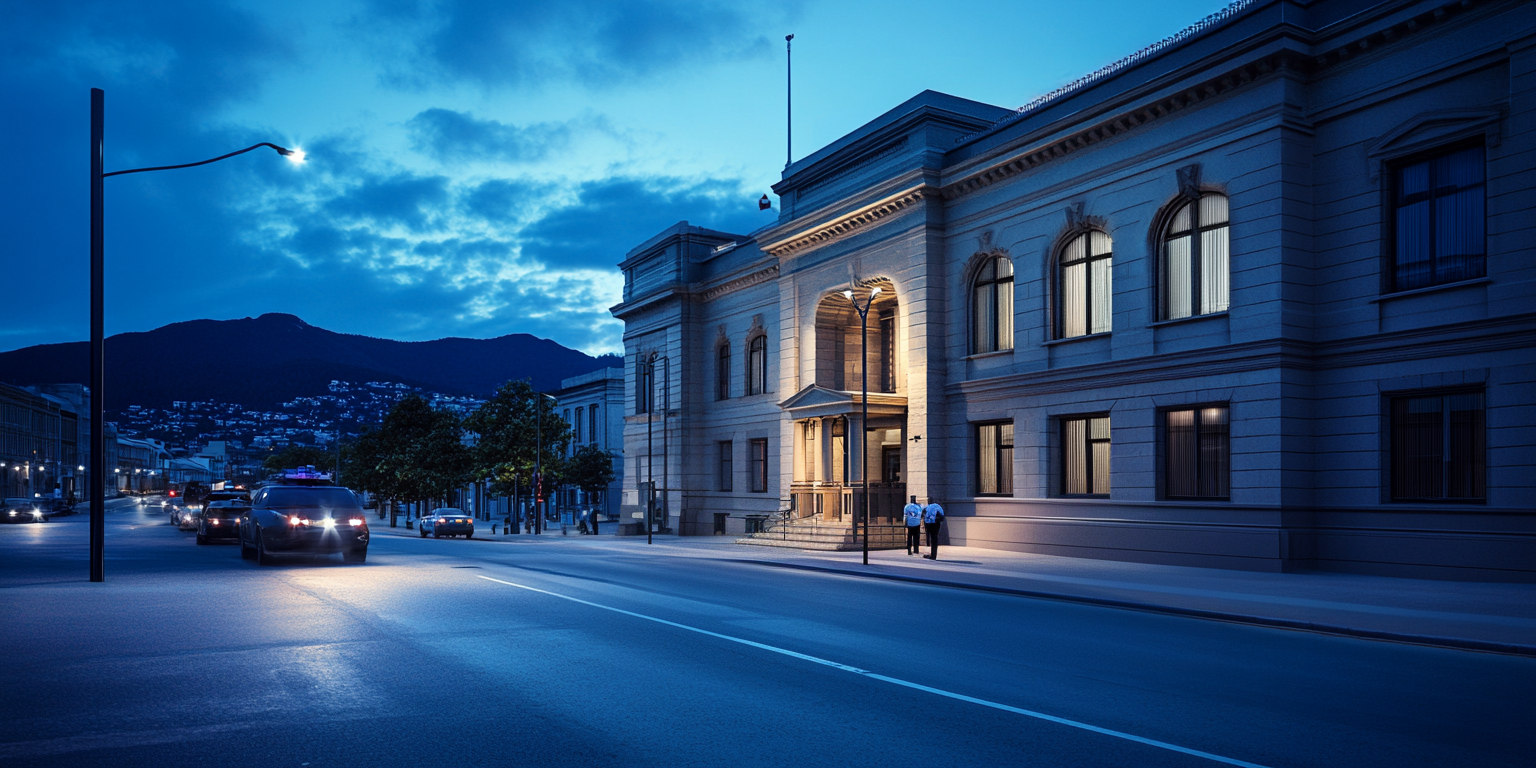
Hobart Police Station, Tasmania
The Tasmania Police Hobart Station at 47 Liverpool Street serves as Southern Division headquarters and state command centre, a utilitarian ten-storey structure built 2001-2003 that houses investigation, custody, forensic, command, and specialist operations across its substantial footprint. The building gained tragic significance in 2018 through Detective Karl Jenkins' disappearance and Detective Sarah Lahey's death during investigations conducted from its offices. Despite architectural ordinariness, the station has become a repository of accumulated human stories—confessions extracted in interview rooms, cases built in detective workspaces, losses memorialised incompletely on corridor walls—persisting through tragedy with institutional efficiency whilst containing grief its design never anticipated.
The Tower at the Corner
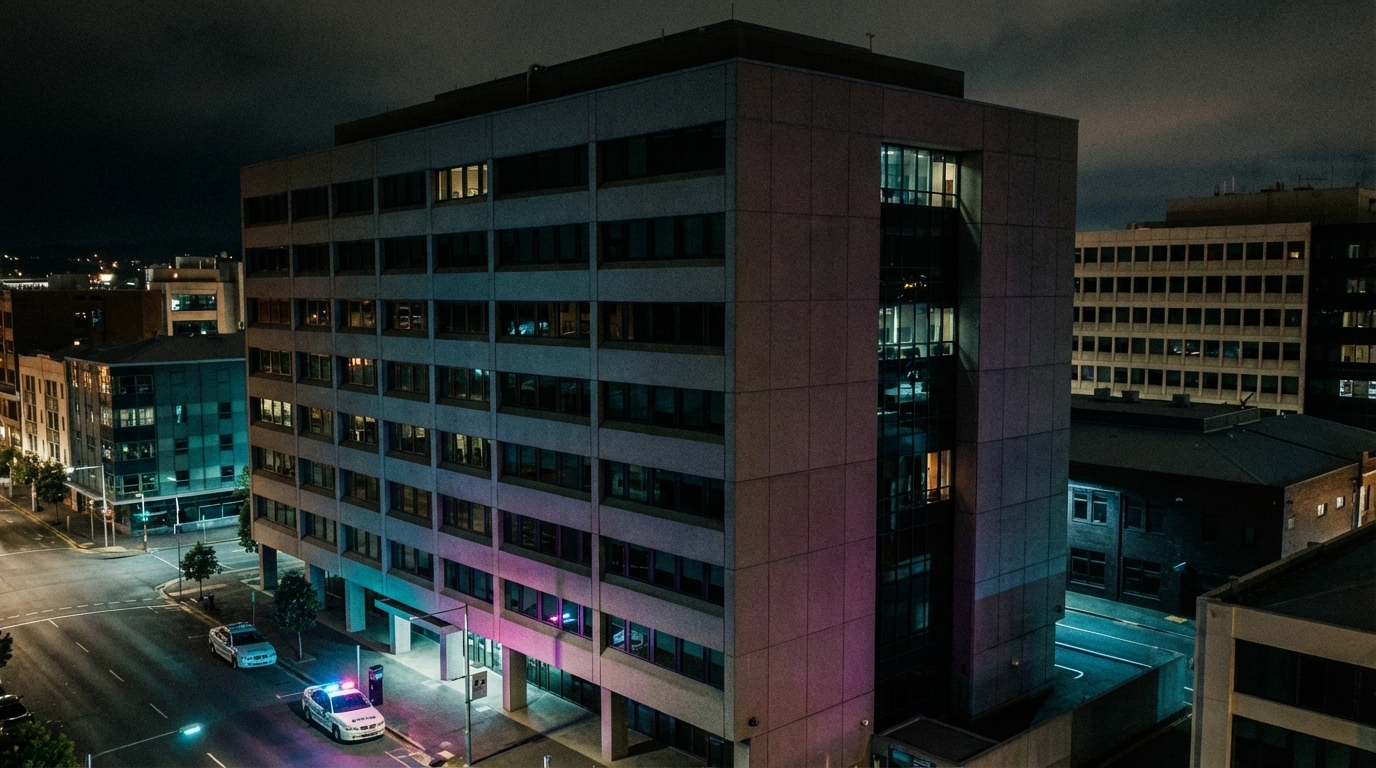
At the intersection of Liverpool Street and Argyle Street in central Hobart stands a building that embodies both transparency and secrecy, service and loss, duty and grief. The Tasmania Police Hobart Station at 47 Liverpool Street—a ten-storey structure of rendered concrete and blue-grey panels—occupies its prominent corner opposite the Royal Hobart Hospital with the utilitarian confidence characteristic of early 2000s government architecture. There is nothing beautiful about the building, nothing that invites admiration for aesthetic achievement. It was designed for function, built for endurance, and has become something more through the accumulation of stories contained within its walls.
This single facility serves triple duty as state headquarters for Tasmania Police, command centre for Southern Division, and the primary police station for Hobart's metropolitan area. The consolidation reflects practical efficiency—having state command, divisional operations, and public-facing services under one roof allows for integrated responses and streamlined coordination. What might appear as administrative convenience actually shapes daily operations: detectives moving between floors encounter uniformed officers returning from patrol, senior command observes ground-floor reception dynamics directly, and specialist units remain accessible to both operational officers and the public they ultimately serve.
This is where Detective Karl Jenkins logged his final entry on 2 August 2018 before disappearing into circumstances that defy conventional explanation. This is where Detective Sarah Lahey worked her last shift before dying in Myrtle Forest six days later. This is also where Jenny Triffett walked through the front doors on 15 July 2018 to report her husband missing—initially dismissed by reception staff overwhelmed with routine inquiries, until Karl happened through the ground floor and recognised the legitimacy of her concern. This is where hundreds of officers begin and end their days, where crimes are investigated and solved, where victims seek justice and perpetrators face consequences, where the machinery of law enforcement operates with relentless continuity regardless of who is lost along the way.
The building replaced colonial-era infrastructure in 2003, erected during a period when Tasmania Police modernised its operations and centralised its command structure. What was lost in architectural character was gained in operational capacity—climate control replaced draughty corridors, secure digital systems replaced paper filing, purpose-built forensic laboratories replaced improvised evidence rooms, specialist units found dedicated spaces rather than sharing cramped offices across the city. The ten-storey design allowed for vertical segregation of functions—public-facing services at ground level, operational units in the middle floors, command and administrative functions at the heights, with secure basement facilities providing the foundation for everything above.
The building represents a deliberate choice: efficiency over heritage, function over form, the practical requirements of contemporary policing over sentimental attachment to the past. Yet the sterility of the architecture cannot prevent the accumulation of human weight. Every interview room has absorbed countless confessions, denials, and revelations. Every desk in the detective workspace has witnessed the slow construction of cases from fragments of evidence and witness statements. Every cell in the custody suite has contained human beings at their most vulnerable or their most dangerous. The building may have been designed without sentiment, but sentiment has colonised it regardless—in the memorial plaques that line one corridor, in Karl Jenkins' still-empty office, in the break room conversations that fall silent when certain names are mentioned.
From street level, the building presents an imposing facade—ten storeys of rendered concrete and blue-grey cladding that make no concessions to aesthetics beyond basic functionality. The entrance on Liverpool Street features security measures disguised as architectural elements: reinforced glass doors that appear merely modern but can withstand considerable impact, bollards positioned as if for aesthetic spacing but actually calculated to prevent vehicle attacks, CCTV cameras integrated into lighting fixtures with sight lines covering every approach angle.
The building's mass dominates its corner, visible from multiple approach routes and recognisable to anyone who works in central Hobart. From the upper floors, the views extend across the city towards the waterfront, taking in the commercial district below and the mountain ranges beyond—a perspective that seems almost contradictory for a building so focused on the intimate details of human transgression and institutional process.
Ground Floor: The Public Face and the Hidden Machinery
The public enters through Liverpool Street, passing through glass doors into a reception area that serves as Hobart's primary police station whilst simultaneously functioning as the entry point to state headquarters. This dual purpose creates particular dynamics—the reception must manage routine public inquiries whilst also controlling access to sensitive operations above, must maintain welcoming accessibility whilst enforcing rigorous security protocols.
Bullet-resistant glazing separates visitors from the civilian officers who staff the front desk. The waiting area contains twelve seats bolted to the floor beneath CCTV cameras, occupied throughout the day by people reporting crimes, seeking information, or simply waiting for processes they don't fully understand to unfold. The space witnesses the full spectrum of police-public interaction: elderly residents reporting neighbourhood disturbances, parents seeking advice about troubled teenagers, business owners filing burglary reports, and occasionally someone like Jenny Triffett, whose missing husband complaint initially seemed routine until examined more closely.
The reception area operates under carefully calibrated protocols. Civilian staff manage the public interface with practised efficiency, triaging arrivals based on urgency and requirement—emergency matters are fast-tracked to duty officers, routine inquiries are processed through standard channels, and those seeking information are directed to appropriate resources. The volume of daily inquiries creates inevitable pressure: staff learn to distinguish genuine emergencies from exaggerated concerns, actual crimes from civil disputes, matters requiring immediate response from those that can wait.
This triage system, whilst necessary for managing limited resources, occasionally results in legitimate matters being initially dismissed—as happened when Jenny Triffett reported her husband missing. Reception staff, processing dozens of inquiries daily, applied standard protocols: adult missing less than 24 hours, no evidence of foul play, possible marital dispute. The matter would have been logged and deprioritised had Karl Jenkins not passed through reception at that moment, overheard the exchange, and recognised something in Jenny's demeanour that warranted immediate attention.
The ground floor layout facilitates such fortuitous interventions—detectives from the first floor regularly pass through reception when arriving, departing, or accessing the vehicle garage via internal stairs. Senior officers from upper floors use the same entrance. The building's consolidated design means that someone like Karl, returning from an external appointment or simply traversing between building areas, might encounter public interactions that would remain invisible if headquarters and public station occupied separate facilities.
Behind the reception area's orderly calm lies the building's custody suite—eight cells of reinforced concrete where individuals spend hours or days in temporary containment. The cells are designed for safety rather than comfort: fixed concrete benches with thin mattresses, stainless steel toilets engineered to prevent hanging attempts, recessed lighting that cannot be tampered with, windows in doors allowing constant observation. The Custody Sergeant monitors CCTV feeds from all cells simultaneously, a role requiring both vigilance and numbing familiarity with human beings at their worst.
The custody suite operates continuously, processing the daily throughput of arrests, charges, and court appearances that constitute the judicial system's rhythm. Detainees are searched, photographed, fingerprinted, and interviewed according to strict protocols designed to protect both their rights and the integrity of any subsequent prosecution. The space maintains a peculiar atmosphere—clinical yet tense, bureaucratic yet charged with the emotional volatility of people whose freedom has just been curtailed.
Six interview rooms occupy the ground floor—sterile spaces where audio recording systems capture every word and CCTV cameras document every gesture. Room 5 contains toys and age-appropriate furnishing for child witnesses, a reminder that crime's impacts extend across all ages. Room 6 provides privacy for solicitor-client consultations, the only interview space without recording equipment. The rooms are cleaned regularly but never quite lose the accumulated tension of thousands of difficult conversations—the confessions extracted through patient questioning, the alibis that crumbled under scrutiny, the witness accounts that shifted with each retelling.
At the building's operational heart sits the Operations Control Room, a 90-square-metre nerve centre where dispatchers coordinate officer deployment across Southern Division. Radio communications crackle continuously, digital maps display officer locations in real-time, incident logs accumulate throughout each shift. The room operates 24/7 with minimum three-operator staffing during peak periods, managing the constant flow of emergency calls, routine inquiries, and officer check-ins that constitute the rhythm of police work. Multiple screens display feeds from traffic cameras, alerts from automated systems, weather information, and tactical displays for major incidents requiring coordinated response.
The armoury occupies an interior position with no external walls, protected by dual-authentication access and continuous monitoring. Here rest the tools of force that officers hope never to deploy—service pistols, tactical shotguns, body armour, less-lethal options—all catalogued, secured, and tracked through rigorous check-in/check-out protocols. The room's climate control preserves ammunition whilst fire suppression systems stand ready to contain any accidental discharge. Every withdrawal is logged automatically, creating an audit trail that survives indefinitely in digital archives. Senior officers conduct quarterly inventories, verifying that every weapon, every round of ammunition, every piece of tactical equipment remains accounted for.
First Floor: The Detective Domain
The stairs or lift deliver visitors to the first floor into an atmosphere distinctly different from the public-facing ground level. This is detective territory—the Criminal Investigation Branch workspace where complex cases are built through methodical accumulation of evidence, witness testimony, and analytical insight.
The open-plan workspace contains forty-two desks arranged in pods, each workstation equipped with dual monitors, secure telephone lines, and lockable drawers for confidential materials. The space operates under a clear desk policy—at shift's end, every document must be secured, every screen locked, every sensitive material removed from view. The policy creates a peculiar daily rhythm: mornings begin with detectives unlocking drawers and retrieving yesterday's work, evenings conclude with the reverse process, and the workspace transforms each night into an expanse of empty desks that reveal nothing of the investigations they support during daylight hours.
The desks themselves tell stories through their accumulated personalisation—family photographs positioned to be visible during long hours, coffee mugs bearing slogans ranging from humorous to cynical, desk organisers containing the specific tools each detective has learned they cannot work without. Some desks maintain almost monastic minimalism, cleared completely each evening and rebuilt each morning. Others display the organised chaos of long-term investigations, with Post-it notes and reference materials that somehow remain within the clear desk policy's technical limits.
Karl Jenkins' desk occupied the northwest corner pod, positioned near the windows overlooking Liverpool Street. The desk remains assigned to him officially—administrative protocols cannot reassign a workspace whilst an officer remains listed as missing rather than deceased. The surface stays empty in compliance with policy, but the locked drawers still contain his materials, periodically inventoried by Internal Affairs but never cleared. Colleagues sometimes glance at the empty space, the absence more noticeable than occupancy would be, a daily reminder of unresolved circumstances.
The Incident Room operates as the division's tactical centre during major investigations. Whiteboard walls stretch floor-to-ceiling across 120 square metres, typically covered with photographs, timeline constructions, relationship maps, and evidence catalogues during active cases. The room transforms based on investigative needs—sometimes configured for large team briefings with chairs arranged theatre-style, other times arranged for small strategy sessions with tables positioned for collaborative work, occasionally dedicated to single high-profile cases that demand weeks or months of sustained focus.
In July and August 2018, the Incident Room became command centre for the Greyson-Jeffries missing persons investigation—whiteboards covered with photographs of Jamie Greyson, Kain Jeffries, Luke Smith, and Gladys Cramer, timeline constructions attempting to establish movements on the days of disappearance, maps marked with last known locations and search areas. Karl Jenkins and Sarah Lahey spent hours in that room, building cases that would ultimately consume them both. After their deaths, the whiteboards were photographed for evidence preservation, then erased. The room has hosted numerous investigations since, but older detectives still sometimes refer to it as "the Jenkins room," unable to fully separate the space from the tragedy it witnessed.
The Cold Case & Records Room occupies approximately 80 square metres filled with compactus shelving units—mobile shelving systems that compress together when not in use, maximising storage capacity. Physical case files date back decades, organised by year, case type, and status. Digital terminals provide access to historical records extending back further still, and microfilm readers allow examination of materials predating digitisation efforts. The room maintains controlled temperature and humidity to preserve aging documents, and access is restricted to authorised personnel only.
Detective Sergeant Alexander Stout visits this room regularly, periodically reviewing the Jenkins-Lahey investigation materials stored here. The files occupy several shelving units—witness statements, evidence logs, surveillance reports, forensic analyses, and hundreds of pages of documentation accumulated during the investigation into Karl's disappearance and Sarah's death. Stout's reviews follow no fixed schedule but occur whenever new information surfaces or whenever he simply cannot let the unfinished business rest. He has never formally closed the investigation, cannot close it whilst Karl remains officially missing and Sarah's death circumstances remain partially obscured by classification.
Second Floor: Command and the Weight of Decision
Authority resides on the second floor in offices that overlook Hobart's central business district. The Division Superintendent's corner office occupies the building's premium position—maximum natural light through floor-to-ceiling windows, views extending towards the waterfront and Mount Wellington beyond, furnishing that acknowledges rank through quality rather than ostentation. Here occur the strategic decisions that shape Southern Division's operations: resource allocation, operational priorities, responses to political pressures, management of public perception following controversial incidents.
The office contains the expected accoutrements of senior command—substantial desk of Tasmanian oak, ergonomic leather chair that cost more than most officers earn in a fortnight, credenza displaying commendations and photographs from ceremonial occasions, bookshelves containing policy manuals and legal references that are actually consulted rather than merely decorative. The walls display framed photographs from significant cases and commendations from community organisations, creating a visual narrative of career progression and institutional achievement.
Adjacent to the Superintendent's office runs a corridor of senior command offices—Detective Inspectors, uniform branch commanders, operational coordinators—each space slightly smaller than the Superintendent's but maintaining the same aesthetic of restrained professionalism. These offices generate the documentation that drives operations below: operational orders, resource allocations, policy directives, performance expectations. The paperwork may seem abstract, but it translates directly into how officers conduct investigations, how resources deploy across the division, how priorities shift in response to emerging threats or political pressures.
The Briefing Room serves multiple functions—morning shift briefings where operational intelligence is shared, press conferences where carefully prepared statements are delivered to media, training sessions where officers learn new procedures, stakeholder meetings where police operations intersect with community concerns. The room's theatre-style seating accommodates 120 people, whilst audio-visual systems project information across large screens and enable video conferencing with remote participants. The acoustics are carefully managed to ensure clarity during recordings, important for press conferences that will be scrutinised frame by frame by journalists looking for inconsistencies or revealing details.
On 15 August 2018, this room hosted Sarah Lahey's memorial service. Colleagues filled the seats whilst command officers delivered eulogies that praised her dedication and investigative capabilities without addressing the circumstances of her death. The service focused on Sarah's contributions during her nine-year career, the cases she'd solved, the people she'd helped. What remained unspoken, known only to senior command and Internal Affairs investigators, was the complexity of her final weeks—the compromised judgement, the unauthorised operations, the choices that had led her to Myrtle Forest.
The second floor also houses the primary break room—90 square metres of informal space where officers decompress between intense periods of work. Commercial-grade coffee machine (frequently malfunctioning despite maintenance contracts that seem to accomplish nothing beyond generating invoices), vending machines (perpetually requiring restocking and displaying "Out of Order" signs with suspicious frequency), microwave ovens (usually containing reheated curry or pizza, occasionally something that creates smells necessitating windows being opened regardless of weather), tables and chairs (often fully occupied during peak lunch hours, creating the social dynamics of any shared dining space).
The room's television displays news channels, and officers watch their own work reported back to them through media filters that sometimes align with operational reality and sometimes diverge dramatically. During major incidents, the break room becomes an informal command post where off-duty officers gather to monitor developments, offering commentary that ranges from supportive to cynical depending on how the media coverage reflects actual circumstances.
The break room operates under unwritten protocols refined through years of shared use. Conversations remain professional but can edge into personal territory—officers discuss cases whilst carefully avoiding classified details, share frustrations about bureaucratic requirements whilst maintaining institutional loyalty, acknowledge the emotional weight of particularly difficult incidents whilst resisting overt displays of vulnerability. New officers learn these protocols through observation and gentle correction, gradually understanding what can be said in this space and what must remain private.
Third Floor: Specialist Responses to Specific Harms
The third floor houses specialist units addressing particular categories of crime that require dedicated expertise and sustained focus. These units operate with greater autonomy than general duties officers, developing specialised knowledge and maintaining long-term investigations that span months or years.
The Drug & Alcohol Services unit occupies the eastern section of the floor, its officers conducting investigations into trafficking, production, and distribution of controlled substances across Southern Division. The unit maintains informant networks, conducts surveillance operations, coordinates with Australian Federal Police on interstate matters, and executes search warrants that often prove either spectacularly successful or disappointing anticlimaxes with little middle ground. Case files contain evidence of both sophisticated criminal enterprises and opportunistic amateurs, the full spectrum of Tasmania's drug trade documented in witness statements and surveillance photographs.
The Family Violence Unit operates from the western section, staffed by officers with specialised training in domestic violence dynamics, child protection, and trauma-informed interviewing. The work is emotionally exhausting—every case involves victims trying to navigate complex situations where love and fear intertwine, where leaving may be more dangerous than staying, where children become collateral damage in adult conflicts they cannot comprehend. The unit works closely with support services, creating safety plans and pursuing prosecutions that victims sometimes support and sometimes resist, navigating the complicated reality that effective intervention often requires working against the victim's stated preferences for their own protection.
The Sexual Assault Unit occupies dedicated space designed for sensitivity and privacy. Interview rooms feature comfortable furnishing rather than institutional sterility, allow victims to provide statements without feeling interrogated, and accommodate support persons and advocates. The unit's officers undergo extensive training in trauma responses and forensic interviewing, learning to extract necessary evidence whilst minimising additional harm to individuals who have already suffered considerable violation. The work requires extraordinary patience—investigations often proceed slowly as victims process trauma, remember additional details, or find courage to disclose information they initially withheld from shame or fear.
These specialist units share common facilities—meeting rooms for case conferences, secure storage for sensitive materials, dedicated interview spaces equipped for recording witness statements. The floor maintains a quieter atmosphere than the general detective workspace below, the cases demanding sustained concentration and the subject matter creating emotional weight that discourages casual conversation.
Officers from these units rarely discuss their work in the general break room. The cases they handle contain details that shouldn't be shared casually, involve victims whose privacy must be protected absolutely, and carry emotional burdens that are difficult to articulate to those who don't share the work. The third floor develops its own culture—supportive but self-contained, professionally excellent but emotionally demanding, essential but exhausting.
Fourth Floor: Digital Domains and Emerging Threats
The fourth floor addresses crimes that increasingly define contemporary policing—offences occurring in digital spaces, investigations requiring technical expertise, threats that cross geographical boundaries with ease.
The Digital Forensics & Cybercrime Unit occupies purpose-built facilities designed for both investigation and case management. Here officers coordinate digital evidence examination, manage cybercrime investigations, liaise with interstate and international agencies, and develop capability for addressing emerging technological threats. The unit maintains relationships with technology companies, attends conferences on digital forensics techniques, and constantly updates skills to keep pace with criminal innovation in digital spaces.
The unit's offices feature modern workstations, secure network access for examining seized devices, and dedicated spaces for case coordination. Officers here manage investigations ranging from online fraud to child exploitation, from hacking attempts against government systems to digital evidence recovery from traditional crimes. The work requires continuous learning—technology evolves constantly, criminals adopt new tools and techniques rapidly, and forensic methods must adapt accordingly.
The unit coordinates closely with James Longey in the basement digital forensics workspace. Whilst James handles the deep technical analysis—the blockchain investigations, the data recovery from damaged drives, the cryptographic challenges that require specialised skills—the fourth floor unit manages operational aspects: case progression, witness liaison, coordination with prosecutors, strategic planning for complex investigations. The division of labour reflects different skill sets: James thrives in isolation with technical challenges, whilst the unit officers excel at coordination and operational management.
Intelligence & Analysis occupies adjacent space, its analysts processing information from multiple sources to identify patterns, assess threats, and support operational planning. The analysts work with data from surveillance, informants, financial records, social media, and inter-agency intelligence sharing, creating products that inform resource allocation and tactical decisions. The work is cerebral and often frustrating—intelligence rarely provides complete pictures, patterns emerge slowly from vast amounts of data, and actionable insights are rare enough to be celebrated when they occur.
The floor maintains secure facilities for handling classified materials, dedicated networks isolated from general police systems, and spaces for sensitive briefings. Access is controlled more strictly than lower floors, with restricted areas requiring additional authentication and all movements logged automatically.
Fifth Floor: Roads, Water, and Public Safety
The fifth floor houses units addressing specific operational domains that require specialised skills and dedicated resources.
Traffic & Road Policing Command coordinates highway patrol operations, traffic enforcement, collision investigation, and road safety initiatives across Southern Division. The unit manages deployment of marked and unmarked traffic vehicles, coordinates with Department of State Growth on road safety campaigns, investigates serious collisions, and prosecutes dangerous driving offences. Officers here analyse crash statistics, identify high-risk locations, and develop targeted enforcement strategies to reduce road trauma.
The unit maintains its own briefing facilities where traffic officers receive deployment instructions, are updated on current operations, and share intelligence about problem vehicles or drivers. During major incidents—serious collisions, pursuits, or traffic disruptions—the unit coordinates responses and manages media liaison to keep the public informed without compromising ongoing operations.
Marine & Rescue Services coordination occupies adjacent facilities, managing police boat operations, water-based rescues, and coastal security. Tasmania's extensive coastline and active maritime industries create unique policing requirements—recreational boating accidents, marine pollution incidents, suspected smuggling, and search-and-rescue operations all fall within this unit's purview. The unit maintains close relationships with other maritime agencies: Water Police, Australian Maritime Safety Authority, Marine and Safety Tasmania, and volunteer rescue organisations.
The floor also houses regional liaison officers who coordinate with outer district stations, specialist support for rural operations, and planning staff who develop operational strategies for division-wide initiatives. These coordinators ensure that Hobart headquarters remains connected to operational realities across Southern Division, that resources deploy effectively across urban and rural environments, and that specialist capabilities support general duties officers when required.
Sixth Floor: The Administrative Foundation
Policing requires administrative support that often goes unnoticed but without which operational capability would collapse. The sixth floor houses these essential functions.
Human Resources manages recruitment, personnel records, leave administration, performance management, and employee relations. The unit coordinates recruitment campaigns, processes applications, manages the selection process that transforms civilians into police officers, and handles the endless administrative requirements of maintaining a workforce. HR deals with the full spectrum of employment matters—from celebrating promotions and commendations to managing discipline and grievances, from coordinating training to processing medical retirements.
The Recruitment section maintains engagement with schools, universities, and career expos, promoting policing careers and managing the pipeline of potential applicants. The work has become increasingly important as competition for quality recruits intensifies and public perceptions of policing shift in response to national and international events.
Training Coordination manages the professional development that keeps officers current with evolving legislation, techniques, and technologies. The section schedules courses at the Tasmania Police Academy, coordinates specialist training with external providers, manages qualifications and competency records, and ensures compliance with training requirements. Every officer's career involves continuous learning, and this section ensures that learning occurs systematically rather than haphazardly.
Occupational Health & Safety addresses workplace safety in an occupation where danger is inherent but can be managed through proper procedures, equipment, and support. The unit investigates workplace incidents, identifies hazards, develops safety protocols, and coordinates with Workers Compensation when officers are injured. The work includes physical safety—ensuring proper equipment, training in defensive tactics, protocols for high-risk operations—and psychological safety, coordinating access to counselling services and managing return-to-work programs following traumatic incidents.
Seventh Floor: Money, Systems, and Support
The seventh floor handles the financial and technological infrastructure that enables police operations.
Finance manages the division's budget, processes expenditure, tracks financial performance, and coordinates with central Finance for major procurement. The work is detailed and demanding—every expenditure must be justified, every budget allocation defended, every financial year requiring planning and reporting that satisfies Treasury requirements. The unit ensures that operational capability remains funded, that resources deploy efficiently, and that taxpayer money is spent appropriately.
Procurement coordinates purchasing for everything from vehicles to stationery, manages contracts with suppliers, ensures compliance with government procurement policies, and negotiates terms that balance cost with capability. Major purchases require business cases, tender processes, and evaluation criteria that satisfy probity requirements whilst actually acquiring what operations need.
IT Services maintains the technology infrastructure supporting police operations across Southern Division. The section manages servers, networks, desktop systems, mobile devices, and the myriad applications that modern policing requires. Every system needs maintenance, every upgrade needs planning, every problem needs troubleshooting, and the work occurs mostly invisibly until something fails and operations grind to a halt.
The section coordinates with state-level IT but maintains local capability for immediate support. When systems fail during critical operations—and they always fail at the worst possible moments—IT staff respond regardless of time or circumstances, restoring capability that officers have come to depend upon absolutely.
Administrative support staff provide secretarial services, document management, records coordination, and general administrative assistance for units across the building. The work is essential but often undervalued—every report requires formatting, every meeting requires coordination, every major operation generates documentation that must be managed properly. These staff maintain institutional memory, knowing where documents are stored, which procedures apply to specific situations, and how to navigate bureaucratic requirements efficiently.
Eighth Floor: Standards, Law, and Accountability
The eighth floor houses functions concerned with institutional integrity and legal compliance—units that investigate police conduct, ensure adherence to standards, and manage legal matters.
Internal Affairs investigates complaints against police, examines allegations of misconduct, and maintains professional standards across Tasmania Police. The unit is simultaneously essential and resented—necessary for accountability but inevitably viewed with suspicion by officers who see themselves as being investigated by colleagues. The work requires both detective skills and political sensitivity, investigating matters that can end careers whilst maintaining relationships with officers across the organisation.
The unit investigated circumstances surrounding Sarah Lahey's death, examining whether her final operations occurred within authorised parameters and whether any policy breaches contributed to her death. The investigation remained incomplete at the time of this writing, its conclusions having implications for how Sarah's service would be memorialised and whether her family would receive benefits associated with death in service.
Professional Standards addresses broader questions of organisational conduct, developing policies for ethical decision-making, providing advice on complex situations, and delivering training on professional responsibilities. The unit manages the tension between operational effectiveness and ethical constraints, acknowledging that policing requires both getting results and maintaining community trust through proper conduct.
Legal Services provides advice on legislative interpretation, reviews operational proposals for legal risks, coordinates with the Director of Public Prosecutions on major cases, and manages civil litigation involving Tasmania Police. The unit's lawyers understand both general law and the specific statutes governing police powers, providing advice that balances operational objectives with legal constraints.
The section reviews operational plans for high-risk activities—major raids, covert operations, surveillance activities—ensuring that proposed actions remain within legal authority and that evidence will be admissible if matters proceed to prosecution. The work requires understanding both law and practical policing, translating abstract legal principles into operational guidance that officers can apply in dynamic situations.
Ninth Floor: Adaptation and Development
The ninth floor provides flexible space for training, meetings, and development activities that don't fit neatly into other floors' dedicated functions.
Training facilities include classrooms equipped with audio-visual systems, practical training spaces for scenario-based exercises, and breakout rooms for small group work. The spaces host courses ranging from legal updates to defensive tactics refreshers, from leadership development to specialist investigative techniques. The facilities supplement the Tasmania Police Academy at Rokeby, providing central Hobart location for training that doesn't require Academy facilities.
Meeting rooms of various sizes accommodate everything from small project teams to large stakeholder consultations. The rooms feature modern furniture, video conferencing capability, and sufficient power outlets for the inevitable proliferation of laptops and mobile devices. Booking systems manage competing demands for limited space, with priorities negotiated through informal hierarchies and official policies that don't quite align.
The floor also houses project teams developing new initiatives or managing organisational changes. These teams occupy space temporarily, completing their work and disbanding once objectives are achieved. Current projects might include implementing new case management systems, developing community engagement strategies, or planning responses to emerging crime trends identified through intelligence analysis.
The flexibility serves important functions—organisations need space to experiment, to try new approaches, to develop capabilities before they're mature enough for permanent accommodation. The ninth floor provides that experimental space, allowing innovation without committing to permanent structural changes until new approaches prove their value.
Tenth Floor: Strategic Vision and External Relations
At the building's apex, the tenth floor houses executive functions concerned with strategy, planning, and external relationships.
Executive offices for Assistant Commissioner Southern Division and senior strategic advisers occupy premium corner spaces with extensive views across Hobart. These offices generate the long-term plans that shape divisional direction, the strategic relationships that position police within broader government objectives, and the high-level coordination that ensures Southern Division contributes appropriately to state-wide initiatives.
Strategic Planning develops multi-year plans, assesses emerging trends, evaluates organisational performance, and coordinates major change initiatives. The work is necessarily abstract—planning for circumstances three or five years distant requires making assumptions about future crime patterns, technological developments, legislative changes, and community expectations. The plans provide direction even when specific details inevitably require adjustment as circumstances evolve.
Media & Communications manages external messaging, prepares statements for press releases, coordinates media responses during major incidents, and maintains Tasmania Police's public profile through social media and traditional channels. The unit operates under constant pressure—media want immediate responses, situations develop faster than careful statements can be prepared, and every communication will be scrutinised for implications beyond its literal content.
The unit prepared statements following Karl Jenkins' disappearance and Sarah Lahey's death, crafting language that acknowledged the tragedies whilst avoiding details that might compromise investigations or breach privacy. The statements were analysed extensively by journalists looking for what wasn't said, by conspiracy theorists identifying supposed cover-ups, and by the families who wanted more information than could be publicly released.
The tenth floor also hosts high-level meetings with government ministers, stakeholder consultations with community organisations, and strategic briefings for visiting officials. The spaces are designed to impress appropriately—professional but not ostentatious, modern but not wasteful, presenting Tasmania Police as competent and accountable without suggesting excessive spending on executive comfort.
From these heights, the views extend across Hobart and beyond—the waterfront with its tourist attractions, the commercial district with its daily rhythms, the suburbs spreading towards distant mountains. It's a perspective that seems disconnected from the street-level realities that ground floor officers navigate daily, yet the strategic decisions made here ultimately shape what occurs in those streets.
Basement: The Foundation of Operations
The basement exists as the building's functional foundation—concrete floors, steel-reinforced doors, limited natural light, and the permanent hum of mechanical systems. This is where vehicles are housed, evidence is stored, forensic work occurs, and the logistical machinery supporting visible policing operations remains hidden from public view.
The vehicle garage accommodates fifty-two bays arranged across 800 square metres—marked patrol vehicles, unmarked detective vehicles, specialist units, and support vehicles. The space operates continuously as vehicles depart for shifts, return for refuelling, and undergo basic maintenance. Fleet management staff coordinate vehicle allocation, track maintenance schedules, and ensure that operational requirements are met despite the inevitable reality that some vehicles are always off-road for repairs or servicing.
Karl Jenkins' unmarked Ford Territory occupied bay 23 until 2 August 2018, when it was recovered from the Granton area and subsequently impounded for forensic examination. The bay has since been reassigned, though some officers still refer to it as "Jenkins' spot," unable to fully separate the mundane detail of parking allocation from the tragedy it now evokes.
The Forensic Services Laboratory—colloquially known as "the Lab" among officers—occupies approximately 200 square metres divided into specialised zones. Here forensic technicians examine physical evidence under controlled conditions: developing fingerprints in chemical chambers, analysing trace evidence under microscopes, photographing items under precise lighting, processing biological samples according to strict protocols. The work demands meticulous attention to detail and infinite patience, each examination potentially providing the crucial evidence that transforms suspicion into prosecutable case.
The laboratory operates under rigorous quality standards, maintaining accreditation through regular audits and proficiency testing. Every procedure follows documented protocols, every result is peer-reviewed before being reported, and every piece of evidence is tracked through chain of custody documentation that will survive courtroom challenges from the most aggressive defence solicitors.
Adjacent to the main laboratory, separated by concrete walls and secure doors, lies the Digital Forensics workspace—what the technical staff call "the Lair" with a mixture of affection and acknowledgement of its cave-like qualities. This is James Longey's domain, a specialised area distinct from the fourth floor Digital Forensics unit that handles case coordination and operational cybercrime investigations.
The Lair is where deep technical analysis occurs, where complex digital forensics problems get solved through concentrated expertise and specialised tools. The space features multiple workstations with extensive monitor arrays—James's own setup boasts six monitors displaying different facets of whatever investigation currently consumes his attention. The room contains isolated networks for examining seized devices without risk of contamination or data loss, forensic workstations configured with specialised software for data recovery and analysis, and server racks providing the computational power necessary for cryptocurrency analysis or breaking encryption.
The workspace maintains the atmosphere of focused isolation that technical work requires. The concrete walls provide both physical security and acoustic separation, the controlled environment protects sensitive equipment, and the basement location ensures that interruptions are rare—visiting the Lair requires deliberate effort, discouraging casual drop-ins that would disrupt concentration. Officers bring digital evidence here when they need James's particular expertise, entrusting him with hard drives, mobile devices, and computing equipment that might contain evidence crucial to investigations.
The Lair operates under the same quality standards as the physical forensics laboratory, with documented procedures, peer review, and rigorous chain of custody. But it maintains its own character—more isolated, more specialised, more dependent on individual expertise than teamwork. James thrives here, solving problems that would frustrate the fourth floor unit's broader operational focus, chasing patterns through data with the patience and technical skill that make him invaluable despite his preference for working alone.
The Secure Evidence Lockup stores material from major cases requiring highest security—weapons, drugs, high-value property, biological evidence, and digital storage devices. Access requires dual-authentication and comprehensive logging, whilst environmental controls maintain conditions necessary for evidence preservation. The lockup currently contains materials from dozens of active investigations, including items recovered during the Greyson-Jeffries case that remain catalogued and secured pending resolution of matters connected to Karl's disappearance and Sarah's death.
Evidence management is unglamorous but essential work. Every item must be logged, stored appropriately, maintained in condition suitable for potential court presentation, and eventually disposed of according to retention schedules that vary by offence type and case status. The work requires diligence and attention to detail—mishandled evidence can destroy prosecutions, and chain of custody failures provide defence counsel with opportunities to argue reasonable doubt.
The K9 holding facility provides short-term accommodation for operational police dogs deployed with handlers on extended shifts. Four individual kennels of stainless steel construction occupy one corner of the basement, maintained with meticulous hygiene standards. From November 2017 through August 2018, Jargus-9B occasionally occupied these kennels when deployed with Karl Jenkins, though Karl's preference was returning home with Jargus whenever possible. The kennels have housed various service dogs since, the space serving its functional purpose whilst containing no memorial to the particular dog-handler partnership that ended so tragically.
Building services and mechanical systems occupy the basement's remaining spaces—electrical switchgear, water systems, fire suppression equipment, climate control machinery, emergency generators, and the countless technical systems that keep a ten-storey building operational. These systems are maintained by contractors and building management staff, operating mostly invisibly until failures disrupt operations above. During major incidents, the basement's emergency systems activate automatically—backup power prevents loss of critical systems, fire suppression stands ready to contain any outbreak, and redundant systems ensure that key operations can continue despite primary system failures.
The Memorial Wall and What Cannot Be Resolved
Inside the station, positioned along a second-floor corridor that all personnel pass regularly, hangs a wall of memorial plaques honouring fallen officers. Names are inscribed with dates of service and death, each representing an individual life dedicated to policing and ultimately lost in that service. Officers pass this wall daily, usually without conscious acknowledgement, the memorial integrated into their routine whilst remaining perpetually present in peripheral awareness.
Karl Jenkins' name does not appear on this wall. Missing is not dead, and police protocols require evidence or declaration before memorial recognition. The absence creates a peculiar void—everyone knows Karl should be acknowledged, everyone understands why he cannot be, and the administrative impossibility of memorialising someone officially missing creates ongoing discomfort that no policy can resolve.
Sarah Lahey's name appears provisionally, pending completion of Internal Affairs investigation into the circumstances of her death. The provisional status reflects administrative caution regarding whether her death occurred during authorised duties or unauthorised operations. The distinction matters legally and ceremonially, determining the nature of recognition afforded to her service and sacrifice.
These absences and qualifications create a memorial wall that cannot fully function as intended—it honours some whilst excluding others based on administrative technicalities rather than the human reality of loss. Officers passing the wall know what it should contain, know who should be recognised, and experience daily the inadequacy of institutional mechanisms for processing grief and acknowledging sacrifice.
Some officers have taken to pausing briefly at the wall during quiet moments, their attention focused on spaces between plaques where names should appear but don't. The gestures are private and unofficial, individual responses to collective loss that institutional procedures cannot adequately address. No policy governs these pauses, no protocol defines appropriate remembrance, and the informality may be more genuine than any official ceremony could achieve.
The Building's Persistence and the Stories It Contains
The Tasmania Police Hobart Station continues operating with relentless efficiency regardless of tragedy, loss, or unresolved questions. Shifts change across all ten floors, cases are investigated, evidence is processed, detainees are managed, strategic plans are developed, and the administrative machinery of law enforcement maintains its rhythms. The building absorbs everything—confessions and denials, grief and determination, routine bureaucracy and extraordinary crisis—without altering its essential character.
New officers arrive, learning the building's geography through practical necessity—which stairwells provide fastest access between floors, which lifts are most reliable during peak periods, which break rooms have functioning coffee machines, where the closest printer can be found when one's own has run out of toner at a critical moment. They inherit desks previously occupied by predecessors they never knew, work cases that echo investigations from years earlier, and gradually accumulate their own experiences within spaces that contained countless experiences before them.
The building's fluorescent lighting flickers in certain stairwells despite maintenance attempts, the basement ventilation creates a constant low hum that technical staff learn to ignore, and various pieces of equipment maintain operational status through percussive maintenance techniques passed down through generations of users. These minor imperfections humanise the otherwise utilitarian space, transforming abstract architecture into familiar environment shaped by daily use and accumulated experience.
Each floor maintains its own character whilst contributing to the building's unified purpose. The public-facing ground floor operates with careful professionalism, managing the intersection between community access and institutional security. The detective floors above maintain focused intensity, the quiet concentration of complex investigations progressing through methodical work. The specialist unit floors develop particular expertise, officers becoming deeply knowledgeable about specific crime types and intervention strategies. The administrative floors keep the machinery functioning, managing resources and coordinating activities across the division. The executive floor maintains strategic perspective, positioning Southern Division within broader organisational and political contexts.
At night, the building never fully quiets. The Operations Control Room maintains its 24/7 vigil on the ground floor, custody cells contain individuals awaiting morning court appearances, the basement's digital forensics workspace occasionally illuminates as James Longey works late on cases demanding immediate attention, and security systems monitor corridors throughout the building whilst recording nothing of consequence. The building persists through darkness and daylight alike, indifferent to time's passage whilst containing all the human dramas unfolding within its walls.
The ten storeys represent more than mere vertical organisation—they embody the complexity of contemporary policing, the necessity of specialisation, and the infrastructure required to address crime in all its manifestations. From the basement's technical foundations to the tenth floor's strategic vision, from the public-facing reception to the isolated specialist units, the building contains the full spectrum of police work.



