Hobart Airport, Tasmania
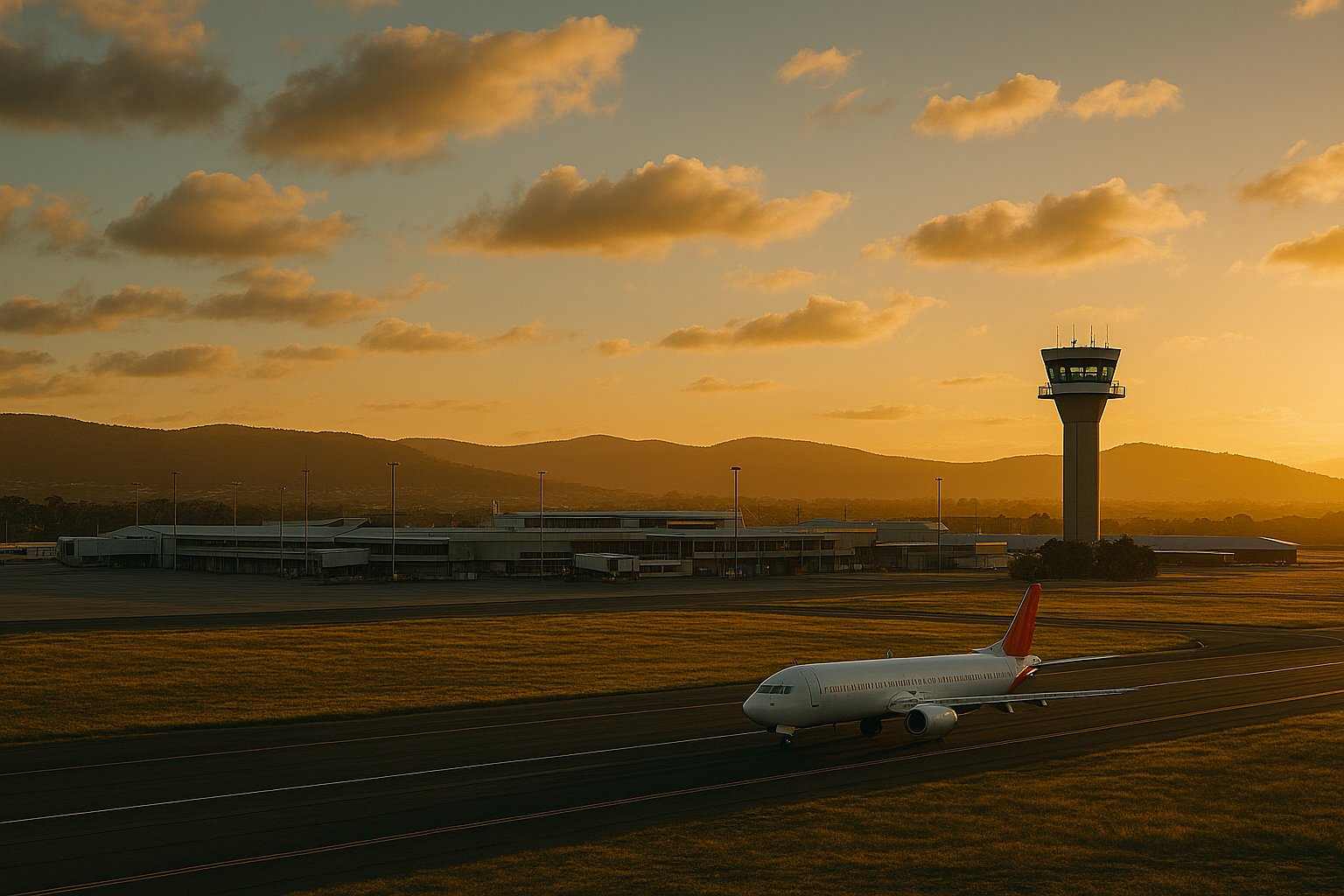
Hobart Airport serves as Tasmania's primary aerial gateway, connecting the island state to mainland Australia and beyond. Nestled on the eastern shore of the Derwent River estuary, this modest regional facility has evolved from its 1956 opening into a vital link for an isolated population. Its terminals witness the full spectrum of human experience—family reunions and bitter farewells, business routines and life-altering departures, the ordinary and the inexplicable unfolding side by side.
An Island's Gateway
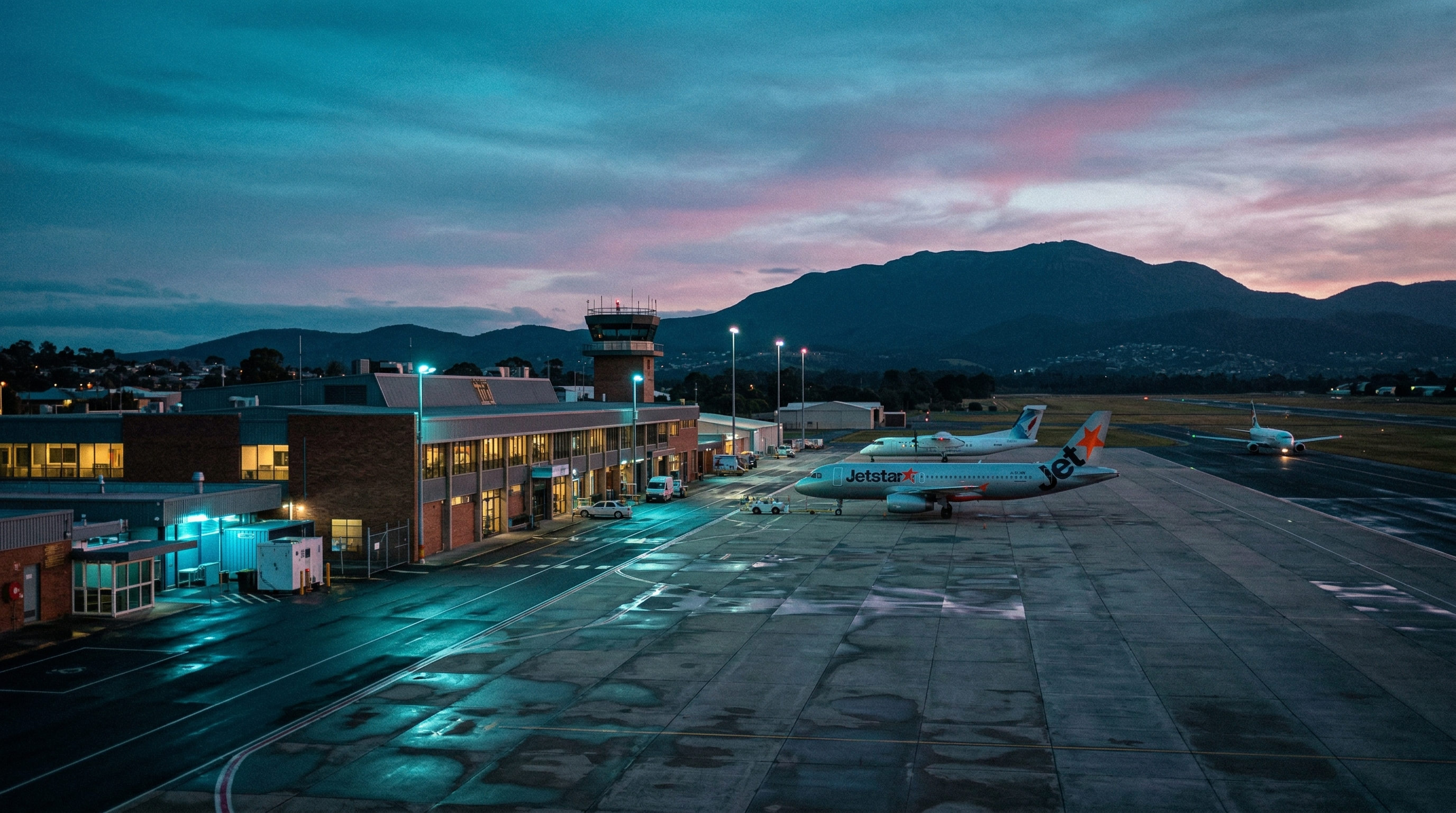
Hobart Airport exists because Tasmania exists as an island. The temperamental waters of Bass Strait separate the island state from the mainland, making air travel not merely convenient but essential. The airport sprawls across the flat terrain at Cambridge, seventeen kilometres from Hobart's city centre, chosen for its practicality rather than its charm. To the west, the Wellington Range rises in the distance—a constant reminder of the dramatic topography that makes Tasmania both beautiful and challenging.
When operations commenced in 1956, the new facility replaced the inadequate arrangements at Western Junction near Launceston. The decision reflected both aviation necessity and political ambition. The capital city demanded infrastructure befitting its status, even if the modest scale of operations told a different story about Tasmania's actual position in the national hierarchy.
Those early passengers would scarcely recognise the contemporary facility. The 1950s airport offered basic amenities and limited services, characterised by the informal atmosphere of post-war regional Australian aviation. The staff knew the regular passengers by name. Weather delays were announced with apologetic shrugs rather than recorded messages. The terminal felt more like an enlarged bus shelter than the sterile efficiency of modern air travel.
The subsequent decades brought expansions that tracked Tasmania's gradual evolution. The 1970s and 1980s saw improvements responding to growing tourist interest and increasing business traffic. The construction of an international terminal in 1985 reflected aspirations that exceeded reality—"international" remained largely confined to seasonal flights to New Zealand. Still, the addition spoke to ambitions of connecting Tasmania more directly to the world beyond Australia's shores.
By the early twenty-first century, the airport had settled into its role as functional infrastructure serving greater Hobart's population and the tourist traffic discovering Tasmania's attractions. MONA's 2011 opening brought increased visitation, straining capacity during the summer months and festival periods. Yet the facility retained its modest character. This was a regional airport connecting an island to the mainland, nothing more and nothing less.
The Theatre of Everyday Transit
For most travellers, Hobart Airport represents pure functionality. It's a threshold crossed with minimal contemplation beyond the practical concerns—where to collect the luggage, how much the parking will cost, whether the flight will depart on time.
The departure lounges fill with the predictable demographics. Bleary-eyed business travellers clutch takeaway coffees like lifelines, their movements automated by routine. Holiday-makers wander in shorts and thongs, seemingly oblivious to the terminal's air-conditioned chill. Elderly couples manage mobility aids with practised patience. Backpackers wrestle oversized rucksacks through the security scanners, invariably surprised when told to remove their boots.
The retail offerings remain determinedly modest. A newsagent stocks paperbacks and travel-sized toiletries. The café serves industrial coffee and overpriced sandwiches. A duty-free shop maintains an optimistic inventory that suggests customer bases perpetually failing to materialise. These are spaces designed for transaction rather than lingering, efficiency rather than comfort.
Yet airports possess a peculiar quality that transcends their utilitarian purpose. They exist as liminal spaces—belonging neither to origin nor destination, suspended between departure and arrival. Passengers occupy these terminals without truly inhabiting them, present in body whilst mentally projected toward their destinations.
The security checkpoints reinforce this sense of transition. The ritual removal of shoes and belts, the emptying of pockets, the conveyor belt's slow progress through the scanning machines—these procedures mark the passage from ordinary civic space into the regulated realm of controlled travel. Whether effective or merely theatrical, the security creates boundaries both physical and psychological.
Beyond those checkpoints, the departure gates compress diverse humanity into uncomfortable proximity. Strangers bound for identical destinations pursue entirely different purposes. Business travellers review presentations whilst families manage overtired children. Some passengers read novels, others stare into the middle distance lost in private contemplation. These temporary communities dissolve upon boarding, never reconvening in quite the same configuration.
Departures That Linger
Across nearly seven decades of operation, Hobart Airport has processed millions of passengers. Most pass through unremarked and unremarkable—ordinary people pursuing ordinary purposes, their journeys leaving no particular impression on the collective memory.
Yet certain departures carry a weight that exceeds their surface appearance. Australia Day 1999 saw the terminal filled with holiday travellers, the particular energy of a long weekend humming through the departure lounges and arrival gates. Amongst that crowd, Jamie Greyson boarded a flight that marked not temporary absence but permanent severance. Tasmania shrinking beneath the aircraft wings represented escape from the complications that couldn't be resolved, from the relationships that couldn't continue. The letters would remain unwritten, the explanations would stay unspoken. The airport stood complicit in that departure—enabling escape whilst offering no absolution. For Jamie, the terminal would forever carry associations with that warm summer morning, with the eucalyptus-scented memories left behind, with the geographic punctuation mark that ended one chapter without providing closure.
Nearly two decades later, in the pre-dawn darkness of 13 January 2018, Nathan Cowdrey moved through those same terminals carrying more than ordinary luggage. The bored efficiency of the security checkpoint officers, processing hundreds of passengers daily, ensured his backpack passed unremarked despite the contents whose significance exceeded their physical weight. In the departure lounge, Nathan studied the fellow passengers with an intensity that bordered on paranoia—the business travellers, the families, the elderly couples—any of them might be something other than they appeared.
Mount Wellington stood sentinel beyond the plate glass windows that morning, its peak catching the first light whilst the city below remained wrapped in shadow. For Nathan, that view carried the weight of farewell not merely to a city but to the version of himself who'd lived an ordinary life bounded by comprehensible rules. His destination was Adelaide, where his brother Josh would collect him, but the journey represented something far more complex than a fraternal visit. He was pursuing something that had gone missing, following a trail that began with inexplicable circumstances and led toward the destinations he couldn't yet comprehend.
July's Domestic Tensions
Six months later, on 24 July 2018, the airport became an arena for the particular tensions of family obligation reluctantly fulfilled. Jamie Greyson returned to the terminal—not as a departing passenger but as a reluctant chauffeur, summoned by his partner Luke to collect Luke's brother Paul from an early morning flight. The drive from Berriedale had already been an exercise in suppressed irritation, and the airport's announcement of flight delays stretched patience to breaking point.
In the small café, Jamie sought refuge in chocolate cake and a cappuccino—comfort that was simultaneously indulgence and protest. Around him, the other travellers pursued their own journeys whilst he used dessert as rebellion, each mouthful representing defiance against the expectations being placed upon him. When Paul's flight finally landed, the arrival gates witnessed passive-aggressive theatre in restrained waves and carefully neutral greetings.
These domestic dramas—Jamie's resentful collection duty, Paul's carefully vague explanations, the weight of unspoken complications—unfolded against the backdrop of hundreds of other personal narratives. Business people reviewed documents. Couples shared quiet conversations. Children wailed over dropped toast. The airport absorbed it all with the indifference of infrastructure, providing the stage but offering no commentary on the performances enacted within its terminals.
The Architecture of Suspension
The airport architecture exists in perpetual contradiction. The terminals must be simultaneously welcoming and secure, efficient and comfortable, transient and substantial. Hobart Airport embodies these tensions in its regional modesty.
The departure lounges create deliberate discomfort. Hard plastic seating discourages lingering. Harsh fluorescent lighting eliminates shadows whilst flattening perspective. The spaces function as holding pens rather than gathering places—necessary but unwelcoming, designed to process rather than accommodate.
Yet this very functionality serves purposes beyond the official designation. The uncomfortable seating ensures passengers remain alert for the boarding calls. The open layouts enable security observation. The sparse amenities prevent the accumulation of crowds that might complicate emergency evacuations. Every design choice reflects the compromise between competing priorities—passenger comfort versus operational efficiency, welcoming atmosphere versus security necessity.
The baggage carousels at arrivals create their own social dynamics. The passengers who moments before sat in enforced proximity aboard the aircraft now jostle for position around the moving belt. The carousel's hypnotic rotation induces a peculiar trance state—eyes tracking each emerging bag, disappointment when the wrong luggage appears, relief or frustration depending on timing. These experiences are simultaneously universal and deeply personal, the prosaic conclusion to journeys that might carry profound significance or represent mere routine.
The airport café occupies a curious position in this ecosystem. Too expensive to justify its quality, too convenient to avoid entirely, it serves as refuge for those fleeing discomfort or boredom. Its generic offerings—industrial coffee, pre-packaged sandwiches, slices of cake under plastic domes—provide comfort through familiarity rather than excellence. The travellers seeking distraction find temporary respite amongst the strangers pursuing identical strategies for managing the peculiar suspension that airports enforce.
Tasmania's Connection to Broader Networks
The airport's function extends beyond the simple point-to-point connections. It serves as Tasmania's primary node in the networks both visible and otherwise—the commercial linkages that keep island enterprises connected to mainland markets, the academic collaborations that prevent intellectual isolation, the political shuttles that maintain necessary connections between Hobart and Canberra.
The tourist traffic flows bidirectionally. Mainlanders arrive seeking wilderness experiences, World Heritage areas, burgeoning food culture, and increasingly prominent arts festivals. Tasmanians depart for mainland holidays, medical treatments unavailable locally, family visits, or simple escape from island confines. The airport facilitates both movements with equal efficiency, indifferent to whether passengers view Tasmania as destination or origin.
The business travel maintains particular patterns. Mining companies shuttle personnel between operations and headquarters. Government departments rotate staff through mainland training programmes. Corporate consultants fly in for brief engagements before departing. These movements create the rhythms that shape the airport's daily operations—peak periods for certain routes, predictable passenger demographics on particular flights, familiar faces amongst the regular travellers.
The facility also serves the cargo functions that receive less attention than the passenger operations. Freight handlers process seafood bound for mainland markets, ensuring Tasmania's premium products reach the restaurants whilst still fresh. Agricultural exports—poppies for pharmaceutical purposes, specialty produce, breeding stock—move through the dedicated facilities. Mail and parcels flow in both directions, maintaining the connections that digital communication cannot entirely replace.
This cargo function occasionally intersects with the passenger operations in unexpected ways. Packages go missing. Shipments disappear into logistical black holes. The items that should arrive fail to materialise, creating cascades of inconvenience or worse. The vast machinery of modern logistics, for all its tracking systems and digital oversight, remains vulnerable to human error, mechanical failure, and the occasional inexplicable disappearance that defies explanation.
The Peculiar Space Between
What emerges from the accumulated experience is an understanding of Hobart Airport as something beyond the official designation. It functions not merely as transport infrastructure but as a threshold—a space where the ordinary and extraordinary exist in uncomfortable proximity, where private dramas unfold against public infrastructure, where lives change course between check-in and boarding gate.
This quality isn't unique to Hobart. All airports possess it to some degree. The enforced waiting, the mixing of strangers, the peculiar combination of public exposure and personal anonymity—these conditions create the environments where things occur that might not happen elsewhere. Conversations between strangers who'll never meet again. Decisions made in the departure lounges that alter life trajectories. Farewells spoken that carry finality beyond ordinary parting.
Yet Hobart Airport's particular character—its regional modesty, its role as Tasmania's primary mainland connection, its position serving an isolated population—lends these experiences additional weight. For an island population, departure always carries implications beyond simple travel. It might represent opportunity or exile, temporary absence or permanent departure. The return flights bring relief or resignation, homecoming or the acknowledgment of limited options.
The airport witnesses these departures and returns with the indifference of infrastructure. Its terminals process passengers with mechanical efficiency regardless of the emotional freight. The security checkpoints wave through both the fleeing and the returning. The baggage carousels deliver luggage with equal indifference to joy or sorrow. The facility performs its designated function without commentary on the human experiences unfolding within its boundaries.
