HMS Resolution
Launched on 17 March 1782 from Portsmouth's Royal Dockyard, the HMS Resolution served the British Crown for over four decades across three distinct chapters of imperial history. This three-masted barque patrolled Caribbean waters during the American Revolutionary War's final years, charted unknown Pacific territories during the age of exploration, and transported hundreds of convicts to Australia's burgeoning penal colonies. Her most celebrated voyage under Captain Josiah Haverford delivered William Jeffries to Sydney Cove in 1808. Renowned among crews as "The Iron Lady," she was decommissioned on 14 August 1825.
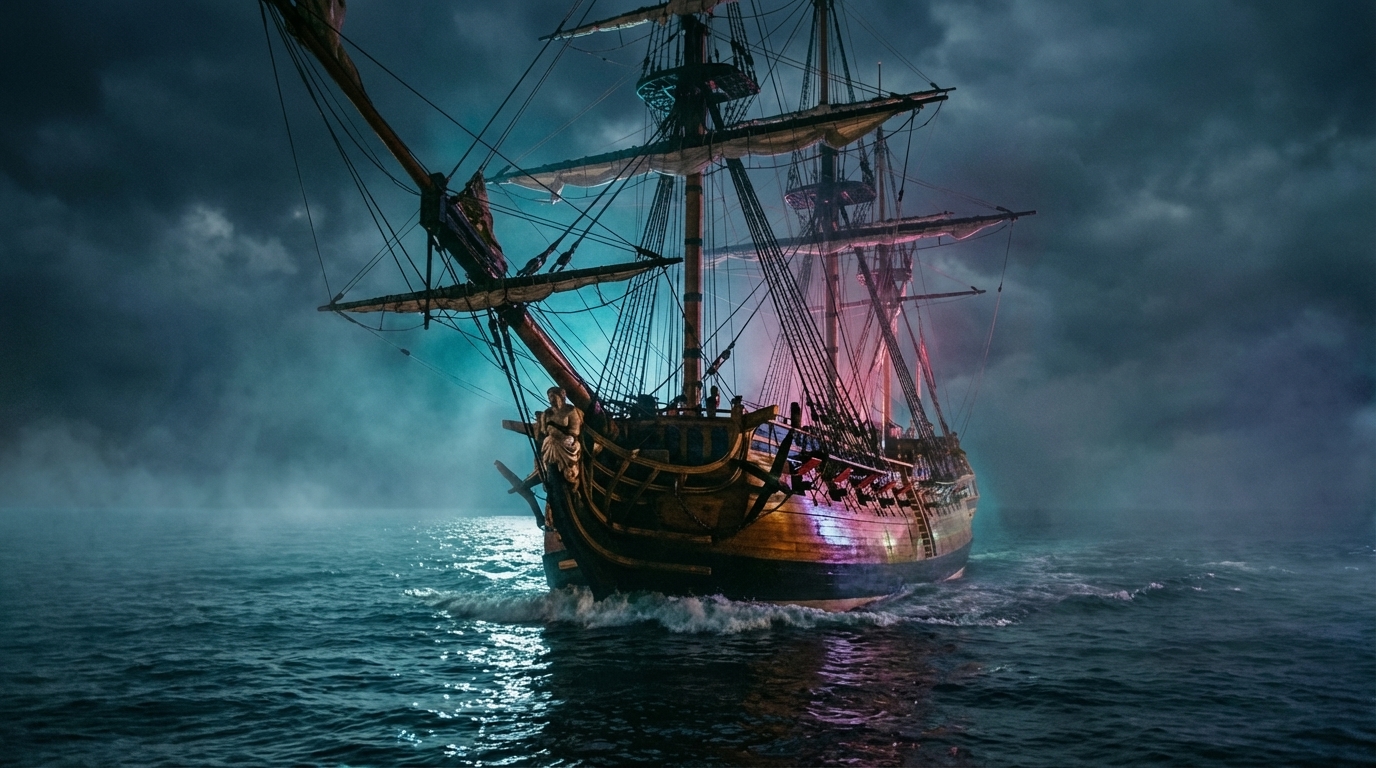
Birth in the Royal Dockyard
The keel that would become HMS Resolution was laid in Portsmouth's Royal Dockyard during the autumn of 1780, her construction authorised by the Admiralty Board as part of a programme to expand Britain's naval capacity during the ongoing American Revolutionary War. The conflict had stretched royal resources thin, and the need for versatile vessels capable of patrol, transport, and exploration duties had never been greater. The Resolution was designed to fill this gap—sturdy enough for extended voyages, spacious enough for significant cargo, yet manoeuvrable enough for military operations should circumstances demand.
Master Shipwright Thomas Slade the Younger oversaw her construction, applying the lessons his father had learned building vessels for the Royal Navy across three decades. The elder Slade had designed HMS Victory herself; the son brought that same expertise to the Resolution, albeit on a more modest scale. The barque's frame rose from English oak harvested in the forests of Hampshire and Sussex, timber selected for its density and resistance to rot. Her hull planking came from the same stocks, the wood seasoned in covered sheds before being shaped to the curves her designers had specified.
She measured one hundred and twelve feet from stem to stern, her beam spanning twenty-eight feet at its widest point. Three masts would carry the square-rigged sails that gave barques their distinctive silhouette: the foremast and mainmast rigged square, the mizzenmast carrying a gaff sail that improved her handling in variable winds. Below decks, the main hold could accommodate substantial cargo—whether military stores, exploration equipment, or, as her later career would demonstrate, human beings destined for distant shores.
The Resolution slid down the slipway and into Portsmouth Harbour on 17 March 1782, her hull striking the grey waters as onlookers cheered from the dockside. She was the fourteenth Royal Navy vessel to bear the name Resolution, a designation that the Admiralty reserved for ships expected to demonstrate the quality their name proclaimed. The fitting-out process consumed another three months, her masts stepped and rigged, her copper sheathing applied to protect against the marine worms that devoured lesser vessels, her stores loaded for the maiden voyage that would test whether her builders' confidence had been justified.
Caribbean Service
Captain Edward Falkner received command of the Resolution in July 1782, his orders directing him to join the Caribbean Squadron patrolling waters where British merchant shipping remained vulnerable to American privateers and their French allies. The Revolutionary War was entering its final phase, negotiations for peace already underway in Paris, but the fighting continued while diplomats deliberated. The Resolution would contribute what she could to protecting British interests during these uncertain months.
She departed Portsmouth on 3 August 1782, her crew of eighty-five men settling into the routines that would govern their lives for months to come. Captain Falkner, a veteran of fifteen years' service, ran his ship with the steady competence that experience had taught him. He drilled his crew in gunnery and sail handling, preparing them for engagements that might never materialise whilst ensuring they would be ready if circumstances demanded action.
The Atlantic crossing proved uneventful, the Resolution demonstrating the seaworthiness her builders had promised. She handled well in the moderate swells of the open ocean, her copper-sheathed hull cutting cleanly through waters that would have challenged vessels of lesser construction. By mid-September, she had reached Barbados, where she joined the squadron under Admiral Sir Hugh Pigot's command.
The months that followed brought patrol duties rather than dramatic engagements. The Resolution cruised the shipping lanes between the Caribbean islands, her presence deterring privateers whilst reassuring merchant captains that the Royal Navy maintained its protective vigilance. She encountered no significant combat—the war was winding toward its conclusion—but her patrols contributed to the security that allowed British commerce to continue despite the conflict's uncertainties.
News of the preliminary peace treaty reached the Caribbean in the spring of 1783. The war that had justified the Resolution's construction was ending, but her service to the Crown was only beginning. She returned to Portsmouth in June 1783, her first chapter complete, her timbers already bearing the salt-stained patina that marked a working vessel.
Pacific Exploration
The years following the Revolutionary War brought reorientation of British naval priorities. With American independence acknowledged and French hostility temporarily diminished, the Admiralty turned attention toward exploration and the expansion of geographical knowledge that might yield future commercial and strategic advantages. The Resolution, her design well-suited to extended voyages in distant waters, was selected for refitting as an exploration vessel.
The conversion, undertaken during 1786 and early 1787, modified her internal arrangements to accommodate the scientists, artists, and additional stores that exploration demanded. Her armament was reduced, the space previously devoted to powder magazines and shot lockers now given over to specimen storage and charting equipment. New water casks increased her capacity for the extended periods between resupply that Pacific voyaging required.
Captain Richard Byron assumed command in March 1787, his appointment reflecting both his navigational expertise and his family connections—he was a distant relative of the poet who would later bear the same surname to literary fame. Byron's instructions directed him to the South Pacific, where British interests in the region remained inadequately mapped. The Resolution would contribute to remedying this deficiency.
She departed Portsmouth on 15 April 1787, beginning a voyage that would consume three years and carry her to waters few British vessels had previously reached. The passage around Cape Horn tested both ship and crew, the Resolution proving her strength against seas that had destroyed lesser vessels. By November 1787, she had reached the Pacific, her course set for New Zealand's still-mysterious coastline.
The months that followed brought systematic charting of New Zealand's shores, Byron's surveys adding precision to maps that previous explorers had sketched only approximately. The Resolution anchored in numerous bays and harbours, her boats venturing ashore to take measurements and establish relationships with the Maori peoples whose territories these explorations traversed. These interactions, conducted with varying degrees of success, provided information that would prove valuable to later settlers whilst introducing complexities that the charts themselves could not capture.
The Resolution returned to Portsmouth in August 1790, her holds containing specimens, her officers bearing charts, her reputation enhanced by successful completion of a demanding assignment. She had demonstrated capabilities beyond mere naval service, proving herself adaptable to whatever purposes the Crown might require.
Transformation to Convict Transport
The 1790s brought yet another reinvention. Britain's overcrowded prisons had created a crisis that transportation to distant colonies seemed to answer, and the penal settlement at New South Wales required a steady supply of vessels capable of delivering convicts across fifteen thousand miles of ocean. The Resolution, spacious, sturdy, and proven in Pacific waters, was an obvious candidate for this grim duty.
Her conversion to convict transport, undertaken in 1792, transformed the spaces that had accommodated scientists and specimens into compartments designed for human cargo. The main hold received the barred partitions that would separate convicts from crew, the gratings that would provide minimal ventilation to the fetid darkness below, the chains and shackles that would restrain those whom the law had condemned to exile. These modifications stripped whatever romance her exploration years had accumulated, replacing it with the brutal pragmatism that transportation demanded.
She made her first convict voyage in 1793, departing Portsmouth with two hundred prisoners destined for Sydney Cove. The passage proved the horrors that such voyages entailed: disease spreading through the crowded hold, inadequate food and water stretching what stores existed, death claiming those too weak to survive conditions that tested even the healthy. The Resolution delivered her cargo—those who survived—to colonial authorities whose own circumstances left little capacity for mercy.
The years that followed brought regular repetition of this grim commerce. The Resolution became a familiar presence in the convict transport fleet, her departures from Portsmouth marking the beginning of journeys that would transform British criminals into Australian labourers. Each voyage etched its toll upon her timbers, the accumulated stress of repeated passages around the Cape of Good Hope and through the Southern Ocean gradually wearing what her builders had made strong.
The 1807 Voyage
The voyage that would define the Resolution's legacy began in April 1807, when Captain Josiah Haverford assumed command for a passage to New South Wales carrying one hundred and fifty convicts. Haverford, a veteran of Trafalgar whose administrative capabilities matched his combat experience, approached the assignment with the systematic thoroughness that characterised his approach to every duty. The Resolution would test whether that thoroughness could manage the challenges that convict transport imposed.
Among the prisoners loaded aboard was William Jeffries, a twenty-two-year-old Portsmouth dockworker convicted of stealing a pocket watch from a merchant named Josiah Blackwell. Jeffries was one face among many, one entry in manifests that recorded human beings as cargo, yet his subsequent career would far exceed anything his humble origins or criminal conviction might have predicted. The Resolution, carrying him into exile, was unknowingly transporting a man whose colonial success would eventually rival that of free settlers.
The voyage departed Portsmouth on 15 April 1807, the Resolution's familiar silhouette diminishing as she worked down the Channel toward the open Atlantic. Captain Haverford had organised his ship with characteristic precision: the convicts secured below in conditions that, whilst harsh, met the minimal standards the Admiralty prescribed; the crew stationed according to watches that would maintain the vessel's operation through months at sea; the stores distributed to sustain life across the vast distances ahead.
The passage proved as arduous as any the Resolution had undertaken. Storms in the Southern Ocean battered her ageing hull, the timbers that had weathered decades of service groaning under stresses that tested their remaining strength. Scurvy appeared among both convicts and crew, the disease's relentless progression claiming lives despite the lime juice and sauerkraut that Haverford had insisted upon loading. Thirteen men died during the passage, their bodies committed to seas that received such offerings with indifferent finality.
Yet the Resolution endured, as she had endured previous trials. Haverford's discipline maintained order among convicts whose desperation might otherwise have erupted into violence. His attention to sanitation, exceptional by the standards of convict transports, limited disease's spread beyond what uncontrolled conditions would have permitted. The ship that had charted New Zealand's coastline now demonstrated different capabilities: the capacity to deliver human cargo alive across distances that destroyed vessels less capably commanded.
Sydney Cove
The morning of 28 February 1808 brought the cry that every soul aboard had awaited: land sighted off the bow. The Resolution had reached Australian waters, her ten-month passage nearing its end. As the coastline resolved from morning haze into the sandstone cliffs and eucalyptus-covered headlands that marked Sydney's approaches, those aboard could finally believe that survival was assured.
She anchored in Sydney Cove that afternoon, her arrival drawing the attention of colonial officials, soldiers, and settlers whose lives revolved around the ships that connected their distant settlement to the world beyond. Captain Haverford oversaw the disembarkation with the efficiency he had maintained throughout the voyage, the convicts shuffling down gangplanks into the harsh Australian sunlight that would illuminate their years of servitude.
William Jeffries was among those processed that day, his assignment to the government farm at Parramatta recorded in ledgers that tracked the human resources upon which colonial development depended. He looked back at the Resolution as guards marched him away from the dock, this vessel that had carried him from everything familiar into exile. The ship that had been his prison for ten months had also been his salvation; without her sturdy hull and capable command, he would have joined those whose bodies the ocean had claimed.
The Resolution remained in Sydney Harbour for several weeks, her crew undertaking the repairs and reprovisioning that the passage had necessitated. Australian timber replaced planking that the voyage had strained; local stores supplemented supplies that the months at sea had depleted; rest restored strength that the journey's demands had exhausted. By April 1808, she was ready to return to Portsmouth, her holds now empty of the human cargo she had delivered.
The Iron Lady
The years following the 1807 voyage established the Resolution's reputation among those who served aboard convict transports. Crews began calling her "The Iron Lady," a designation that captured both her physical resilience and the unyielding discipline her voyages demanded. She was not comfortable—no convict transport could claim such distinction—but she was reliable, a vessel whose survival could be trusted when others faltered.
She continued making regular passages between England and Australia throughout the 1810s, each voyage adding to the toll that accumulated service exacted. Her timbers, however well-maintained, could not indefinitely resist the stresses of repeated Cape passages. Her rigging, however frequently renewed, gradually lost the responsiveness that her youth had possessed. She aged as all ships aged, the inexorable processes of wear and decay asserting themselves despite the efforts of dockyard workers whose repairs grew increasingly extensive.
The convicts she transported during these years numbered in the hundreds, each voyage delivering another complement of Britain's condemned to the colony whose labour force their sentences would supply. Most of these prisoners vanished into the anonymity that transportation imposed, their individual stories lost within the administrative machinery that processed them as units of labour rather than human beings. Yet some, like William Jeffries, would emerge from servitude to achieve prominence that their criminal origins would have seemed to preclude.
Final Years
By the early 1820s, the Resolution's condition had deteriorated beyond economical repair. Surveys conducted by dockyard inspectors revealed rot in timbers that appeared sound from without, structural weaknesses that no reasonable investment could remedy. She had served for over forty years, longer than most naval vessels of her era, but the time had come to acknowledge that her useful life had ended.
The Admiralty ordered her decommissioning in the spring of 1825, the formal process concluding on 14 August of that year. She was stripped of her fittings—the anchors and chains, the blocks and tackle, the copper sheathing that had protected her hull—these items salvaged for use in vessels whose service continued. What remained was sold for scrap, her oak timbers destined for purposes far removed from the voyages they had enabled.
The breaking up of a ship possesses a melancholy that the launching of new vessels cannot entirely dispel. The Resolution had carried explorers to unknown shores, convicts to distant exile, cargo and correspondence across oceans that separated Britain from her most remote possessions. She had weathered storms that destroyed other vessels, survived passages that tested every capacity her builders had provided. Now she would be reduced to timber and firewood, her physical existence ending whilst her legacy persisted in the records and memories of those whose lives she had shaped.







