
Hampshire, England
Hampshire is the oldest shire in England's historical record, first named in the Anglo-Saxon Chronicle in 757 AD and rooted in the Saxon trading port of Hamwic — the settlement that would become Southampton and give its name to an entire county. Spanning 1,455 square miles of chalk downland, ancient woodland, and Solent coastline, Hampshire has served as the seat of Wessex kings, the treasury of Norman monarchs, and the home of the Royal Navy. Its county town, Winchester, was England's capital before London claimed the title; its ports at Portsmouth and Southampton have launched fleets, emigrants, and convict transports to every corner of the known world. From the New Forest, where William the Conqueror cleared villages to make a hunting ground, to the quiet Hampshire downs where Gilbert White pioneered the study of natural history and Jane Austen wrote her novels, the county's character is one of deep institutional continuity overlaid with centuries of human departure — voluntary and otherwise.
The Oldest Shire and Its Landscape
Hampshire holds a distinction that no other English county can claim: it is the first shire to appear in the historical record. The Anglo-Saxon Chronicle, under the year 757, records that the councillors of the West Saxons deprived King Sigeberht of his kingdom except for Hampshire — a reference that establishes the county as a unit of governance older than England itself. The name derives from Hamwic, the major Saxon trading port that flourished on the eastern bank of what is now Southampton between approximately 700 and 850 AD, and whose administrative centre was called Hamtun. The Domesday Book of 1086 recorded the county as Hantescire, from which the modern abbreviation "Hants" survives. From 1889 until 1959, the administrative county bore the formal title County of Southampton — a reminder that the shire was, in origin, the hinterland of its principal port.
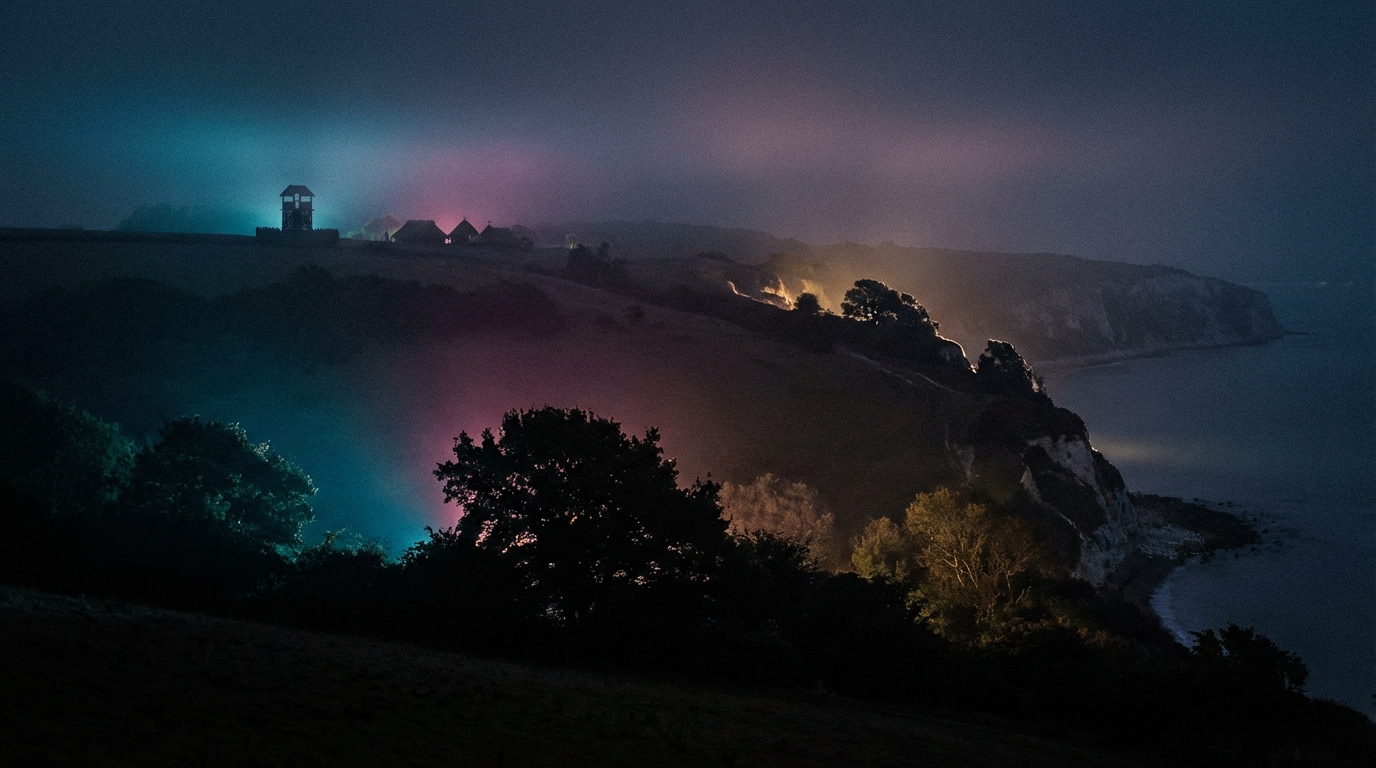
The county covers 1,455 square miles, bordered clockwise by Dorset, Wiltshire, Berkshire, Surrey, and West Sussex, with the English Channel and the Solent forming its southern edge. A broad belt of chalk downland runs from the Hampshire Downs in the northwest to the South Downs in the southeast, reaching heights of nearly 290 metres at Pilot Hill. The chalk gives rise to Hampshire's most celebrated rivers — the Test and the Itchen, which flow south through wooded valleys into Southampton Water, and the Loddon and Wey, which drain northward into the Thames. The Hampshire Avon passes through Fordingbridge and Ringwood before forming the county's western boundary with Dorset. In the southwest, the New Forest preserves one of the largest expanses of ancient woodland and open heathland remaining in England, a landscape whose character was determined not by nature alone but by the violent act of royal appropriation that created it.
Hillforts, Romans, and the Coming of the Saxons
The chalk downland attracted Neolithic settlers who farmed the river valleys and built hillforts on the commanding heights. Iron Age fortifications survive at Winklebury near Basingstoke, Buckland Rings above Lymington, St Catherine's Hill overlooking Winchester, and Oram's Arbour within Winchester itself — the last of these a defended settlement of the Belgae tribe dating from around 100 BC. Hampshire formed part of a broader territory the Celts called Gwent or Y Went, describing the county's open downs, a region that also extended into parts of Somerset and Wiltshire. When the Roman legions arrived, Hampshire was among the first areas to fall. The Romans established their regional capital at Venta Belgarum — modern Winchester — which by the third century had grown into one of the most significant towns in Roman Britain, enclosed by stone walls and connected by roads to Silchester, Portchester, Clausentum at Bitterne, and Old Sarum. At Portchester, near the mouth of Portsmouth Harbour, the fort of Portus Adurni was built between 285 and 290 AD as part of the Saxon Shore defences — one of the best-preserved Roman coastal fortifications in northern Europe, whose massive stone walls would be reused by Norman castle-builders eight centuries later.
After the Roman withdrawal in the early fifth century, the southern portion of the county — particularly the Meon valley and the Hamble estuary — was settled by Jutish tribes, a people distinct from the Saxons and Angles who colonised other parts of England. The Jutes formed small kingdoms along the rivers, including the Meonwara of the Meon valley and the Wihtwara of the Isle of Wight. By the sixth century, the West Saxons had absorbed these communities, and Winchester became the capital of the kingdom of Wessex. The Saxon trading port of Hamwic, established around 700 AD on the site of what would become Southampton, grew into a planned town of remarkable ambition — gridded streets, workshops producing metalwork, bone, leather, and woollen goods, and a harbour trading directly with northern France and the Low Countries. Its population reached an estimated two to three thousand, and it housed a royal mint striking coins for several Anglo-Saxon kings between 786 and 858.
Alfred's Wessex and the Heart of Saxon England
Hampshire's significance in the formation of England itself cannot be overstated. It was here, in the kingdom whose capital stood at Winchester, that the dynasty of Wessex mounted the resistance that prevented the complete Danish conquest of Anglo-Saxon England. In May 878, King Alfred assembled an army drawn from the populations of Somerset, Wiltshire, and Hampshire and defeated the Viking forces at the Battle of Edington — the engagement that preserved Wessex as an independent kingdom and laid the foundation for the eventual unification of England under Alfred's descendants. Alfred rebuilt Winchester with a new street grid, established its mint, and commissioned the Anglo-Saxon Chronicle, the historical record that would prove indispensable to the development of English national identity. His widow Ealhswith founded Nunnaminster in Winchester, and a New Minster was established in the early tenth century. The ecclesiastical reform led by Bishop Æthelwold in the late tenth century made Winchester a centre of monastic revival whose influence extended across southern England.
Viking raids continued to afflict the county despite Alfred's victories. In 860 a Norse host stormed Winchester; in 981 another army sacked Southampton; and in 994 raiders wintered at Southampton, living off the surrounding countryside. Yet by the time of the Norman Conquest, Hampshire was a firmly established shire whose county town had served as the seat of English government for two centuries. Winchester remained the repository of the royal treasury and the site where the Domesday Book itself was initially kept — a symbol of the county's centrality to the governance of the kingdom even as political power began its long migration toward London.
The Conqueror's Forest, the Cathedral, and the Norman Centuries
The Norman Conquest brought two transformations to Hampshire that would define its character for centuries. The first was the construction of Winchester Cathedral, begun in 1079 by Bishop Walkelin to replace the Saxon Old Minster. Built on wooden piles driven into the alluvial soil of the Itchen valley, the cathedral grew to become the longest Gothic cathedral in Europe — 556 feet of nave stretching through the heart of a city that the Normans recognised as second only to London in importance. The shrine of St Swithun, a ninth-century bishop whose cult had made Winchester a major pilgrimage site, ensured a steady flow of visitors and revenue. The bishops of Winchester ranked among the most powerful and wealthy in medieval Christendom — their diocese, stretching across seven counties and encompassing over sixty manors, was second only to Milan in its riches.
The second transformation was the creation of the New Forest. William I, whose love of hunting was legendary, cleared an area of southwestern Hampshire for use as a royal game reserve — an act that chroniclers of the following century denounced as the destruction of churches and villages across more than sixty parishes. The Domesday Book confirms that thirty to forty settlements within the forest boundaries were recorded as being without ploughs, peasants, or value in 1086, their populations displaced or absorbed. The forest's name — recorded in Domesday as simply "new" — became a permanent reminder of an act of dispossession that contemporaries regarded as divine provocation. The death of William Rufus, killed by an arrow while hunting in the New Forest on 2 August 1100, was interpreted by chroniclers as God's punishment for the Conqueror's destruction of settled land. The king's body was carried to Winchester Cathedral for burial.
By the twelfth century, the centre of political power had shifted decisively from Winchester to Westminster, but Hampshire retained its institutional importance. The annual St Giles' Fair, held at the beginning of September on the hill above Winchester, was one of the most significant commercial gatherings in medieval England, drawing traders from the Continent as well as from across the kingdom. Southampton served as the principal port through which England conducted trade with Normandy, Gascony, and the wider Mediterranean — wool and cloth flowing outward, wine, spices, dyestuffs, and luxury goods flowing in. The Domesday survey recorded 44 hundreds and 483 named places across Hampshire, with Winchester and Southampton clearly the dominant settlements and Basingstoke, Christchurch, and Stockbridge of local significance. Portsmouth did not appear in Domesday at all, though its time would come.
Ports, the Navy, and the Reach of Empire
The rise of Portsmouth transformed Hampshire from a county defined by its agricultural interior and its ancient capital into one defined equally by its coastline and its relationship with the sea. In 1194, Richard I granted Portsmouth its first royal charter, and his brother John established a permanent dockyard there in 1212. Henry VII ordered the construction of the world's first dry dock at Portsmouth in 1495, inaugurating a tradition of naval innovation that would continue for five centuries. By the Stuart era, Portsmouth had become the most heavily fortified naval port in the world, and by 1801 it was the ninth-largest town in England — a population surge driven almost entirely by the dockyard and its supporting industries. Southampton, meanwhile, evolved from a medieval wool port into a gateway for transatlantic voyages, military expeditions, and — from the nineteenth century onward — the great ocean liners that connected Britain to its empire and beyond.
Hampshire's ports were not merely points of embarkation for trade and warfare. They were also conduits through which lives were permanently redirected. The Winchester Assizes, held in the Great Hall built by Henry III between 1222 and 1235, sentenced generations of men and women to transportation — first to the American colonies, and after 1788 to the penal settlements of New South Wales and Van Diemen's Land. Convicts tried at Winchester passed through the Hampshire countryside to the waiting ships at Portsmouth or Southampton, their journeys marking the point at which the county's institutional machinery — its courts, its gaols, its harbour infrastructure — intersected with the lives of the poor, the desperate, and the unlucky. The Jeffries family of Hanover Street, Portsmouth, knew this machinery intimately. William Jeffries Sr., born in Portsmouth on 22 April 1785, was tried at the Hampshire Assizes for a crime he did not commit, convicted, and transported aboard the Catherine Roy — one among thousands of Hampshire lives reshaped by the judicial and maritime systems that the county had built to serve the purposes of Crown and Empire. John Langford, born in Southampton in 1791, was sentenced at Winchester to fourteen years' transportation for the theft of navy provisions. Daniel Parsons, also Southampton-born, sailed as ship's cook aboard the Lady Catherine to Van Diemen's Land in 1812. The port towns of Hampshire produced both the ships and the men who sailed in them — some as crew, some as cargo.
The county's reach extended even to the naming of new territories. In 1629, Captain John Mason — who had served as captain of Southsea Castle and held extensive interests in colonial ventures — was granted the territory between the Merrimack and Piscataqua rivers in North America and named it New Hampshire, after the county he considered his adopted home. He never set foot in his namesake colony, dying in London in 1635, but the name endured — one of only a handful of English counties to have given its name directly to an American state.
Civil War, Assizes, and the Georgian County
During the English Civil War, Hampshire was predominantly parliamentary territory, though royalist attempts to hold Southampton, Winchester, and Portsmouth complicated the picture. The Battle of Cheriton, fought near Alresford on 29 March 1644, was a decisive parliamentary victory that ended royalist hopes of advancing on London from the southwest. Winchester Castle, besieged by Cromwell's forces in September 1645, fell on 8 October and was demolished on Cromwell's orders in 1649 — though the Great Hall survived, its thirteenth-century Purbeck marble columns and the medieval Round Table preserved by circumstance rather than intention. The cathedral, too, survived the war, though parliamentary soldiers vandalised its interior, shattering the great western stained-glass window. When the fragments were reassembled in 1660, they were set into the window as a mosaic rather than restored to their original design — a compromise that can still be seen today.
The post-war centuries saw Hampshire settle into its role as a prosperous, predominantly rural county whose character was defined by the institutions concentrated in its principal towns. Winchester, as county town, hosted the Assizes and Quarter Sessions that drew lawyers, officials, and litigants from across the shire. The cathedral, the college founded by William of Wykeham in 1382, and the Hospital of St Cross — England's oldest charitable institution, founded by Henry of Blois in the twelfth century — ensured a permanent population of clergy, scholars, and the educated professionals who served them. The bishops of Winchester remained among the wealthiest and most politically significant in England well into the sixteenth century. Winchester College educated the sons of Hampshire's gentry and professional families, several of whom — including members of the Blackwood, Hawkins, and Whitaker families whose descendants would cross the world to Van Diemen's Land, California, and beyond — carried the county's institutional culture into lives lived far from the chalk downs where they had been raised.
Beyond the county town, the rural interior supported a mixed agricultural economy of corn-growing, cattle-rearing, and timber production for the navy. The exception was Hampshire's remaining coastal industry: salt production, which had flourished at Lymington since the Middle Ages. By the mid-eighteenth century, 163 saltpans were in operation along the coast between Lymington and Hurst Spit, and Lymington salt was exported as far as Norway and Newfoundland. The industry collapsed in the nineteenth century when railway links to the Cheshire salt mines made inland rock salt cheaper than anything the coastal evaporation pans could produce. The last Lymington saltern closed in 1865.
White, Austen, and the Literary Landscape
Hampshire's rural character produced two of the most influential figures in English literary and intellectual history, both of them products of the same quiet downland landscape and the clerical households that sustained it. The Reverend Gilbert White, born at Selborne in 1720, spent his life observing the flora and fauna of his parish with a precision and empathy that had no precedent in English natural history. His Natural History and Antiquities of Selborne, published in 1789, was the first work to study animals in their natural habitat rather than as dead specimens on a dissecting table, and it has been continuously in print ever since — one of the most frequently published books in the English language.
Jane Austen was born at Steventon, near Basingstoke, in 1775 — the year in which the elderly White, fifteen miles away at Selborne, noted the onset of a hard winter in his diary. Her father was rector of the parish, and her early novels were begun in the rectory where she grew up. After periods in Bath and Southampton, she settled at Chawton, near Alton, where she revised Sense and Sensibility, Pride and Prejudice, and Northanger Abbey, and wrote Emma, Mansfield Park, and Persuasion in their entirety. She died in Winchester on 18 July 1817, at the age of forty-one, and was buried in the nave of the cathedral. John Keats, visiting Winchester in the autumn of 1819, was moved by the quality of the light along the Itchen to compose "To Autumn" — a poem whose warmth and melancholy owe everything to the particular character of a Hampshire September.
The Modern County
The nineteenth and twentieth centuries transformed Hampshire's southern coast from a scattering of ports and market towns into a continuous urban belt stretching from Southampton through Fareham and Gosport to Portsmouth. The railway, arriving in the 1840s and 1850s, connected the county's towns to London and to each other, accelerating both population growth and the suburbanisation of the interior. Southampton and Portsmouth were split off as independent unitary authorities in 1997, though they remain part of Hampshire for ceremonial purposes. The ceremonial county's population at the 2001 census stood at approximately 1.64 million, making it one of the most populous counties in England — a transformation driven largely by the London commuter belt's encroachment into the county's northeastern corner and by continued development along the south coast.
Both world wars confirmed Hampshire's strategic importance. Portsmouth endured devastating Luftwaffe raids that killed 930 people and destroyed much of the city centre. Southampton suffered fifty-seven raids, with 631 killed and nearly forty-five thousand buildings damaged — the highest proportion of housing stock lost of any city in the United Kingdom. On 6 June 1944, Hampshire's ports served as the principal departure points for the D-Day landings: troops, vehicles, and landing craft embarked from Portsmouth, Southampton, and a chain of smaller harbours along the Solent coast for the invasion of Normandy. Southwick House, just north of Portsmouth, served as the headquarters of General Eisenhower during the operation.
Today Hampshire encompasses two national parks — the New Forest, designated in 2005, and the South Downs, designated in 2010 — alongside its cathedral city, two major ports, and a rural interior whose chalk streams, ancient woodlands, and downland pastures preserve a landscape that Gilbert White would still recognise. The county's identity remains what it has been since the Saxon trading port of Hamwic first gave it a name: a place defined by the institutions it has built, the people it has produced, and the journeys — willing or otherwise — that have begun within its borders.







