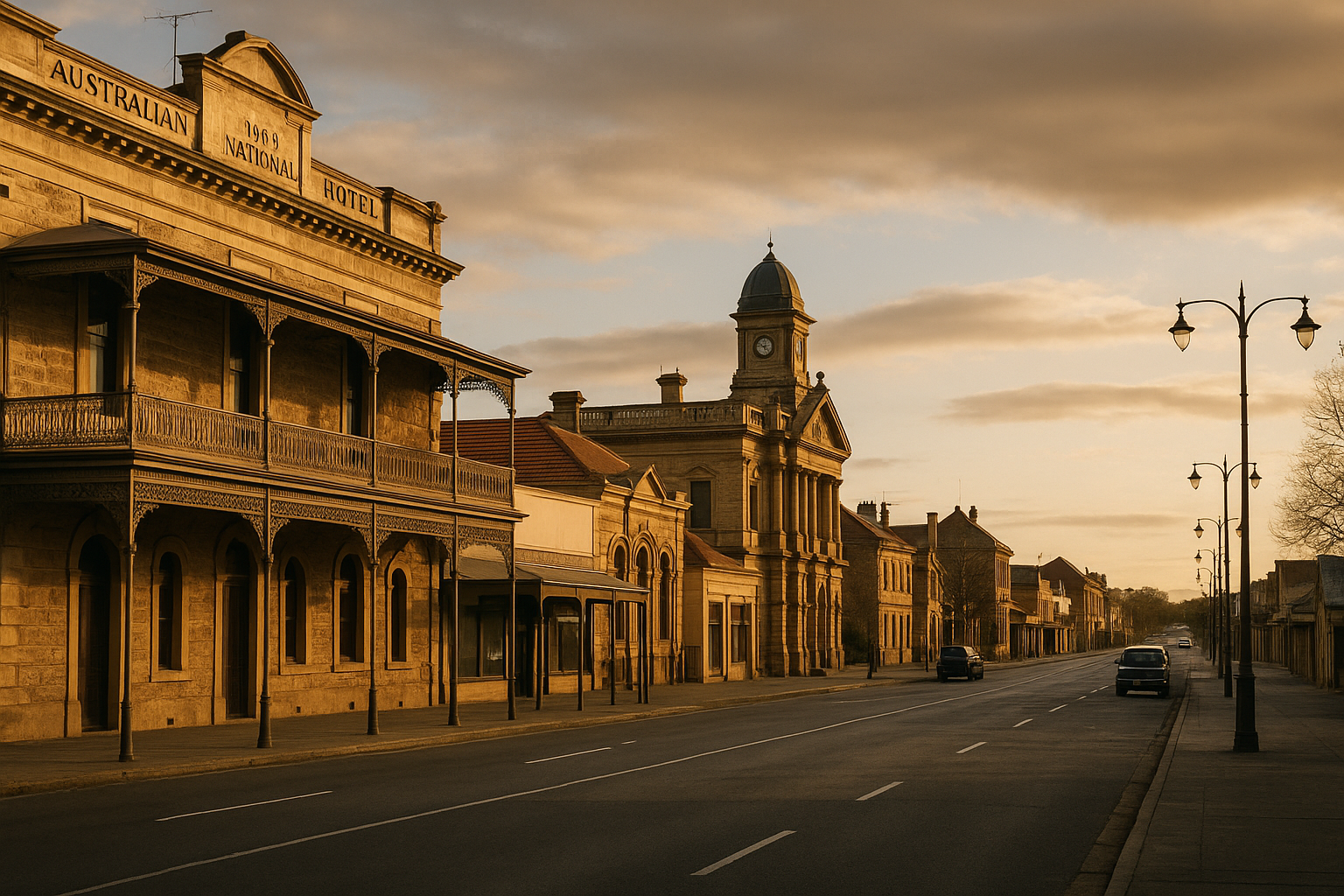
Gawler, South Australia, Australia
Gawler stands at the confluence of the South Para and North Para rivers, approximately forty-two kilometres north of Adelaide. Established in 1839 as one of South Australia's earliest planned settlements, the town has navigated nearly two centuries of transformation—from colonial market town to industrial powerhouse to agricultural community to contemporary satellite suburb. Its grid-pattern streets, heritage limestone buildings, and proximity to the Barossa Valley wine region mark it as both gateway and destination. The town has produced generations of families whose stories interweave with broader Australian narratives: the Jennings farming dynasty whose Irish ancestors planted roots in 1889, the O'Connor family whose Kingsford Smith Pub has served the community since 1932, and countless others whose births, marriages, labours, and deaths have accumulated into the quiet resilience that defines regional Australia. Gawler embodies the tension characteristic of many such places—between heritage and development, agricultural tradition and suburban expansion, the weight of history and the demands of an uncertain future.

Geography and Setting
Gawler occupies a distinctive position in South Australia's geography, situated at the point where the South Para and North Para rivers converge to form the Gawler River. This confluence, which attracted the town's original surveyors, creates a natural amphitheatre of gentle hills and river flats that has shaped development patterns across nearly two centuries. The town lies approximately forty-two kilometres north of Adelaide's central business district, positioning it as both the historic gateway to the Barossa Valley wine region and, increasingly, as the northernmost extent of Adelaide's metropolitan sprawl.
The landscape surrounding Gawler reflects the broader character of the Adelaide Plains and Mount Lofty Ranges transition zone. To the south and west stretch the flat agricultural lands that supported wheat farming through the colonial and federation eras. To the east, the terrain rises toward the ranges, with the road to the Barossa ascending through increasingly undulating country. The rivers themselves, though modest by international standards, provided sufficient flow to power early water mills and continue to define the town's recreational and environmental character.
The climate follows the Mediterranean pattern typical of South Australia—hot, dry summers and mild, wet winters—that has determined agricultural possibilities since European settlement. Rainfall averages approximately 450 millimetres annually, sufficient for dryland farming but requiring careful water management during the extended dry season. This climatic reality has shaped everything from crop selection to building materials, with the local Roseworthy limestone featuring prominently in structures erected during the nineteenth century.
Colonial Foundation and Early Development
The European history of Gawler commenced formally in 1839, when surveyors working under the direction of Colonel William Light's successors laid out the town's distinctive grid pattern. The settlement took its name from George Gawler, South Australia's second Governor, whose administration oversaw the colony's difficult early years. Unlike the eastern Australian colonies, South Australia was established as a "free colony" without convict labour—a distinction that influenced settlement patterns, social attitudes, and civic development throughout the region.
The town plan drew inspiration from English market towns, incorporating deliberate provision for public spaces, wide streets, and integration of the natural landscape. This calculated approach to settlement—more deliberate than accidental—reflected the broader idealism that characterised South Australia's founding. The grid layout, centred on the commercial thoroughfare of Murray Street, established patterns that persist in the contemporary streetscape.
Early settlers arrived seeking opportunities beyond Adelaide's increasingly congested streets. Among them was Eliza Netherby, a widowed milliner from Wiltshire who opened one of Gawler's first haberdasheries in 1842. Netherby's enterprise represented the commercial ambition that animated early settlement, whilst her subsequent role as a founding member of the Ladies' Benevolent Society—an organisation supporting indigent settlers during harsh drought years—demonstrated the civic consciousness that developed alongside commercial activity.
The initial decades of settlement established Gawler's economic foundations in agriculture, particularly wheat and sheep farming. The confluence of the Para rivers made the location suitable for water-powered milling, and flour mills became central to the local economy. Blacksmiths, tanneries, and associated trades clustered around the agricultural core, creating a functional market town that served the surrounding farming district.
Industrial Transformation
The 1860s marked a pivotal transition in Gawler's development with the establishment of the James Martin & Co. Foundry, an enterprise that would transform the town from agricultural service centre into South Australia's early industrial heart. The foundry produced locomotives, mining equipment, and agricultural machinery that were shipped across the Australian colonies, establishing Gawler's reputation far beyond South Australia's borders.
Industrial success attracted workers from Britain and Germany, bringing skills essential to foundry operations but also introducing class consciousness and unionist sentiment that would influence local politics for decades. Workers settled in modest cottages on the town's western fringe, an area that became known locally as "The Soot Rows" for the industrial residue that marked daily life in proximity to the foundry's operations.
Industrial growth brought challenges alongside prosperity. Sanitation in the workers' quarters proved inadequate, and outbreaks of typhoid fever during the 1870s prompted the council's first public health inquiry. The investigation was chaired by Councillor Ernest Quigley, a former stonemason whose personal tragedy—his own daughter succumbed to the disease—lent urgency to reform efforts. The inquiry's recommendations initiated improvements in water supply and waste management that would continue through subsequent decades.
Despite these difficulties, the industrial era fostered cultural development that earned Gawler the nickname "The Colonial Athens" for its enthusiasm for the arts. Cultural figures like Mary-Anne Hilderbrand, a piano teacher and local composer whose students regularly performed at the Mechanics' Institute Hall, contributed to a civic culture that valued education and artistic expression alongside commercial and industrial achievement.
Agricultural Foundations and the Jennings Legacy
While industry shaped Gawler's urban character, agriculture remained fundamental to the surrounding district. On 15 April 1889, William and Margaret Jennings—Irish migrants who had arrived in South Australia seeking opportunity unavailable in their homeland—purchased a farming property north of Gawler for £250. The couple planted an oak sapling to mark the occasion, establishing a symbol that would witness five generations of family stewardship.
The Jennings Family Farm became emblematic of the agricultural perseverance that sustained the region through economic fluctuations, climatic challenges, and social transformation. William's grandson, Thomas Jennings, achieved particular recognition during the 1920s for trialling dryland farming methods that helped stabilise barley yields during periods of low rainfall. His innovations, developed through practical experimentation rather than formal agricultural education, contributed to the broader body of knowledge that enabled farming families to survive the challenges of Australian conditions.
The establishment of the Gawler Women's Agricultural Cooperative in 1934 demonstrated how agricultural communities responded to the Depression's hardships. Founded by Edith Cottenham, a widowed orchardist who understood both the practical challenges and isolation facing women managing small holdings, the cooperative provided mutual aid and education during years when government assistance remained limited. The organisation's success reflected Gawler's characteristic blend of individual initiative and collective support.
Federation, War, and Interwar Development
The early twentieth century brought economic contraction as heavy industry declined. The foundries scaled down operations as demand shifted and competition from larger metropolitan centres intensified. Many younger residents departed for Adelaide or interstate opportunities, beginning a demographic pattern that would recur through subsequent generations.
The First World War drew heavily upon Gawler's population, with over three hundred men from the region enlisting for overseas service. The Gawler War Memorial, erected in 1921, records those who served and those who did not return. Among the names inscribed is Private Francis Colgrave, a farmhand whose letters to his sister—preserved by the local RSL branch—capture both the hardship of trench warfare and the longing for the Para River's quiet banks that sustained men through distant horror.
Jack O'Connor, born 7 August 1895 in Adelaide but destined to become one of Gawler's most significant figures, was among those who served. O'Connor enlisted with the 10th Battalion, Australian Imperial Force, on 21 August 1914 and served at Gallipoli and on the Western Front. His wartime experience, including wounds sustained at Pozières in July 1916 and Passchendaele in October 1917, would shape his subsequent civilian life. More significantly, his military service brought friendship with Charles Kingsford Smith, the aviator whose trans-Pacific flight in 1928 would make aviation history—and in which O'Connor served as navigator aboard the Southern Cross.
The interwar years saw tension between modernisation and social conservatism. Strong Methodist and Anglican congregations resisted the introduction of licensed dance halls and Sunday cinema screenings, whilst agricultural interests advocated for infrastructure improvements that would support farming operations. Educational development continued with the establishment of Gawler High School on 3 February 1936, providing secondary education that had previously required travel to Adelaide.
The Kingsford Smith Pub
The opening of the Kingsford Smith Pub on 12 March 1932 represented both personal achievement and community investment. Jack O'Connor, having returned from aviation work and settled in the Gawler district, constructed a two-storey establishment combining local limestone and red brick in a style reflecting the town's architectural heritage. The pub's name honoured his friend and former comrade, with Kingsford Smith himself attending the opening night as guest of honour.
The establishment's physical character reflected O'Connor's vision for a venue that would serve the community across generations. The main bar, measuring approximately fourteen metres by nine metres, featured an L-shaped counter of Tasmanian blackwood and seven brass taps dispensing local beers. An ancient oak tree planted in 1933—allegedly grown from an acorn provided by Kingsford Smith—shaded the beer garden where returned servicemen gathered for annual ANZAC Day observances beginning that same year.
Following Kingsford Smith's disappearance over the Andaman Sea in November 1935, O'Connor commissioned a memorial that would preserve his friend's memory within the pub's fabric. Artist Eleanor Whitfield, a Gawler resident whose work appeared in several regional venues, painted a mural depicting the trans-Pacific flight—a work measuring 2.4 metres by 1.8 metres that cost £40 and was completed in 1936.
Jack O'Connor married Evelyn Rose Parker, a schoolteacher from Kapunda, on 18 June 1938 at St George's Anglican Church. Their three children—Michael Patrick, born 12 March 1940; Thomas Daniel, born 7 September 1942; and Margaret Rose, born 3 January 1945—would continue the family's connection to both the pub and the broader Gawler community. Jack's death on 15 September 1962, at age sixty-seven, occasioned a funeral at St George's Anglican Church attended by hundreds of mourners, with the Gawler Chronicle publishing a front-page obituary acknowledging his contributions to aviation history and community life.
Post-War Expansion
The decades following the Second World War brought renewed growth and significant transformation. Returned servicemen received low-interest loans enabling home construction, and the Gawler Housing Board oversaw development of Willaston Estate to accommodate young families and war widows. Bitumen roads replaced gravel throughout the town, water mains extended to previously unserviced areas, and the infrastructure of modern suburban life gradually displaced older patterns.
Educational facilities expanded to serve the growing population. Gawler Primary School, which had served the community since its establishment on 2 February 1857, saw enrolments increase from wartime levels of approximately 180 students to over 400 by 1975. Gawler High School, rebuilt in 1956 under the leadership of Headmaster Albert Wallingford, introduced vocational programmes in agriculture, automotive mechanics, and textiles alongside academic streams. Wallingford's modest but notable gesture of introducing the school's first Aboriginal Studies curriculum demonstrated progressive currents within an otherwise conservative community.
The Gawler Agricultural Show grew in size and profile during these years, featuring equestrian events, produce competitions, dairy goat judging, and attractions that drew visitors from throughout the region. The town's public library, first housed in a converted post office storeroom, moved into purpose-built quarters in 1972 following sustained lobbying by local residents—an achievement that reflected both civic ambition and the value placed on education and literacy.
Notable Families and Community Character
The post-war generation included individuals whose lives would interweave with Gawler's subsequent development. Gregory Selway, born 14 March 1945, would become an agricultural innovator whose sustainable farming practices earned regional recognition. Alfred Ronald Harris, born 14 September 1945, assumed management of the Kingsford Smith Pub from his grandfather Jack O'Connor's family in March 1965 and continues to serve the establishment into his eightieth year. Rosalind May Winters, born 22 June 1947 to the family operating Winters Orchard on Gawler's southern outskirts, married Alfie Harris on 12 April 1969 and became integral to the pub's operations.
The Jennings family continued their agricultural presence across multiple generations. Brian Edward Jennings, born 3 September 1945, married Patricia and served on the town council whilst modernising farming techniques on the family property. His son Cody Brian Jennings, born at Hutchinson Hospital on 15 August 1968, represented the fourth generation of the family's Gawler presence. Brian's death in November 1997 at age fifty-two passed stewardship to the next generation, with daughter Anne Elizabeth, born 22 November 1970, eventually assuming leadership of the farming operation.
Other Jennings children pursued paths that carried Gawler's influence beyond the region. Janice Marie Jennings, born 12 September 1975, trained as a nurse following graduation from Gawler High School in 1993 and served as a Clinical Nurse Specialist at Royal Adelaide Hospital until her death in November 2019 at age forty-four. Kenneth Oliver Jennings, born 29 January 1978, discovered musical talent at the family's piano and pursued an international career as a concert pianist, carrying compositions inspired by Gawler's landscapes to audiences worldwide.
Contemporary Transformation
The late twentieth and early twenty-first centuries have witnessed Gawler's reinvention as suburban expansion from Adelaide transformed the town's character and demographics. With the decline of full-time farming and the rise of boutique agriculture—olive oil production, heritage fruit cultivation, alpaca wool—the economic base shifted toward patterns more characteristic of peri-urban communities than traditional regional towns.
The Gawler Farmers' Market, established in 2004, showcases this transformation. Operating on Saturday mornings, the market offers sourdough bread, quince paste, organic honey, and local produce alongside live folk music—a conscious cultivation of artisanal identity that appeals to both long-term residents and newcomers attracted by the town's heritage character and proximity to Adelaide.
Environmental stewardship has become increasingly prominent in Gawler's contemporary identity. The Barossa Bushgardens, a community-led project on the town's outskirts, began in 1999 as a weed-removal initiative and has expanded to host workshops on native gardening, water conservation, and land regeneration. Such efforts reflect growing awareness of environmental challenges facing the region, including biodiversity loss, water scarcity, and the impacts of climate change on agricultural viability.
Urban encroachment from Adelaide has presented both opportunities and challenges. Infrastructure investment and increased tourism have benefited the local economy, whilst concerns about suburbanisation, loss of agricultural land, and cultural dilution of Gawler's regional identity have animated community debate. The tension between development pressure and heritage preservation—evident in planning disputes, conservation campaigns, and shifting property values—reflects broader Australian conversations about the character of peri-urban communities.
Institutional Continuity
Several institutions established across Gawler's history continue to serve the contemporary community. Gawler Primary School, approaching its 170th anniversary, maintains the original 1857 building as a heritage-listed museum whilst operating modern facilities on the expanded grounds. Gawler High School, having navigated nearly nine decades of educational and social change, continues to provide secondary education with particular strength in agricultural science and environmental studies—programmes that reflect the town's character whilst preparing students for contemporary challenges.
The Kingsford Smith Pub remains a gathering place where community rhythms find expression. Alfie Harris, now approximately eighty years old, has reduced his daily involvement whilst maintaining evening shifts that connect present patrons with nearly a century of continuous hospitality. His daughter Emily Harris manages daily operations, representing the fourth generation of family stewardship since Jack O'Connor's original establishment. The hand-painted mural commemorating the trans-Pacific flight, the ancient oak in the beer garden, and the brass taps at the blackwood counter persist as tangible links to the pub's Depression-era origins.
Hutchinson Hospital, established in 1912, has served as the birthplace for generations of Gawler residents and continues to provide medical services to the community. St George's Anglican Church, site of countless weddings, funerals, and baptisms—including Jack O'Connor's marriage to Evelyn Parker, Alfie Harris's marriage to Rosalind Winters, and Brian Jennings's memorial service—maintains its central role in the town's spiritual and social life.
Character and Significance
Gawler embodies tensions characteristic of many Australian regional communities approaching their second century. The planned colonial settlement has become a complex contemporary place where heritage buildings neighbour modern developments, where fourth-generation farming families encounter newcomers attracted by lifestyle considerations, and where the pace of change alternately threatens and revitalises traditional community character.
The town's significance extends beyond its local boundaries. As gateway to the Barossa Valley, Gawler serves visitors seeking wine tourism whilst maintaining its own distinct identity. As northern terminus of Adelaide's suburban expansion, it represents the frontier where metropolitan and regional Australia negotiate coexistence. As repository of colonial, industrial, and agricultural heritage, it preserves physical and cultural evidence of broader Australian development patterns.
Yet Gawler's essential character may be found less in such abstractions than in the accumulated particulars of community life: the families whose generations have overlapped in school classrooms and church pews, the businesses that have served customers across decades, the annual rituals of agricultural shows and ANZAC services that mark time's passage, and the countless individual stories that constitute collective memory. The restless young person sensing possibilities beyond familiar horizons, the publican who knows each patron's preferred drink, the farmer calculating whether this season's rainfall will suffice—such figures have populated Gawler across its history and continue to define its present.
The town persists as both place and idea: a specific location where particular people have lived particular lives, and a representative instance of the regional Australian experience with its characteristic blend of constraint and possibility, tradition and adaptation, rootedness and restlessness. In this tension between the specific and the general, the local and the universal, Gawler finds its enduring significance—a significance likely to persist through whatever transformations the coming decades may bring.
