Frederick Woolley
Frederick Woolley was born in Wootton, Oxfordshire, on 12th March 1805, the third of eight children of Thomas and Agnes Woolley. He emigrated with his family to Van Diemen's Land aboard the Morley in 1820 and secured employment as a post boy in the colonial postal service at sixteen, beginning a career that would span nearly five decades. His delivery of a mysterious letter to Jeffries Manor in August 1821 placed him at the periphery of one of colonial Tasmania's most enduring mysteries. He married Elizabeth Turner in 1837, fathered four children, and rose to become postmaster of Hobart. He died on 5th January 1870, aged sixty-four.
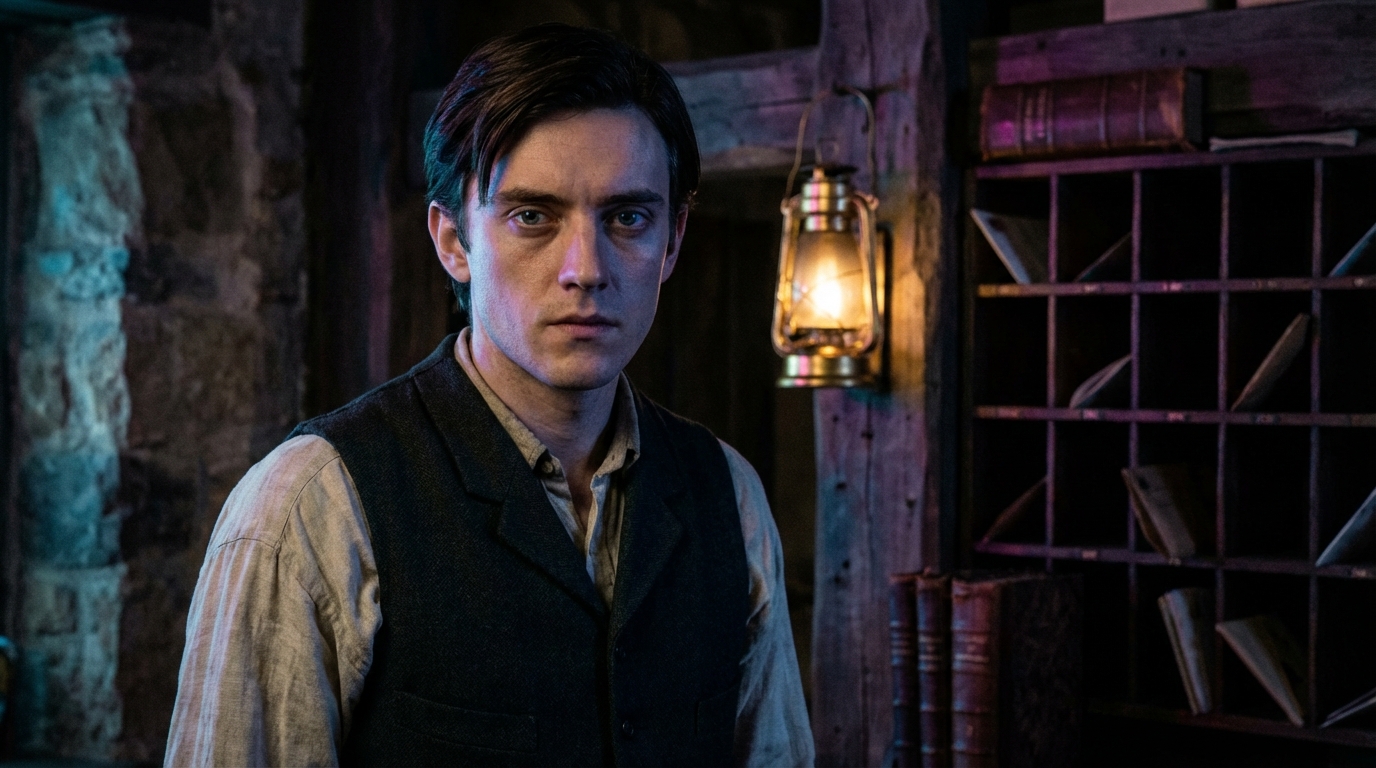
The Third Child (1805–1819)
Frederick Woolley entered the world on 12th March 1805 in the cottage on Pound Lane, Wootton, Oxfordshire, the third child and second son of Thomas Woolley Sr. and his wife Agnes, née Evans. Elizabeth was four, Henry approaching two—the household already contracted by poverty and the slow failure of Thomas Sr.'s cobbling business. Agnes, at twenty-six, was establishing the midwifery practice that would gradually supplant her husband's trade as the family's primary income, though the long hours attending births in neighbouring villages left her increasingly absent from the domestic sphere her children inhabited.
Frederick's earliest memories would always carry the smell of leather and the sound of his father's hammer—the rhythmic percussion of a craft being practised with diminishing returns. Thomas Sr.'s workshop occupied the front room of the cottage, and the tanning solutions, the stretched hides, the worn tools accumulated over generations of Woolley cobblers created the sensory landscape of Frederick's infancy. But the workshop's output was declining. Grandfather William Woolley's death in 1808 brought debts rather than inheritance, and the encroachment of factory-produced footwear from the expanding industrial centres meant that even competent village cobblers found their custom evaporating.
Frederick occupied a position in the family order that granted him neither the authority of the eldest children nor the indulgence afforded to the youngest. Elizabeth, as firstborn daughter, served as Agnes's deputy. Henry, as eldest son, carried the weight of paternal expectation. Frederick existed in the space between—present, unremarkable, absorbing everything. He proved a quiet child, observant rather than demanding, with an unusual facility for remembering details that others overlooked. The parish schoolmaster, when Frederick attended sporadically between the ages of six and ten, noted his aptitude for numbers and his exceptional recall, though any thought of extended education was fantasy in a household where school fees competed with bread for the family's diminishing resources.
The subsequent arrivals of Sarah in 1807, John in 1809, Thomas Jr. in 1812, George in 1814, and Mary in 1817 transformed the Pound Lane cottage into an exercise in compression. Eight children and two adults in two rooms required that every member of the household learn to occupy minimal space, to modulate their needs according to available resources, to accept scarcity as the normal condition of existence. Frederick adapted to these constraints more readily than his siblings. Where Henry chafed against limitation and Elizabeth managed it through authority, Frederick developed the particular skill of being useful without being conspicuous—a talent that would prove invaluable in the career that awaited him.
His father's dark moods—those periods of withdrawal that descended without warning and could last for days—affected Frederick differently from his older siblings. Elizabeth interpreted them as obstacles to be managed. Henry experienced them as threats. Frederick watched with the detached attention of a child who understood, instinctively, that accurate observation was the surest form of self-preservation. He catalogued the warning signs: the set of his father's shoulders before a retreat, the particular quality of silence that preceded eruption, the way Agnes adjusted the household's rhythms to accommodate what could not be prevented. These skills in reading atmosphere and anticipating consequence would serve him throughout a life spent handling other people's correspondence and the secrets it contained.
The Voyage and Arrival (1820)
The family's decision to emigrate crystallised during the winter of 1818–1819, when the post-Napoleonic depression that had been eroding rural England's economy finally made the Woolley household's position untenable. Frederick, at fourteen, understood the decision's necessity with the pragmatism that characterised his approach to circumstances beyond his control. England offered nothing; the colonies offered uncertainty, which was at least a different proposition from the certainty of continued decline.
The Morley departed Deptford on 15th February 1820, carrying the Woolley family and their fellow emigrants toward Van Diemen's Land. The voyage lasted four months, and Frederick experienced it with the same quiet attentiveness he brought to everything. He observed the ship's hierarchies, memorised the crew's routines, noted which passengers adapted and which did not. The storm off the Cape of Good Hope, which terrified most of the emigrants and reduced Thomas Sr. to paralysed inaction, revealed in Frederick a capacity for calm under pressure that his family had not previously recognised. He helped secure cargo, assisted with rationing, and maintained the kind of steady competence that experienced sailors noticed and appreciated.
The family's arrival in Hobart Town on 18th June 1820 deposited fifteen-year-old Frederick into a settlement that was simultaneously raw and full of possibility. The Goulburn Street cottage that became their colonial home provided more space than Wootton but also confronted the family with realities that emigration pamphlets had not advertised—the omnipresence of convict labour, the settlement's rough social fabric, the distance between promise and actuality that defined colonial existence. Agnes established her midwifery practice rapidly, her skills in immediate demand. Thomas Sr. struggled to find purpose, his cobbling trade as redundant in Hobart as it had become in Oxfordshire. Frederick, watching his father's continued displacement, resolved that his own colonial life would be built on skills the colony actually needed.
The Post Boy's Burden (1821–1828)
In early 1821, Frederick secured the position that would define his trajectory—post boy for the colonial postal service. The role required delivering mail to outlying properties across the expanding settlement, journeys that could last days through terrain where bushrangers, escaped convicts, and the landscape itself presented constant hazards. The work demanded physical endurance, navigational competence, and above all the discretion that came with handling correspondence whose contents could alter lives, destroy reputations, or reveal secrets their authors believed safely sealed. Frederick, at sixteen, possessed all three qualities in measures that his employers quickly recognised.
The pivotal delivery came on 2nd August 1821. Frederick was tasked with carrying a letter to Jeffries Manor, one of the colony's most prominent estates. The letter bore no return address and was sealed with an unfamiliar wax crest—details that Frederick's trained eye registered automatically. The manor's butler, Thomas Whitfield, received the correspondence with visible unease, and Frederick sensed an atmosphere within the household that his experience of reading domestic tension made immediately legible: something was wrong, or was about to be.
One week later, on 9th August 1821, William Jeffries Sr. disappeared. The wealthy entrepreneur vanished from his estate without explanation, leaving behind a young wife, an infant son, and a household suffocating in whispered speculation. The investigation that followed—led by Constable Broadmoor amidst reports of strange letters sealed in crimson wax, visitors whose descriptions shifted in the retelling, and sounds from locked rooms that defied rational explanation—would become one of colonial Tasmania's most enduring mysteries.
Frederick's role in these events was peripheral but indelible. He had been the last known person to deliver correspondence to the manor before the disappearance. The letter he had carried—its contents never established, its sender never identified—became one of the investigation's many loose threads. Frederick provided what testimony he could: the unmarked letter, the unfamiliar crest, Whitfield's reaction. Beyond these facts he had nothing to offer, yet the experience embedded itself in his consciousness with a permanence that decades would not diminish. He had carried something into that house whose consequences he could neither understand nor forget, and the knowledge that ordinary service could entangle a man in events far beyond his comprehension shaped his subsequent approach to every letter, every delivery, every sealed document that passed through his hands.
Rising Through the Service (1828–1837)
Frederick's reliability and discretion brought him to the attention of James Morrison, the postmaster of Hobart Town. Morrison, who ran the postal service with the precision of the military career he had left behind, recognised in Frederick qualities that transcended mere competence: an ability to calculate routes efficiently, remember names and addresses without error, and maintain absolute silence about the correspondence he handled. In 1828, Morrison offered Frederick a position as junior clerk in the post office itself—a promotion that exchanged the physical dangers of bush riding for the subtler challenges of managing a colony's written communications from behind a counter.
The transition from post boy to clerk marked Frederick's entry into Hobart's administrative infrastructure. He learned to navigate the intricate relationships between government, military, and commercial interests that the postal service both facilitated and observed. Every letter that passed through his hands carried information whose significance he was trained to ignore but could not help absorbing. He became senior clerk in 1832, assistant postmaster in 1834, and by the time Morrison retired in 1835, Frederick's appointment as postmaster of Hobart Town was the natural conclusion of fifteen years spent mastering a service that most colonists took for granted.
The appointment was not without controversy. Several longer-serving employees resented the promotion, and whispers about Morrison's favouritism circulated through the close networks of colonial administration. Frederick addressed these challenges through the only method he trusted—scrupulous fairness and relentless work. He arrived before any other employee and departed after all had left. He maintained standards that even his critics could not fault and demonstrated a political neutrality that, whilst it prevented the kind of patronage-based advancement more flexible men achieved, ensured his position survived every change of colonial administration.
Marriage and Family (1837–1845)
Frederick first encountered Elizabeth Turner at St David's Church in September 1836. She had recently arrived in the colony with her family—her father James Turner, a Portsmouth merchant whose business had failed, seeking colonial reinvention of the kind that Frederick's own family had pursued sixteen years earlier. Elizabeth, at twenty-three, possessed the practical intelligence and quiet competence that Frederick valued above beauty or social accomplishment. Their courtship proceeded with the propriety expected of a government official and a merchant's daughter: supervised walks, carefully chaperoned teas, and the gradual recognition that their temperaments were complementary rather than passionate.
The wedding on 15th April 1837 at St David's Church was modest but respectable, attended by the network of colonial administrators and established families that Frederick's position required him to maintain. Elizabeth wore grey silk that would serve for best occasions for years afterward. Morrison, Frederick's mentor, stood as best man. The ceremony established Frederick and Elizabeth as a legitimate Hobart household—respectable, solvent, and positioned precisely where Frederick's careful planning had intended.
Their first child, Eliza, arrived on 20th August 1838 after a difficult labour that left Elizabeth weakened for months. Frederick, whose own childhood had been defined by paternal distance, found himself unexpectedly moved by his daughter's dependence. Thomas followed on 3rd February 1840, William on 18th May 1843, and Mary on 4th December 1845, completing a family of four that tested Frederick's salary without exceeding his capacity to provide. He established education funds for each child—small amounts saved weekly with the discipline that poverty had taught him—determined that his children would receive the learning his own circumstances had denied.
The Postmaster's Decades (1845–1865)
The discovery of gold in Victoria in 1851 created chaos across all colonial services as workers abandoned their positions for the goldfields. Frederick lost more than half his postal staff in three months, yet managed to maintain services through extended working hours and the recruitment of workers others might have rejected—women, older men, and reformed convicts whose reliability he assessed with the same careful observation he applied to everything. His brother Henry, prospering in Launceston's grain trade during the gold rush demand, would later note with characteristic resentment that Frederick's postal service career attracted the kind of public respect that commercial success could not purchase.
The deaths of his parents—Thomas Sr. on 22nd May 1853, Agnes on 9th August 1855—reached Frederick as milestones in a grief that had been accumulating since the family left Oxfordshire. His father's passing severed the final connection to the man whose dark moods and failed ambitions had driven the emigration that shaped all their lives. Agnes's death cut deeper. She had been the family's engine, the midwife whose competence sustained them through poverty in two hemispheres, and her absence left a silence that Elizabeth's steady companionship could not entirely fill.
His handling of sensitive correspondence during the political tensions of the 1850s and 1860s demonstrated both the discretion he had cultivated since his post boy years and the principles that discretion served. When pressured by various factions to reveal the contents or destinations of certain letters, he maintained strict confidentiality, earning respect from all parties even as it made him no faction's particular ally. The Jeffries mystery, never resolved, remained a constant undertone in his professional consciousness—a reminder that sealed letters could contain consequences no courier could anticipate.
John's death on 19th March 1864, from injuries sustained in a farming accident in the Huon district, confronted Frederick with the vulnerability that shadowed even careful lives. His brother had been the family's quiet observer, the one who carried knowledge he could never share, and his death at fifty-five reminded Frederick that the Woolley men were not guaranteed the longevity that their mother's Evans bloodline had provided Agnes.
Decline and Death (1865–1870)
By the mid-1860s, the accumulated toll of decades spent working beyond reasonable limits had begun manifesting in ways Frederick could not conceal. His hands developed a tremor that compromised the precise handwriting upon which his professional reputation partly rested. His memory, once exceptional, showed gaps that frightened him more than any physical symptom. Chest pains he had initially dismissed as digestive complaint became frequent enough to require acknowledgment, if not the medical attention he could not afford to publicise.
Elizabeth observed her husband's deterioration with the same quiet competence she brought to all domestic management, gradually assuming responsibilities he could no longer sustain whilst maintaining the fiction of his continued capacity. Their relationship, which had begun as practical alliance and deepened through decades of shared labour, achieved during these final years a tenderness that neither would have predicted from the restrained courtship of 1836.
Frederick applied for retirement in 1868, citing age and health. The colonial administration, recognising his service, granted a pension sufficient to maintain Elizabeth after his death—the provision that had motivated his negotiations above all other considerations. His final years were spent organising papers with obsessive thoroughness, destroying some documents whilst carefully preserving others, as though curating the evidence of a life that had been lived in service to systems whose inner workings he understood better than most.
Death and Burial
Frederick Woolley died on 5th January 1870, aged sixty-four. The end came gradually—a weakening over several days, attended by Elizabeth and their daughter Eliza, who had returned from Launceston for the vigil. His final words were too faint to be reliably recorded, though Elizabeth believed he had said something about letters.
The funeral at St David's Church drew a substantial gathering—government officials, postal workers past and present, and citizens who recognised that the colony's communications had been sustained for nearly fifty years by this quiet, meticulous man. The eulogy praised his duty and dedication in terms that were accurate without being revealing, the kind of carefully constructed public language that Frederick himself had spent a lifetime handling.
He was buried in Cornelian Bay Cemetery, the headstone marked with his name, dates, and the inscription "Faithful Servant"—words that captured the visible architecture of his life whilst concealing the hidden chambers that the Jeffries mystery and a lifetime of managing other people's secrets had constructed within it. Elizabeth, who would outlive him by twenty-three years, maintained his papers and his memory with the same steady competence she had brought to their marriage, ensuring that the quiet postmaster's contribution to colonial Tasmania was not entirely forgotten.







