
Fern Tree, Tasmania, Australia
Fern Tree is a small residential suburb perched on the eastern slopes of kunanyi/Mount Wellington, approximately twelve kilometres from Hobart's central business district. Characterised by its position at the threshold between urban settlement and ancient Tasmanian wilderness, the suburb has long attracted those seeking contemplative solitude without complete isolation. The inexplicable disappearance of the Triffett family in August 2018 transformed Fern Tree's reputation, leaving the community to grapple with mysteries that resist conventional explanation.
Location and Geography
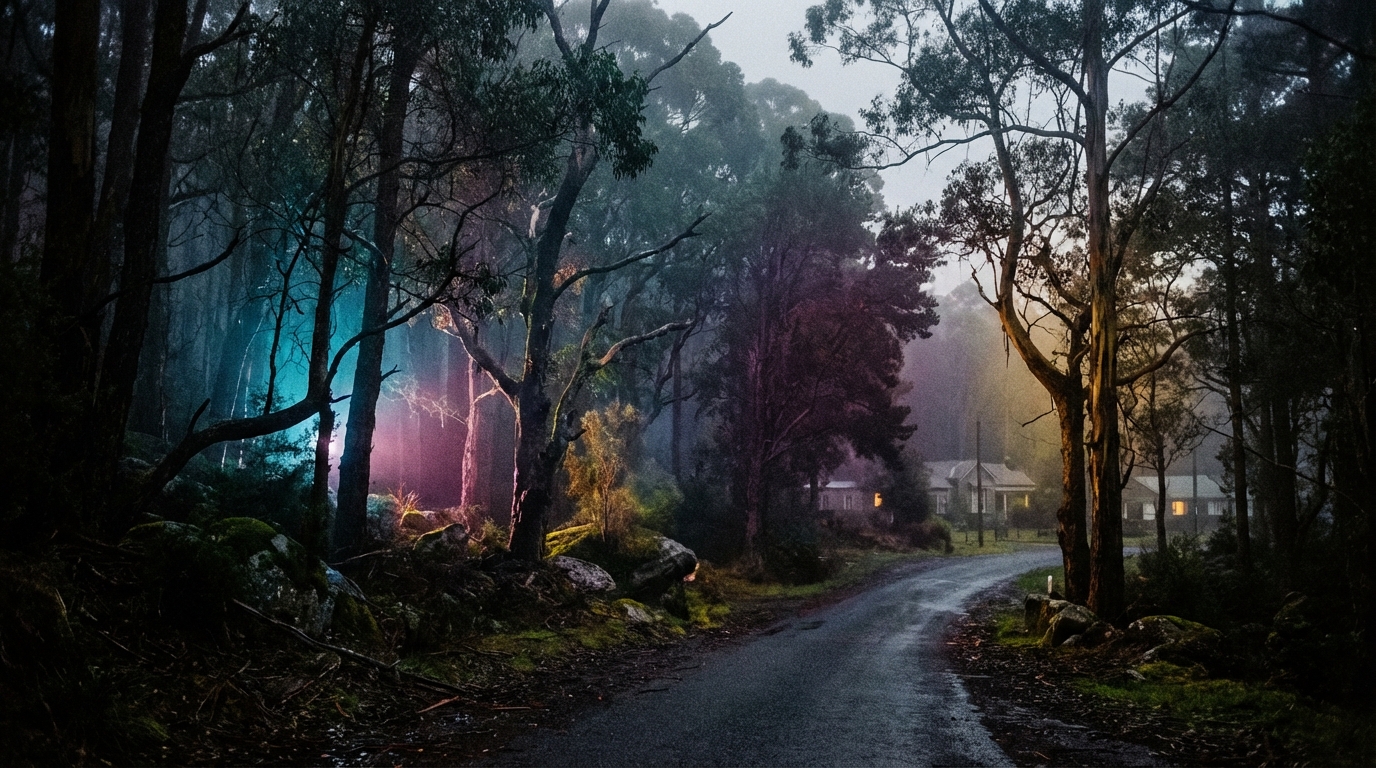
Fern Tree occupies a distinctive position within greater Hobart, situated where the island's capital dissolves gradually into the wild forests clothing kunanyi/Mount Wellington's imposing flanks. The suburb extends across the mountain's eastern slopes at elevations ranging from approximately three hundred to five hundred metres above sea level, creating a residential zone where human habitation exists in constant dialogue with the ancient landscape surrounding it. The terrain rises steeply in places, with properties often occupying narrow strips of cleared land between the road and the encroaching bush.
The mountain itself dominates every aspect of Fern Tree's existence. Kunanyi, as the Palawa peoples have known it for millennia, rises to 1,271 metres, its dolerite-capped summit visible from throughout Hobart and serving as the region's most recognisable landmark. From Fern Tree, the peak looms with an immediacy impossible in the city below, its weather patterns directly influencing the suburb's microclimate. Morning mists frequently settle amongst the tree ferns and eucalypts, creating atmospheric conditions that earned the locality its name and contribute to its somewhat mysterious character.
The roads serving Fern Tree wind through terrain that resists straightforward navigation. Pillinger Drive, where the Triffett family made their home, exemplifies this pattern—a narrow, tree-lined street where human habitation dissolved gradually into wild Tasmanian bush. Properties along such roads occupy that liminal space characteristic of Fern Tree itself, neither wholly urban nor completely rural, positioned on the threshold between Hobart's cultivated edges and the ancient forests that have clothed these slopes since time beyond reckoning. The suburb's boundaries blur where residential streets give way to walking tracks ascending toward the summit or descending toward the Springs, creating transitions that feel less like edges than gradual dissolutions.
Historical Development
The land encompassing Fern Tree had been home to the Muwinina people for tens of thousands of years before European arrival, the Aboriginal inhabitants maintaining complex relationships with kunanyi that integrated the mountain's resources, spiritual significance, and seasonal patterns into their cultural practices. The British colonisation of Van Diemen's Land from 1803 onwards initiated processes of displacement that would fundamentally alter the area's human geography, though the mountain itself remained largely beyond agricultural exploitation due to its terrain and climate.
European settlement of the Fern Tree area developed gradually during the nineteenth century, initially as a route toward the mountain's higher reaches rather than as a destination in itself. The locality's name derived from the tree ferns that thrived in the moist, sheltered gullies characteristic of the eastern slopes, their presence marking conditions too wet for conventional agriculture but suitable for timber extraction and, eventually, residential development. By the early twentieth century, Fern Tree had begun attracting those seeking retreat from Hobart's increasingly industrialised character, establishing patterns of occupancy that would define the suburb for generations.
Through the mid-twentieth century, Fern Tree evolved from scattered retreats to a more established residential community, though it retained the sense of separation from urban Hobart that had attracted its earliest settlers. The population expanded beyond its earlier retreat-community origins during the 1970s, when suburban development reached areas previously considered too remote for comfortable commuting. Houses constructed during this period, including the pale blue weatherboard dwelling at 5 Pillinger Drive that would become the Triffett family home, exemplified classic Tasmanian countryside design adapted to the suburb's particular conditions—substantial construction for weather resistance, generous verandahs for enjoying views when conditions permitted, and proportions that balanced comfortable living with the modest scale appropriate to forested settings.
Suburban Character
Contemporary Fern Tree maintains characteristics distinguishing it from Hobart's more conventional suburbs. The population remains relatively small, creating a community where residents recognise neighbours and notice unfamiliar vehicles on quiet streets. Properties typically occupy generous blocks, with gardens transitioning imperceptibly into surrounding bushland rather than terminating at defined boundaries. The suburb attracts a particular demographic—writers, scientists, environmentalists, creative professionals, and families who value contemplative solitude without complete isolation.
The artistic community Fern Tree has attracted over decades creates neighbourhood culture that differs markedly from more suburban alternatives. Conversations at local gathering points touch on environmental philosophy, creative projects, and the particular challenges and pleasures of mountain living. This intellectual atmosphere, combined with the physical beauty of the setting, has made Fern Tree desirable for those whose priorities extend beyond property values and commuting convenience. The suburb offers something increasingly rare in contemporary Australia—genuine connection to landscape that isn't merely aesthetic but daily, practical, and occasionally demanding.
Yet Fern Tree's character carries complications alongside its attractions. The same isolation that provides peace can become claustrophobic. The tight-knit community that offers support can also sustain rumour and speculation. The proximity to wilderness that delights during fine weather becomes threatening when storms descend from the mountain or bushfire risk elevates. Properties that seem charmingly secluded during summer weekends feel exposed during winter nights when mist obscures neighbouring houses and sounds carry strangely through fog. The suburb's liminal quality—neither urban nor wild, neither connected nor isolated—creates ambiguity that can tip toward unease when circumstances turn strange.
The Triffett Family
The pale blue weatherboard house at 5 Pillinger Drive, constructed in 1974 by local architect Stephen Hargrave, became home to the Triffett family when Nial and Jenny purchased the property in 2015, shortly after their 25 June wedding. The couple had been together since university days, and though their son Sammy had arrived the previous October, the house represented their first significant joint investment—a space they could genuinely claim as their own and transform according to their shared vision.
The location suited both their circumstances and sensibilities. Jenny's teaching position at St Michael's Collegiate School required reasonable commuting distance to Hobart's centre, which Fern Tree provided without sacrificing the quieter environment they preferred. Nial's fencing business, Triffett Fencing Solutions, operated throughout greater Hobart and southern Tasmania, making the Fern Tree location practical for accessing job sites whilst maintaining space for a home workshop. But beyond practical considerations, the house and its setting appealed to something deeper in both their natures—the proximity to Mount Wellington's walking tracks for Nial's love of outdoor activities, the artistic community for Jenny's creative inclinations, the solid character of the house itself offering a canvas they could gradually reshape.
The first years of Triffett occupancy transformed the dwelling from merely functional house into genuine family sanctuary. Nial approached property maintenance with a craftsman's attention, personally constructing garden fencing that demonstrated the quality workmanship his business reputation was built upon. Jenny brought creative warmth to the interior spaces, where her love for the arts manifested in carefully curated details—bookshelves holding eclectic collections spanning theatre history and children's literature, walls displaying framed posters from performances she had directed, and increasingly, Sammy's artwork evolving from childish scribbles into more recognisable representations of his expanding world.
The arrival of Buffy, their Dalmatian, in late 2017 added joyful chaos to household routines. Dog doors were installed, feeding stations established, portions of the garden designated for canine activities. The family appeared, to all external observation, to be thriving—young parents building a life together in a suburb that suited their values, their toddler growing within sight of the mountain, their future seemingly secure in the foundation they were constructing.
Events of July 2018
The unravelling began with a phone call in the cold stillness of a winter night. On 28 July 2018, Jenny Triffett feigned sleep as her husband answered a cryptic call, his hushed voice and secretive manner confirming suspicions that had been mounting for months. Something was not right. Nial's growing distance, his unexplained absences, the financial strain he tried to hide—all converged in that pre-dawn moment when Jenny recognised that the life they had built was fracturing along lines she could not yet trace.
What Jenny did not know was that Triffett Fencing Solutions had been teetering on the edge of collapse for months. An accounting error discovered in 2017 had revealed systematic problems spanning multiple years, creating tax obligations and penalties that threatened to destroy everything Nial had built. By July 2018, creditors were threatening legal action, outstanding invoices could not be collected fast enough to meet immediate obligations, and the reputation Nial had established through eight years of quality work risked destruction through financial failure having nothing to do with his actual craftsmanship. He needed a miracle—and when Luke Smith's call came offering an urgent commercial project worth one hundred thousand dollars cash, desperation overwhelmed scepticism.
The morning of 28 July unfolded in the Fern Tree household with an atmosphere of mounting unease. Jenny prepared for a crucial doctor's appointment with Sammy, whose unsettling behavioural changes had been adding to her concerns. The familiar motions of domestic life—breakfast preparation, dressing her son, navigating the gentle disorder of toddlerhood—felt performed beneath the weight of unspoken fears. As she prepared to leave, an unmarked car with tinted windows sat across the street, its presence stirring a deep instinct to be wary. The morning's routine became a careful departure, each step shadowed by the possibility of unseen eyes.
Returning home that afternoon, Jenny discovered Nial's absence and an unsettled house. His usually locked office stood ajar, revealing a disturbing list containing names, some heavily crossed out—including Dr Carmichael's, the paediatrician she had just visited. His laptop was gone, the desk cleared of materials that normally cluttered its surface. The family dog Buffy adopted a tense, focused stance at the side fence, responding to presences Jenny could not perceive. And when she discovered Sammy's bed empty and the back door ajar, the day's accumulating unease crystallised into genuine terror.
Relief at finding Sammy in the sandpit proved short-lived when the boy described events that defied rational explanation. The back door, he said, was already open when he woke. A man had come—a man who took Buffy through a strange circle of coloured light that appeared in the garden. The rainbow portal, as Sammy would later describe it to police officers who struggled to record testimony from a four-year-old, had simply appeared and then vanished, taking the family pet with it. Jenny's grasp on reality, already strained by the day's accumulating strangeness, began to splinter.
Official Response
When Jenny's mother Rowena arrived unannounced that evening, her sharp elegance and unfiltered judgement reopened old tensions even as her presence stirred unexpected comfort. The conversation in the dining room pushed Jenny into speaking aloud what she had resisted admitting even to herself—that Nial was missing, that something was profoundly wrong, that the life she had built in this Fern Tree house was collapsing around her. The admission made the situation heavier, shifting it from private fear to shared, tangible fact.
The police officers who arrived in response to Jenny's call about her missing husband brought presence that felt detached rather than reassuring, their demeanour raising as many doubts as it offered comfort. The interview that followed tested Jenny's composure as she recounted the day's events—the phone call, the strange car, the open office, Sammy's testimony about rainbow lights and a man taking Buffy. The officers' questions varied from probing to dismissive, their scepticism evident in exchanges that left Jenny less certain rather than more reassured.
A text message from Nial during the interview complicated matters further. Its plain words—claiming he needed time away, suggesting he would be in touch—masked an undercurrent that Jenny felt was wrong, yet to the officers it read as possible explanation undermining her fears. The police departed advising legal contact rather than further immediate action, leaving Jenny with less certainty than before they arrived. In their absence, Rowena responded with a rare moment of genuine comfort, an embrace that shifted their dynamic and grounded Jenny in ways she had not expected. But comfort could not answer the questions multiplying in the darkness outside the Fern Tree windows.
The Disappearance
The days following 28 July brought Jenny Triffett into a nightmare that defied resolution through conventional means. Nial remained unreachable despite the text message suggesting voluntary absence. Police investigations proceeded according to protocols that seemed inadequate to circumstances Jenny struggled to articulate. The watchers she had glimpsed—figures at the edge of properties, vehicles that appeared and disappeared without explanation—continued their surveillance despite official scrutiny. And Sammy's testimony about dimensional portals and men made of light placed the family's experience beyond the boundaries of what authorities were equipped to investigate.
Sharon Pafistis, another woman grasping for answers about inexplicable disappearances, became an unlikely ally as Jenny pursued understanding that official channels could not provide. Together they uncovered fragments of something dark and impossible to explain—patterns suggesting that the Triffetts were not the first family to encounter phenomena defying rational explanation, that Hobart harboured secrets beneath its provincial facade, that the boundaries between what was possible and what Jenny had witnessed were far more permeable than anyone acknowledged.
On 4 August 2018, Jenny and Sammy Triffett vanished from their Fern Tree home. The circumstances echoed the strangeness that had preceded Nial's disappearance—no evidence of violence, no indication of conventional departure, simply absence where presence had been. The pale blue weatherboard house stood empty, its carefully tended garden beginning the slow process of reverting to the bush that pressed against its boundaries from every direction. The family's belongings remained in place, their lives interrupted mid-sentence, their story acquiring an ending that was not an ending at all but a vanishing.
Legacy and Reputation
The Triffett case achieved notoriety throughout Tasmania and beyond, becoming one of those mysteries that communities struggle to process because it resists the categories available for understanding. Detective Karl Jenkins' investigation, documented in Case File 019-054, established patterns suggesting circumstances far more complex than standard missing persons reports could accommodate. The house at 5 Pillinger Drive became central to multiple theories—domestic violence, financial desperation, involvement with criminal elements, psychological breakdown—none of which fully explained the totality of evidence or the particularly strange details that emerged from investigation.
The Fern Tree community, tight-knit and observant, found itself confronting questions without satisfactory answers. Neighbours recalled the Triffetts as a normal young family, their domestic routines unremarkable, their presence welcomed rather than concerning. The transformation of their home from symbol of family warmth to haunting relic created dissonance that the suburb struggled to resolve. Local residents began avoiding the property, its overgrown state serving as visible reminder of unresolved mysteries the community would prefer to forget.
The house's current condition reflects the case's unresolved nature. Title technically remains with Nial and Jenny Triffett, though presumption of death declarations could eventually transfer ownership. The structure continues deteriorating without maintenance—weatherboard cladding requiring paint it will not receive, gutters clogging with leaves nobody clears, the slow decay echoing the family's vanishing. For those who knew the Triffetts, the house represents something beyond mere property: the last place anyone saw them living ordinary lives, the physical space containing their hopes and struggles, the structure that witnessed whatever impossible events led to their disappearance.
Rowena Hodgman, Jenny's mother, has been photographed standing before the locked front door, her expression suggesting grief transcending ordinary loss—mourning not just a daughter and grandson but the unanswered questions that make closure impossible. The artistic community that defines Fern Tree's character has responded to the case in various ways, from deliberate silence to creative engagement. Artist and neighbour Cecilia Vane created an installation titled "Absent House" in 2021, using domestic objects to explore themes of memory, loss, and what communities choose to remember versus what they suppress.
Contemporary Character
Modern Fern Tree continues its existence at the threshold between urban Hobart and the wilderness clothing kunanyi's slopes, though the suburb's character has been inflected by the Triffett disappearance in ways both obvious and subtle. Properties still attract those seeking contemplative solitude, the mountain still dominates every view, and the community still maintains its creative, environmentally conscious identity. Yet conversations occasionally turn to the empty house on Pillinger Drive, to the family that vanished without explanation, to the questions that remain unanswered years after official investigations concluded without resolution.
The suburb's liminal quality—that characteristic positioning between defined categories—has acquired new dimensions in light of the Triffett case. Where previously Fern Tree's threshold character referred primarily to its geographical situation between city and wilderness, the disappearance suggests additional boundaries that may be more permeable than conventional understanding allows. Sammy Triffett's testimony about rainbow portals and men made of light, dismissed by police as the imagination of a traumatised toddler, resonates differently for those who have encountered unexplained phenomena in Tasmania's haunted landscape.
The walking tracks ascending toward the summit or descending toward the Springs continue drawing visitors whose encounters with the mountain range from recreational to spiritual. The mists still settle amongst tree ferns on winter mornings, creating atmospheric conditions that blur boundaries between visibility and obscurity. The bush still presses against property boundaries with patient vegetative pressure, reminding residents that their occupation of this landscape remains provisional, that the forces shaping kunanyi's slopes operate on timescales rendering human settlement momentary.
