Evelyn Rose Blackwood (née Harris)
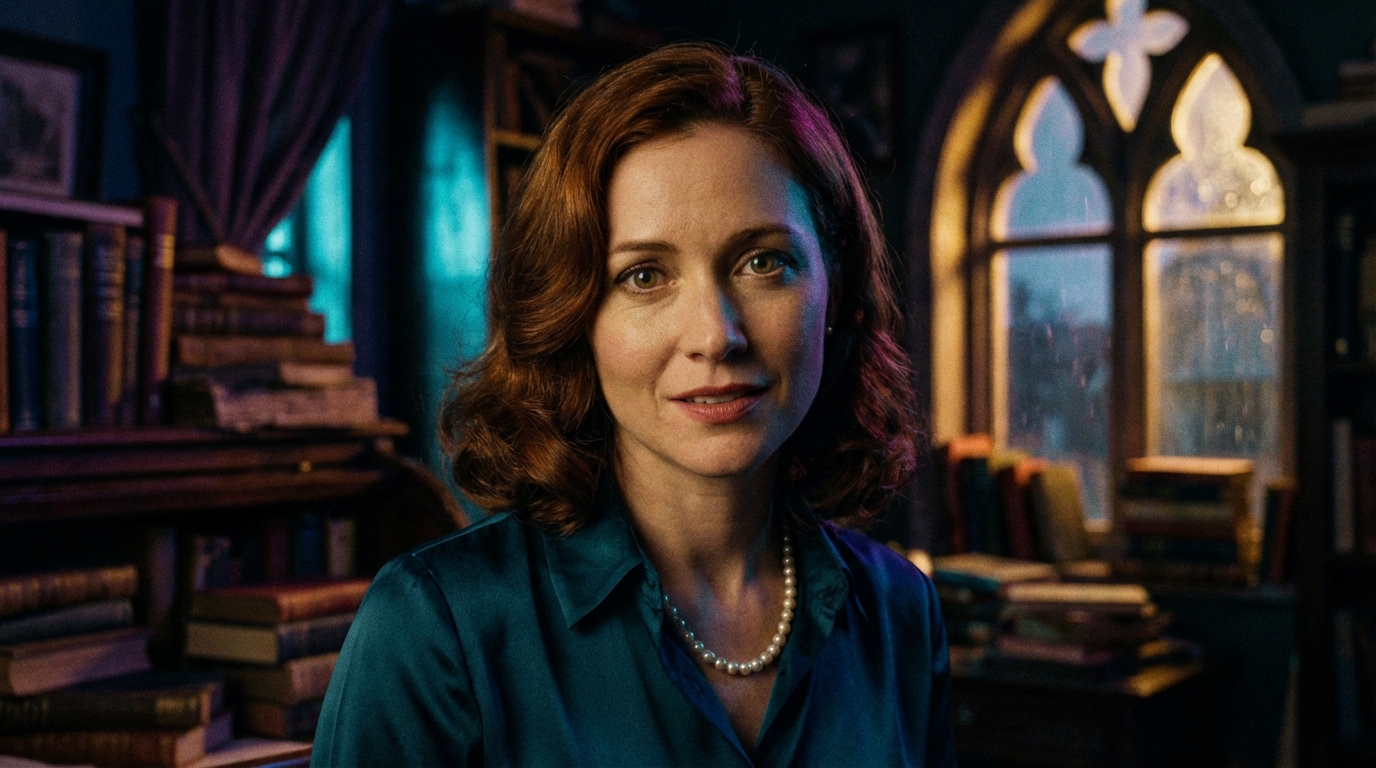
Evelyn Rose Blackwood, née Harris (1942–2020), was an Australian author and philanthropist who married Maxwell Alastair Blackwood in 1965 and was widowed by his unexplained death in 1974. The daughter of a Sydney schoolteacher, she raised their only child alone, built a literary career whose historical fiction drew on the colonial past she had married into, and spent forty-six years managing the space between what she knew about her husband's death and what she chose not to say.
Origins
Evelyn Rose Harris was born on 4 March 1942 in Sydney, New South Wales, the only child of Harold James Harris, a secondary school teacher whose commitment to education shaped the household's intellectual character, and Beatrice Ellen Harris, née Hosking, an avid reader and local historian whose interests in colonial Australia's social history would, through the indirect channels by which maternal passions transmit themselves to daughters, prove more formative than either parent anticipated. The Harris household was modest, orderly, and governed by the assumption that intellectual curiosity constituted both the highest pleasure and the most reliable form of social advancement available to a family whose financial resources were limited and whose cultural aspirations were not.
Evelyn grew up surrounded by books — her father's pedagogical texts, her mother's historical collections, and the novels that Beatrice accumulated with the particular enthusiasm of a woman who regarded reading as both recreation and resistance against the constraints that a schoolteacher's salary imposed upon a life whose imaginative range exceeded what that salary could fund. The household's literary atmosphere cultivated in Evelyn a relationship with language and narrative that would sustain her through circumstances that the modest Sydney childhood had not prepared her to navigate.
Education
Evelyn attended St Catherine's School in Sydney, where her academic performance and her engagement with the school's drama club and newspaper confirmed the literary orientation that her home life had encouraged. She was a student whose capabilities expressed themselves most naturally through writing — essays, short stories, the narrative explorations of local historical events and legends that her teachers recognised as unusually accomplished and that reflected her mother's historical interests filtered through a sensibility whose instinct for fictional form exceeded what factual history alone could satisfy.
She enrolled at the University of Sydney in 1960 to read English literature, the discipline providing the formal framework for interests that her upbringing had cultivated informally. Her university years deepened her engagement with both classical and contemporary literature — she was particularly drawn to Virginia Woolf and T.S. Eliot, writers whose formal experimentation and psychological depth resonated with a temperament that valued the interior dimensions of experience as much as the exterior ones. She graduated in 1963 with a degree whose practical applications were not immediately apparent and whose intellectual value she would draw upon for the rest of her life.
Maxwell
Evelyn met Maxwell Alastair Blackwood through the social networks that connected Melbourne's commercial establishment to Sydney's professional circles — the parties, the fundraisers, the institutional occasions at which the children of Australia's upper-middle class encountered each other under conditions that their parents considered appropriate and that the participants themselves experienced as simultaneous opportunity and assessment. Maxwell was completing his studies at the London School of Economics before returning to Melbourne to join Obsidian Healthcare Group; Evelyn was a recent graduate whose literary ambitions had not yet acquired the institutional structure that a career required. Their shared enthusiasm for intellectual conversation and their mutual recognition that each possessed qualities the other valued — Maxwell's strategic confidence, Evelyn's imaginative depth — produced an attraction whose basis was genuine and whose trajectory was conventional.
They married in 1965 and settled in Melbourne, where Maxwell assumed his position at Obsidian. The marriage brought Evelyn into the orbit of a family whose scale and complexity exceeded anything her Sydney upbringing had encompassed. She met Alastair Prometheus Blackwood — her father-in-law, the founder of Obsidian, a man whose intellectual intensity and social opacity she found simultaneously fascinating and disturbing. She met Margaret, her mother-in-law, whose composed management of the household communicated, to a woman with Evelyn's sensitivity to unspoken dynamics, that the composure was managing something rather than reflecting it. She absorbed the family's atmosphere without being able to name what the atmosphere contained, and the discomfort that accompanied her earliest years within the Blackwood household expressed itself as a watchfulness she maintained without understanding its necessity.
Motherhood and the Change
Evelyn Rose Blackwood — their daughter, named for her mother — was born on 19 August 1967. Evelyn managed the domestic demands of motherhood alongside the social obligations that Maxwell's position at Obsidian generated, the combination producing a life whose daily structure was determined by institutional requirements and whose private satisfactions were found in the hours she spent reading, writing, and maintaining the literary interests that her marriage had not displaced but had relegated to the margins of a schedule she did not control.
Maxwell's assumption of the Chief Executive role in 1971 changed the marriage's emotional character in ways that Evelyn perceived before she could identify their cause. The man whose warmth and strategic confidence she had married became, over the three years that followed, progressively more guarded, more restless, and more absent — not physically absent, in the manner of his father, but emotionally absent, the body present at the dinner table and the mind engaged with matters whose nature he did not discuss. The later nights accumulated. The alcohol consumption increased — not dramatically, not to the point where the word "problem" attached itself, but enough that Evelyn registered the change and added it to the inventory of observations she was compiling without understanding what they collectively described. The weekend sailing trips along the Australian coast, which had provided the marriage's most reliable occasions of shared pleasure, ceased to alleviate the tension that Maxwell carried home from the office and that he deposited in the household without explanation.
Evelyn did not ask what was wrong. The omission reflected less the Blackwood household's established culture of non-enquiry — Evelyn was not, by temperament, a woman inclined toward strategic silence — than the instinct of a wife who sensed that the answer to her question would not improve the situation and might, in ways she could not specify, make it worse. She watched, she waited, and she maintained the domestic environment whose stability her daughter required and whose normality was becoming increasingly difficult to sustain.
The Death
Maxwell Alastair Blackwood died on 3 May 1974 in Sydney. He was thirty-three years old. Evelyn was thirty-two. Their daughter was six.
The death was sudden. The circumstances were not explained to Evelyn in terms that her intelligence could accept as adequate. The official record provided a cause. The cause did not account for Maxwell's presence in Sydney, did not address the nature of the work that had consumed his final months, and did not resolve the questions that Evelyn's two years of accumulated observation had generated — questions about what her husband had discovered within Obsidian's operations, about why the discovery had changed him, and about whether the change and the death were connected in the way that the chronology suggested and that the official account did not acknowledge.
She did not pursue the questions publicly. The decision was not made from the same motivations that governed Margaret's silence — Evelyn was not protecting a marriage's architecture or maintaining a social facade. She was protecting her daughter, whose childhood had already been ruptured by the loss of her father and whose exposure to the institutional questions surrounding that loss Evelyn determined, with the fierce pragmatism that widowhood at thirty-two imposed, would serve no purpose that the child's welfare required. She buried her questions alongside her husband and built, on the ground that the burial cleared, a life whose independence from the Blackwood institutional machinery was maintained with a quiet deliberateness that those who did not know her history might have mistaken for indifference.
The Literary Career
The writing that had occupied the margins of Evelyn's married life moved, after Maxwell's death, toward its centre. She began publishing in the late 1970s — historical fiction whose settings in colonial Australia reflected both her mother's influence and the particular perspective of a woman who had married into a dynasty whose colonial origins she understood better, after nine years within it, than the dynasty's own members cared to examine. Her novels explored the intersection of private experience and institutional power, the ways in which families were shaped by the organisations they served, and the costs that institutional ambition imposed upon the domestic lives that sustained it.
Her most successful work, Echoes of the Past, was a historical fiction novel set in early colonial Australia that wove elements of the Blackwood family's history into a narrative whose fictional framing provided the distance that direct autobiography could not. The book became a bestseller and established Evelyn's reputation within Australian literary circles as a writer whose historical imagination was grounded in emotional precision and whose prose style — controlled, observant, and possessed of an undertone of suppressed feeling that reviewers identified without being able to name its source — distinguished her from the more conventional practitioners of the genre.
She published several subsequent novels and biographical works, each exploring the territory that her marriage and its aftermath had mapped — the relationship between public achievement and private cost, the ways in which institutional secrecy shaped the families adjacent to it, and the particular loneliness of women whose intelligence equipped them to perceive what was happening around them without empowering them to change it. The literary career was genuine, productive, and sustained across four decades. It was also, in ways that Evelyn acknowledged to herself without ever stating publicly, a form of testimony — the closest she came to articulating what she knew, what she suspected, and what she had chosen, for her daughter's sake, not to investigate.
Philanthropy and Widowhood
Evelyn's philanthropic work, which expanded throughout the 1980s and 1990s, focused on women's education and healthcare — causes whose personal resonance reflected both her father's commitment to teaching and her own experience of the constraints that institutional power imposed upon the women who existed within its proximity. She became known for eloquent speeches and effective fundraising, contributing to the expansion of educational opportunities for young women in rural areas. The work provided purpose, community, and the particular satisfaction of directing resources toward people whose circumstances she understood — women and girls whose capabilities exceeded the opportunities their environments provided.
Her widowhood lasted forty-six years — longer than most lives contain, longer than any marriage she had observed, and long enough to transform the grief of 1974 into something more complex than grief's conventional trajectory suggested. She did not remarry. The decision reflected neither ideological commitment to Maxwell's memory nor an inability to form new attachments, but rather the particular independence that early widowhood conferred and that her literary career reinforced — the discovery that she was capable of constructing a life whose satisfactions did not require the partnership that her twenties had assumed to be essential and that her thirties had demonstrated was, for her, not.
Her relationship with her daughter's involvement in Obsidian Healthcare Group — the younger Evelyn Rose eventually taking a significant executive role within the organisation — produced tensions whose management required the same restraint that the earlier, larger silence had demanded. Evelyn watched her daughter enter the institutional architecture that she believed had destroyed her husband, and the watching constituted a form of endurance whose difficulty those outside the family's specific history could not fully appreciate. She did not forbid, did not warn publicly, did not provide the testimony that might have altered her daughter's trajectory. She had chosen silence in 1974 to protect a six-year-old child, and the silence had acquired, across the decades, a momentum that could not be reversed without consequences whose scope exceeded what the reversal's benefits could justify.
Death
Evelyn Rose Blackwood died peacefully at her Melbourne home on 12 October 2020, at the age of seventy-eight. The death was quiet — respiratory failure following a period of declining health that the COVID-19 pandemic's restrictions had complicated without directly causing. She died during Melbourne's extended lockdown, the isolation of her final months mirroring, with an irony she would have appreciated, the isolation that had characterised her widowhood's earliest and most difficult years.
She was survived by her daughter Evelyn Rose Whitmore, née Blackwood, whose executive career within Obsidian continued the family's institutional connection that the elder Evelyn had spent four decades maintaining a careful distance from. The mother-daughter relationship, in its final years, achieved an equilibrium whose basis was mutual respect rather than mutual comprehension — the daughter understanding that her mother's reticence about the Blackwood family's history reflected experience rather than prejudice, the mother accepting that her daughter's choices were made with information and agency that the mother's own situation, in 1974, had not provided.
Evelyn Rose Blackwood had been a woman who married into a family whose institutional power exceeded what her literary imagination, despite its considerable range, could fully encompass, and who spent the decades after that family destroyed her husband building a life whose independence from its machinery was maintained with a determination whose quietness disguised its ferocity. She wrote novels whose themes drew on what she had witnessed without disclosing it. She raised a daughter whose resilience reflected the mother's own. She kept a silence whose motivations shifted, across forty-six years, from protection to habit to the recognition that what the silence contained had become, through the passage of time and the accumulation of institutional change, something whose disclosure would serve no purpose that the silence had not already, in its way, achieved.







