
Evelyn Margaret Baker (née Dawson)
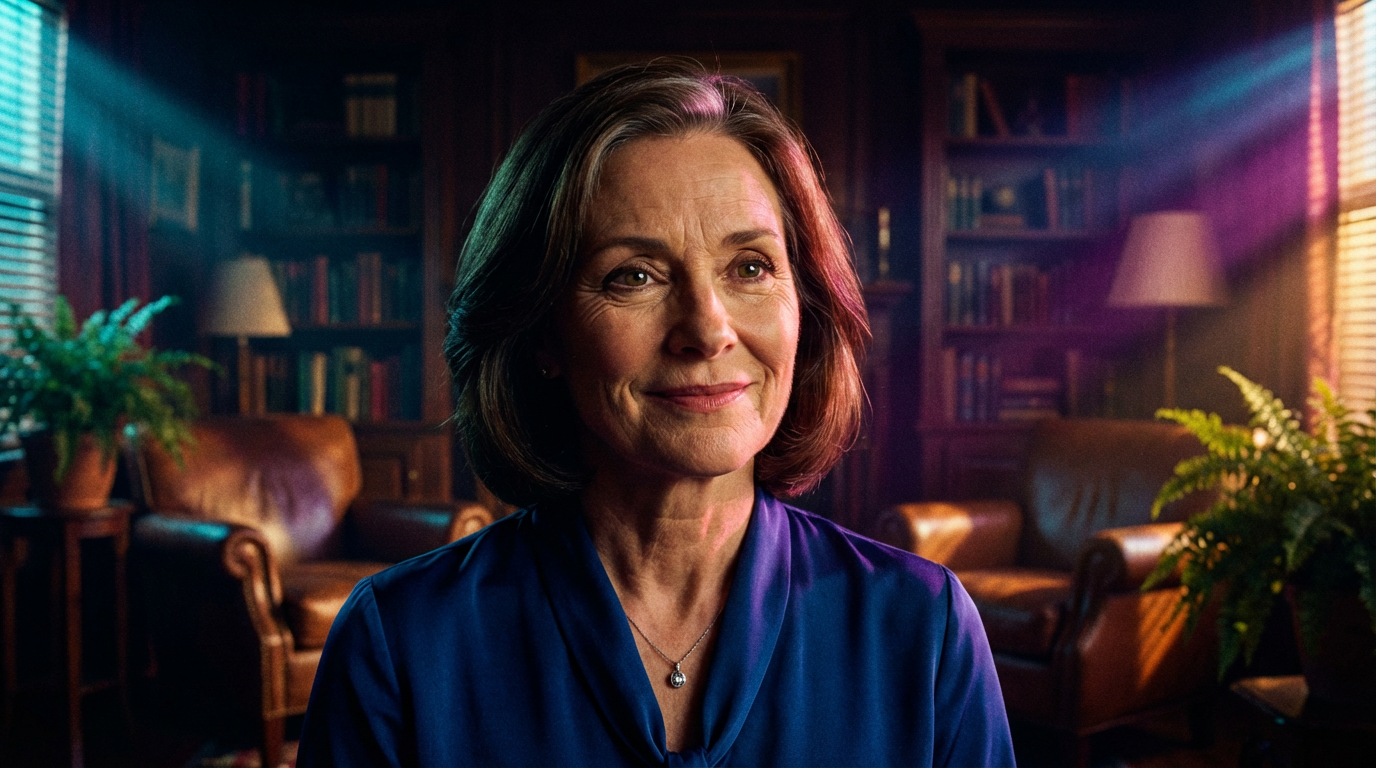
Evelyn Margaret Dawson, born 12 March 1969 in Adelaide, South Australia, is the fourth of six children from a prominent Latter-day Saint family distinguished by faith, education, and service. Her marriage to Jonathan Edward Baker in 1991 established a household rooted in spiritual practice and environmental stewardship, producing seven children whose lives reflect their parents' dual commitment to progress and devotion. As Relief Society President of Playford Ward for nearly a decade, she became the moral compass of her community, her quiet grace anchoring those navigating turbulent circumstances. When the mysterious events of 2018 drew her family toward Clivilius, Evelyn's unwavering clarity held them together through spiritual uncertainty and into a new world.
Birth and Early Childhood
Evelyn Margaret Dawson was born on 12 March 1969 at the Queen Elizabeth Hospital in Adelaide, the fourth of six children born to Harold Vincent Dawson and Margaret Elaine Dawson (née Callister). Her arrival expanded a household already distinguished by its reputation within Adelaide's Latter-day Saint community, where her father served as a school principal and high priest in the Adelaide South Stake, and her mother had dedicated years as Relief Society secretary before transitioning fully to the demands of raising six children.
The family home in Glenunga, a middle-class eastern suburb characterised by its tree-lined streets and proximity to quality schools, became the foundation for Evelyn's formative years. The Dawson household was known throughout the stake for hosting weekly Family Home Evenings that drew extended family and friends into their orbit, transforming Monday nights into occasions of spiritual instruction, music, and fellowship. These gatherings established patterns that would shape Evelyn's understanding of faith as something practised in community rather than isolation.
As the middle daughter, positioned between older siblings Thomas, Rachel, and James, and younger sisters Abigail and Hannah, Evelyn learned early the art of navigation and connection. Thomas, eight years her senior, had already begun his path toward agricultural engineering by the time Evelyn entered primary school. Rachel's eventual marriage into the Perera family and mission service in Sri Lanka would later expand Evelyn's understanding of faith's global dimensions. James, the brother closest to her in age, shared her love of music and would eventually become a music teacher and LDS choir director. The younger sisters—Abigail, who would pursue nursing in Brisbane, and Hannah, who would become an art historian in Melbourne—looked to Evelyn as both example and confidante.
The household culture combined Harold's educational philosophy with Margaret's domestic warmth, creating an environment where intellectual curiosity and spiritual devotion existed in easy partnership. Books lined every available surface, music accompanied meals and chores, and service projects were as regular as family prayers. Harold's role as school principal brought a certain structure to the home, while Margaret's natural hospitality ensured that structure never became rigidity.
Education
Evelyn's educational journey began at Linden Park Primary School in 1974, where she quickly distinguished herself as a student of unusual verbal ability and organisational talent. Teachers noted her capacity to synthesise information and communicate it clearly—skills that would later define her church leadership. She was the child who organised playground games with inclusive rules, who remembered every classmate's birthday, who could be trusted to lead a group project to successful completion without adult intervention.
Her transition to Wilderness School for Girls in 1982 marked an elevation in academic rigour that Evelyn met with characteristic determination. The prestigious girls' school, with its emphasis on both academic excellence and character formation, provided an environment where her talents could flourish alongside equally ambitious peers. She excelled in English and History, developing a particular love for nineteenth-century literature that would remain lifelong. Her oratorical abilities earned her regular invitations to speak at both church and civic youth forums, experiences that honed her capacity to articulate ideas with clarity and conviction.
By her final year at Wilderness, Evelyn had achieved the position of Head Prefect and graduated as Dux—the highest academic honour. These achievements reflected not merely intelligence but the disciplined application of natural gifts that would characterise her entire life. She approached her studies with the same spirit she brought to her faith: committed, thorough, and always oriented toward service to others.
Her tertiary education at the University of Adelaide (1987–1990) produced a Bachelor of Arts with majors in English Literature and Education, a combination that prepared her for what she initially imagined would be a teaching career. Alongside her university studies, she completed a Diploma in Religious Instruction through the Institute of Religion on the Adelaide campus in 1989. This dual focus—secular academic excellence and formal religious education—established the integration of faith and intellect that would define her approach to church leadership.
During her university years, Evelyn served as vice-president of the LDS Student Association, organising events that brought together students of various faith backgrounds for interfaith dialogue. These early experiences in bridge-building between religious communities would later find expression in her interfaith women's dialogue evenings and her gift for making spiritual wisdom accessible to diverse audiences.
Faith and Church Life
Evelyn's relationship with the Church of Jesus Christ of Latter-day Saints was not merely inherited but actively chosen and continually renewed through decades of devoted service. Raised in a household where faith formed the architecture of daily life, she never experienced the dramatic conversion that marks some spiritual journeys. Instead, hers was a faith deepened through consistent practice, tested by life's ordinary challenges, and refined into something both robust and tender.
Her formal church service began with Young Women's leadership in Playford Ward (1993–1997), where she mentored teenage girls through the turbulent waters of adolescence with a combination of doctrinal clarity and personal warmth. These years established her reputation as someone who could hold space for doubt and struggle without losing sight of faith's anchoring truths. Young women who had passed through her classes would later seek her counsel during their own marriages, pregnancies, and crises—the mentorship extending far beyond any formal calling.
A period as Stake Relief Society Instructor (2002–2004) expanded her influence beyond the ward level, requiring her to develop curriculum and train teachers across multiple congregations. Her teaching style combined doctrinal substance with personal testimony and practical application, never allowing scripture study to remain purely theoretical. She was known for the questions she asked rather than the answers she provided, drawing out understanding rather than simply delivering it.
The calling that would define her church service came in 2009 when she was sustained as Relief Society President of Playford Ward. She would serve in this capacity for nine years, navigating economic downturns, family crises, and the ordinary challenges that congregations face across time. Under her leadership, the ward developed robust welfare initiatives, a winter clothing drive for northern Adelaide families, and the Playford Sisterhood Garden—a community garden initiative that brought LDS women together with neighbours of other faiths.
Her leadership style was characterised by what observers described as powerful yet compassionate authority. She could deliver difficult truths with sufficient grace that recipients felt cared for rather than condemned. She never rushed to fill silences, preferring instead to let truth settle gently, like snow. Those who worked alongside her marvelled at her capacity to anchor a room without demanding attention, to be simultaneously everywhere and entirely present.
Throughout her church service, Evelyn maintained a practice of handwritten journaling, recording spiritual impressions, family milestones, and dreams. These journals became spiritual repositories she would revisit during seasons of uncertainty, reminding herself of God's faithfulness through patterns only visible across time. The practice reflected her understanding that faith was not a destination but a journey requiring regular documentation and reflection.
Marriage and Family Life
Evelyn met Jonathan Edward Baker through overlapping LDS circles in the late 1980s, their courtship unfolding against the backdrop of young adult activities and shared service in the Adelaide South Stake. Jonathan, born in 1966 to George and Anne Baker of Parafield Gardens, was completing his engineering degree while Evelyn finished her teacher training. Their connection was immediate but unhurried—two people recognising in each other a shared vision for what family life could become.
They were married on 15 June 1991 in the Adelaide Australia Temple at Marden, surrounded by family members who had gathered from across Australia to witness the sealing ordinance. The marriage united two families with deep roots in Adelaide's Latter-day Saint community: the Dawsons of Glenunga with their educational and musical heritage, and the Bakers of Parafield Gardens with their practical craftsmanship and quiet steadiness.
The young couple established their home in Smithfield, a northern suburb of Adelaide characterised by modest brick houses and established suburban rhythms. The neighbourhood sat adjacent to Craigmore, placing them within easy reach of families who would become their closest friends and fellow travellers. Jonathan's work as an environmental engineer complemented Evelyn's domestic leadership, his focus on sustainability extending naturally into their household practices.
Together, they raised seven children across eight years, creating a household that hummed with the particular energy of large families grounded in faith. Their children arrived in a pattern that would later seem providential: daughter, then three sons in succession, followed by three daughters. Amelia Grace (born 28 May 1993) would become a primary school teacher in Mount Barker. Benjamin Thomas (born 3 September 1994) pursued accountancy and financial analysis. Nathaniel James (born 14 February 1996) developed his father's affinity for systems through information technology. Samuel David (born 8 July 1997) chose the practical path of electrical work. Rebecca Anne (born 11 October 1998) served an LDS mission in the Philippines before pursuing social work. Lydia Hope (born 4 June 2000) studied midwifery, her gentle empathy finding expression in the care of mothers and newborns. And finally, Chloe Marie (born 15 April 2001), the youngest, whose sharp intellect and quiet spiritual depth would draw the family into circumstances none of them could have anticipated.
The family's philosophy combined Jonathan's environmental stewardship with Evelyn's spiritual nurture. Family Home Evening on Mondays, church attendance consuming much of Sunday, morning and evening prayers creating bookends to each day—these rhythms shaped children who would later describe their upbringing as simultaneously structured and warm, demanding and supportive. Jonathan built most of the family's furniture, teaching each child the basics of carpentry. Evelyn led a monthly book club for LDS women, inviting speakers to explore scriptural themes in classical literature. Together, they maintained a no-pesticide vegetable garden and ornamental herb garden that was featured in LDS newsletters as an example of domestic stewardship.
Community and Service Work
Beyond her formal church callings, Evelyn's commitment to service extended into the broader community of northern Adelaide. Her leadership of winter clothing drives ensured that families facing economic hardship could face the season with dignity, the practical love made tangible in warm coats and sturdy shoes. These drives operated through networks she had cultivated across years of visiting teaching, Relief Society leadership, and interfaith engagement.
The Playford Sisterhood Garden represented perhaps her most enduring community legacy. Co-founded with other LDS women but intentionally opened to neighbours of all faiths, the garden became a space where women from diverse backgrounds could work the soil together, sharing stories and struggles while nurturing something living. The garden produced vegetables for families in need and flowers for hospital visits, but its deeper purpose was the community it created—women who might never have met otherwise discovering common ground in the turning of earth and the passing of seasons.
From 2011 to 2015, Evelyn hosted interfaith women's dialogue evenings at her Smithfield home, gatherings that brought together Mormon, Catholic, Anglican, Muslim, and secular women for conversations about faith, family, and meaning. These evenings were characterised by careful listening and genuine curiosity rather than apologetics or debate. Evelyn's gift was creating space where difference could be acknowledged without becoming division, where questions could be explored without demanding resolution.
Her mentorship extended far beyond formal programmes. Young women who had passed through her Young Women's classes would return years later seeking counsel on marriages, careers, and crises of faith. She maintained long-term correspondence with many, her letters combining practical wisdom with spiritual encouragement. She was known as someone who could be called at three in the morning when a marriage was falling apart, who would appear at hospital bedsides and gravesides, who remembered birthdays and anniversaries that others forgot.
Those who received her care described her as a spiritual mother figure—someone who could hold your worst moments without flinching, who offered truth wrapped in sufficient tenderness that it could be received rather than rejected. Her presence at funerals and wedding receptions carried a quality that people struggled to articulate: something lit from within, a steadiness that anchored rooms and calmed anxieties.
Personal Interests and Character
Evelyn's character expressed itself through the particular interests she cultivated across decades. Her garden, a collaboration with Jonathan that combined traditional English varieties with Australian natives, reflected her understanding of beauty as something both inherited and adapted. She favoured plants that required patience—roses that needed proper pruning, herbs that rewarded consistent attention, vegetables that demanded seasonal wisdom. The garden became a space of meditation, a place where her hands could work while her mind processed the concerns of those she served.
Her love of literature, seeded during her Wilderness School years, remained a lifelong passion. Jane Austen and Charles Dickens occupied honoured positions on her shelves, their works annotated and reread across decades. But she was equally drawn to LDS women's histories, seeking out the stories of pioneer women whose faith had been tested by circumstances far harsher than her own. These reading interests informed her teaching, allowing her to draw connections between scriptural truths and the literary expressions of human experience.
Those who knew her well described her as articulate, resolute, and affectionate—a combination that could seem contradictory until encountered directly. She could deliver unwelcome truths with sufficient warmth that recipients felt loved rather than judged. Her resoluteness was not rigidity but rootedness, a steadiness that came from knowing her own foundations. And her affection, while not effusive, was reliable—consistently expressed through small attentions and sustained presence rather than dramatic gestures.
Her physical appearance carried the signature touches that those who knew her would instantly recognise: the coral lipstick applied with careful precision, the pale blue cardigan she favoured despite its inadequacy against Adelaide's winter chill, the dark curls she pushed back from her cheeks with characteristic grace. She wore her wedding band with the unconscious habit of long marriage, turning it absently when deep in thought about those she loved.
Her handwritten journals, maintained across decades, represented a spiritual practice as regular as prayer. She recorded impressions, dreams, moments of doubt, and experiences of grace—creating a documentary of spiritual life that served both her own reflection and, she hoped, the eventual benefit of her children and grandchildren. The practice reflected her understanding that faith unexamined could become faith unfounded, that the careful attention to God's working required documentation and reflection.
Crisis and Strength: The 2018 Turning Point
The events of 2018 tested everything Evelyn had built across decades of faithful living. Her youngest daughter Chloe, then seventeen, became entangled in circumstances that remain recorded only in family records—mysterious events with spiritual dimensions that defied easy categorisation. The Smith family of neighbouring Craigmore, whose son Charles had been Chloe's close friend since childhood, found themselves drawn into the same unfolding situation.
When Playford Ward families began gathering at the Adelaide Australia Temple on 29 July 2018 for what had been announced as an evening of prayer and unity, the nature of the gathering proved more significant than anyone had anticipated. Apostle Nathaniel Carter's cryptic call to service, urging certain families to consider relocation, created ripples of uncertainty throughout the congregation. In the months that followed, families who had been fixtures of the ward began disappearing quietly—their homes empty, their departures unannounced.
Evelyn's response to the crisis revealed the depth of her spiritual formation. She increased family devotional time, gathering her children for extended scripture study and prayer. She initiated a forty-day family fast and prayer initiative, calling upon spiritual resources that had been cultivated across a lifetime. Perhaps most significantly, she took leave from her community responsibilities to focus solely on familial and spiritual needs—a decision that reflected her understanding that some seasons required concentration rather than expansion.
Her clarity during this period was noted by all who witnessed it. While others wavered or questioned, Evelyn maintained a steadiness that anchored her family through uncertainty. Her decades of visiting teaching had prepared her for the ministry of presence during crisis—the understanding that sometimes showing up was the only answer available, that truths could be allowed to settle gently without requiring immediate resolution.
Jonathan served as the quiet stabilising force beside her, his practical wisdom complementing her spiritual leadership. Together, they navigated their children through decisions that would reshape their lives entirely, maintaining family cohesion when everything familiar was falling away.
Transition and New Beginnings
The Baker family's relocation to Clivilius in early 2019 marked the most significant transition of Evelyn's life. Leaving Adelaide meant leaving the networks she had cultivated across decades, the gardens she had tended, the mentees who still sought her counsel. It meant stepping into a world where established patterns of leadership would need to adapt to unprecedented spiritual and cultural territories.
Yet Evelyn approached the transition with the same resolute grace she had brought to every previous challenge. Her essential nature as moral compass remained constant even as the landscape changed entirely. In the LDS-affiliated settlement that became their new home, she found new opportunities for the service that had always defined her—new young women needing mentorship, new families requiring support, new communities seeking the anchoring presence she had always provided.
Her children scattered according to their various paths—some remaining on Earth, others joining the family in Clivilius, youngest daughter Chloe eventually marrying Charles Smith and building a new life in the settlement of Bixbus. The family that had gathered around the Smithfield table for Family Home Evenings now existed across dimensions, connected by bonds of love that proved more enduring than geography.







