Euphemia "Effie" Stewart
Born in Edinburgh on 3 November 1742, Euphemia Stewart learned the arts of diplomacy and negotiation accompanying her father Angus to the Grassmarket before his death in 1754 left the family in hardship. Appointed Guardian on 28 April 1762, she followed her sister Elspeth to Clivilius, where she established the trade networks that transformed New Edinburgh from desperate survival to thriving prosperity. Her discovery of Bridgetown in 1764 opened crucial commercial pathways. Married to musician James Murray in 1768, she bore three children whilst serving as the Directorate's diplomatic voice. The last surviving Stewart sister, she died on 19 September 1814, aged seventy-one.

The Golden Child
Euphemia Stewart—known from infancy as Effie—entered the world on 3 November 1742, the second daughter born to Angus Callum Stewart and Morag Stewart née MacKenzie in their modest Edinburgh home near the Grassmarket. Her arrival came four years after her elder sister Elspeth, expanding a household already shaped by the rhythms of forge and needle, craft and commerce.
From her earliest years, Effie distinguished herself through a beauty that seemed to illuminate whatever space she occupied. Golden hair caught the light like spun thread, and bright eyes sparkled with an intelligence that charmed adults and drew other children into her orbit. Where Elspeth was serious and watchful, Effie radiated warmth that made strangers feel like old acquaintances. These qualities, evident even in childhood, would prove far more than superficial gifts—they were the foundations of diplomatic talents that would one day reshape the fortunes of an entire settlement.
The Stewart household grew around her: Katrina arrived in February 1744, quiet and determined; Violet followed in August 1746, delicate and perpetually curious. As the second-eldest, Effie occupied a unique position—old enough to share responsibilities with Elspeth, young enough to bridge the gap with her younger sisters. She became the family's natural mediator, smoothing conflicts with instinctive grace, translating between temperaments that might otherwise have clashed.
The Marketplace Apprentice
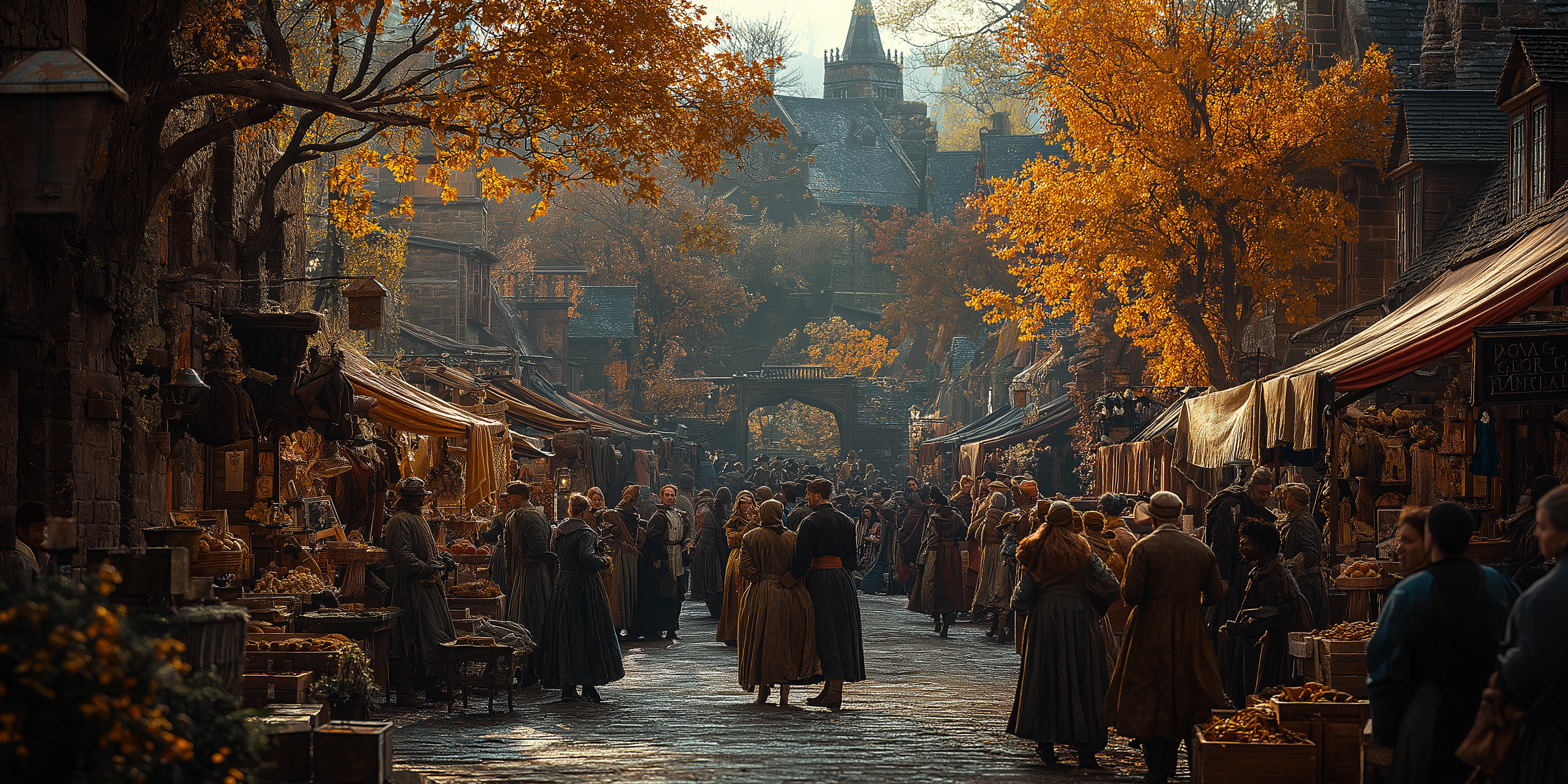
While Elspeth gravitated toward their mother's needlework and the patient precision it demanded, Effie found her education in a different classroom entirely. From an early age, she accompanied her father to Edinburgh's bustling markets, watching as Angus conducted the business that sustained their household. The Grassmarket teemed with merchants hawking goods from across Scotland and beyond—Highland cattle drovers, fishwives with baskets of herring, traders displaying textiles and tools and treasures of every description.
Angus Stewart was not merely a blacksmith selling his wares; he was a craftsman who understood that commerce required more than fair prices and quality goods. Relationships mattered. Trust, once earned, became currency more valuable than coin. A man's word, honestly given and faithfully kept, opened doors that remained closed to those who dealt in deception. These lessons, absorbed through observation rather than instruction, shaped Effie's understanding of how the world truly functioned.
The merchants of the Grassmarket quickly recognised something special in the blacksmith's golden-haired daughter. Her genuine interest in their wares—the questions she asked, the attention she paid to their answers—charmed men who had grown cynical through years of haggling with customers who cared only for the lowest price. By the time she was ten, Effie could negotiate on her father's behalf with a skill that surprised those who mistook youth for naivety.
The Forge Falls Silent
On 21 June 1754, the world Effie had known shattered beyond recognition. She was eleven years old when word came of the accident at her father's forge—an explosion of some kind, details unclear, but the outcome devastatingly certain. Angus Stewart lingered for three days while his family held vigil, hope fading with each laboured breath, before death claimed him at the age of thirty-nine.
The loss struck Effie with particular force. Her father had been more than parent and provider—he had been her teacher in the arts of human connection, her guide to understanding how relationships could be cultivated like precious crops. The marketplace that had seemed so vibrant now felt hollow, the merchants' familiar calls echoing with absence. She had lost not only a father but a mentor whose lessons she had only begun to absorb.
The months that followed revealed the precariousness of their situation. Debts emerged that Angus had concealed, obligations that consumed savings and threatened the modest stability the family had maintained. Effie watched her mother fade under grief's weight, saw her elder sister shoulder burdens too heavy for shoulders so young. The golden child who had charmed merchants with easy smiles learned a harder truth: that beauty and warmth, however genuine, could not pay creditors or put food on the table.
Yet even in hardship, Effie's natural gifts found expression. She took over aspects of household management that had previously fallen to her parents, applying the negotiation skills learned at her father's side to stretching insufficient resources further than seemed possible. When Elspeth secured an apprenticeship at Moira MacKenzie's Emporium in 1755, Effie managed the younger girls with a competence that belied her thirteen years—maintaining routines, preserving the sense of normalcy that children require even when circumstances are anything but normal.
The Portal Key
In April 1762, the Stewart sisters' lives transformed in ways none of them could have anticipated. Five days after Elspeth received a Portal Key from the Guardian Lizbeth Wilson and crossed into the realm called Clivilius, Effie found herself facing the same extraordinary choice.
On 28 April 1762, Lizbeth placed the ancient artefact into Effie's hands—a key that opened doorways between worlds, that carried with it responsibilities extending far beyond anything Edinburgh's marketplaces had prepared her for. At nineteen, Effie had spent years honing skills she had believed were meant for commerce and household management. Now she understood that her gifts of connection and persuasion served purposes greater than she had imagined.
The crossing into Clivilius was disorienting—a realm that bore no resemblance to Scotland's familiar landscapes, raw and unformed, challenging in ways that tested every capacity she possessed. But where some might have seen only obstacles, Effie perceived opportunity. This new world needed exactly what she could offer: the ability to forge relationships from nothing, to build trust where none existed, to transform strangers into allies through the patient arts of diplomacy.
Building Bridges
When New Edinburgh was formally established on 22 May 1762, the four Stewart sisters each brought distinct contributions to the fledgling settlement. Elspeth provided leadership and strategic vision; Katrina would develop agricultural expertise that fed the community; Violet's architectural imagination shaped the physical structures that sheltered them. Effie's role was perhaps less visible but no less essential: she became New Edinburgh's bridge to the wider world.
The settlement could not survive in isolation. Resources were scarce, knowledge of this strange realm limited, and potential threats lurked beyond every horizon. Someone needed to venture out, to discover what other communities existed in Clivilius, to negotiate the relationships that could transform precarious survival into sustainable prosperity.
Effie embraced this mission with enthusiasm born of purpose finally aligned with talent. On 8 March 1764, she discovered Bridgetown—a settlement positioned at a crucial crossroads, a natural hub where trade routes converged. The name itself spoke to the location's significance: a bridge between communities, between possibilities, between isolation and connection. For Effie, it represented everything she had worked toward since childhood—a place where the art of relationship-building could flourish, where her father's lessons about trust and commerce found their fullest expression.
The trade networks she established over the following years became New Edinburgh's lifeline. Where once the settlement had scraped by on whatever resources its members could gather independently, now goods flowed along pathways Effie had negotiated—materials for construction, seeds for cultivation, tools and supplies that transformed a desperate camp into a thriving community. Each agreement she secured, each alliance she forged, wove another thread in the tapestry of interconnection that would sustain New Edinburgh for generations.
Marriage and Family
In 1768, Effie's personal life flourished alongside her diplomatic achievements. James Murray was a musician from a neighbouring settlement—a man whose artistic temperament complemented her practical gifts, whose quiet steadiness balanced her social dynamism. Their courtship unfolded through the networks Effie had built, two people from different communities finding common ground in shared values and mutual respect.
Their wedding became a celebration that transcended personal happiness, demonstrating the connections New Edinburgh had forged with surrounding settlements. The entire community attended, bearing witness to a union that embodied the very principles Effie had championed: that relationships between individuals and communities strengthened everyone involved, that bridges built through trust endured longer than walls built through fear.
The children who followed extended these connections into the next generation. Angus, born in 1770, carried his grandfather's name and something of his grandmother Morag's quiet determination. Morag, arriving in 1773, inherited her mother's gift for reading people and situations. Lily, the youngest, born in 1776, displayed an artistic sensibility that recalled her father's musical talents. Through them, Effie's legacy would continue long after her own diplomatic missions had ended.
The Directorate
By 1775, thirteen years of growth had transformed New Edinburgh beyond anything the founding sisters had dared imagine during those desperate early months. The informal collaboration that had sustained initial development required formalisation—structures that could manage increasing complexity while preserving the cooperative spirit that had defined Stewart leadership from the beginning.
On 15 August 1775, Effie participated in establishing the Directorate—a governing body in which four Guardians shared responsibility for different aspects of New Edinburgh's administration. The structure reflected her deepest convictions about leadership: that sustainable governance required distributed authority, that different perspectives strengthened rather than weakened collective decision-making, that the relationships between leaders mattered as much as their individual capabilities.
Within the Directorate, Effie naturally assumed responsibility for external relations—the diplomatic portfolio that aligned perfectly with her lifelong expertise. Trade negotiations, inter-settlement agreements, the delicate dance of maintaining alliances while protecting New Edinburgh's interests: these became her formal domain, though in practice she had been performing these functions for over a decade.
The Last Sister
The final years of Effie's life brought losses that tested the resilience she had cultivated through seven decades of challenge and adaptation. On 8 November 1801, Elspeth Stewart—the eldest sister, the First Guardian, the leader whose vision had guided New Edinburgh from its founding—drew her final breath. Effie had spent thirty-nine years working alongside her sister, their different gifts complementing each other in ways that had shaped a civilisation. Now that partnership was severed, and the weight of continuing their shared legacy fell more heavily upon those who remained.
A decade later, on 27 August 1811, Katrina departed—the quiet sister whose agricultural expertise had fed the community through seasons of plenty and scarcity alike. Effie was sixty-eight years old, watching the constellation of sisterhood that had defined her life dim star by star.
Violet's death on 14 March 1813 left Effie as the sole surviving Stewart sister. For eighteen months, she carried alone the memories of their Edinburgh childhood, their father's lessons in the Grassmarket, the extraordinary journey that had transformed four ordinary Scottish girls into founders of a new civilisation. The burden of being the last keeper of shared history pressed upon her, even as she continued the diplomatic work that had always been her calling.
Death
On 19 September 1814, Effie Stewart completed her final journey. She was seventy-one years old, the last of the founding sisters, surrounded by the family and community she had helped build through more than half a century of patient relationship-building.
Her fifty-two years in Clivilius had witnessed the miraculous transformation of windswept wasteland into thriving settlement, of isolation into interconnection, of desperate survival into enduring prosperity. The trade networks she had woven connected New Edinburgh to communities across the realm; the diplomatic principles she had championed—that trust mattered more than threats, that relationships built through genuine interest outlasted those based on mere convenience—remained embedded in the settlement's approach to external affairs.
The golden-haired girl who had charmed Edinburgh's merchants, the eleven-year-old who had lost her father and learned that warmth alone could not sustain a household, the young woman who had crossed between worlds to build bridges in a realm she had never imagined—all of these became threads in a legacy that extended far beyond her mortal years.







