Ethan Alexander Williams
Ethan Alexander Williams, born 14 September 2006 in Brisbane, was the second child of Daniel Edward Williams, an electrical engineer, and Claire Margaret Williams, a primary school teacher. A focused, stubborn boy with an obsessive interest in entomology and biological illustration, he attended Brisbane Grammar School and filled sixteen sketchpads with precise drawings of insects and ecosystems. He died on 5 August 2018, aged eleven, from a skull fracture sustained in the school bus collision in Clivilius.
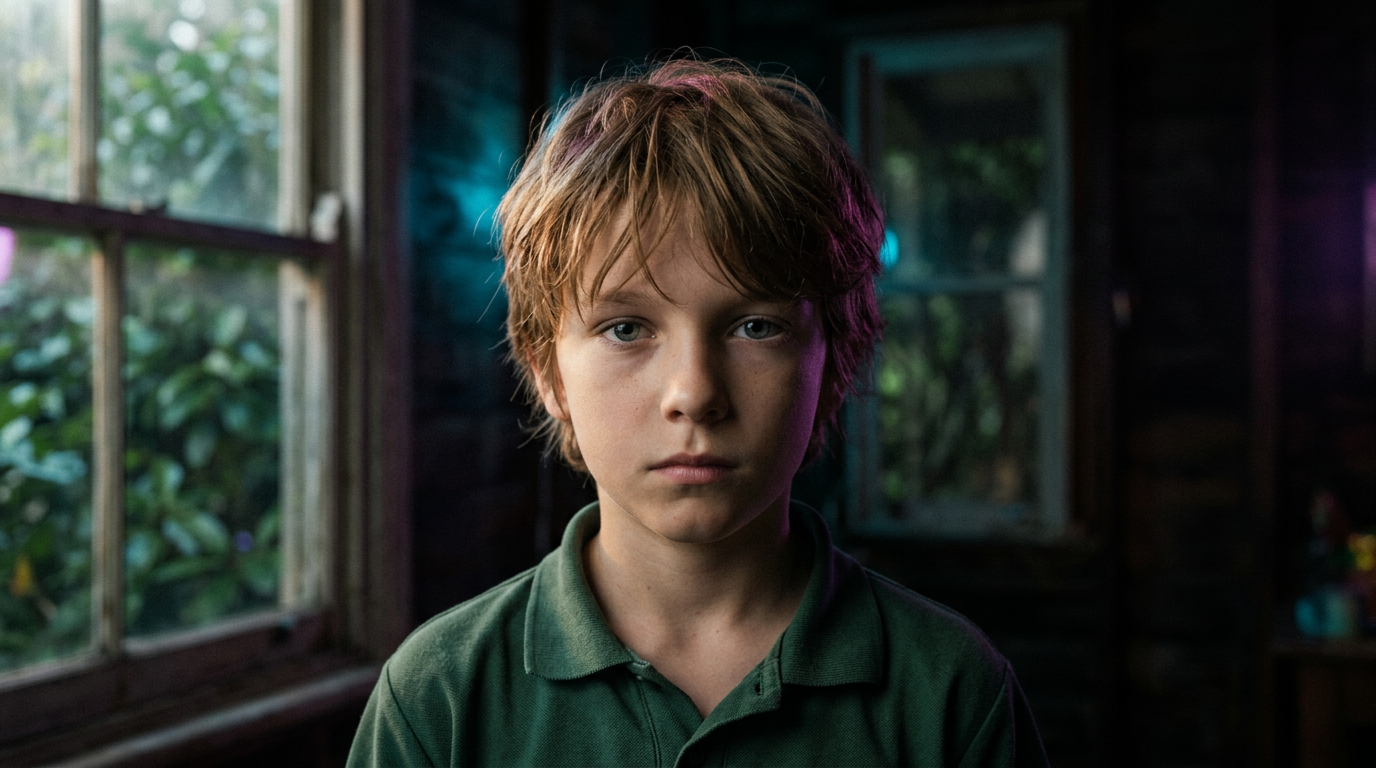
The Jar on the Step
Ethan Alexander Williams was born on 14 September 2006 at the Royal Brisbane and Women's Hospital, the second child of Daniel Edward Williams, an electrical engineer, and Claire Margaret Williams (née Henson), a primary school teacher. He arrived two years after his sister, Amelia Rose Williams, born on 3 March 2004, and three years before his brother, Jamie Daniel Williams, born on 18 November 2009. The family lived in a weatherboard Queenslander on stilts in Ashgrove, in Brisbane's inner north-west, on a street where jacaranda trees dropped purple flowers across the footpath every October and the bins went out on Tuesday mornings with a regularity that Claire considered a measure of civilisation.
Daniel worked for an engineering consultancy that contracted to the Queensland government, designing electrical systems for schools and hospitals across the south-east. The work was steady, technical, and occasionally required him to spend two or three nights in a regional town — Toowoomba, Bundaberg, Rockhampton — leaving Claire to manage the household alone. She did so with the practical efficiency of a woman who ran a classroom of twenty-five seven-year-olds five days a week and considered the demands of three children at home a gentler version of the same skill. She taught Year 2 at a state primary school in The Gap, a fifteen-minute drive from home, and had done so since before Amelia was born.
Claire's mother, Patricia Anne Henson, a retired nurse who lived alone in a fibro cottage in Mitchelton since the death of her husband Colin in 2003, was available for school pick-ups on the days the schedule didn't cooperate. Patricia was a practical, unsentimental woman whose approach to grandmothering involved Vegemite sandwiches, firm boundaries, and an inexhaustible willingness to sit on the back step and watch whatever Ethan had found that afternoon.
Ethan was the quiet child. Not shy — he would talk at length to anyone who showed interest in what he was interested in — but quiet in the way of a boy who spent more time watching than participating. He was the one who sat on the back step with a jar while Amelia and Jamie played in the yard, examining whatever he had found under a rock or beside the garden bed. Claire noticed it before he started school: the focus, the stillness, the way he could spend forty minutes observing an ant trail with a concentration most adults could not sustain for five.
He was also, from early on, difficult in the specific ways that highly focused children are difficult. He refused to eat vegetables unless he had been told exactly what they were and where they came from. He would not wear corduroy — the texture was the particular enemy — and Claire spent more mornings than she cared to count negotiating with a five-year-old about trousers. He could be so absorbed in a drawing that he genuinely did not hear his name being called, a quality Claire initially mistook for defiance before she understood it as concentration so complete it excluded everything else.
Daniel, who was a patient man in most respects but impatient with what he considered nonsense, found Ethan's sensitivities baffling and occasionally infuriating. The morning Ethan refused to go to school because his socks were the wrong thickness produced an argument that Claire had to mediate from the kitchen while burning toast and packing three lunches simultaneously. Daniel loved his son. He did not always understand him, and the gap between love and understanding was a space the family navigated with varying degrees of grace.
Sixteen Sketchpads
Ethan attended Ashgrove State School for Prep through Year 4, a small government primary school ten minutes' walk from the house. He was an adequate student in most subjects and an exceptional one in science, where his teacher in Year 3, a young woman named Jessica Cheng, noted that he could identify more native plant species than most of the adults she knew. His reading was advanced for his age. His handwriting was appalling and remained so for the rest of his life, a source of ongoing friction with teachers who valued presentation and a source of complete indifference to Ethan, who could not understand why the shape of a letter mattered when its meaning was clear.
He entered Brisbane Grammar School in Year 5, in 2017. Daniel and Claire had stretched the budget to afford the fees, a decision driven less by academic ambition than by the school's science facilities and its field programme, which Claire had researched with the thoroughness of someone who understood that her son needed something particular and was willing to find it. The school's middle years programme offered regular excursions to parks, reserves, and research stations across south-east Queensland — exactly the kind of structured access to the natural world that Ethan craved and that a suburban backyard in Ashgrove could not provide.
He settled in slowly. The school was larger and louder than Ashgrove State, and Ethan was not a boy who made friends quickly. He was polite but not gregarious, more comfortable at the periphery of a group than at its centre, and his tendency to steer every conversation toward whatever he was currently studying did not always endear him to classmates who wanted to talk about rugby league or Fortnite. He had no interest in sport beyond the mild confusion of someone who could not understand why people ran toward a ball on purpose.
He found his people eventually. Noah Jones shared his interest in the natural sciences, though Noah's focus was geological where Ethan's was biological, and the two of them could sit in companionable silence for an entire lunch break, each absorbed in their own subject, occasionally exchanging an observation about a rock or an insect as though continuing a conversation that had never actually started. Isabella Taylor had an ecological seriousness that matched Ethan's intensity. They were not a group in any visible social sense. They recognised each other in classrooms and on field excursions as people who cared about the same kinds of things, and in the ecosystem of a school, that recognition was enough.
His biology teacher, Mr. Andrew Pryce, was a young teacher in his second year at Brisbane Grammar who recognised in Ethan not brilliance but something rarer: a willingness to look. Pryce set a term assignment on local ecosystems and Ethan produced a field guide to the insects of Ashgrove — hand-drawn, with watercolour illustrations and taxonomic notes copied from three library books and checked against a fourth. It exceeded the assignment's requirements by such a margin that Pryce was not sure whether to be impressed or concerned. He gave it full marks and kept a photocopy in his desk drawer.
Ethan drew constantly. Not in the way of a child who wanted to be an artist — he was indifferent to formal art classes, which he found too concerned with technique and not enough with accuracy — but in the way of a naturalist for whom drawing was a method of seeing. His illustrations were biological: precise, labelled, obsessive in their detail. He drew the venation of a leaf, the segmentation of a beetle's thorax, the way a spider's web caught light at a specific angle in the morning. His sketchpads accumulated on the shelf above his desk at home. By the time he was eleven there were sixteen of them, each filled from cover to cover.
The drawings were meticulous but not perfect. He pressed too hard with pencils, leaving grooves in the paper beneath. He had no patience for backgrounds, so his subjects floated in white space. He occasionally misspelled the Latin names he copied so carefully, and when Amelia pointed this out he responded with a fury disproportionate to the correction. Being wrong about the things he cared about was, for Ethan, intolerable in a way that being wrong about anything else was not.
He was not an easy sibling. Amelia, fourteen by the time of the field trip and already developing the social fluency Ethan lacked entirely, found him exhausting — his refusal to be interested in anything she was interested in, his habit of correcting her about animal facts at the dinner table, his indifference to her opinions on any subject outside biology. Jamie, eight and desperate for his older brother's attention, followed Ethan around the garden on weekends and was mostly ignored unless he happened to find something interesting under a rock, at which point Ethan became briefly and intensely engaged before retreating back into his own world.
Claire mediated these dynamics with the patience of a teacher and the fatigue of a mother, and Daniel, when he was home, took Ethan to the Queensland Museum on Saturday mornings — an outing that served the dual purpose of feeding Ethan's interests and giving the rest of the family three hours of quiet. Ethan had recently declared that he wanted to be an entomologist, a word he could spell correctly and define precisely, and which Jamie tried and failed to pronounce at the dinner table, producing a rare and unguarded laugh from Ethan that Claire stored in her memory the way other mothers stored photographs.
The Unfinished Beetle
The overnight field trip to D'Aguilar National Park departed from Brisbane Grammar School at half past seven on the morning of Saturday, 4 August 2018. Ethan had packed his bag the previous evening with a precision that amused Daniel and irritated Amelia, who had to share the bathroom with a boy who spent twenty minutes arranging coloured pencils in chromatic order inside a ziplock bag. He brought his current sketchpad, his field guide to Queensland insects, a magnifying glass that Daniel had given him for his tenth birthday, and a head torch for the night walk that the trip organisers had promised.
The bus carried fifteen students and five adults: the driver, Michael Harris, and four supervisors — Susan Clarke, David Nguyen, Emma Thompson, and Raj Patel. The trip was organised as a combined science and nature study excursion, overnight, with a guided walk through the national park's subtropical rainforest, campfire activities, and a return to Brisbane the following morning. Ethan sat with Noah Jones for the outbound journey and spent most of the drive with his face turned toward the window, watching the landscape change as the city gave way to the D'Aguilar Range.
The park was everything he wanted. The subtropical rainforest offered a density of insect life that Ethan had only read about in books — cicadas, stick insects, a rhinoceros beetle he found under a rotting log and spent fifteen minutes drawing while the guided walk continued without him until Susan Clarke doubled back to collect him. He filled six pages of his sketchpad on the first day. A pademelon appeared at the edge of the campsite at dusk and held still long enough for him to begin a sketch before it vanished into the undergrowth.
The bus departed D'Aguilar on the morning of 5 August for the return journey to Brisbane. Ethan sat in the middle section, near Noah, his sketchpad open on his lap. He was drawing a beetle he had found under a log that morning — a species he had not been able to identify and which he intended to look up in the school library on Monday.
He did not finish the drawing.
The bus passed through a Portal opened by Beatrix Cramer across a road in the Brisbane suburbs and collided with two other vehicles on the far side, in the landscape of Clivilius. The impact was catastrophic. Ethan, seated without a seatbelt in the middle section, was thrown forward into the seat frame ahead of him. He sustained a severe skull fracture. David Nguyen and Raj Patel reached him within minutes, but they had no equipment, no shelter, and no medical supplies beyond a standard first-aid kit designed for scraped knees and insect stings. It was not enough. Nothing available to them would have been enough.
Ethan Alexander Williams died on 5 August 2018. He was eleven years old. He died surrounded by people who had known him for a single weekend or a single school year but who understood, in the way that you understand these things when you are beside a child who is not going to survive, that something irreplaceable had ended.
His sketchpad was recovered from the wreckage, bent but intact. The beetle drawing on the last used page was half-finished — the thorax complete, the legs precisely rendered, the abdomen a pencil outline that trailed off toward the edge of the page. The surviving students and adults kept the sketchpad as the community that became Bixbus established itself in the weeks and months that followed. It was eventually archived alongside other salvaged materials as part of the settlement's earliest records — a document of a world none of them could return to, drawn by a boy who had looked at it more carefully than most.
In Brisbane, the Williams family waited. The bus did not return on schedule. Daniel rang the school. Claire rang other parents. By evening, the police had been contacted. By Monday, the disappearance of a school bus carrying fifteen children and five adults was the lead story on every news broadcast in Queensland. No wreckage was found. No signal from the bus's GPS transponder. No bodies, no debris, no explanation. The search continued for weeks, then months, then settled into the particular bureaucratic limbo of cases that are neither closed nor active — a file that remains open because nobody has the authority or the cruelty to close it.
Claire took leave from teaching and did not return. Daniel continued to go to work because the alternative was to sit in the house where Ethan's sketchpads lined the shelf above a desk that nobody touched. Amelia, fourteen and old enough to understand that her brother was not coming home but not old enough to know what to do with that understanding, became quieter than she had ever been. Jamie, who was eight, asked when Ethan was coming home every evening for three months, and then stopped asking, and the silence that replaced the question was worse than the question had been.
Patricia Henson came to the house more often after the disappearance. She cooked meals that nobody ate. She sat with Claire at the kitchen table in the evenings while Daniel put Jamie to bed, and she did not say that everything would be all right, because Patricia was not a woman who said things she did not believe. She said that she was there. It was, in the end, the only thing that could be said.
The sketchpads stayed on the shelf. The field guide to Queensland insects stayed on his bedside table, open to the page on longhorn beetles, where Ethan had left it on the Thursday before the trip. Claire dusted the room every week. She did not move anything. She did not close the book.







